
VW Passat B8 2.0 TDI: Stage 1, Options and Process
Passat B8 2.0 TDI with EDC17CP74 or EDC17C64: variants, realistic Stage 1 guide values, bookable options, prices and the process at a glance.
October 25, 2026 by Leo Efimow
The Passat B8 is the classic long-distance car: lots of space, a quiet ride, high mileage. If you cover 30,000 or 50,000 kilometres a year, often with luggage or a trailer, you notice the limits of the stock diesel less at top speed than in mid-range pull: on the motorway slip road, uphill, or when overtaking a lorry on a country road. That is exactly where a software optimisation of the 2.0 TDI comes in. This article covers which variants exist, what you can realistically expect, which options can be booked and how the process works with us.
Variants and ECUs
In our catalogue the Passat VIII (B8) runs from 2014. For the diesel, it lists these variants:
| Variant | Engine code | Power | ECU |
|---|---|---|---|
| 1.6 TDI | DCXA | 120 PS | Bosch EDC17CP74 |
| 2.0 TDI | CRLB | 150 PS | Bosch EDC17CP74 |
| 2.0 TDI | DFCA | 190 PS | Bosch EDC17CP74 |
| 1.6 / 2.0 TDI EA288 | n/a | n/a | Bosch EDC17C64 or EDC17C74 |
The difference between the CP74 on one side and the C64/C74 on the other is more than a type label. It determines which price tier the ECU falls into and how much effort access takes. Which unit is in your Passat can be seen on the label of the ECU or in the software ID, which we check during reading anyway.
What is adapted in the ECU
All the units above belong to the Bosch EDC17 family for common rail TDI engines. For Stage 1, the maps that together determine torque are adapted: torque request and limitation, boost targets, rail pressure, injection quantity and the smoke limiter, which ties quantity to the measured air mass. These values are shifted in a coordinated way. Protection functions for exhaust temperature, turbo speed and component temperatures stay active.
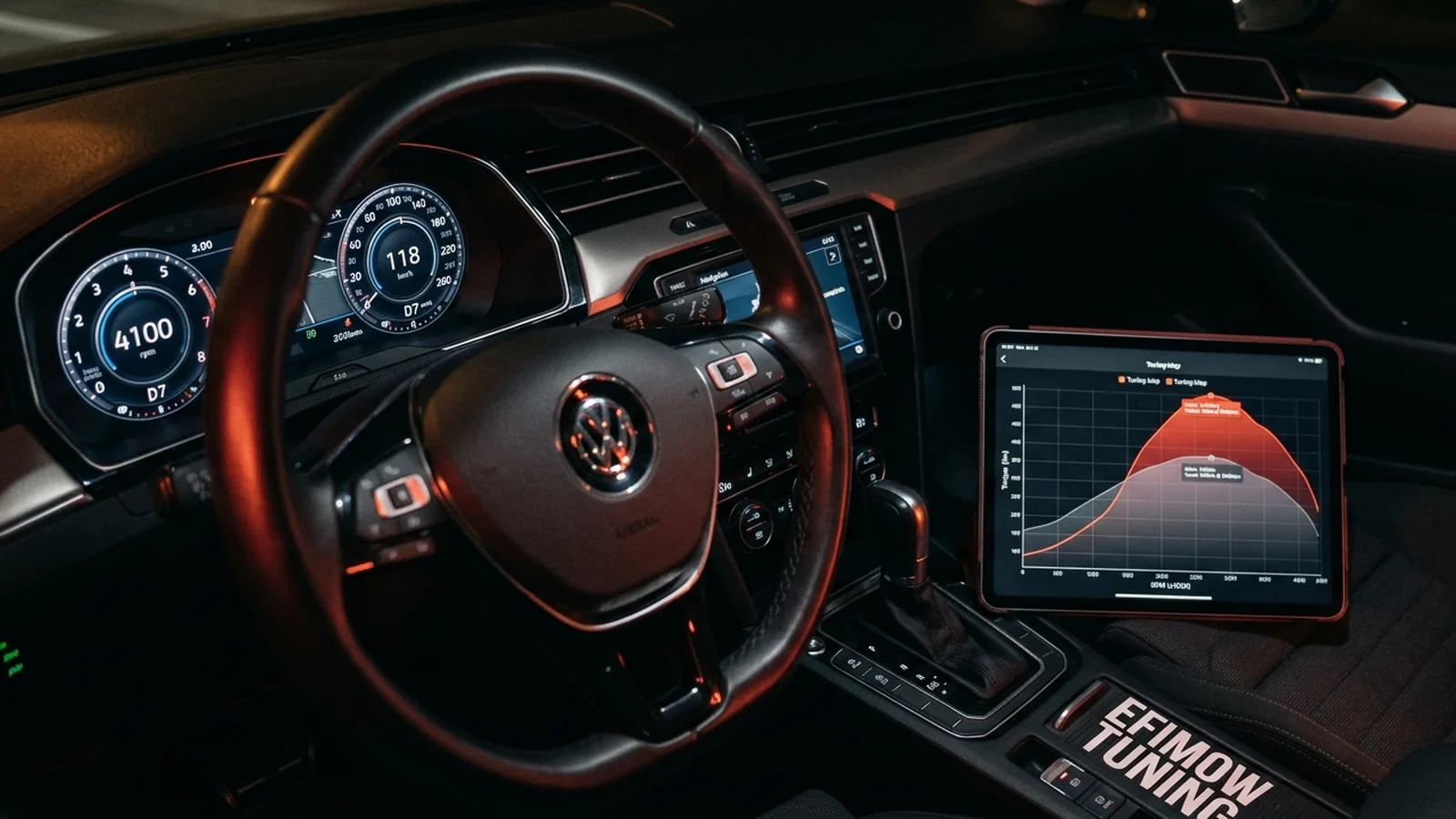
That is the difference from a tuning box, which only falsifies a sensor signal and lets the ECU calculate with wrong input data. On a Passat that often runs under load for long periods, this is not a theoretical point: especially at sustained full load with a trailer, the temperature limits have to work correctly.
Realistic guide values for Stage 1
For the EDC17 family on VAG TDI engines, typical guide values are around 20–30 % more power and around 20–30 % more torque compared with stock. This applies to healthy engines on stock hardware and is an experience value, not a promise. How much you actually get depends on engine condition, factory calibration, fuel quality and the condition of the turbocharger and clutch.
On the Passat the effect is felt mostly in the mid-range. The car pulls more calmly in a high gear, the gearbox needs to downshift less often, and with a trailer there is more reserve uphill. The 190 PS DFCA starts from a higher base; its relative gain is not automatically larger than on the 150 PS engine.
Bookable options
Besides Stage 1, the following options can be booked directly for the EDC17 units in the Passat B8:
- Stage 1+: a slightly more aggressive Stage 1 calibration
- ECO tuning: more torque low down and in the mid-range, peak power unchanged. For high-mileage drivers often the most sensible choice, because the engine can work at lower revs in daily use. Background in the article ECO tuning: saving fuel through software.
- Sharp Throttle: a more direct pedal map
- Vmax removal: observe the tyre speed rating and registration requirements
- DTC Off: only for individual, non-emissions-related fault codes
Launch control and hardcut limiter are only partly feasible on these units and therefore only available on request after the file has been checked; both are pure motorsport functions.
AdBlue, DPF and EGR
Many Passat B8 meet Euro 6 with an SCR catalyst and AdBlue, plus a particulate filter and exhaust gas recirculation. Technically, software can influence these systems. Legally the situation is clear: disabling or removing emissions-related components is emissions tampering and prohibited on public roads. A proper Stage 1 works with functioning exhaust aftertreatment, and a healthy DPF is a precondition anyway for the engine to cope with the extra power over the long term.
Check before tuning
Especially on high-mileage cars, an honest look at the hardware pays off:
- Read the fault memory: clear up entries for boost pressure, exhaust temperature, DPF differential pressure or the AdBlue system first.
- Clutch and dual-mass flywheel: on a manual gearbox they are the first parts to feel more torque.
- DSG: with the dual-clutch gearbox, the transmission software also decides how much torque is transmitted. More in the article "DSG DQ250/DQ381: gearbox software after engine tuning".
- Maintenance: oil, air filter and fuel filter should be up to date; a clogged air filter costs exactly the air the smoke limiter needs.
- Towing: if you regularly tow heavy loads, mention it when ordering. ECO tuning or a moderate Stage 1 calibration is often the better choice here than maximum peak power.
Access to the ECU
The EDC17 generation has had write protection (TPROT) since around 2010, and on later versions from around 2017/2018 (especially CP74 and C74), bench or boot access is often required. Whether that applies to your Passat depends on the software version, not only on the model year. If the ECU has to be opened for this, a 50 € surcharge applies. The original file is saved before any change so that a reflash to stock remains possible.
Price and process
For the Passat B8 with EDC17CP74 (for example the 2.0 TDI DFCA with 190 PS), Stage 1 starts from 300 €, Stage 2 from 375 €. EA288 variants with EDC17C64 also start from 300 €, those with EDC17C74 belong to the newer ECU generation and start from 400 €. Prices follow the ECU generation; surcharges apply for high output, newer model years or when the unit has to be opened.
This is how it works: you select your car in the configurator, book online and decide whether you come to us in Stödtlen on a date of your choice or send in the ECU. The price is the same in both cases.
And Stage 2?
Stage 2 is also possible on the EDC17 units, but only together with hardware. Typical parts are a larger intercooler, an exhaust from the turbo back with catalyst and particulate filter and, depending on the goal, a larger turbocharger. Exhaust parts are only an option with type approval or an expert report; a pipe without catalyst or DPF is not Stage 2 but emissions tampering. Stage 2+ can also be booked for these ECUs. Important: more hardware also means more load on the clutch, gearbox and driveshafts. For a long-distance car like the Passat this is rarely the most sensible route. Stage 1 or ECO tuning usually suits the use better. As with Stage 1, the software and hardware changes void the type approval; Stage 2 is intended for motorsport use only.
Legal framework
The software change voids your vehicle's type approval; the software is intended for motorsport use only. More in the motorsport notice. Anyone who wants to use the power increase on public roads needs an inspection and registration, not least for insurance cover.
Conclusion
The Passat B8 2.0 TDI is a typical case where chip tuning is less about peak power than about composure. As typical guide values, the EDC17 ECUs offer around 20–30 % more power and torque, sensibly complemented by ECO tuning or Sharp Throttle. What matters is a healthy engine, intact exhaust aftertreatment, a look at the clutch or DSG and the right access to the ECU. Disabling exhaust aftertreatment is not part of it; that is prohibited on public roads.
Which variant your Passat has and what it costs is shown after selecting your car in the configurator.