
Eco-Tuning: Saving 5–15% Fuel. Does It Actually Work?
An honest take: what eco-tuning actually does technically, what your trip computer gets wrong, and when the investment pays off.
May 6, 2026 by Leo Efimow
Eco-tuning is the promise every ad page loves to put in big letters: 5 to 15 percent lower fuel consumption, half a liter to a full liter saved per 100 km (roughly 2 to 4 mpg better), and a more pleasant drive on top. Anyone who looks at this seriously soon sees that there is something real behind the claim, but also that the result depends heavily on how the car is driven, what you measure with, and which factory calibration you start from. A technically clean eco-tune is not magic; it is a very specific kind of Stage 1 file optimized not for peak power but for torque in the low rev range. That is exactly where the question is decided whether a driver actually saves fuel in everyday use. To judge the effect honestly, you have to understand what the file changes, what the trip computer is really showing you, and how large the driver's lever is compared to the software.
What an Eco-Tune Actually Changes
The lever is low-end torque, typically between 1,200 and 2,500 rpm. When the ECU releases noticeably more torque in that band, the driver can upshift earlier in normal traffic and keep the engine longer in the efficient load range. In practice that means: pulling away from a city stoplight at 1,200 instead of 1,800 rpm, cruising on country roads at 1,600 instead of 2,200 rpm, and holding 70 mph (110 km/h) on the highway in top gear without the gearbox kicking down. The file modifies several maps in the ECU: torque target, boost request in part-load, the injection map, and the throttle pedal curve. Peak power often stays close to factory or rises only modestly. That is not the point.
On the BMW four-cylinder B48 with an MG1 or MD1 ECU, a clean eco variant typically means about 30–50 Nm of additional torque from roughly 1,500 rpm onward, a flatter and earlier torque curve, a no-more-aggressive throttle pedal, and boost targets that stay clearly below the values of a performance file. On the diesel (for example the B47 or the older N47), the effect is even stronger, because the compression-ignition engine is most efficient in the low rev range to begin with.
How Much Fuel It Actually Saves
The honest answer is: it depends on what load profile the engine usually sees. On steady highway runs between 80 and 100 mph (130–160 km/h) the saving is small, often under two percent. The engine is already operating at a similar load point with or without the eco-tune, and the extra torque is never called for. In a city-and-country mix, however (exactly the profile of an average commuter), savings of 5 to 10 percent are realistic. With heavily torque-loaded use such as towing, a fully loaded estate, or hilly terrain, fuel savings of 8 to 15 percent are within reach because the load peaks dip into higher rev ranges less often.
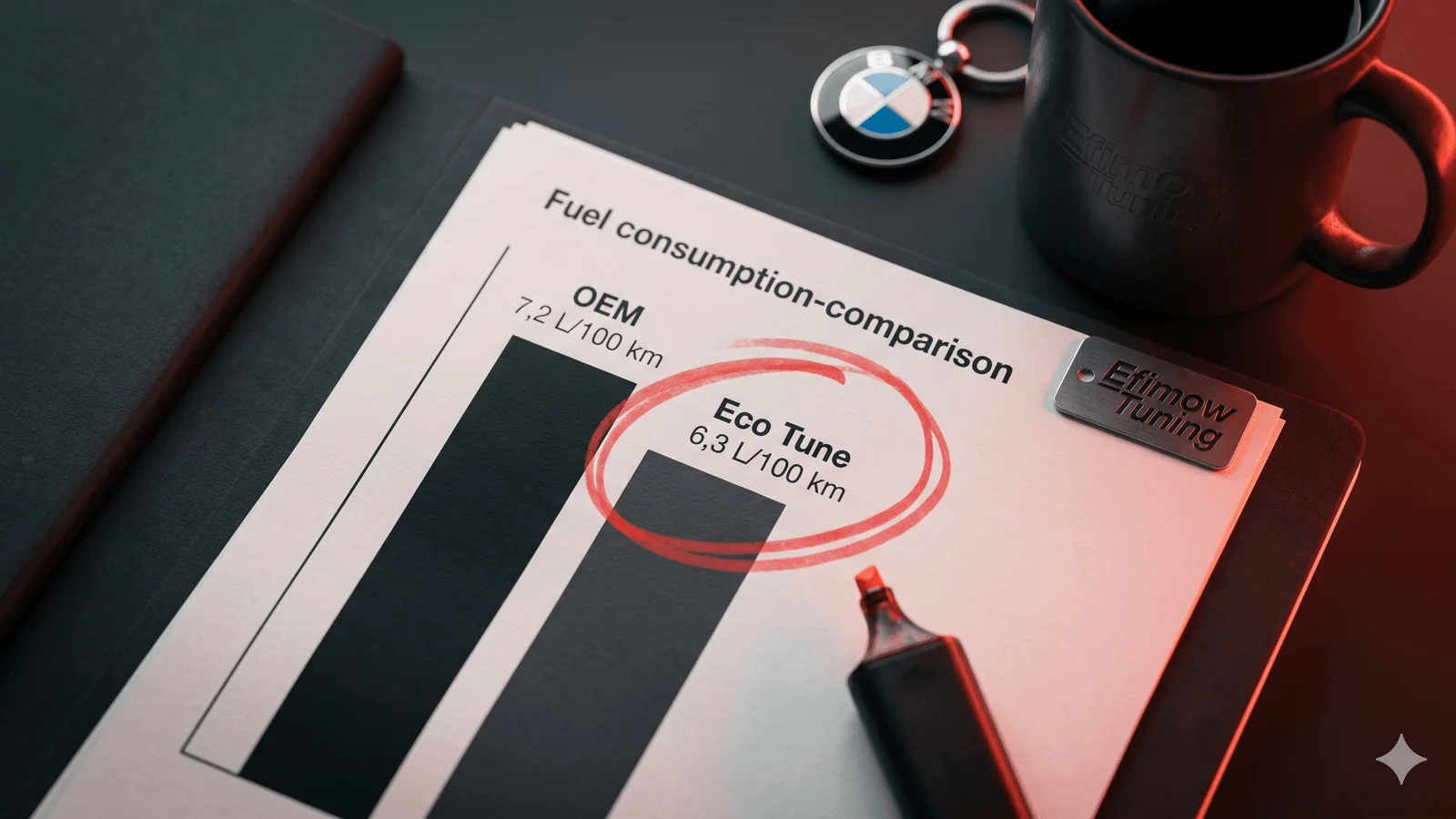
More important than the percent figure is the baseline. "5 percent less" on a car that previously ran 7.5 L/100 km (roughly 31 mpg US) is about 0.4 liters saved. At 15,000 km per year that adds up to 60 liters. At a fuel price around 1.80 € per liter (or roughly 6.80 USD per US gallon equivalent), that is around 108 € per year. With a typical eco-tune investment between 400 and 650 €, the payback period on pure fuel cost runs three to five years. That is not bad, but it is also not the miracle product it is sometimes sold as.
The Trip Computer Trap
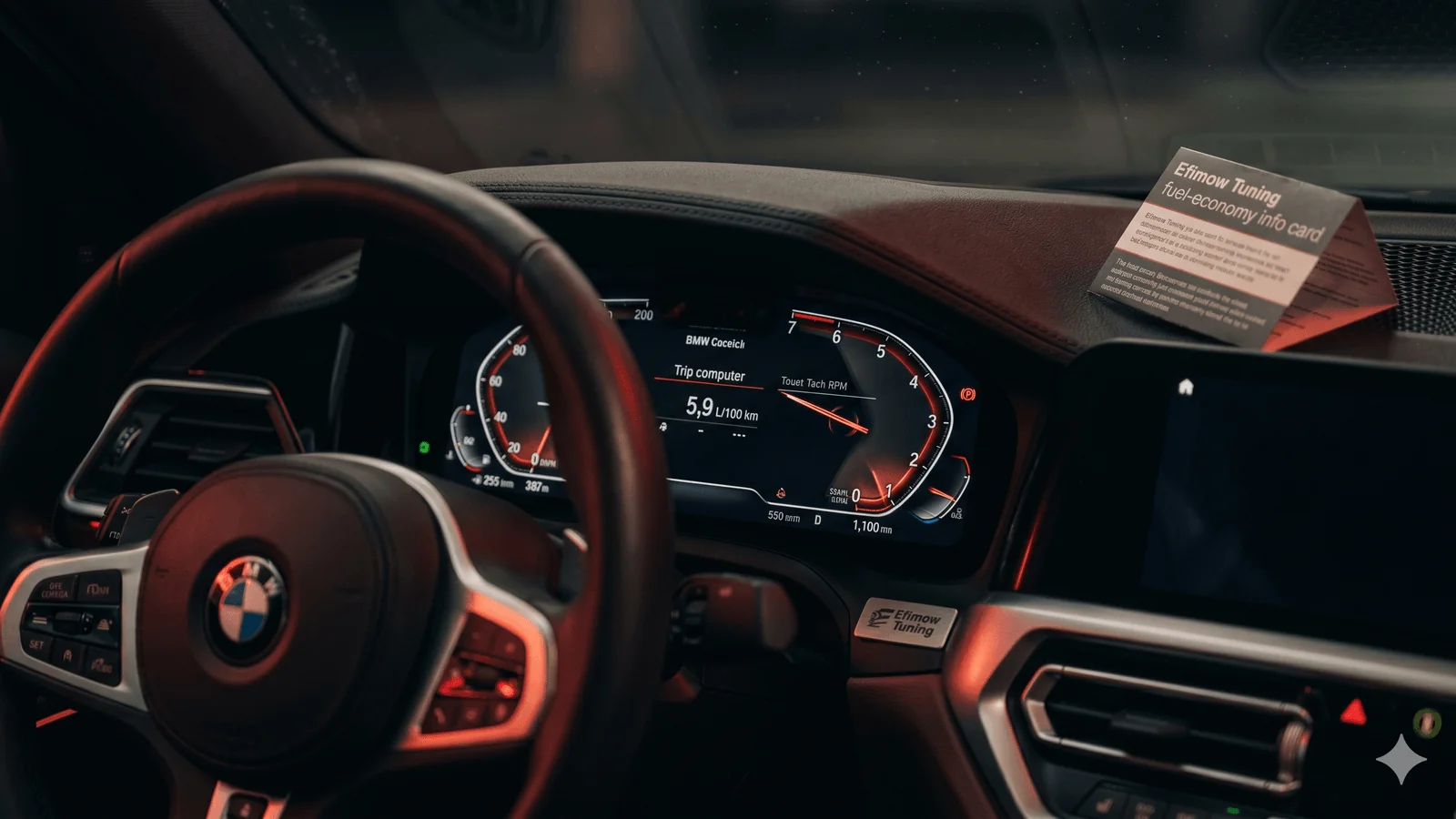
This is probably the single biggest source of disagreement between eco-tune providers and their customers. The trip computer in a BMW does not calculate fuel consumption from actually metered fuel volume; it derives it from the injection times the ECU is asking the injectors to perform. When an eco-tune recalibrates the injection maps, the same displayed value can mean a different reality than it did before. In practice, the BMW trip computer also reads systematically lower than reality even in factory state: deviations of 0.3 to 0.8 L/100 km versus a fill-up at the pump are well documented in independent tests.
For evaluating an eco-tune that means: if you only watch the trip computer, you are seeing a combined change of actual consumption and altered display behavior. The only reliable method is the old one: fill-to-fill measurement over at least three to five comparable tank fills, ideally at the same pump and on the same commuter profile. Anyone who measures honestly before and after the tune gets a number worth something. Everything else is mood data.
The Factor That Beats Everything: Driver Behavior
The uncomfortable truth from every fuel-economy study is that the driver is the largest variable. Between a relaxed and a hectic driving style on the same route there is typically a 15 to 30 percent difference in fuel use. That is more than any serious eco-tune can deliver. So if your primary goal is saving money, the largest lever sits not in the ECU but in your right foot and your shifting habits. Coasting earlier, upshifting sooner, correct tire pressure, less roof load: the sum of these points beats any software optimization.
An eco-tune only delivers its full value when the driver is already driving economically. Then the software helps extract the last slice of efficiency the factory calibration was holding back for the robustness reasons mentioned earlier. A driver who pushes the car hard, treats the throttle as an on-off switch, and never shifts below 2,500 rpm will hardly benefit from an eco-tune, because the file is optimized for a load range that this driver simply does not use.
Bottom Line
Eco-tuning is technically honest when it is sold honestly. The 5 to 15 percent range is real, but it depends on driving profile, on the baseline, and on the driver, and the trip computer systematically distorts the picture. The 400 to 650 € investment pays back in three to five years on fuel cost alone for regular high-mileage drivers, faster on diesel and towing duty. Anyone who sees eco-tuning as a supplementary tool to an already economical driving style gets a measurable benefit. Anyone who expects a miracle device that halves fuel cost should put the money into next year's vacation instead and just drive 10 km/h slower on the way there.