
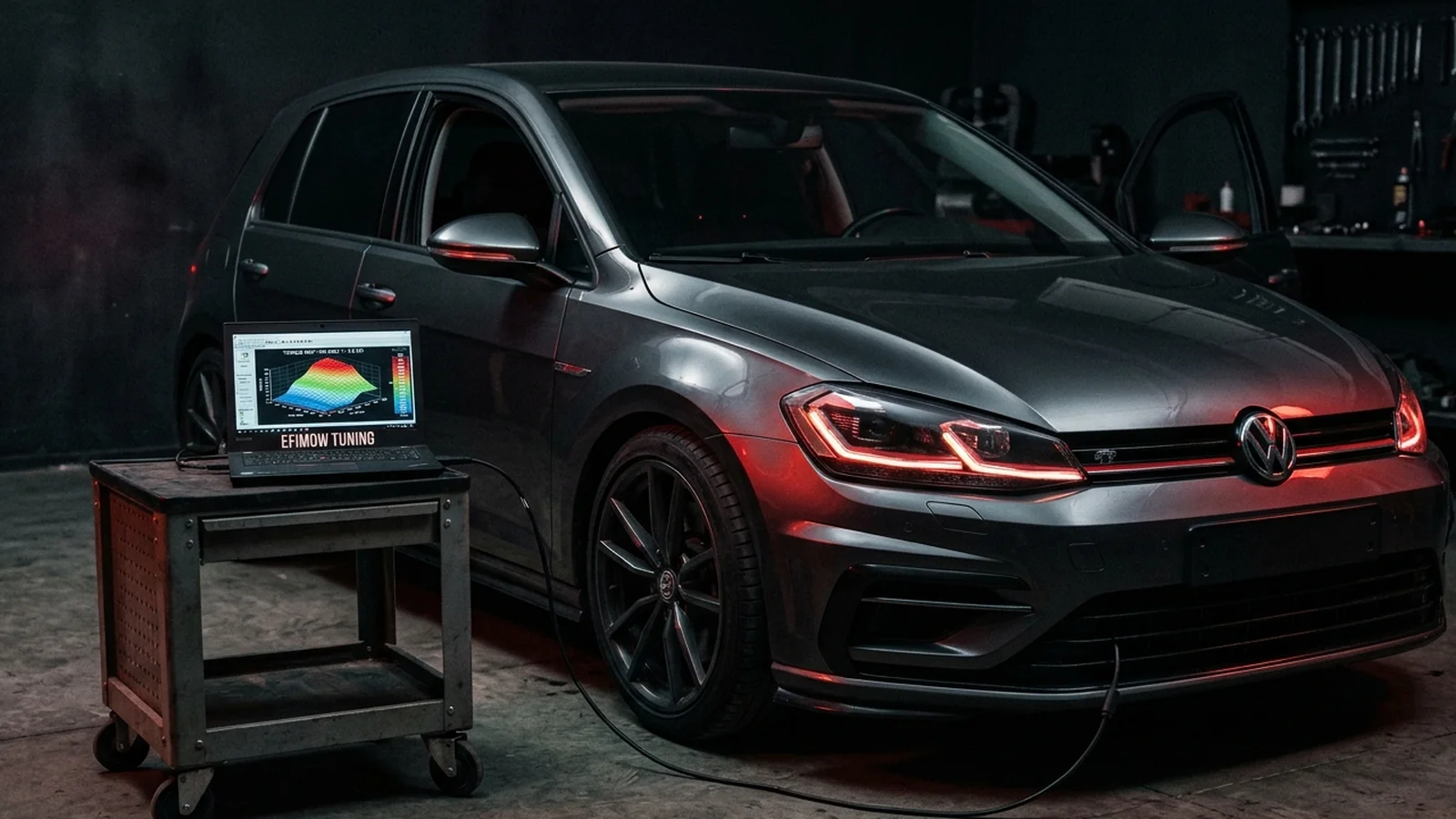
VW Golf 7 2.0 TDI Chip Tuning: What Is Realistic with EDC17
Golf 7 2.0 TDI with Bosch EDC17C64: which variants exist, what Stage 1 realistically delivers, which options are possible and where the limits are.
October 25, 2026 by Leo Efimow
The Golf 7 with the 2.0 TDI is one of those cars that become almost invisible in everyday traffic because there are so many of them. Commuters, field sales, family car, second car with a tow bar: the two-litre diesel handles all of it without fuss. That is exactly why the chip tuning question comes up so often: the engine is robust and economical, but when overtaking on a country road or with a fully loaded boot, many drivers would like a bit more pull from low revs. In this article we look at what is actually possible with the Bosch EDC17 ECU, where the limits are and how the process works.
Which Golf 7 TDI variants exist
According to our catalogue, the Golf VII ran from 2012 to 2020. The two-litre diesel comes in several power levels that share the same basic engine (the EA288) and differ mainly in calibration, turbocharger and peripherals:
| Variant | Engine code | Power | ECU |
|---|---|---|---|
| 2.0 TDI | CRVA | 110 PS | Bosch EDC17C64 |
| 2.0 TDI | CRBC / CRLB | 150 PS | Bosch EDC17C64 |
| 2.0 GTD | CUNA | 184 PS | Bosch EDC17C64 |
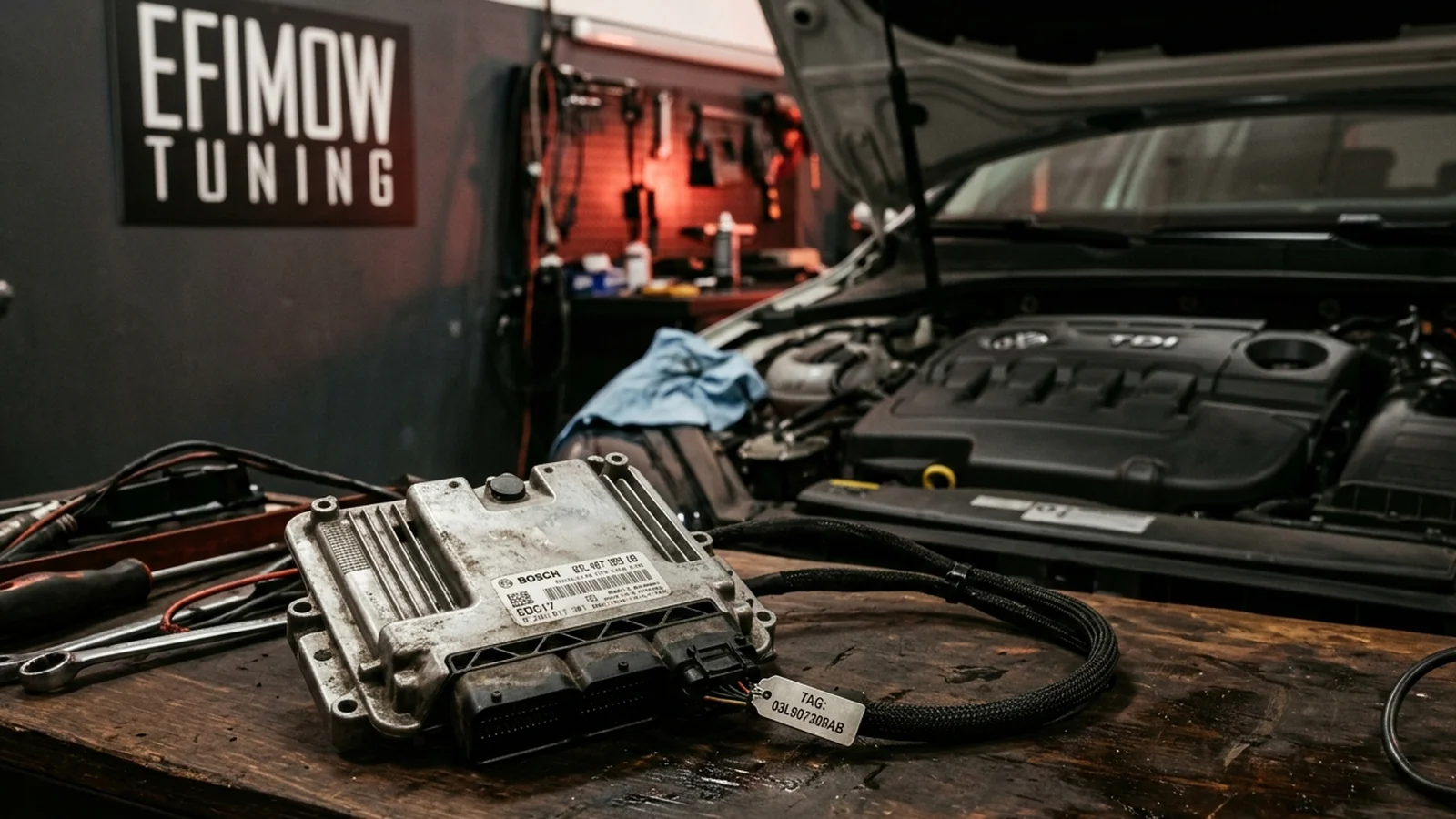
On top of that there are later EA288 calibrations with the Bosch EDC17C74, and the smaller 1.6 TDI engines exist with EDC17C64 as well as with a Delphi DCM6.2. For the software this distinction matters: the ECU decides how access works and which functions can be adapted cleanly. Before ordering, it is worth checking the registration document and, even better, the label on the ECU itself.
What the EDC17 controls in the TDI
The EDC17 is a common rail ECU. From pedal position, engine speed, air mass, boost pressure and numerous temperatures it calculates a target torque and translates it into injection quantity, rail pressure, start of injection and boost target. In between sit limiters: the smoke limiter, which ties fuel quantity to the available air, torque limiters for engine and gearbox, and protection functions for exhaust temperature and turbocharger.
A proper Stage 1 tune shifts exactly these maps (torque request, boost, rail pressure, quantity and smoke limitation) in a coordinated way. The protection functions stay active. If you want to dig deeper, the article Bosch EDC17 explained describes how the ECU is structured.
What Stage 1 realistically delivers
For the Bosch EDC17 family on VAG TDI engines, typical guide values for Stage 1 are around 20–30 % more power and around 20–30 % more torque compared with stock. These are experience values for healthy engines on stock hardware, not a promise for your specific car. How much you actually get depends on the condition of the engine, the factory calibration and how much reserve the turbocharger and clutch have in your individual case.
On the Golf diesel you feel it mostly in the mid-range: the engine pulls earlier and more evenly, you downshift less often, and with a trailer or full load there is more in reserve. Peak power matters less in daily driving than a broad torque plateau where you actually drive.
Comparing the power levels is interesting: relative to stock, the 110 PS CRVA often shows the most noticeable effect because its calibration is held back the most. The 184 PS GTD starts from a higher base, so the percentage headroom is not automatically larger.
Options for the Golf 7 TDI
Besides Stage 1, the following software options can be booked for the EDC17C64:
- Stage 1+: a slightly more aggressive version of Stage 1
- ECO tuning: more torque in the low and mid-range, peak power unchanged; interesting for high-mileage drivers
- Sharp Throttle: a more direct pedal map
- Vmax removal: the limiter is a parameter; you need to observe the tyre speed rating and registration requirements
- DTC Off: only for individual, non-emissions-related fault codes, for example after an approved modification
Launch control and a hardcut limiter are only partly feasible on the EDC17 diesel and are therefore only available on request after the file has been checked. Both are pure motorsport functions. Pops & bangs do not exist technically on a diesel: no spark, no overrun crackle.
What does not belong on this list: disabling the diesel particulate filter, EGR or AdBlue system. It is technically documented, but it is emissions tampering and prohibited on public roads. A Golf without working exhaust aftertreatment loses its type approval and will be noticed at the latest at the periodic inspection.
Access: OBD, bench or boot
The EDC17C64 in the Golf 7 is listed with OBD access in our catalogue. That does not mean every ECU behaves the same. From around 2017/2018, and especially on later software versions with stricter write protection (TPROT), it may be necessary to remove the ECU and work on it on the bench. If the unit has to be opened for that, a 50 € surcharge applies. This is a fixed part of our pricing logic, not a random number. The article "OBD, bench and boot compared" gives an overview of the access paths.
Whatever the path: the original file is saved before any change. Only then is a reflash to stock possible at any time.
What to check beforehand
Tuning makes a healthy engine stronger; it does not make a sick one healthier. A quick check before the appointment pays off:
- Fault memory: exhaust temperature sensors, the DPF differential pressure sensor and the boost pressure sensor should be free of faults.
- DPF condition: a heavily loaded particulate filter raises exhaust back pressure. Frequent short trips are bad for the DPF anyway.
- Clutch and dual-mass flywheel: with a manual gearbox, the clutch is often the first part to feel the extra torque. If it already slips slightly on stock, it needs replacing before tuning.
- Gearbox: with DSG, the transmission software also decides how much torque gets through. More on that in "DSG DQ250/DQ381: gearbox software after engine tuning".
- Maintenance: oil change, air filter and fuel filter should be up to date.
Price and process
For the Golf 7 2.0 TDI with EDC17C64 (for example the 150 PS CRBC engine), the Stage 1 software starts from 300 €, Stage 2 from 375 €. The price follows from the ECU generation, not from gut feeling; surcharges only apply if the unit has to be opened for access.
The process for cars outside BMW is simple: you book online via the configurator and decide whether you come to us in Stödtlen on a date of your choice or send in the ECU. The price is the same in both cases, because the work on the ECU is identical.
Legal, short and clear
The software change voids your vehicle's type approval; the software is intended for motorsport use only. Details are in the motorsport notice. Anyone who wants to use a power increase on public roads needs an inspection and registration of the change. That is not a formality, but a precondition for insurance cover and the periodic inspection.
Conclusion
The Golf 7 2.0 TDI is a rewarding candidate for a clean software optimisation: the EDC17C64 is well documented, the EA288 base has reserves, and 20–30 % more power and torque are realistic as typical guide values, with intact hardware and active protection functions. What matters is a healthy starting point, an honest check of clutch and DPF and the right access path. Options such as ECO tuning or Sharp Throttle round off the package; exhaust aftertreatment stays untouched.
If you want to know which calibration your Golf carries and what it costs, select your car in the configurator. It shows the price and available options for your variant.