
Bosch EDC17 Explained: The Diesel ECU of a Whole Generation
What the Bosch EDC17 controls, which VAG variants exist, why TPROT changed access and how all of that affects tuning and price.
October 25, 2026 by Leo Efimow
If you drive a diesel built between roughly 2008 and 2020, there is a good chance a Bosch EDC17 is working under the bonnet. Golf, Passat, A4, Octavia, Transporter, and far beyond the VW Group too, including BMW, where the DDE7 and DDE8 engine controllers are based on the EDC17. Hardly any other ECU has shaped an entire diesel generation like this. For tuning, the EDC17 is therefore something like a common language: once you understand its structure, you understand why one car is tuned over OBD in an hour while the next one's ECU has to go on the workbench.
What the EDC17 is
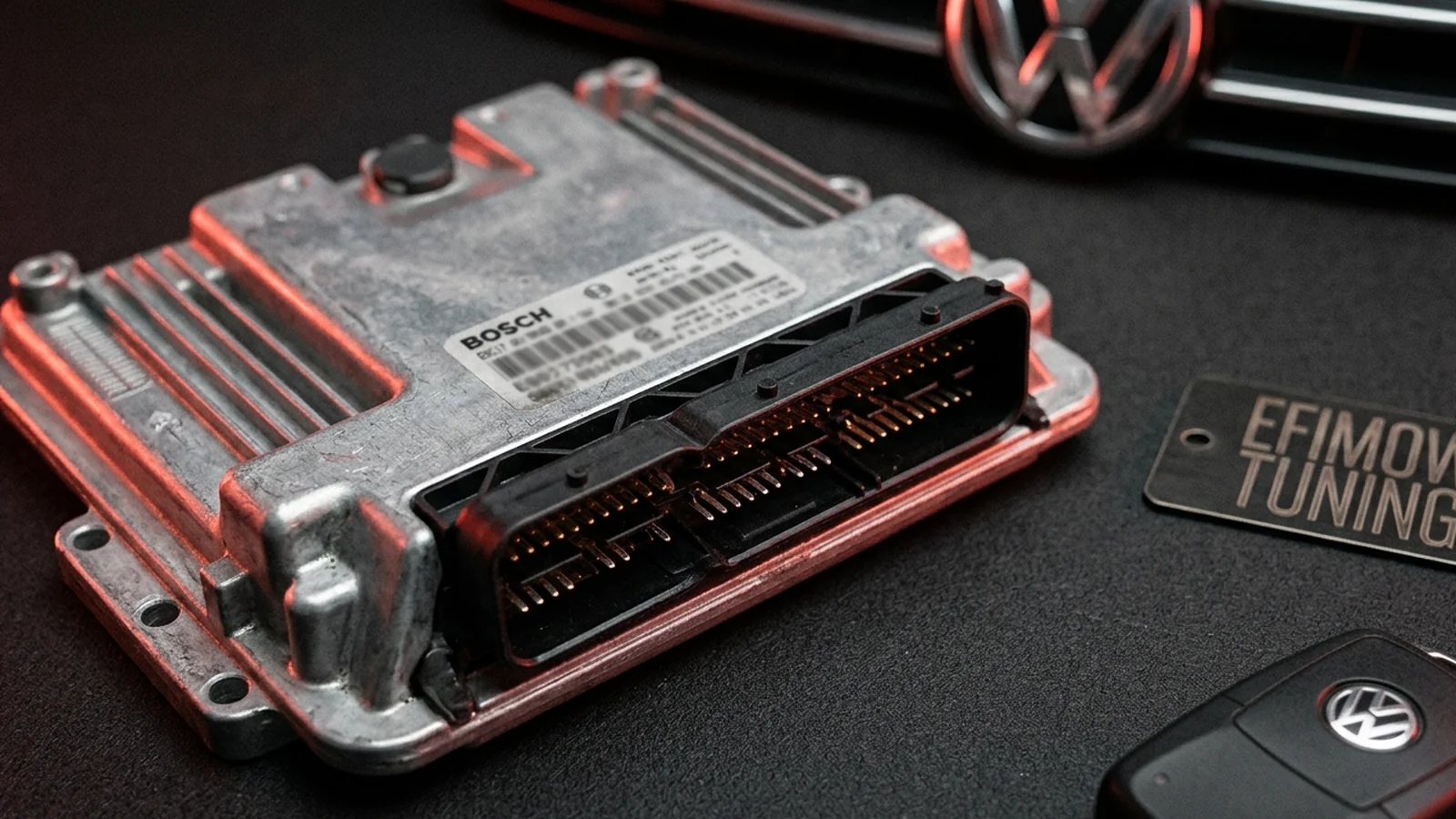
EDC stands for Electronic Diesel Control, the 17 for the generation. The EDC17 is designed for common-rail diesels and replaced the EDC16. Inside works a microcontroller from the Infineon TriCore family, considerably more powerful than its predecessors' processors, with more memory and more computing power for what modern diesels demand: multiple injections per cycle, particulate filter regeneration, exhaust gas recirculation, later SCR dosing, and coordination with gearbox and chassis controllers over the CAN bus.
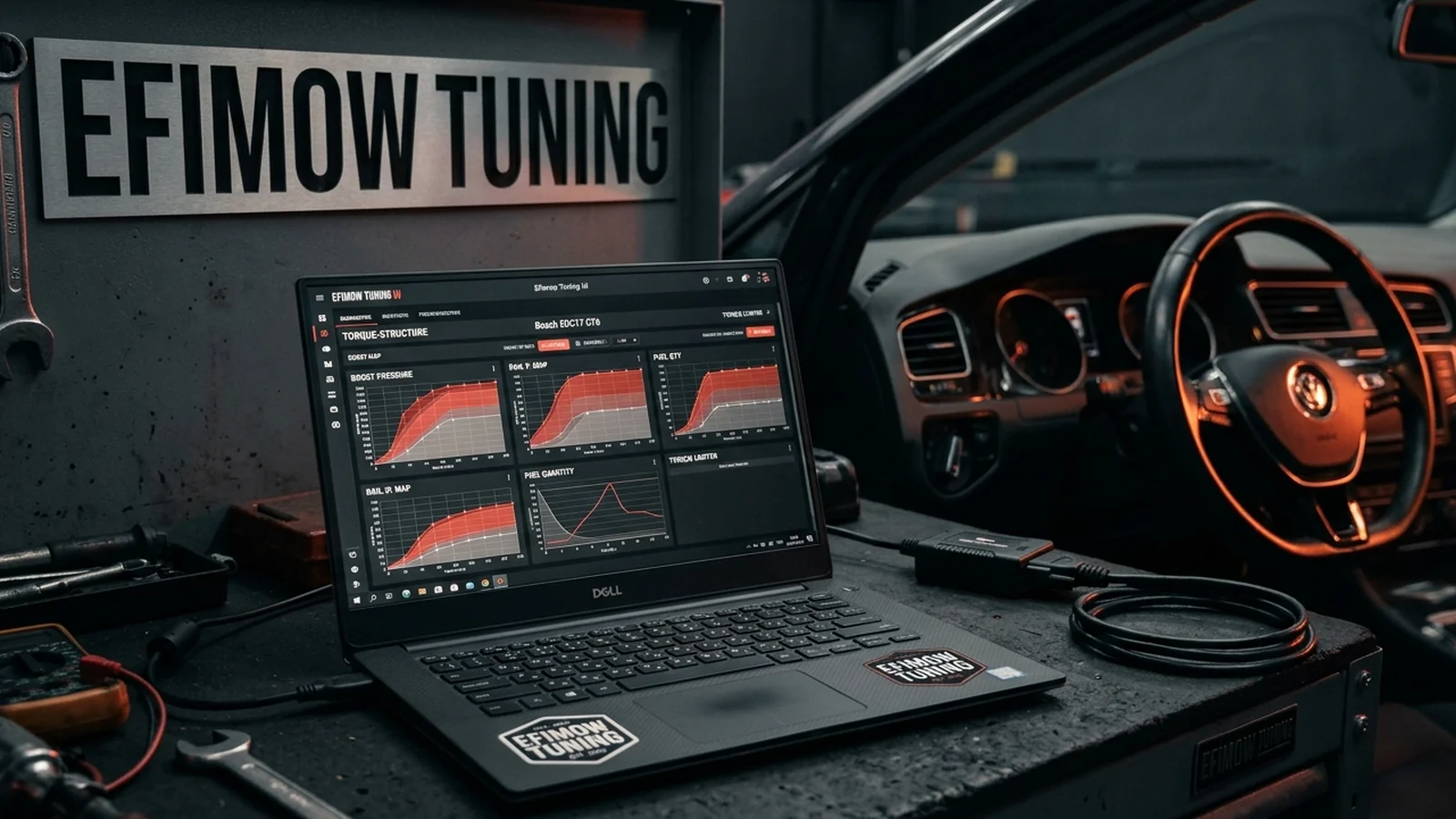
The software is modular. Instead of individual "power" maps there is a torque structure: the ECU calculates a target torque from driver demand, limiters and requests from other control units, and derives injection quantity, injection timing, rail pressure and boost pressure from it. For calibration this means that raising a single map achieves little, because a limiter kicks in somewhere else. A clean Stage 1 on an EDC17 adjusts this chain consistently.
The most important maps for tuning
An EDC17 calibration typically focuses on these areas:
- Torque limiter: defines how much torque the engine may deliver depending on rpm, gear and conditions.
- Injection quantity and start of injection: determine how much fuel is injected and when, including pilot and post injections.
- Rail pressure targets: the pressure in the common-rail accumulator, decisive for atomisation and combustion.
- Boost targets and limitation: control the turbocharger, usually with variable turbine geometry.
- Smoke limiter: limits fuel quantity relative to measured air mass and prevents excessive soot.
Protection functions such as exhaust gas temperature models and component protection stay active in a serious calibration. After every change the checksums also have to be corrected, otherwise the ECU will not start properly.
The VAG variants at a glance
The EDC17 is not a single piece of hardware but a family. The VW Group alone uses numerous variants. Some typical assignments from our catalog:
| Variant | Typical applications (examples) |
|---|---|
| EDC17C46 | 2.0 TDI CR in Golf VI, Passat B6/B7, Octavia II |
| EDC17CP14 | 2.0 TDI in the Audi A4 B8 (e.g. CAGA, CAGB), 2.7/3.0 V6 TDI |
| EDC17CP20 | Transporter T5 2.0 TDI, Audi A6 C7 3.0 TDI |
| EDC17C64 | 1.6/2.0 TDI EA288 in Golf 7, Octavia III, A3 8V |
| EDC17C74 / CP74 | 2.0 TDI EA288 in Golf 7 facelift, Passat B8, Transporter T6 |
| EDC17CP44 / CP54 | 3.0 V6 TDI in A4, A6, A8, Q7 |
For the whole VAG EDC17 family, our research gives typical guide values of 20–30 % more power for 1.6 and 2.0 TDI and 15–25 % for V6 and V8 TDI, with 20–30 % more torque. These are ranges that depend on the condition and software version of the individual car.
TPROT: why access is not the same everywhere
From around 2010, Bosch gave the EDC17 a write protection known in the trade as TPROT. It prevents modified software from simply being written over the diagnostic port. For many variants, tool makers found ways around this protection over OBD. With later software versions (especially on EA288 engines to Euro 6d, i.e. CP74 and C74), removal and bench or boot access are often required.
An example from the PCMflash module list: the VAG EDC17 units are listed there in module 50 (UDS ECUs) and module 65 (older variants on TP2.0/K-Line), each with virtual read. That means only the calibration area is read over OBD; the rest is completed from a database of original files. For the EDC17C64 the list also notes that ECUs with the post-2021 TPROT version are only accessible via bench module 71, which is only included from version 1.3.1. Version 1.2.x covers modules 1 to 88 but not this support yet. What OBD, bench and boot access each involve is explained in the post OBD, bench and boot compared.
Original file and the way back
Whether OBD, bench or boot: before anything is written, we back up the ECU's original file. With boot access the complete memory is read; with virtual read over OBD, the calibration area. This backup is your way back: before a dealer visit, before selling the car, or if you want to return it to stock. A software update at a dealer can also overwrite a modified calibration. Even then it helps to know that the starting point is cleanly documented. The backup is not a formality but the first working step of every serious calibration.
How the generation affects price
Our pricing rules follow the ECU generation. For diesel cars the EDC17 forms its own tier with Stage 1 from €300 and Stage 2 from €375. The newer variants from EDC17C74 onwards are assigned, like MD1 and Simos 18, to the latest generation because they are better protected and mean more calibration work: there, Stage 1 starts at €400. Surcharges for high engine power, newer model years and required bench or boot access can be added.
In concrete terms: the Audi A4 B8 2.0 TDI CAGA with EDC17CP14 is from €300, a Golf 7 2.0 TDI with EDC17C64 likewise from €300, a Transporter T6 with EDC17C74 from €450 because of the model-year surcharge. The configurator shows you the exact price for your car once you have selected model and engine. Tuning is done on site in Stödtlen on your preferred date or via an ECU you send in; the price is the same either way.
Options and what is not possible
For the VAG EDC17 our data lists as bookable, besides Stage 1 and Stage 2: Stage 1+ and Stage 2+, ECO tuning, Sharp Throttle, Vmax removal and DTC Off for individual, non-emissions-related fault codes. Launch control and a hard limiter are only available on request after checking the file. Pops & bangs or a popcorn limiter do not exist on a diesel. Without spark ignition there is no technical basis for them.
The EDC17 also controls the DPF, EGR and, on Euro 6 variants, the SCR system with AdBlue. Disabling these functions by software is emissions tampering and prohibited on public roads. Regardless of that: the software change voids your vehicle's type approval; the software is intended for motorsport use only (see the motorsport notice).
Conclusion
The Bosch EDC17 is the diesel ECU of a whole generation: powerful, modular and well documented. For tuning that means familiar structures and typical guide values of 20–30 % on the four-cylinder TDIs. The difference between variants lies less in the calibration than in access: early ECUs can often be handled over OBD, late EA288 versions frequently need bench or boot. That is exactly what we check before we start. If you want to know which EDC17 is in your car, have a look at the ECU page for the EDC17C64 or select your model directly in the configurator.