
OBD vs. Bench vs. Boot: The Three Paths Tuners Use to Reach Your ECU
Three technical paths, four trade-offs. Which one fits which car, what each costs, and how to recognize a serious tuner.
May 6, 2026 by Leo Efimow
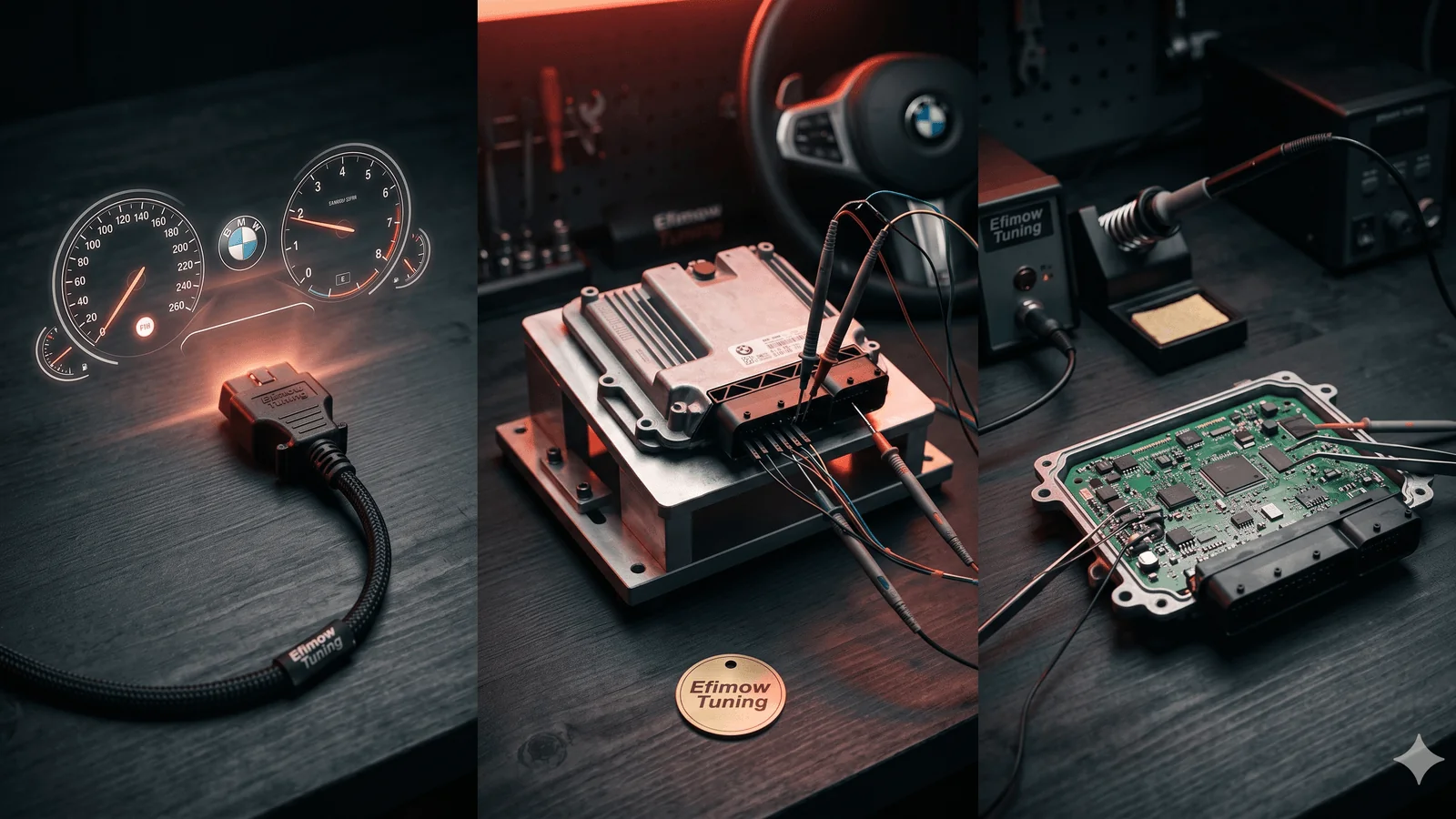
When a tuner says they "flash" your car, that doesn't actually tell you much. What matters is how the ECU is being written, and that single technical question separates the serious shops from the rest. There are three established paths into the engine control unit: OBD tuning over the diagnostic port, bench mode with the ECU removed and on the workbench, and boot mode with the housing opened. Alongside them sits the tuning box, a special case that doesn't write to the ECU at all but manipulates sensor signals on the way in. Which path fits depends on the car, and on a current BMW G-series, the choice is often already made for you by Bosch and BMW.
OBD mode: the standard path
OBD tuning is the oldest and simplest path. The technician plugs a programmer (Autotuner, KESS3, MPPS or similar) into the 16-pin OBD-II connector under the steering wheel, reads the complete ECU calibration, modifies it on the laptop, and writes it back over the same connector. The ECU stays in the car, the vehicle is never opened, and the operation typically takes between 30 and 90 minutes of pure write time.
For more than two decades, this was the default solution for nearly every European vehicle. On BMW it works reliably on older E- and F-generation cars with MSD80, MSD85, MEVD17.x or EDC17, covering a large share of the fleet still on the road today. The advantages: no hardware intervention, no visible traces on the ECU, full reversibility by simply writing the original calibration back. For a Stage 1 remap on an F30 320d, it remains the obvious choice. The cost is also modest, since no extra workshop hours for removal and reinstallation are involved.
The limits have become visible since around 2020. With the Bosch MG1 and MD1 family (fitted in many BMW G-series models from MY 2020 onward), BMW introduced cryptographically signed calibrations and multi-stage bootloaders that block classic OBD writes without prior unlocking. Concretely, the bootloader checks the calibration's signature on every start; an unsigned external calibration simply will not boot. That is not a flaw. It is a deliberate architectural decision, and it shifts the work for modern cars toward bench mode.
Bench mode: the ECU on the workbench
In bench mode the ECU is removed from the car and connected on the workbench through a bench adapter to the programmer. The adapter supplies power from an external source and taps the read- and write-relevant pins directly at the connector strip. The housing stays closed, the PCB is never touched. The intervention is limited to the removal and reinstallation plus the bench connection itself.
Bench mode is today the standard path for modern BMW ECUs with OBD write protection. Specifically that covers the Bosch generations MG1CS003, MG1CS024, MG1CS049, and MG1CS201 on the gasoline side, plus MD1CP032 and MD1CS001 on diesel, fitted in BMW G20, G21, G22, G30, G31, G05, G07 and others from mid-2020. Anyone who wants a full Stage 1 remap on an M340i (B58) from MY 2021 will, in most cases, end up going through bench mode. Workshops typically budget 1.5 to 2.5 hours of labor for removal and reinstallation on top of the pure write time.
A specialized variant is the commercial unlock service for MG1/MD1: the ECU is unlocked once on the bench, after which subsequent writes can again be performed over OBD. In practice, for a BMW G20 owner from 2020 onward, the first appointment is involved; later software updates or stage changes then run over the diagnostic port. A second benefit: returning to the factory calibration later (for a dealer service or before selling the vehicle) can be done without removing the ECU again.
The risks in bench mode are manageable but not zero. Power has to be cleanly disconnected before removal, the bench adapter has to match the ECU exactly, and on reinstallation no connector may sit slightly off. An experienced shop works with defined torque values, a documented connection setup, and a fault-code check after the first engine start: the small steps that separate a professional bench tune from a shortcut job.
Boot mode, BDM, and the comparison table
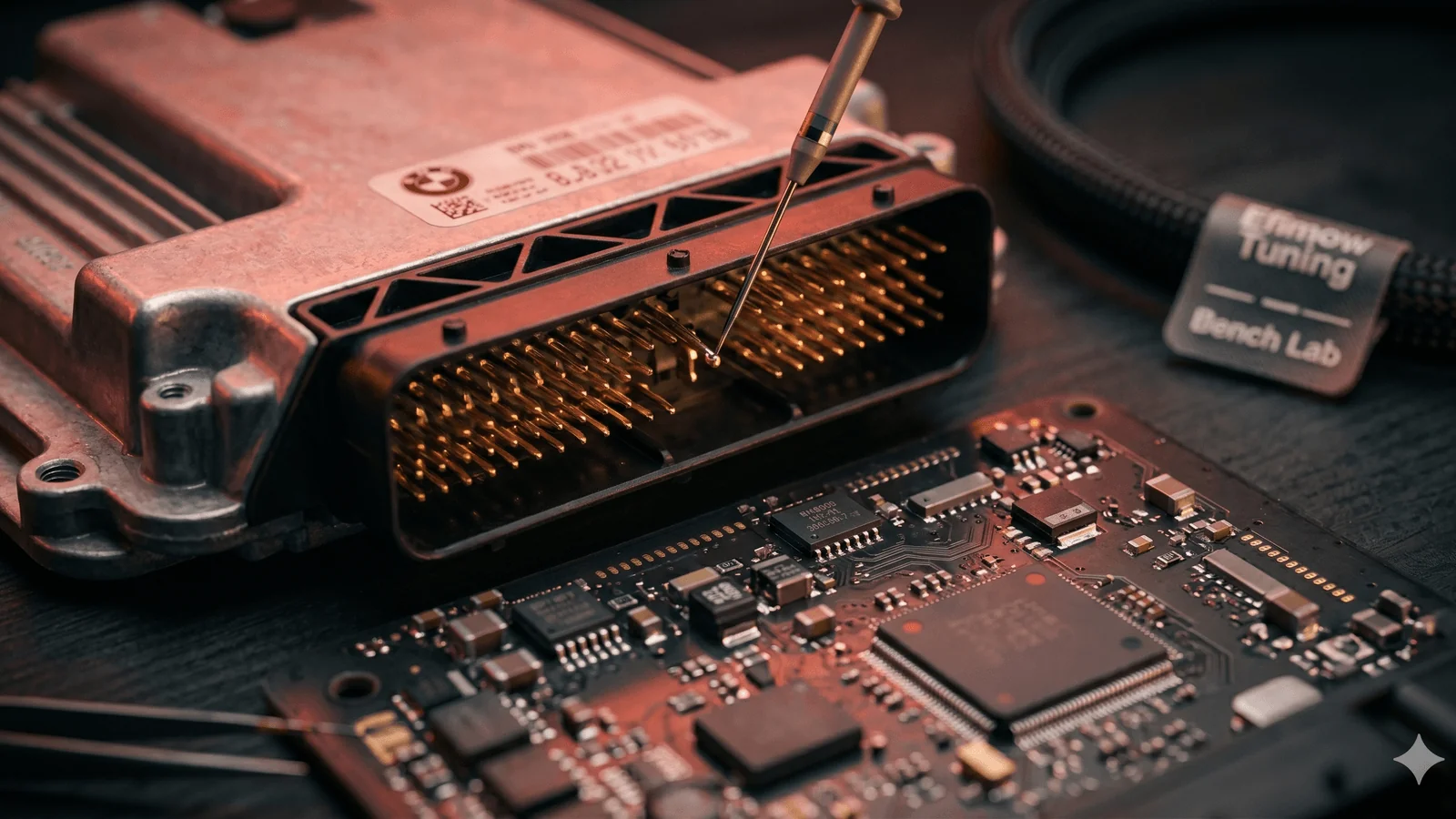
Boot mode is the most invasive of the standard paths. The ECU housing is opened, and the programmer is contacted to test pads or pins directly on the circuit board, through JTAG on some ECUs, or the classic BDM interface (Background Debug Mode) on older generations. Today, boot mode is mainly used to recover an ECU from a failed write attempt ("brick recovery") or when bench mode is unavailable for the unit in question. On modern, cryptographically protected BMW ECUs, boot mode is rarely the first choice. Bench plus prior unlock dominates here.
The tuning box is conceptually different: it is not written into the ECU at all. Instead, it is wired between sensors (rail pressure, boost) and the ECU and manipulates the signals before they reach the control unit. Plug-and-play, no software intervention, but also no way to respect the ECU's internal protective limits, torque models, or diagnostic logic. For a properly calibrated tune on a modern BMW, the box is not a real alternative.
| Method | Hardware intervention | Reversible | Visible traces | Suited for |
|---|---|---|---|---|
| OBD | none | yes, fully | none | BMW E/F-series, many EDC17/MEVD17.x, unlocked MG1/MD1 |
| Bench | ECU removal | yes | only at the connector | BMW G-series from 2020, locked Bosch MG1/MD1 |
| Boot/BDM | open housing | partial | yes, clearly | recovery, older generations, special cases |
| Tuning box | sensor adapter | yes, by unplugging | connector modification | not recommended for serious BMW tuning |
Bottom line
The access path is not a detail. It determines effort, price, and quality of the result. On a BMW E92 or F30, OBD remains the clean standard: fast, reversible, no traces. On a G20 or M340i from 2020 onward, the route normally goes through bench mode or a bench-unlock procedure that re-enables future OBD writes. Boot mode is the specialty discipline for recoveries and edge cases; the tuning box remains a solution with well-known weaknesses. A serious workshop tells you up front which path will be used on your specific car, why, and what that means concretely, from disassembly hours to reversibility. Anyone who can't give you a clear answer to that question is the wrong shop to work with.