
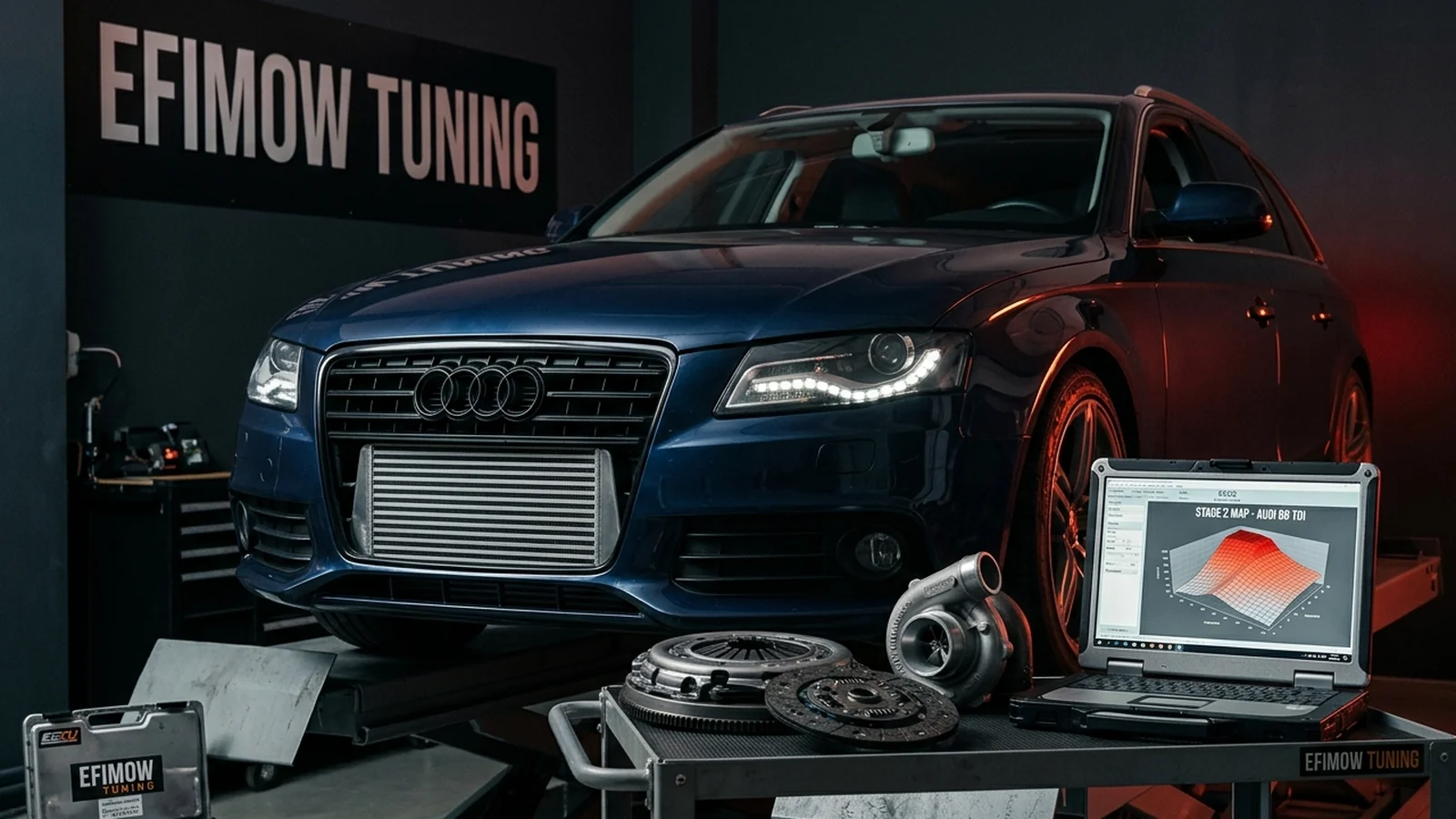
TDI Stage 2: Intercooler, Turbo, Clutch: What You Really Need
Stage 2 on a TDI means software plus matching hardware. Which parts make sense, which are overrated and what applies legally.
October 25, 2026 by Leo Efimow
"Stage 2" sounds like the logical next step once Stage 1 has been fun. On a TDI, though, this step is no longer a pure software update. Stage 2 means the calibration is designed around modified hardware that gives the engine more headroom. On a diesel, that mainly means cooler charge air, less exhaust back pressure and a driveline that can transfer the extra torque. Which parts are really needed for that is one of the most common questions in our workshop. The honest answer: fewer than parts shops like to sell, but more than "just a sharper file".
How Stage 2 differs from Stage 1
A Stage 1 uses the reserves the stock engine brings with it. The limits are set by components designed for stock output: the intercooler, which at some point no longer cools the compressed air enough; the exhaust system with its back pressure; the turbocharger with its efficiency window; and the clutch with its torque capacity. Stage 2 moves one or more of these limits through hardware and adapts the software precisely to it.
The order matters: software follows hardware, not the other way round. A Stage 2 file on a stock car is not a Stage 2 but an overdone Stage 1. You will find more on the general concept in the post Stage 2 tuning.
Intercooler: often the most sensible first step
On a diesel, charge-air temperature is one of the most important values. Warmer air has a lower density, so less oxygen per charge, and more fuel without more oxygen means more soot and higher exhaust gas temperatures. Many stock intercoolers in compact and mid-size cars are tightly sized. Under sustained load, in summer or with a trailer, the charge air heats up and the ECU pulls power.
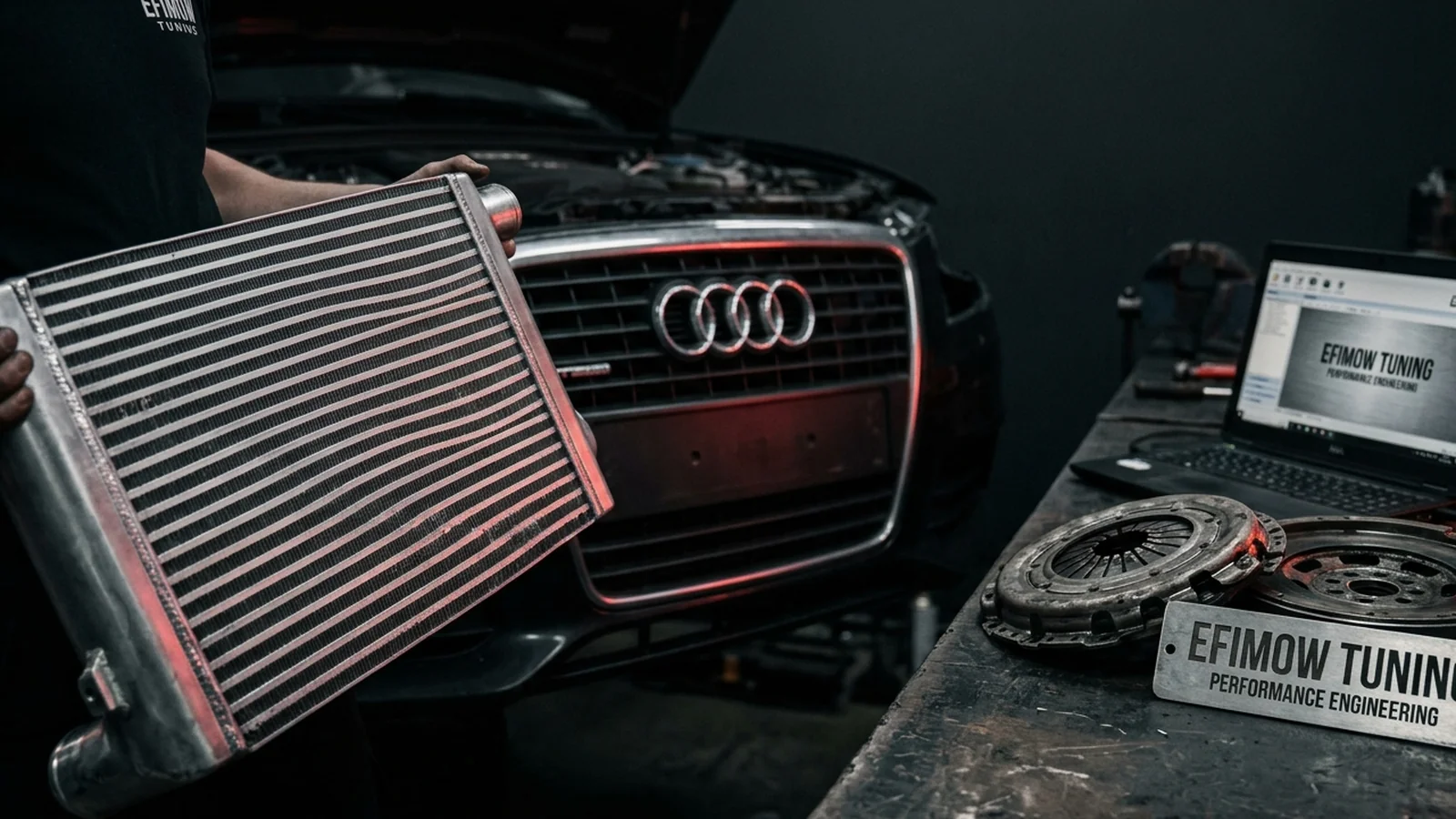
A larger intercooler lowers intake air temperature and makes the power more stable: less spectacular on paper, but in everyday driving often the most noticeable improvement. It is also a component with no influence on exhaust aftertreatment, which makes the legal assessment simpler than with exhaust parts.
Exhaust from the turbo back: only with DPF and catalyst
Back pressure behind the turbine limits how freely the turbo can work. An exhaust from the turbo back with a larger cross-section lowers this back pressure and the exhaust gas temperature ahead of the turbine. On a modern TDI, however, the oxidation catalyst and diesel particulate filter sit in exactly this area, and depending on the emissions standard the SCR system too.
So without exception: an exhaust from the turbo back is only an option with catalyst and particulate filter, and it needs type approval for the part (ABE) or a parts certificate. Removing the DPF or catalyst is emissions tampering and prohibited on public roads. A "Stage 2" built on a gutted exhaust is not a legal option. On many TDIs the gain from a modified exhaust is also smaller than expected, because the DPF itself accounts for a large share of the back pressure.
Bigger turbocharger: the step beyond Stage 2
A larger or upgraded turbo is the measure with the biggest effect on peak power, and with the most consequences. More air demands more fuel, so injection quantity, injectors and high-pressure pump reach their limits. Response, exhaust gas temperatures and the load on pistons and con rods change. Whether a turbo swap still counts as Stage 2 or is already a stage of its own is handled differently. More important in practice: a turbo conversion needs an individual calibration and a car in very good condition. It is not something you just add on.
Clutch and dual-mass flywheel: the real bottleneck
On a TDI, the driveline is often the first real limit. According to our research guide values, a Stage 1 alone typically brings 20–30 % more torque on the VAG EDC17 family and 25–35 % on the EDC16 Pumpe-Düse engines. Stage 2 goes beyond that. The stock clutch of a manual gearbox is designed for stock torque plus a safety margin; a clutch that has already done many miles will slip early. The dual-mass flywheel suffers from the higher torque peaks.
Our recommendation from the workshop:
- Check the clutch before you plan Stage 2. If it slips at full throttle in a high gear, it is the first part on the list.
- Uprated clutch only if needed. With a moderate torque increase a healthy stock clutch is often still enough; with a substantial increase it is not.
- DSG cars: The gearbox has its own torque limits in its control unit. Whether and how the gearbox side needs adjusting is something we clarify for each vehicle.
Which components are generally under the most strain with more power is described in the post Which components suffer most.
The sensible order
For most TDI drivers who want to go beyond Stage 1, this order has proven itself: first check the condition (clutch, charge-air path, injectors, DPF loading), then the intercooler, then (depending on the goal) an approved exhaust with DPF and catalyst. A bigger turbo is a project of its own. Each hardware stage gets the matching software, and that is exactly the difference between a Stage 2 and a collection of parts.
Why the hardware list comes before the software
For a Stage 2 calibration we need to know exactly what is fitted: make and size of the intercooler, type of exhaust, condition or type of turbo, clutch. There is no file for "some bigger intercooler", because pressure drop and cooling capacity differ from part to part. That is why every Stage 2 request comes with an honest list of parts. If a component the calibration relies on is missing, the result is at best wasted power and at worst an overload at exactly the point that was supposed to be relieved. The more precisely you describe your hardware, the better the software will fit.
Software, options and prices
For the VAG EDC17, Stage 2 is listed as technically feasible in our data, as is Stage 2+ (€50) as additional fine-tuning to the installed hardware. ECO tuning, Sharp Throttle, Vmax removal and DTC Off for non-emissions-related fault codes can also be booked on Stage 2.
Prices follow the ECU generation. An Audi A4 B8 2.0 TDI CAGA with EDC17CP14 costs from €375 for Stage 2, a Golf 7 2.0 TDI with EDC17C64 likewise from €375, a Golf V 1.9 TDI BXE with EDC16U31 from €250. The configurator shows the exact price for your car. Tuning is done on site in Stödtlen on your preferred date or via an ECU you send in, at the same price.
Legally, Stage 2 is even clearer than Stage 1: the software change and modified exhaust hardware void your vehicle's type approval; the software is intended for motorsport use only (see the motorsport notice).
Conclusion
Stage 2 on a TDI is software calibrated to modified hardware, not the other way round. The intercooler is usually the most sensible first step, an exhaust from the turbo back is only an option with DPF, catalyst and certification, and a bigger turbo is a project of its own. The real bottleneck is often the clutch. If you know your car's condition and build up the hardware step by step, you get a result that still works after many miles. If you are planning how your TDI should grow beyond Stage 1, select your car in the configurator and tell us about your hardware.