
Which Components Take the Hardest Hit From a Tune
An honest ranking: what wears faster under more power, what's more robust than you think, and which maintenance changes pay off.
May 6, 2026 by Leo Efimow
Every bit of extra power comes at a cost. The only real question is where in the drivetrain it gets paid. Blanket reassurance ("everything stays in the green zone") is just as useless as forum panic stories ("the turbo is toast at 30,000 km"). What's actually useful is an honest, component-by-component view: which parts truly see more load under a tune, which are tougher than assumed, and where it's worth adjusting your maintenance. The ranking below (most affected to least) applies to the typical BMW engine families B47, B48, B57, and B58, plus the older N57. It tracks what shops see in actual claim data over years, not what gets repeated on forums.
Turbocharger: the Most Stressed Component
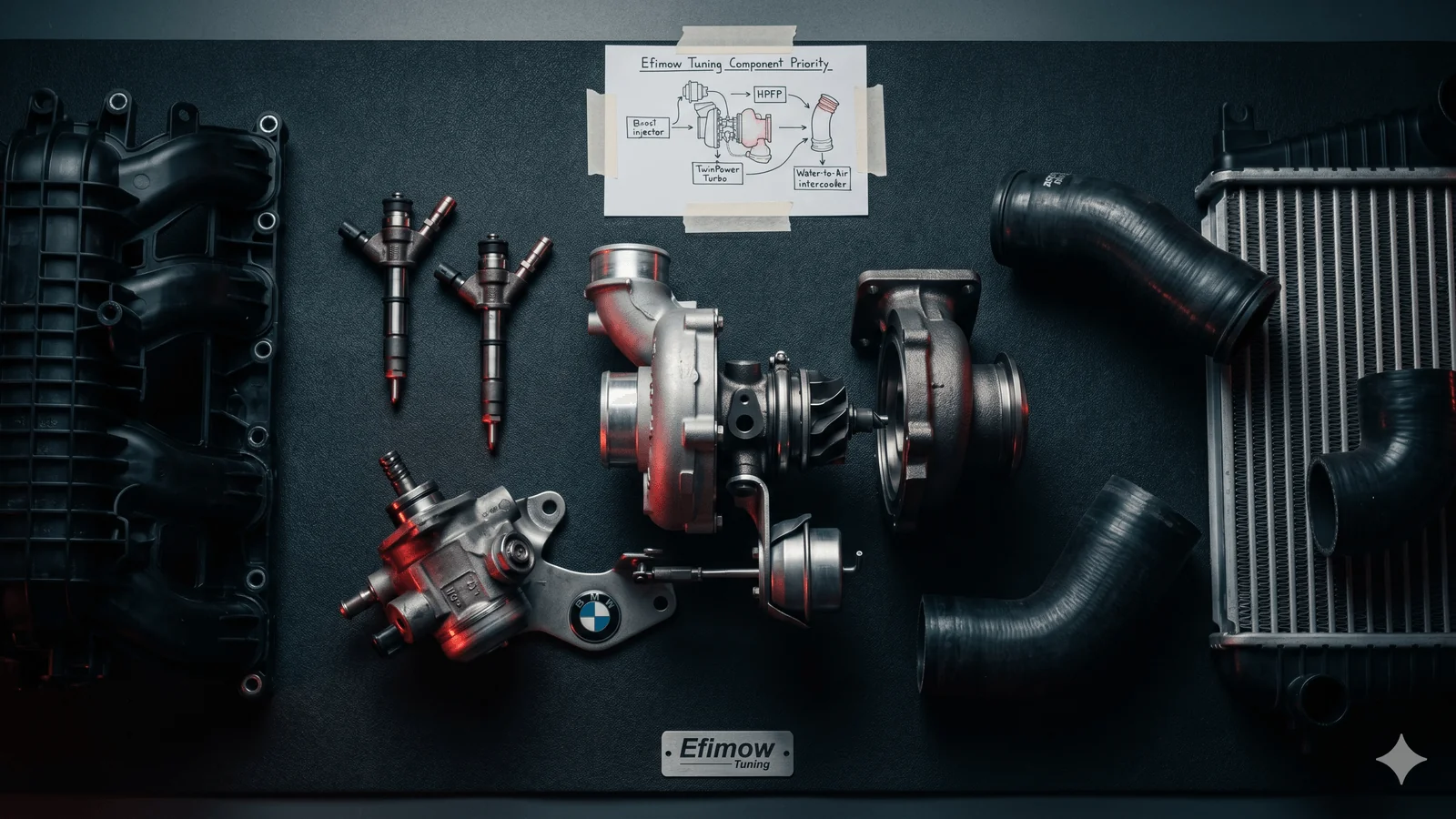
The turbocharger is the part that feels a software tune most directly. Higher boost targets mean higher compressor speeds, more thermal load on the turbine side, more mechanical load on bearings and wheels. On Stage 1 with the OEM twin-scroll unit (a B58 in the 340i, for instance), the operating point still sits well inside what the hardware comfortably handles. By Stage 2 with a downpipe and higher boost, the turbo is more eager but runs much closer to its thermal limit on a sustained basis.
Three things actually matter. First, how the turbo is treated after full load: a brief idle before shutdown, high-quality oil on a shorter interval, no abrupt key-off after a high-speed run. Second, a tune that doesn't push the turbo where compressor efficiency and exhaust flow are overwhelmed, visible in logs where boost and back-pressure creep into the red. Third, correct wastegate control so an overshoot doesn't spike the turbo into an over-speed event. A turbo run outside its map chews up bearings and bakes oil into coke around the bearing housing. Both are modes that good software and sensible driving push much further out.
Fuel System: Critical on Diesel, Mostly Quiet on Petrol
On diesel (B47 and B57), the fuel system is the second most critical area. Higher rail pressure and longer injection events put real load on the high-pressure pump and injectors. Factory rail pressure on modern BMW common-rail diesels sits around 2,500 bar; Stage 1 commonly raises that to 2,700–2,800 bar. The hardware can take it, but pump and injector bodies now run closer to their design limit. Skipped filters or poor diesel bite back faster than on a stock car. A reputable-brand fuel and a filter change every 40,000 km instead of 60,000 km is much cheaper than any repair on a Bosch CP4 pump.
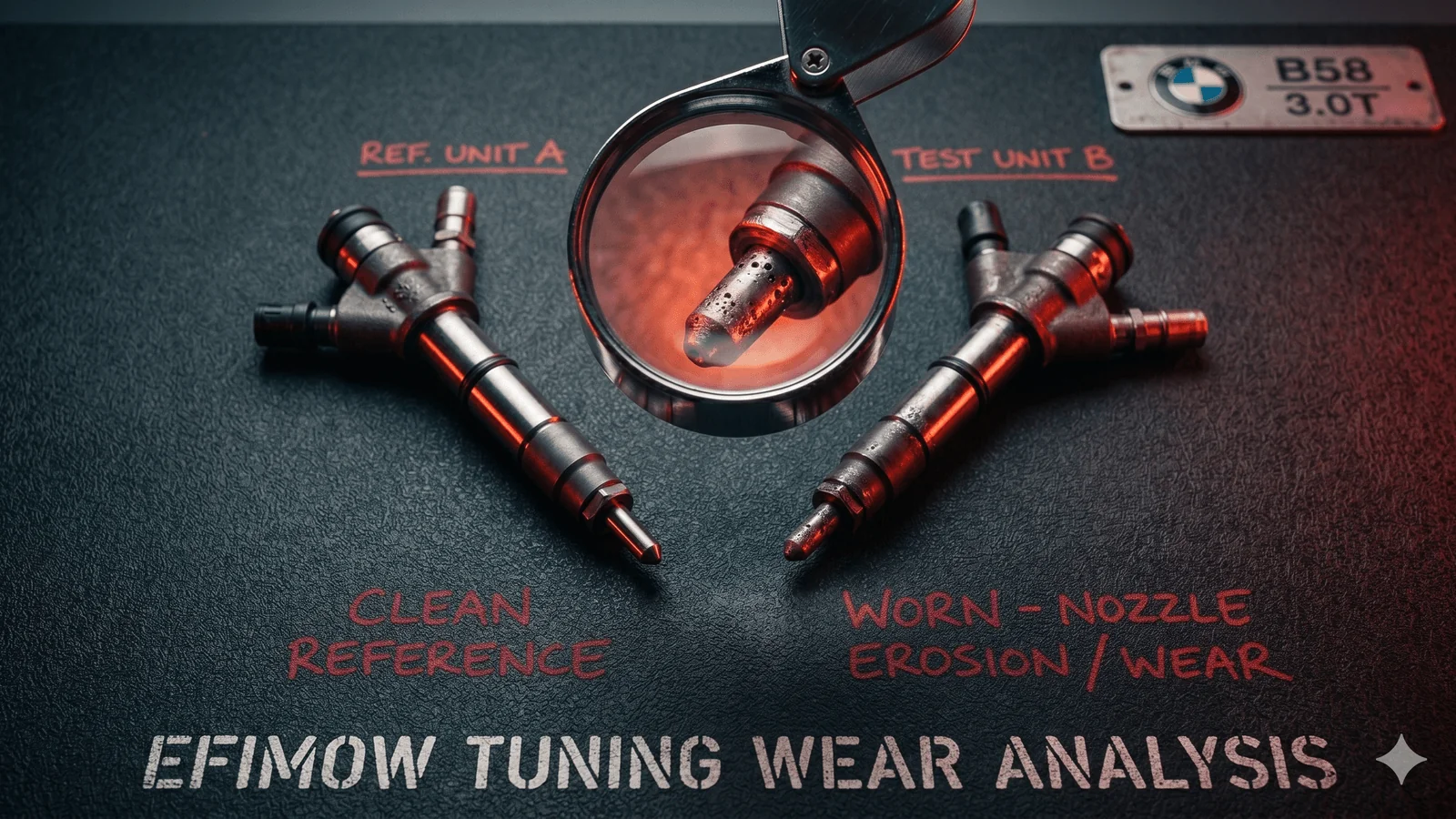
On petrol (B48 and B58), the load on the fuel system under a realistic Stage 1 is mild. BMW DI nozzles are robust, and the B58 high-pressure pump has plenty of reserve. What matters more is fuel quality: 98 RON or higher (US: top-tier 93 octane) isn't premium marketing, it's the precondition for knock control to stay in its expected window. Intake-valve coking is less critical on the B58 than on earlier BMW DI engines, but on a tuned car that mostly sees short urban trips, it's still a real maintenance item to watch.
Cooling and Charge Air: the Underrated Bottleneck
More power means more heat, and heat has to go somewhere. The G20 water radiator is sized for the factory configuration with reserve for towing and hot summer days. Stage 1 adds roughly 10–15 % more heat into that loop, barely noticeable on a highway run below 30 °C ambient. On a winding country road at 35 °C the reserve is already thinner, and in a stop-and-go mountain climb a slightly elevated oil temperature is often the first symptom.
The more frequent bottleneck is the intercooler. OEM intercoolers on four-cylinder cars are compact and well sized for stock power, but they heat-soak quickly under sustained load. Elevated intake air temperature costs power and forces the knock control to pull ignition timing. If you regularly drive flat-out stretches (no-limit autobahn, track, towing over passes), a front-mount intercooler upgrade pays off clearly from Stage 2 onward. On a Stage 1 used mostly in city and country traffic, the OEM unit is usually sufficient if clean and undamaged. IAT values in an MHD log quickly show whether the engine is keeping Stage 1 boost cool or constantly running on the edge.
Brakes and Suspension: Not Directly Loaded, But Thermally Harsher
A common myth: "more power means more brake wear." Directly that's wrong: the brakes don't do extra work because the engine makes more power. Indirectly, they very much do: higher top speeds and quicker accel-brake cycles mean significantly more thermal energy per stop. Kinetic energy scales with the square of speed, so a jump from 200 to 230 km/h means roughly 32 % more energy to dissipate as heat per stop.
Pads and rotors see harsher heat cycles, brake fluid ages faster. The typical BMW owner rarely notices, because they rarely drive that way. Anyone who drives sportingly should change brake fluid earlier after Stage 1 and consider a higher-temperature-stability pad. On the suspension side, a software-only tune is generally uncritical: bushings, ball joints, and dampers handle a far wider load spectrum than Stage 1 produces.
What the Available Data Shows
Reproducible, manufacturer-independent lifetime studies on Stage 1 vehicles are rare. Manufacturers and tuners have different incentives, and long-term data takes time. What shop statistics and fleet data do show: with a moderate Stage 1, professional software, 98 RON petrol or premium diesel, regular service, and a driver who lets the engine warm up and cool down, lifetime reduction on the main components stays in the low single-digit percent range, on the order of 2 to 3 % across a typical 250,000 km service life. With aggressive Stage 2 and no hardware upgrades, that figure climbs noticeably, especially at the turbo, clutch, and DCT.
Bottom Line
The hierarchy of stress is clear: turbocharger first, then fuel system (especially diesel), then cooling and charge air. Brakes and suspension see indirect extra load, rarely critical. If you're planning Stage 1, a tweaked maintenance routine goes a long way: high-quality oil on a shorter interval, prompt filter changes, good fuel, brake fluid a bit earlier. If you're running Stage 2, an FMIC and possibly a downpipe deserve serious thought, not for more power, but to keep the engine in its thermal comfort zone. Extra power is never free, but with proper calibration and honest maintenance the price is very manageable, and rarely where the bench-racers think it is.