
Stage 2 Tuning: Beyond Software Alone
Stage 2 moves the real hardware limits: exhaust back-pressure and intake-air temperature. Which parts matter, what they cost, and what gains are realistic.
July 28, 2024 by Leo Efimow
Anyone who has run Stage 1 to its limit eventually hits the same wall: the engine wants more air in, more exhaust out, and lower charge temperatures, but the factory hardware doesn't allow it. Stage 2 is the answer to that. It is not a bigger software file, it is a combined hardware-and-software package that solves exactly the mechanical bottlenecks Stage 1 cannot reach. Anyone selling Stage 2 as "Stage 1 with a few more horsepower" is selling it wrong. Stage 2 moves the real hardware limits: exhaust back-pressure at the turbine outlet and intake-air temperature downstream of the compressor.
The hardware that actually matters
On a turbocharged BMW there is a clear hierarchy of Stage 2 components. The order is not arbitrary.
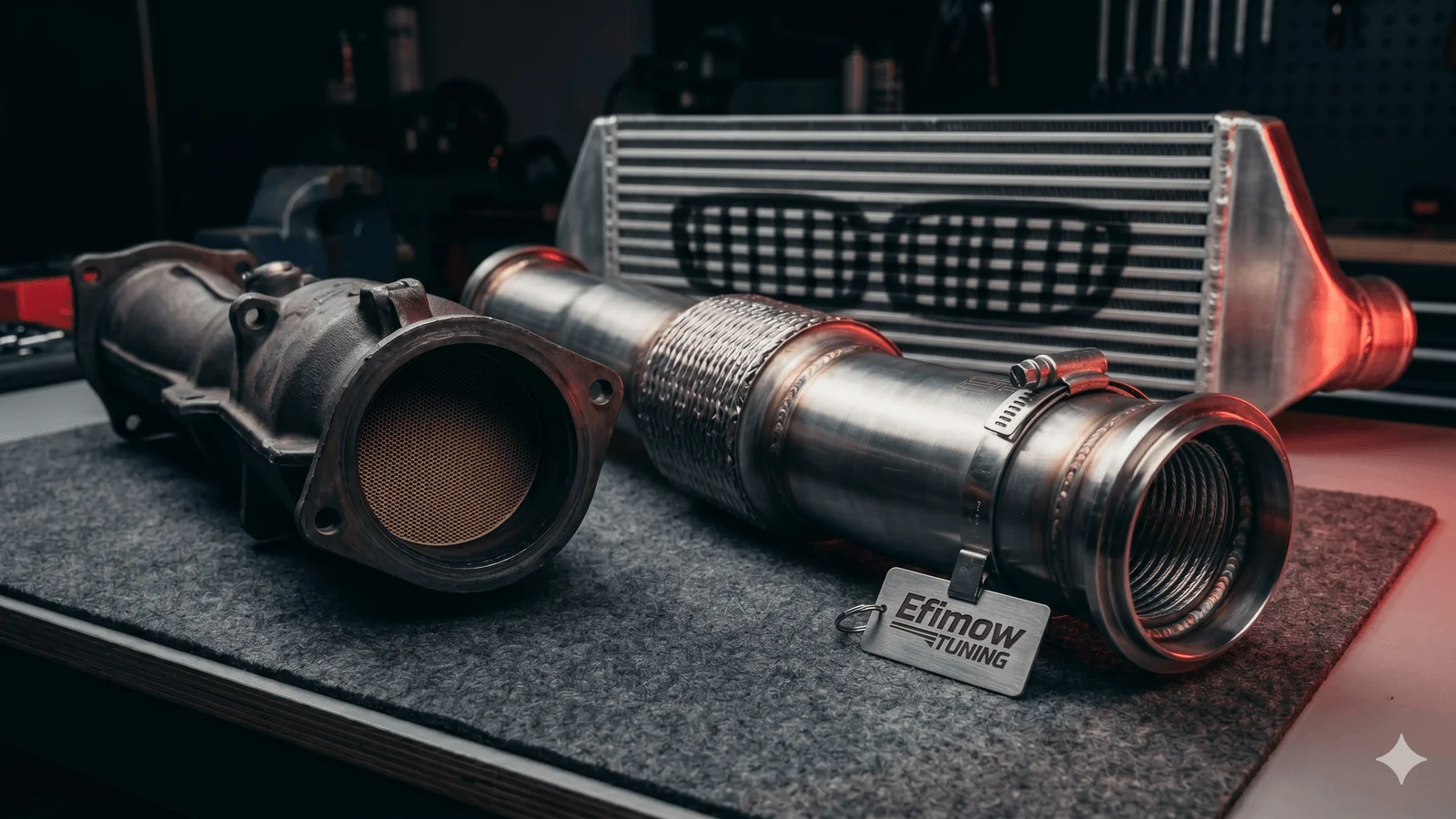
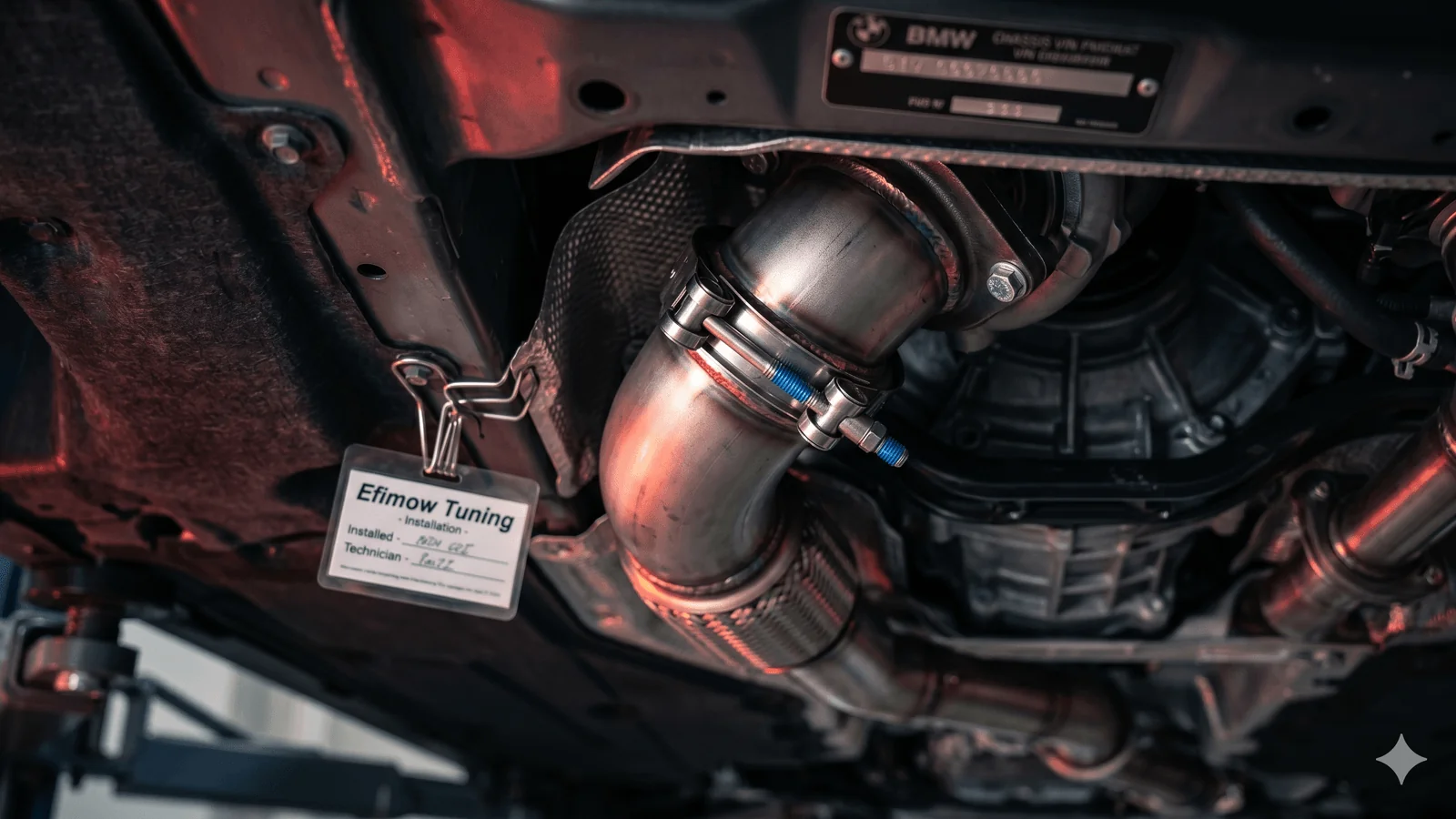
1. Sport-cat downpipe: by far the most important component. The factory downpipe on modern BMW engines contains a high-cell-count primary catalyst (typically 600 cells), positioned immediately behind the turbine outlet. That produces massive exhaust back-pressure. A sport-cat downpipe with a 200- or 300-cell metallic substrate, or a catless variant for motorsport applications, drops back-pressure significantly. The effects: the turbo spools earlier (better low-end response), EGT (exhaust gas temperature) at the turbine inlet drops because the gas evacuates faster, and scavenging (the purging of residuals from the cylinder) becomes more effective. Without this part, Stage 2 immediately runs into the EGT protection limit.
2. Larger intercooler: when the thermals demand it. A front-mount or stock-location upgrade intercooler lowers intake-air temperature (IAT) downstream of the compressor. On a B58 with the factory intercooler, IAT under sustained full load can easily exceed 60 °C. That costs density, costs power, and pushes the knock threshold down. A larger core keeps IAT closer to ambient and offloads the knock-correction logic. It is not mandatory for every Stage 2 build, but for demanding load profiles (autobahn full load, track day) it clearly pays off.
3. Optimized intake: marginal gain. A cone-filter or open intake sounds dramatic but, on an otherwise correctly built Stage 2 BMW, delivers only a small measurable gain. The factory airbox is surprisingly good. Money spent here buys more sound than power.
Software re-calibration on top of new hardware
A Stage 2 software file is not the same file as Stage 1 with higher numbers. It is recalibrated for the new hardware setup. What changes: the boost target is allowed to rise because back-pressure is gone and the turbo reaches the target with less compressor work. The wastegate strategy is matched to the faster spool. The EGT limit is set against the new, lower actual exhaust temperatures, not removed, but recalibrated. On gasoline engines, ignition advance in the upper load range is pulled forward as well, because cooler intake air tolerates more advance before knock onset.
A Stage 2 file on a stock BMW without the hardware is dangerous. Higher boost plus the factory downpipe means the turbo fights massive back-pressure, the compressor reaches its limit, and EGTs spike. Best case, limp mode. Worst case, the customer pays for a turbo replacement.
Realistic gains
Blanket percentage figures are nonsense here as well. Orientation values for BMW Stage 2 builds on mechanically healthy engines:
- B58 with sport-cat downpipe + larger intercooler + Stage 2 software: typically 410 to 440 hp, 580 to 640 Nm, depending on fuel (Super Plus / 100-octane assumed) and hardware specifics. That is a real shift over Stage 1, not just a few extra hp.
- B48 with sport-cat downpipe + software: typically 290 to 320 hp, 430 to 470 Nm. The four-cylinder gains less in absolute terms but a similar amount in percentage.
- B47 with sport-cat downpipe + software: on the diesel, the gain is primarily in the torque plateau and torque build-up speed, not in peak power. Typically an additional 30 to 50 Nm over Stage 1.
Effort and complexity
Stage 2 is not a single workshop morning. Realistically: four to eight hours of installation for the downpipe (depending on chassis and access), plus another one or two hours for the intercooler. Then the software flash itself. Costs split into three buckets: hardware (sport-cat downpipe 700–1,500 EUR, intercooler 600–1,200 EUR), labor (200–600 EUR depending on shop), and software (typically 200–400 EUR uplift over Stage 1, because the calibration is more bespoke).
Add it up and a clean Stage 2 package lands at 2,000 to 3,500 EUR all-in. Significantly more than Stage 1.
Legality and TÜV: short note
Stage 2 requires vehicle-registration paperwork in Germany. A sport-cat downpipe needs either a Teilegutachten (component approval certificate) with subsequent entry per § 19 (3) StVZO (the German road-vehicle ordinance), or the route via individual approval per § 21 StVZO. A catless downpipe is effectively impossible to legalize for German public roads. It is a track-only / motorsport application. The software has to be covered by the Teilegutachten that comes with the part, or assessed separately during individual approval. The Cluster F post "§ 19 StVZO and the Betriebserlaubnis" covers the mechanics of registration in detail.
When Stage 2 makes sense
Stage 2 is right for drivers who want to modify their BMW long-term, who do not hold the car on lease, and who regularly drive in load ranges where Stage 1 already brushes the thermal ceiling: autobahn, track, towing. Drivers who pull a short full-throttle pass once or twice a month are usually better served by a clean Stage 1. Drivers who regularly run their car at the edge and meet the wall of factory hardware get, with Stage 2, the next technically honest level.
What Stage 2 doesn't solve
Stage 2 has clear limits too. The high-pressure fuel pump (HPFP) on a B58 becomes the bottleneck at higher boost, and so do injector flow rates. Anyone planning to run Stage 2 boost long-term while aiming at 470+ hp territory needs pump and injector upgrades on top. That's Stage 2+ or Stage 3 territory. The manual-gearbox clutch (where still fitted) is also a weak point under sharply increased torque; automatics generally hold up better, but even the ZF 8HP has limits that can be shifted with a TCU calibration but not removed.
Brakes and tires also come into focus at Stage 2 power. An M340i at 420 hp and stock brakes can still do one strong stop, but repeated hard braking from high speed produces heat the factory system cannot dissipate. That is a follow-on consequence of higher top speed and faster overtake speeds.