
From Motronic to MG1: BMW Engine Control Units at a Glance
Bosch or Siemens, MS43 or MSD80, MEVD17 or MG1: which DME sits in which BMW, and why the generation decides what tuning can do.
October 26, 2026 by Leo Efimow
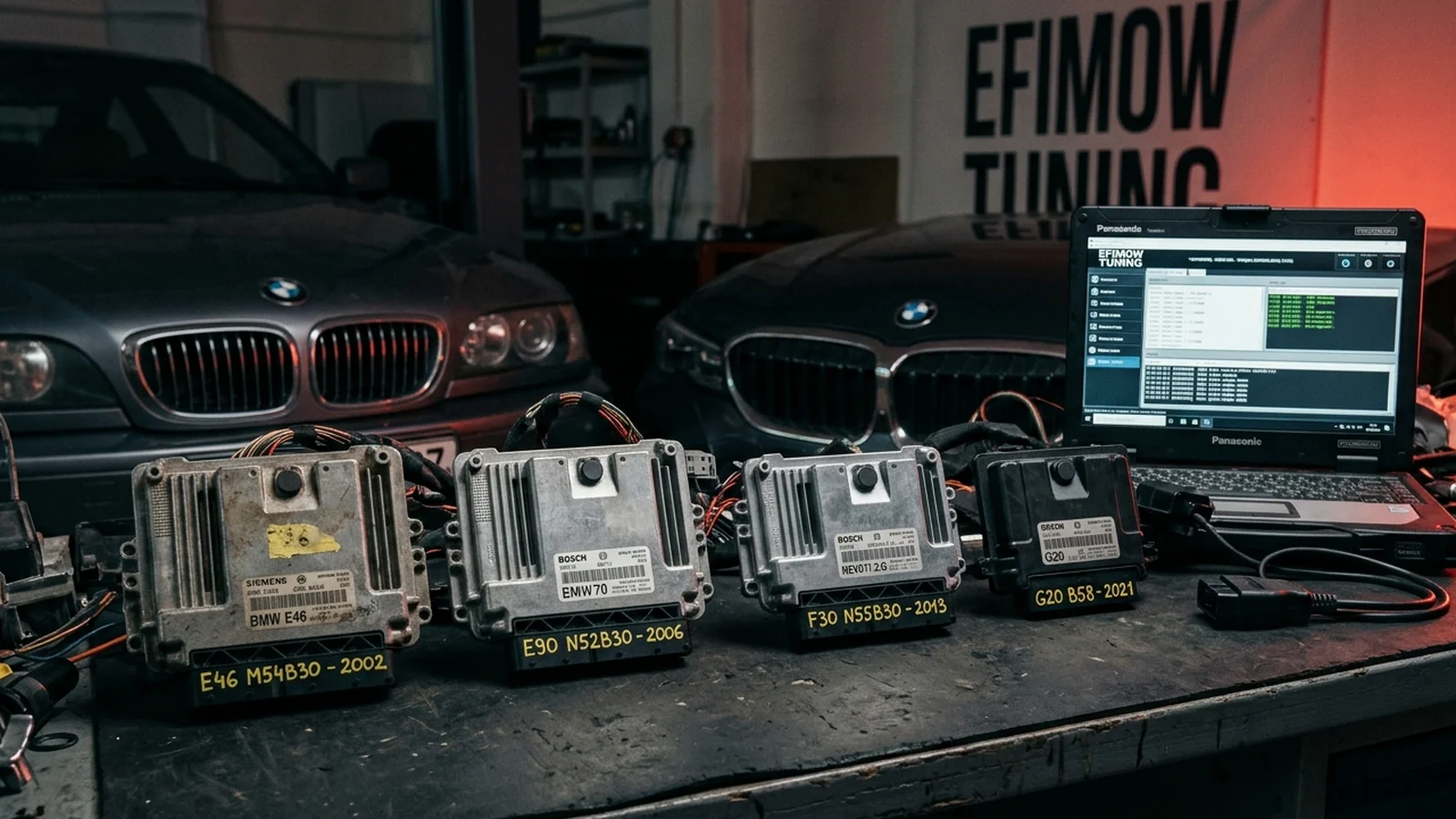
Ask about the engine control unit at BMW and you will rarely hear "ECU". The term is DME (Digitale Motor-Elektronik, digital engine electronics). But the abbreviation does not stand for one device. It stands for a sequence of generations from two suppliers: Bosch and Siemens (later Siemens VDO and Continental). BMW switched between them repeatedly, often even in parallel within the same model series. Depending on the engine, an E46 can have a Siemens MS43 or a Bosch ME9.2; an E90 can have an MSV70, an MSD80 or an ME9.2. For tuning, this is the first question we answer, before stage, extras or price.
Why the DME generation matters more than the model
A "330i" is not a fixed thing. The E46 has an M54 naturally aspirated engine with a Siemens MS43, the E90 first had an N52 with MSV70, later in Europe an N53 with direct injection and MSD81, and the G20 a B48 turbo four-cylinder with a Bosch MG1. Four cars with the same badge, four completely different control units, four different potentials.
The generation decides three things:
- What the software actually controls: port or direct injection, throttle valve or Valvetronic, naturally aspirated or turbo.
- How much headroom there is: a turbo engine responds to boost; a naturally aspirated engine only to ignition, charge and limiters.
- How the unit is read and written: older E-series units via a K-DCAN cable, F- and G-series via ENET, and newer software levels in some cases only after a prior unlock on the removed unit.
The generations on a timeline
The overview below is deliberately simplified. Each family has sub-versions, and transitions happened at different times depending on model and market.
| Period (approx.) | DME | Supplier | Typical engines | Typical series |
|---|---|---|---|---|
| 1980s–mid 1990s | Motronic M1.x / M3.x | Bosch | M20, M40/M42, M50 | E30, E34, early E36 |
| mid 1990s | MS41 | Siemens | M52 | E36 328i, E39, E38 728i |
| from approx. 1998 | MS42 | Siemens | M52TU | E46, E39 |
| from approx. 2000 | MS43 / MS45 | Siemens | M54 | E46, E39, X5 E53, later E60/X3/Z4 |
| from approx. 2001 | ME9.2 | Bosch | N42, N46 (Valvetronic) | E46, E87, E90 |
| from approx. 2004 | MSV70 / MSV80 | Siemens | N52 | E8x, E9x, E6x, Z4 E85 |
| from approx. 2006 | MSD80 / MSD81 | Siemens/Continental | N54, N43, N53 | E8x, E9x, E60 |
| from approx. 2009 | MEVD17.2 | Bosch | N20, N55 | late E9x, F-series |
| G-series | MG1 | Bosch | B48, B58 | G20, G30, Z4 G29, Supra A90 |
Two separate lines run alongside. The M naturally aspirated engines got Siemens units of the MSS line: MSS52 in the E39 M5 (S62), MSS54 in the E46 M3 (S54), MSS60 in the E9x M3 (S65) and MSS65 in the E6x M5 (S85). And on the diesel side the control unit is called DDE; behind it are almost always Bosch units of the EDC generations and, today, the MD1.
What changed from one generation to the next
Motronic and early Siemens units still worked largely with fixed maps for injection time and ignition angle. Load was measured air mass or throttle position. Computing power was modest, the software small. Tuning meant adjusting ignition, mixture and limiters cleanly.
With MS43 and ME9.2, the electronic throttle (drive-by-wire) became widespread, and with the N42 in 2001 came Valvetronic: load is set via variable valve lift, and the throttle stays largely open in normal operation. For the software, this means charge is no longer controlled only by a flap, but by a mechanical actuator system.
MSV70, MSD80/81 and MEVD17 mark the transition to a torque-based structure. Driver demand, transmission, stability control and protection functions report torque requests; the DME decides which torque is delivered and implements it through air, fuel and ignition. The N54 added turbocharging and piezo direct injection, and N20 and N55 combined turbo, direct injection and Valvetronic.
The MG1 continues this structure but models more for component protection and exhaust aftertreatment (usually with a gasoline particulate filter in the G-series), and it is far better protected against unauthorised changes. Why the classic OBD route no longer works easily on many G models from mid-2020 is covered in Why BMW locked OBD access from June 2020.
Naturally aspirated, turbo and realistic expectations
The biggest dividing line is not Bosch versus Siemens, but naturally aspirated versus turbo. A few reference values from our product pages show this clearly:
- E46 330i (M54, MS43): 231 hp stock, Stage 1 approx. 247 hp.
- E9x 330i (N52, MSV70): 258 hp stock, Stage 1 approx. 276 hp.
- E9x 335i (N54, MSD80/81): 306 hp stock, Stage 1 approx. 373 hp.
- G20 M340i (B58): 374 hp stock, Stage 1 approx. 456 hp.
These are calculated reference values, not dyno measurements. On a naturally aspirated engine it is about throttle response, torque curve and clean limiters; on a turbo engine it is about boost and torque limitation, with a much bigger lever, but also more responsibility for clutch, transmission and cooling.
How to find out which DME you have
Registration papers and the type plate only help so much. Three methods are reliable:
- Check the engine code. It is stamped in the engine bay or can be determined from the VIN. M54, N52, N54, N20, B58: the code usually narrows the DME family down clearly.
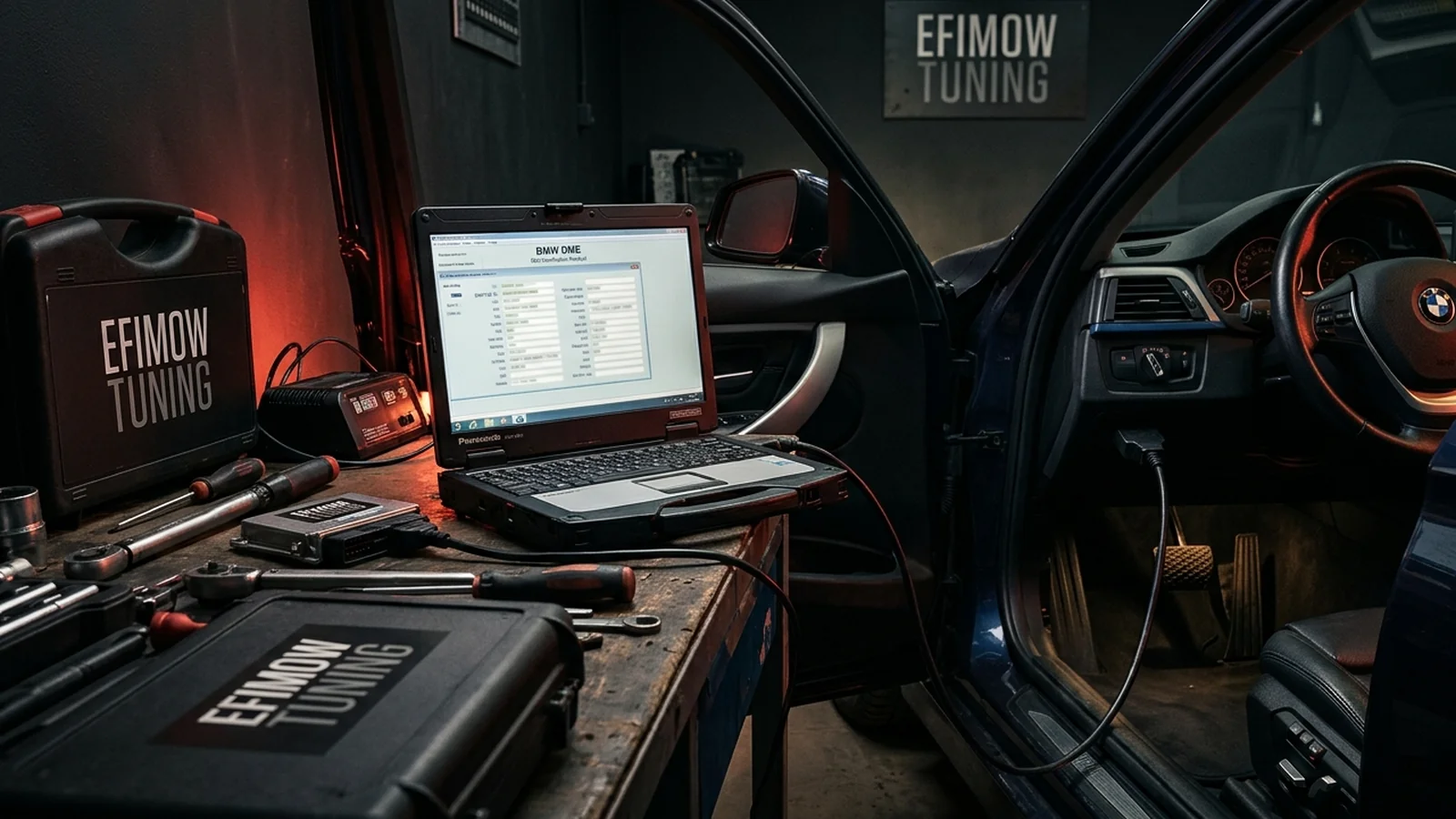
- Read out the diagnosis. Any common BMW diagnostic tool shows the engine control unit's identifier and software level.
- Label on the unit. The housing shows supplier, part number and usually the device name.
In the configurator, selecting series and engine is enough; the matching DME is shown there. For cars on a generation boundary, such as a facelift year, a look at the diagnosis is still worthwhile.
What the generation means for the process
For BMW, the process with us runs online: you configure your car, pay only for hardware and a €5 deposit today, read out the original file and upload it. We adjust the file by hand (usually within 48 hours), and you pay for the software only once it is finished, before flashing it yourself via OBD. For the E-series you need a K-DCAN cable, for the F- and G-series an ENET cable.
The generation also determines the price tier. According to the product pages, an M54 with MS43 starts from €150, an N52 with MSV70 from €170, an N54 with MSD80/81 from €250 and a B58 in the G20 from €275 for Stage 1. The exact price is shown on the respective product page.
The legal side is the same for every generation: the software change voids the vehicle's type approval; the software is intended exclusively for motorsport (motorsport notice).
Conclusion
BMW engine control units are not one uniform family but a sequence of Bosch and Siemens generations, each tied to a generation of engines. If you know which DME runs your car, you also know what is realistic: small but noticeable improvements on naturally aspirated engines, significant gains on turbos and, on the newest units, a careful look at the software level. Details on the individual families are in our articles on Siemens MSD80/81 in the N54 and Bosch MG1 in the G-series.