
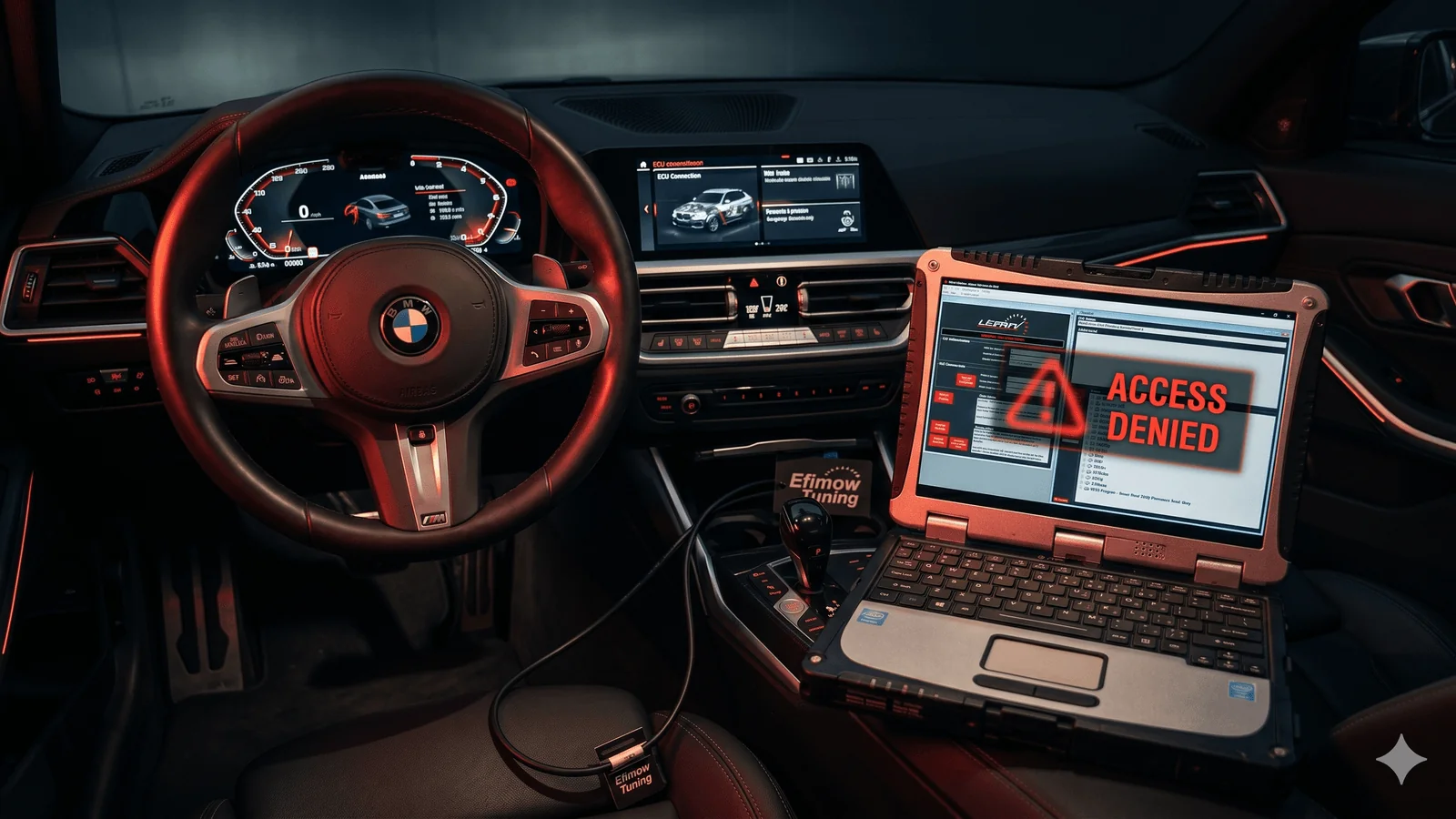
Why BMW Locked Down the OBD Port on the G20 from June 2020
A technical and strategic analysis: what BMW actually blocked, why, and what it means for tuners.
May 6, 2026 by Leo Efimow
Anyone who walked into a tuning shop in the summer of 2020 with a fresh BMW G20 330i (having flashed an F30 without trouble only weeks earlier) was in for a surprise. The software tools suddenly threw write errors, boot sequences aborted, and a few attempts ended with an unresponsive Steuergerät (ECU). This was not a coincidence and not a bug on the tuner's side. It was a deliberate architectural decision by BMW that turned into a recurring topic on enthusiast forums like g20-forum.de within a few weeks. From model year 2020 (in practice, from production date June 2020 onward), the G-generation control units are locked against classic OBD writing. Why, how exactly, and what it means technically and commercially is the subject of this article.
What BMW actually blocked
On the hardware side nothing dramatic changed. The OBD-II connector is still there, the UDS diagnostic protocols (ISO 14229) still respond, and read operations remain possible. What changed sits one layer deeper, inside the bootloader and the key management of the Bosch MG1 and MD1 generation. The directly affected control units are MG1CS003 (B48 four-cylinder petrol, e.g. in the 330i G20), MG1CS008 and MG1CS024 (B58 six-cylinder, e.g. in the M340i G20), MG1CS201, and on the diesel side MD1CP032 and MD1CS001. The platform still runs on Infineon TriCore Aurix microcontrollers, but its security architecture has been tightened significantly.
Three technical building blocks interlock. First, calibration signature verification. On every start, the bootloader checks the cryptographic signature of the flashed calibration; any modification without a valid private key is detected and refused by the Steuergerät. Second, encrypted flash regions. Security-critical memory areas are no longer stored as plaintext; even reading the calibration out only yields ciphertext at first. Third, secure communication protocols. Any write operation over the diagnostic port requires an authenticated channel with challenge-response. Without the matching key, no write command gets through.
On top of all this sits the HSM (Hardware Security Module), a dedicated crypto unit on the TriCore Aurix chip that keeps the private keys hardware-isolated. Even a complete flash dump does not automatically yield the keys needed to produce a valid signature. The result: classic OBD programmers that worked reliably on an F30 in 2019 simply receive no write authorization on a G20 from mid-2020 onward. They return "Security Access denied" or "Authentication failed" long before a single byte would be written.
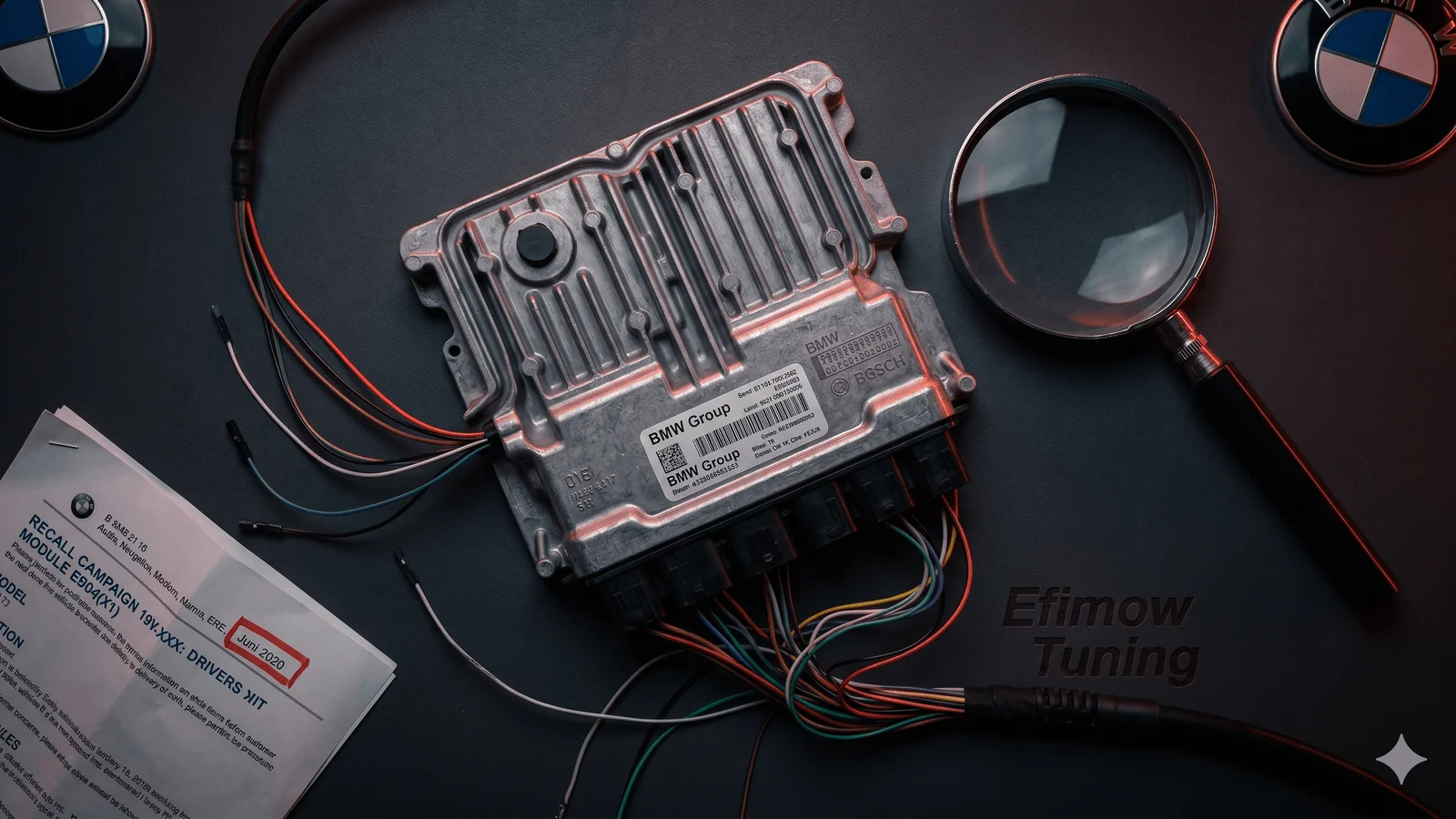
In practice this means: reading still works, writing only with valid authorization. This is exactly where the commercial unlock services from Autotuner, KESS3 and Alientech step in: the Steuergerät is unlocked once in bench mode, after which OBD writes work again. The effort for this initial unlock (removal, bench wiring, license fee for the unlock profile, reinstallation, and a diagnostic check) is what drives the price.
Why BMW took this step
From BMW's perspective, three lines of reasoning converge. First, emissions and type-approval protection. With Euro 6d and the RDE (Real Driving Emissions) tests, the regulatory tolerance for software modifications on the powertrain has tightened. UN Regulation R155 (Cybersecurity Management System), mandatory for new type approvals since July 2022, requires manufacturers to demonstrate active protection against unauthorized software changes. The OBD lockdown from 2020 was a preparation for exactly this regulatory requirement; the timeline is no accident.
Second, dealer binding and data sovereignty. Anyone wanting to change powertrain software is supposed to go through ISTA and the BMW backend, which concentrates licensing fees, diagnostic data and vehicle data in the manufacturer's hands. Third, warranty and liability management. A modified calibration is now identifiable through ECU history and backend telemetry; in a damage case BMW can clearly argue that an unapproved modification was present. The cryptographic signature is, legally, a clean piece of evidence.
These three lines reinforce each other: the lock protects regulatory limits, it routes after-market changes into authorized channels, and it produces an unambiguous evidentiary trail. From BMW's point of view this is an internally consistent strategy. The fact that it constrains the independent tuning market is a deliberately accepted side effect, not a primary goal.
What it means for tuners and owners
On a practical level, the OBD lockdown has measurably reshaped the tuning market for modern BMWs. First, bench mode has gone from special case to default path: for an M340i G20 from MY 2020 onward, removing the Steuergerät and connecting it to a bench adapter is no longer optional, it is the prerequisite. Workshops typically budget an extra 1.5 to 2.5 hours of labor for removal and reinstallation. Second, end-customer prices for a Stage 1 remap on these cars have risen by roughly 200 to 400 EUR, depending on shop and tool license. On g20-forum.de and similar platforms, owners have been openly discussing the extra disassembly and the higher invoice since early 2021.
Third (and this is probably the most important consequence), the market has further differentiated itself. Providers without professional bench equipment have either left this segment or fallen back to selling tuning boxes that never touch the actual Steuergerät. Workshops with full bench and boot-mode capability have gained share. For the owner this means: on a G20 from June 2020, the question "how exactly is my Steuergerät being written" matters more than ever. A shop that just promises "via OBD" has either done a bench unlock up front (and should say so) or has not understood the problem at all.
Conclusion
The OBD lockdown from June 2020 is not sabotage of the tuning market, it is a technically and regulatorily coherent step. BMW is responding to tighter emissions rules, new cybersecurity requirements and a growing warranty risk from unauthorized modifications. Tuners have adapted: bench mode followed by an OBD unlock is now the standard path on modern BMW G-series cars. For the owner this means higher initial cost, longer appointments, but a consistently clean and reversible intervention when the workshop knows its craft. If you are having a G20, M340i or X3 G01 LCI tuned post-2020 and someone tells you it goes "just over the OBD socket," you now know: the correct answer starts with "bench."