
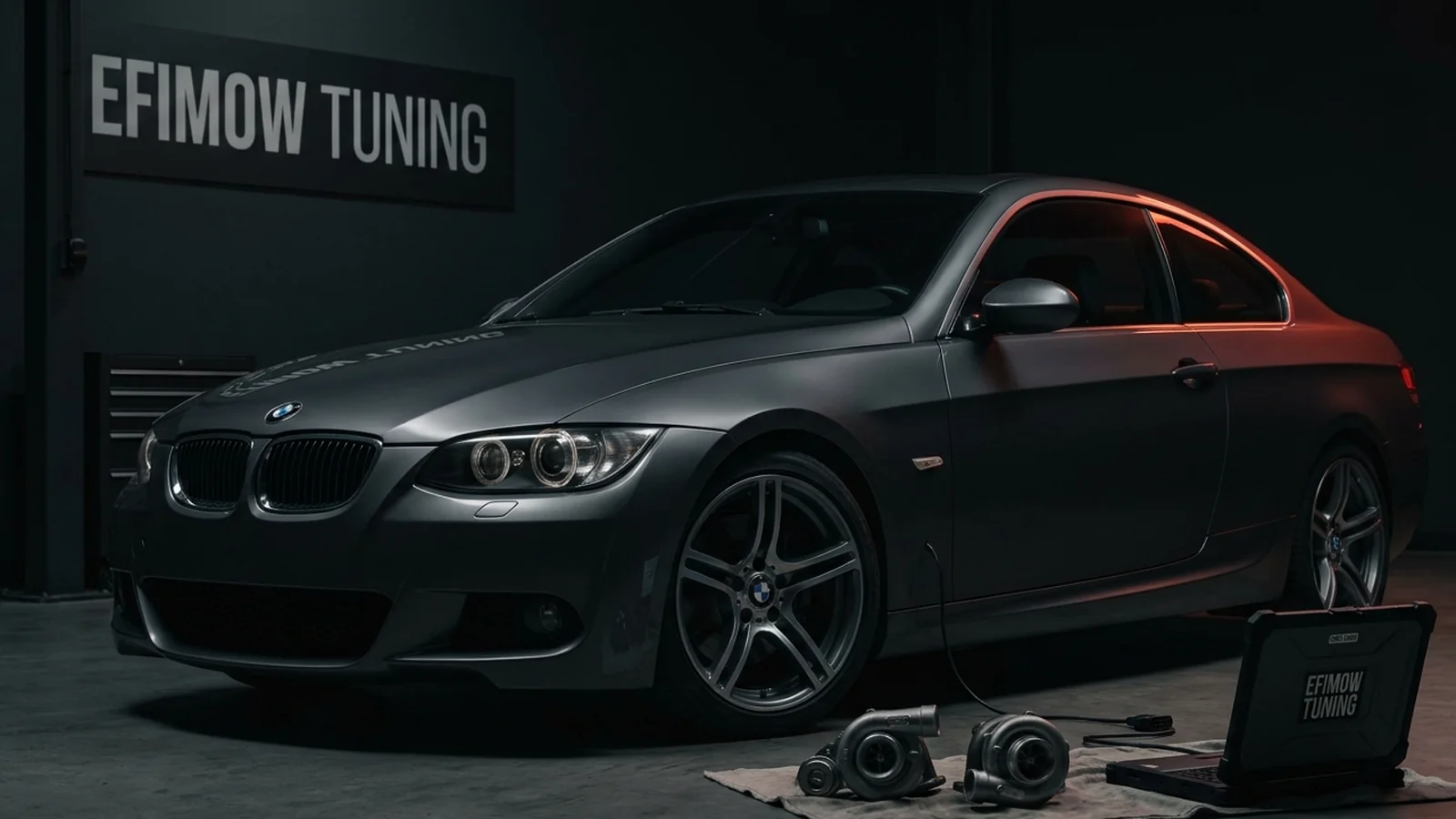
Siemens MSD80/81: N54 Twin-Turbo and N43 with Piezo Direct Injection
MSD80 and MSD81 control the N54 twin-turbo in the 335i and 135i and the lean-burn N43/N53. What software delivers and what has to be right first.
October 26, 2026 by Leo Efimow
When BMW introduced the 335i Coupé at the end of 2006, the N54 was a small sensation: three litres, two turbochargers, direct injection with piezo injectors and a torque plateau previously associated with diesel engines. To this day, the N54 is one of the most popular tuning engines of the E-series. It is controlled by the Siemens MSD80 and its further development, the MSD81. But the same control unit family also sits in engines hardly anyone associates with tuning: the naturally aspirated lean-burn N43 and N53. Both worlds share the same DME and have completely different potential.
Which cars have the MSD80/81
The N54B30 powers, among others, the 335i (E90/E91/E92/E93), the 135i (E82/E88), the 535i (E60/E61), the X6 xDrive35i (E71), the Z4 sDrive35i/35is (E89) and the 1 Series M Coupé. With the E9x facelift and in other series, it was replaced from around 2009/2010 by the N55 with Bosch MEVD17.
The N43 is a naturally aspirated four-cylinder with direct injection and lean-burn operation, found in the 116i, 118i and 120i (E8x) and the 316i, 318i and 320i (E9x), among others. Its six-cylinder sibling, the N53, sits in the 325i and 330i (E9x) and the 523i to 530i (E6x), for example. Whether a particular car has an MSD80 or MSD81 depends on model and year and is shown in the diagnosis.
| Car | Engine | Stock | Stage 1 (reference) | Stage 2 (reference) |
|---|---|---|---|---|
| 335i (E9x), 135i (E8x) | N54B30 | 306 hp / 400 Nm | approx. 373 hp / 520 Nm | approx. 413 hp / 568 Nm |
| 330i (E9x) | N53B30 | 272 hp / 320 Nm | approx. 291 hp / 352 Nm | approx. 305 hp / 368 Nm |
| 320i (E9x) | N43B20A | 170 hp / 210 Nm | approx. 182 hp / 231 Nm | approx. 190 hp / 242 Nm |
The values come from the respective product pages and are calculated reference values, not dyno measurements.
What the MSD80/81 controls
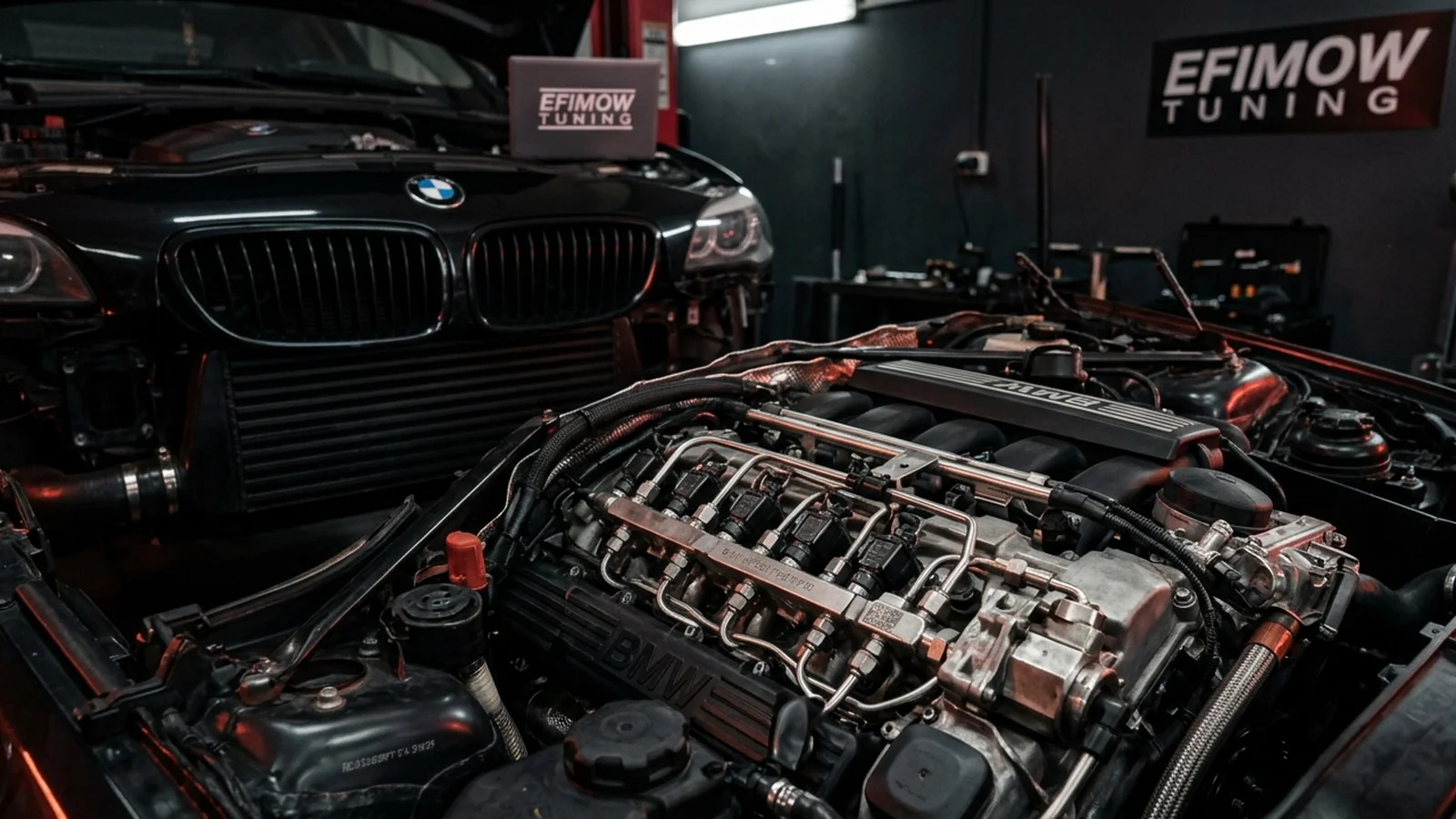
The core of the family is piezo direct injection. Piezo injectors open very quickly and allow several injections per combustion cycle. The DME controls the rail pressure built up by a high-pressure pump, splits the injection into individual partial quantities and coordinates them with ignition angle, double VANOS and cylinder-selective knock control.
On the N54, boost control comes on top. The two turbochargers each feed three cylinders; their wastegates are actuated electro-pneumatically. The DME works torque-based: it calculates a target torque from driver demand, derives charge and boost from it and limits the result via component protection functions, for example for exhaust gas temperature and charge air temperature.
On the N43 and N53, the DME has a different job: lean-burn operation with stratified charge at part load. The engine runs with excess air to save fuel; a NOx storage catalytic converter captures the nitrogen oxides this produces. This technology is sensitive to fuel quality and is part of the emissions control. It is not among the areas a power calibration touches.
N54: why the engine has so much headroom
From the factory, the N54 is tuned comparatively conservatively. The turbochargers, the robust base engine and the broad torque plateau allow much more than stock delivers. A Stage 1 calibration mainly raises the boost targets and torque limiters and adapts ignition and injection to the new load points. According to the product page, around 373 hp and 520 Nm is a realistic reference value for the 335i.
The protection functions remain active. Knock control pulls ignition on poor fuel, and component protection models limit at high temperatures. A sound calibration therefore relies on high-octane fuel and accounts for what the engine tolerates on the motorway in summer, not just the best run on a cool morning.
Stage 2 requires hardware: a more capable intercooler and/or downpipes with sports catalytic converters. The stock intercooler in particular is a known bottleneck on the N54 under repeated full load, because charge air temperature rises and the DME then pulls power. Exhaust parts need approval or an expert report.
What has to be right before tuning
An N54 today is usually 14 to 18 years old. Before power goes up, the engine should be healthy. Typical points we have checked again and again in practice:
- High-pressure pump: Early N54s were known for high-pressure pump failures. Rail pressure that drops under load does not go together with more power.
- Injectors and ignition: Leaking piezo injectors and worn spark plugs or ignition coils cause misfires, which appear sooner under more boost.
- Wastegates: Worn wastegate linkages ("wastegate rattle") make boost control imprecise.
- Vacuum and charge air lines: Leaking hoses mean the target boost is not reached.
- Clutch and transmission: More torque stresses the clutch or automatic transmission. A worn clutch is the first thing to slip after tuning.
On the N43 and N53, the main things to look at are ignition, injectors and the fault memory. The gain there is small, but throttle response improves noticeably.
Software instead of an add-on box
Around the N54, a large scene of add-on control units has developed that modify sensor signals to achieve more boost. The difference from calibrating the DME: a box makes the control unit work with falsified input values, while adapted software shifts the targets themselves, including the protection functions. More on this in Tuning box vs. real chip tuning.
Typical questions from the workshop
Can the automatic transmission handle the extra power? The additional torque also reaches the gearbox. A healthy transmission with well-maintained fluid is the prerequisite; at high mileage, it is worth checking shift quality and fluid condition before tuning.
Do I need premium fuel? Yes, the calibration is designed for high-octane fuel. With a lower octane rating, knock control pulls ignition, and part of the gain is lost.
Is an N54 with MSD81 tuned differently from one with MSD80? The basic principle is the same, but the software differs. A file only ever fits the exact control unit and software level it comes from. That is why we always work with your own original file.
Is tuning worthwhile on the N43? If you are after more power, the N43 will hardly make you happy. If you want more direct response and a rounder pull, you get that on the four-cylinder too.
Can I go back to stock? Yes, at any time, with the backed-up original file.
Process and price
For the E-series, you read out the original file with a K-DCAN cable and upload it in the customer portal. Today you pay only for hardware and a €5 deposit; we adjust the file by hand, usually within 48 hours. Only after completion do you pay for the software and flash it yourself via OBD.
According to the product pages, software for the MSD80/81 costs from €250 for Stage 1 and €325 for Stage 2, for example on the BMW 335i (E9x) or the BMW 135i (E8x). The price for your configuration is shown in the configurator.
Legally: the software change voids your vehicle's type approval; the software is intended exclusively for motorsport (motorsport notice).
Conclusion
The MSD80/81 is a control unit with two faces. In the N54 it controls one of the most rewarding turbo engines BMW has built, with significant potential, provided the high-pressure pump, ignition and charge cooling play along. In the N43 and N53 it controls economical naturally aspirated engines, where software mainly improves the driving feel. How the family fits into the history of BMW engine management is shown in the overview of DME generations.