
Tuning Box vs. Real Chip Tuning: What's Actually Happening in the Engine
Both promise more power. Only one is being honest with the engine, and the difference shows up the first time the knock sensor fires.
May 6, 2026 by Leo Efimow
In the ad copy, both look identical: "+45 hp, +90 Nm, plug-and-play, fully reversible." A tuning box on one side, a software chip tune on the other. The prices sometimes sit close together too. What separates them is not the marketing. It is the question of which information the engine uses to make decisions. A tuning box lies to the Steuergerät (ECU) about one or two sensor values. A real chip tune changes the calibration tables directly inside the ECU and lets the truth stand on everything else. The difference sounds academic until the knock sensor fires for the first time.
What a tuning box actually is
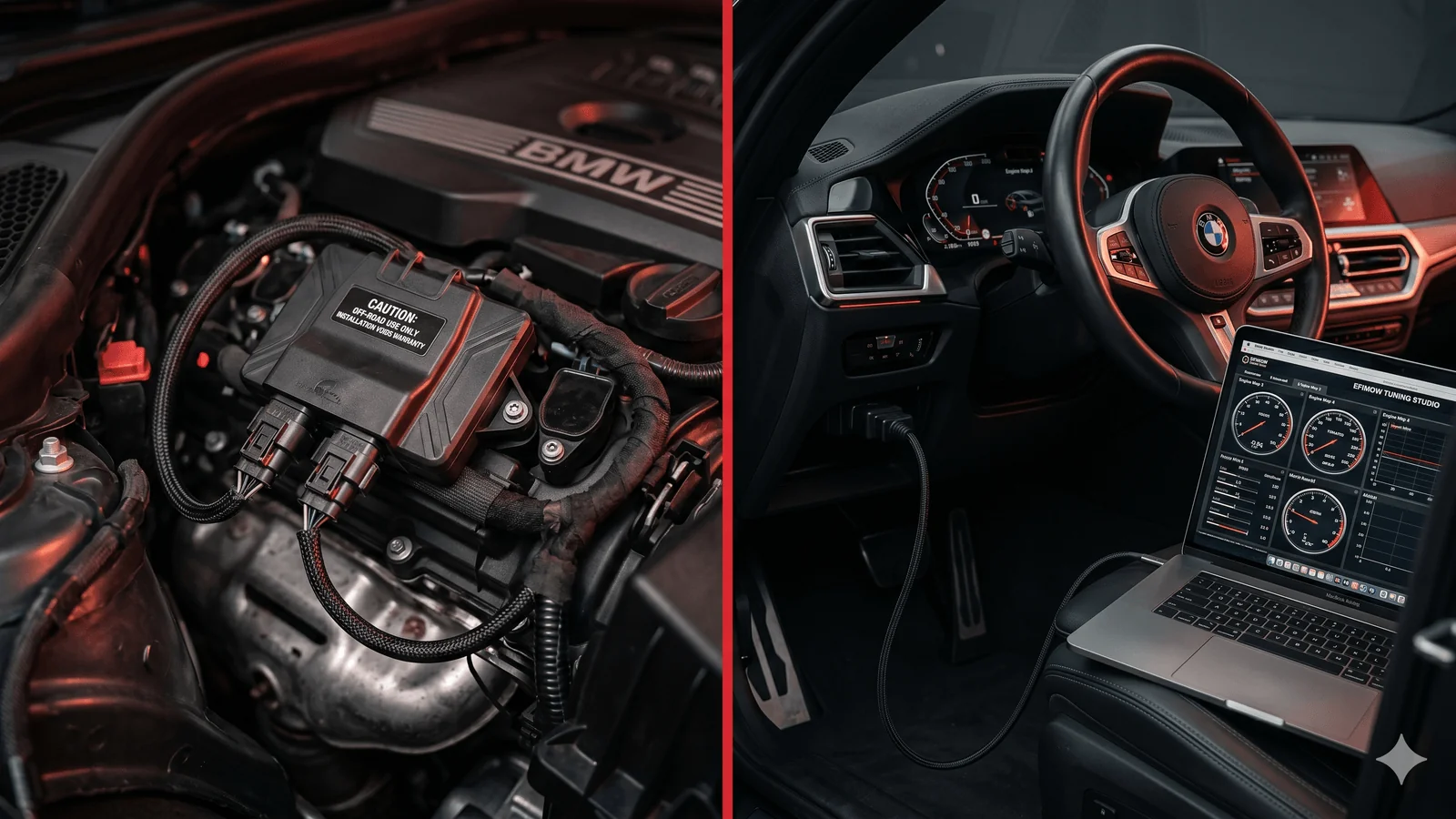
A tuning box is a piggyback module: a small plastic housing with connectors that splices into the wiring between a sensor and the ECU. On a diesel it typically sits on the rail-pressure line; on a turbo gasoline engine it taps the boost-pressure or MAP sensor. The box reads the real sensor signal, applies a fixed or load-dependent offset, and forwards the modified signal to the ECU. The ECU now receives wrong input data and reacts to it with its perfectly normal factory logic, meaning higher commanded pressure, more injected fuel, a wider-open wastegate.
The keyword is "factory logic." A tuning box does not rewrite a single table inside the ECU. It sits in front of it and lies. Everything the ECU does after that (torque limiter, knock correction, lambda control, EGT protection) runs on top of that lie. That is conceptually a very different thing from what most people call "chip tuning."
What a real chip tune does
A software chip tune (or map-based optimization) reads the ECU's calibration, edits it in a tool suite like WinOLS, and flashes it back. What changes are the target values inside the tables themselves: boost targets, injection quantities, ignition angles, torque requests, lambda setpoints. A serious Stage 1 calibration typically touches 20 to 40 maps, more on complex stages or OPF-specific work, drawn from a pool of 80+ combustion-relevant tables present in the calibration.
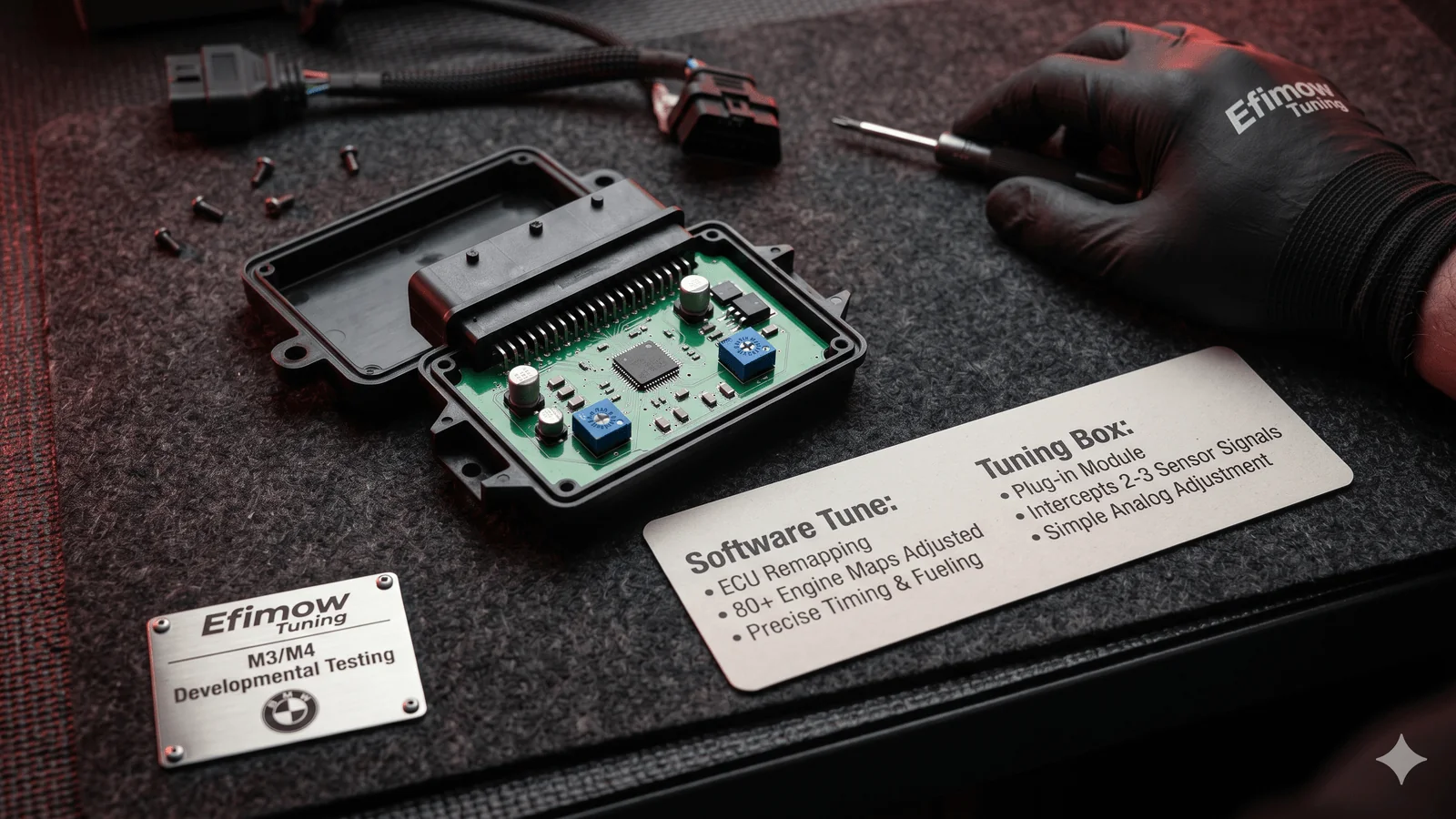
The crucial point: the sensors continue to report real values. When the boost sensor reports 2.1 bar absolute, the ECU knows the manifold sees 2.1 bar. Knock correction, EGT limiting, torque caps all operate on real data and can be deliberately retuned along with the new targets. Extra power does not come from deception; it comes from a deliberate shift of setpoints inside existing safety margins, with protection curves moved along.
Direct comparison
The table below is the centerpiece of this article. It shows the difference where it actually matters to the driver: not in the marketing copy, but in behaviour under load and at the workshop.
| Criterion | Software chip tune | Tuning box |
|---|---|---|
| Number of modified parameters | 20–40 of 80+ maps | 1–2 sensor signals |
| Protection functions active | yes, retuned to new load points | yes, but operating on faked data |
| Reversible without traces | reflash to original calibration | unplug the box, no ECU entry |
| TÜV-eligible | yes, with Teilegutachten or § 19 StVZO | effectively no |
| Detectable at service | depends on calibration source | indirectly via plausibility checks |
| Knock sensor responds to | real knock, with retuned pull-back | real knock, with factory pull-back at falsely high load |
| Torque curve | optimized across the entire map | only where the faked sensor is influential |
| Typical price | 800–1,500 EUR | 300–700 EUR |
| Efficiency | high, since ignition, lambda and pressure are consistent | moderate, since only one variable shifts |
The row "Protection functions active" is the most important trap. Box marketing often claims protections stay untouched. And that is literally true: they remain untouched, but they operate on falsified inputs. If the box's offset makes a real boost of 1.8 bar look like 2.3 bar, the ECU "knows" nothing about the 0.5 bar gap and protects either too late or too early.
Detection: plausibility checks in the modern ECU
Modern BMW ECUs from the Bosch MG1 generation onward run continuous plausibility checks (Plausibilitätsprüfungen) between multiple sensors. Boost-pressure is cross-checked against computed cylinder fill (hot-film mass airflow plus intake-air temperature), rail pressure against commanded pump duty, the torque model against rpm gradient and pedal position. An aggressive tuning box can produce discrepancies the ECU flags as "implausible", at which point a fault code appears, possibly limp mode, in the worst case an unofficial "marker" written into the fault memory that any BMW diagnostic tool can still find after the box is removed.
A software tune behaves differently. The calibration changes, but the sensor cross-checks stay clean because the real values stay real. The only realistic detection is comparing the calibration checksum or version ID against what was originally shipped. BMW dealers do exactly that, especially in warranty cases.
Market reality: why boxes still sell
The honest answer: tuning boxes are a business model, not a technical concept. They are cheap to manufacture (a handful of components on a small board), easy to advertise ("for your BMW! plug-and-play! 30-day money-back!"), and often pitched as "lease-friendly" because they can be unplugged before vehicle return. If you drive a leased car and only want a short-term gain, the temptation is real. But: whatever the box is doing inside the engine cannot be unplugged with it. Knock events, EGT spikes, mechanical load peaks: those stay in the hardware long after the box ends up in the trash.
Conclusion
Both options promise more power. Only one of them talks to the engine honestly. A tuning box is a piece of plastic that disagrees with the sensors; a software chip tune is a deliberate recalibration of setpoints with all protection logic intact. If you care about margins, efficiency and long-term engine health, there is no real choice: the software solution is the only one that does not force the ECU into a lie. The box is cheap precisely because it touches less. And it feels similar at first, because a modern BMW engine will run on falsified data for quite a while before it complains. When it does complain, it tends to be the expensive kind of complaint.