
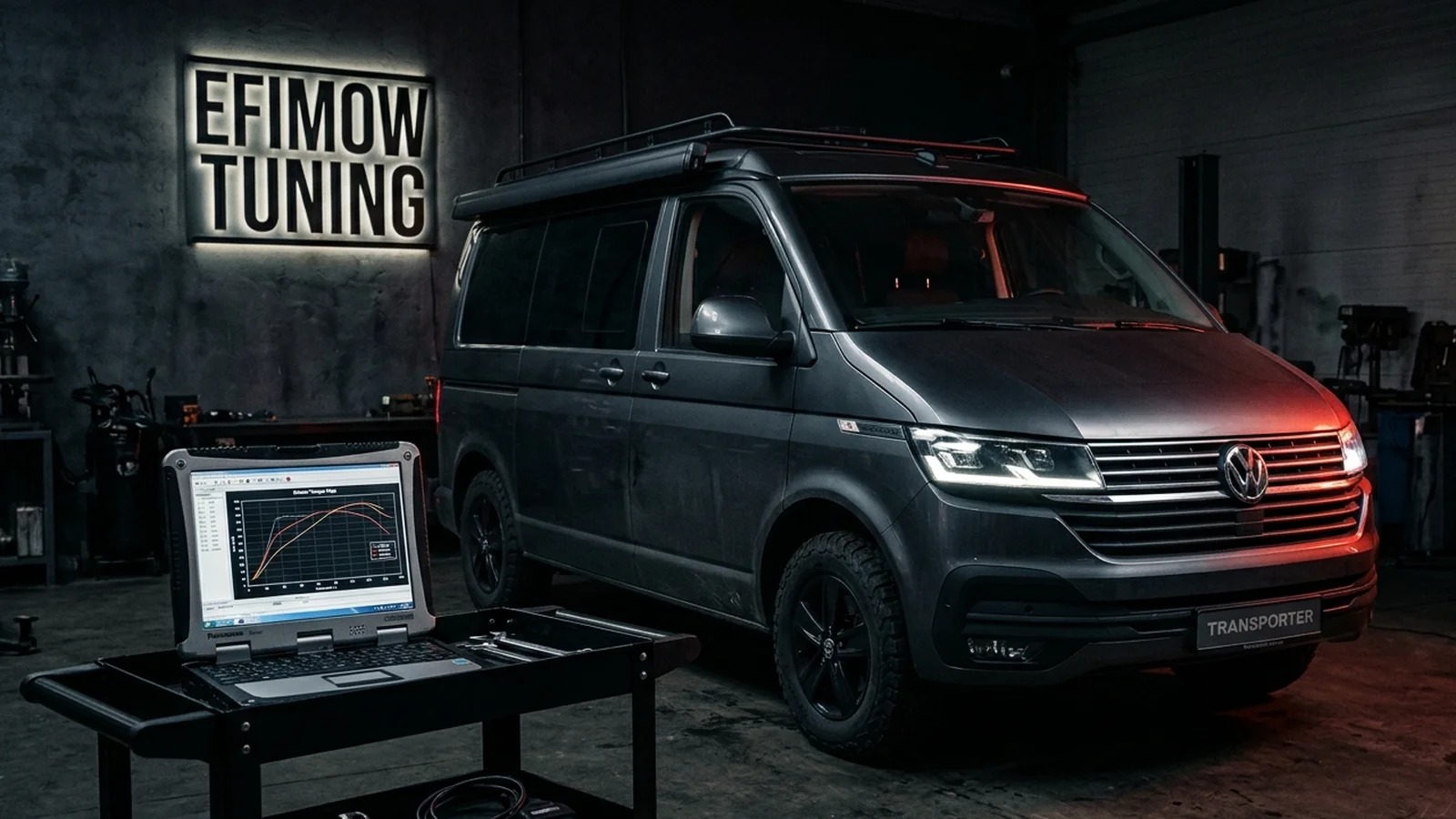
VW Transporter T6 TDI: Tuning for Vans and Campers
The T6 2.0 TDI with EDC17C74 under review: what software brings to a van, which options make sense and what you should keep an eye on.
October 25, 2026 by Leo Efimow
The VW Transporter is not a sports car, and nobody buys one to be first away from the lights. That is exactly why it is such a rewarding car to tune: a T6 is almost always heavily loaded, often pulls a trailer, and as a camper it climbs Alpine passes with a full conversion, water tanks, bikes and the family on board. What matters here is not peak power but torque between 1,500 and 3,000 rpm, the range the engine works in every day. A clean software calibration can make that range noticeably stronger. Done carelessly, it can also put more strain on the clutch, gearbox and exhaust aftertreatment. This post explains what is behind the T6 technically and how we approach a vehicle like this.
Engine and ECU in the T6
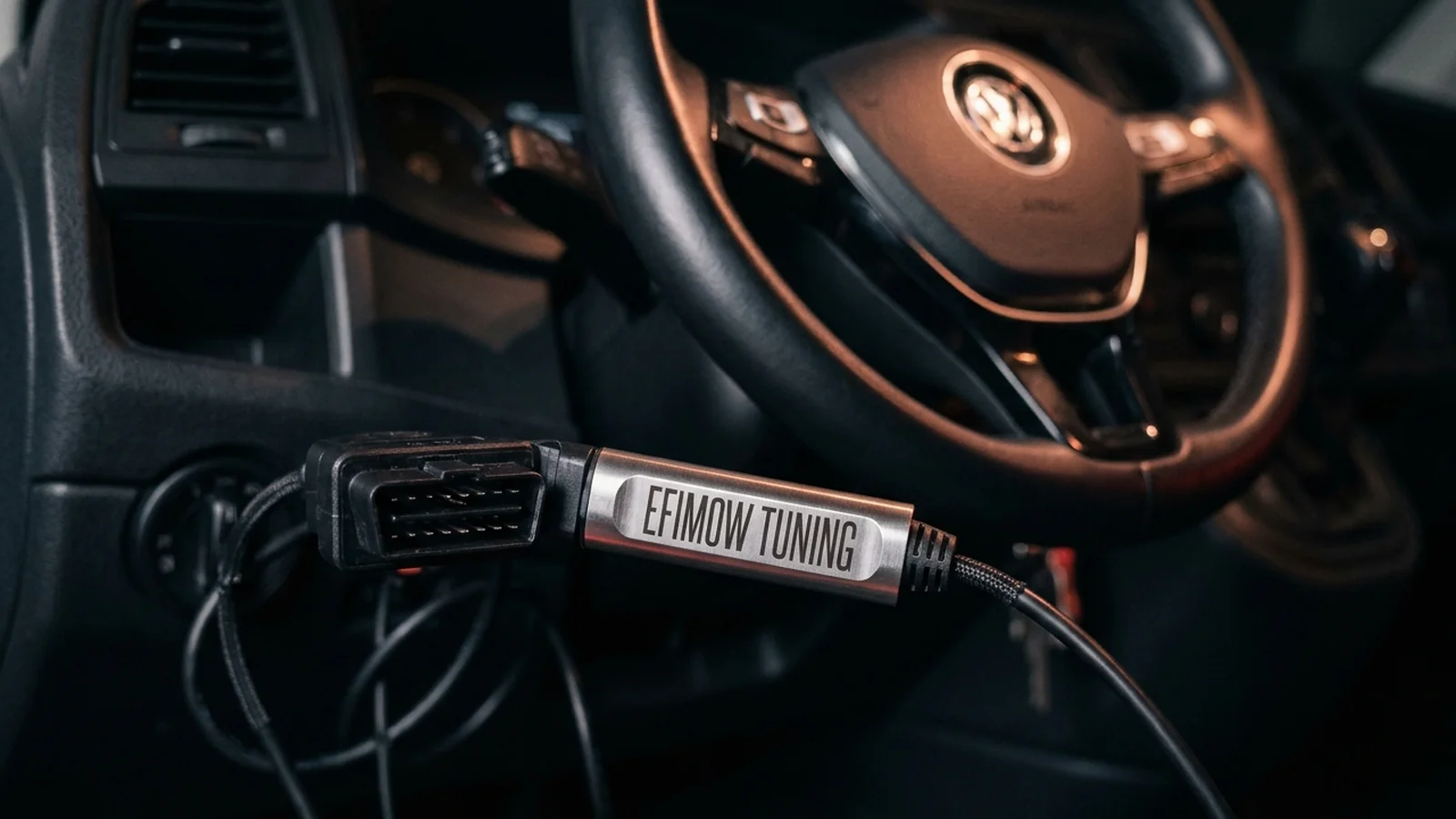
The T6 uses the 2.0 TDI from the EA288 family, a four-cylinder common-rail diesel offered in several power levels. It is controlled by a Bosch EDC17, listed in our catalog as EDC17C74, the same ECU variant found in the Golf 7 facelift, the Passat B8 and the Arteon with the 2.0 TDI EA288. For you that means the software architecture is well known, the map structures are documented, and access is possible over the diagnostic port in many cases.
It cannot be said across the board, though. The EDC17 generation has write protection (TPROT), and later software versions of the EA288 engines are much better protected than early ones. Whether your ECU can be read and written over OBD or has to be removed depends on the software version and hardware number. We check that before the actual work, not afterwards.
What a Stage 1 changes on the T6
On a diesel like the EA288, calibration is mainly about four values: the torque limiter, injection quantity, rail pressure and boost pressure. On top of that comes the smoke limiter, which defines how much fuel may be injected relative to the measured air mass. A Stage 1 moves these values within the reserves the engine has from the factory and adjusts the protection functions rather than switching them off. Exhaust gas temperature monitoring, component protection and torque limits stay active.
As typical guide values, our research for the EDC17 family of VAG TDI engines gives 20–30 % more power and 20–30 % more torque for 1.6 and 2.0 TDI engines. These are ranges, not promises: where your vehicle ends up depends on power level, condition, software version and fuel quality. On a van it also makes sense to shape the extra torque deliberately: a broad, even plateau rather than a peak that stresses the clutch and driveline unnecessarily at full payload.
Clutch, DSG and payload: the van factor
The biggest difference to a passenger car is load. A T6 often runs close to its gross vehicle weight, and with a trailer considerably more. Every torque increase therefore ends up at the clutch or the dual-clutch gearbox, more often and for longer than in an empty estate car. For the calibration that means:
- Manual gearbox: The clutch and dual-mass flywheel are designed for stock torque. A worn clutch will be the first thing to slip after tuning. That is not a software fault, but a sign of its condition. An honest look at mileage and driving profile is worthwhile before the work.
- DSG: The transmission control unit has its own torque limits. If engine torque is raised without the gearbox matching it, you can get slip, harsh shifts or torque limiting. Whether and how the gearbox side needs adjusting is something we clarify for each vehicle.
- Towing: More torque on a climb also means more heat. Exhaust gas temperature and cooling are the limits a van calibration should follow, not the peak figure on paper.
If you use your T6 as a camper, you often benefit most from a calmer driving feel: fewer downshifts on passes, more confidence when overtaking on country roads.
Options that make sense on a T6
For the EDC17C74 our data lists the following options as bookable: Stage 1+ (€25), ECO tuning (€50), Sharp Throttle (€25), Vmax removal (€20) and switching off individual, non-emissions-related fault codes (DTC Off, €25). Launch control and a hard limiter are only available on request after checking the file and rarely relevant on a van.
ECO tuning is particularly interesting for businesses and high-mileage drivers: it optimises torque in the low and mid rev range and leaves top-end power unchanged. If you mostly drive at a steady pace, it can make everyday driving more relaxed without taking the drivetrain to its limits. How much of that shows up in fuel consumption depends heavily on how you drive; there is no fuel-saving guarantee. Vmax removal on a T6, in turn, is mainly a question of tyres: the speed index has to match, and a change to the top speed has to be registered.
AdBlue, DPF and EGR: what is off limits
The T6 with the EA288 has a diesel particulate filter, exhaust gas recirculation and, depending on the emissions standard, an SCR system with AdBlue. Technically, these systems can be influenced by software, which is exactly why corresponding offers appear online. The legal position is clear: switching off or removing the DPF, EGR or AdBlue system is emissions tampering and prohibited on public roads. It breaches EU type approval, the operating permit lapses, and it gets expensive at a roadside check or inspection. A serious performance calibration works with functioning aftertreatment, not against it.
A healthy DPF is also the better choice technically. An engine that produces more soot because of higher fuel quantities loads the filter faster and regenerates more often. A good calibration keeps an eye on the smoke limiter so that this does not happen.
Process and price
We tune the T6 on site in Stödtlen (you choose your preferred date when booking), or you send us the ECU. The price is the same either way, and you book online via the configurator. For the VW Transporter T6 2.0 TDI EA288 our pricing rules give Stage 1 from €450 and Stage 2 from €550: the base is the current EDC17 generation, plus the surcharge for vehicles from model year 2015. If you still drive a T5, you will find it in the catalog too, for example the T5 2.0 TDI Biturbo with EDC17CP20 from €300.
Before writing, we back up the original file. That keeps the way back to the stock calibration open at any time.
One important point to finish: the software change voids your vehicle's type approval; the software is intended for motorsport use only. You will find the details in the motorsport notice.
Conclusion
The T6 with the 2.0 TDI and EDC17C74 is a vehicle where software tuning mainly brings one thing: more composure under load. 20–30 % more power and torque are typical guide values, but what matters more is how the torque is distributed and whether clutch, DSG and cooling can keep up. If you use the van for work, consider ECO tuning; if you drive it as a camper, you will appreciate the broader torque band. Keep away from anything that disables the exhaust aftertreatment. If you want to know what is possible for your T6, start in the configurator with your engine, or read first what a Stage 1 is all about.