
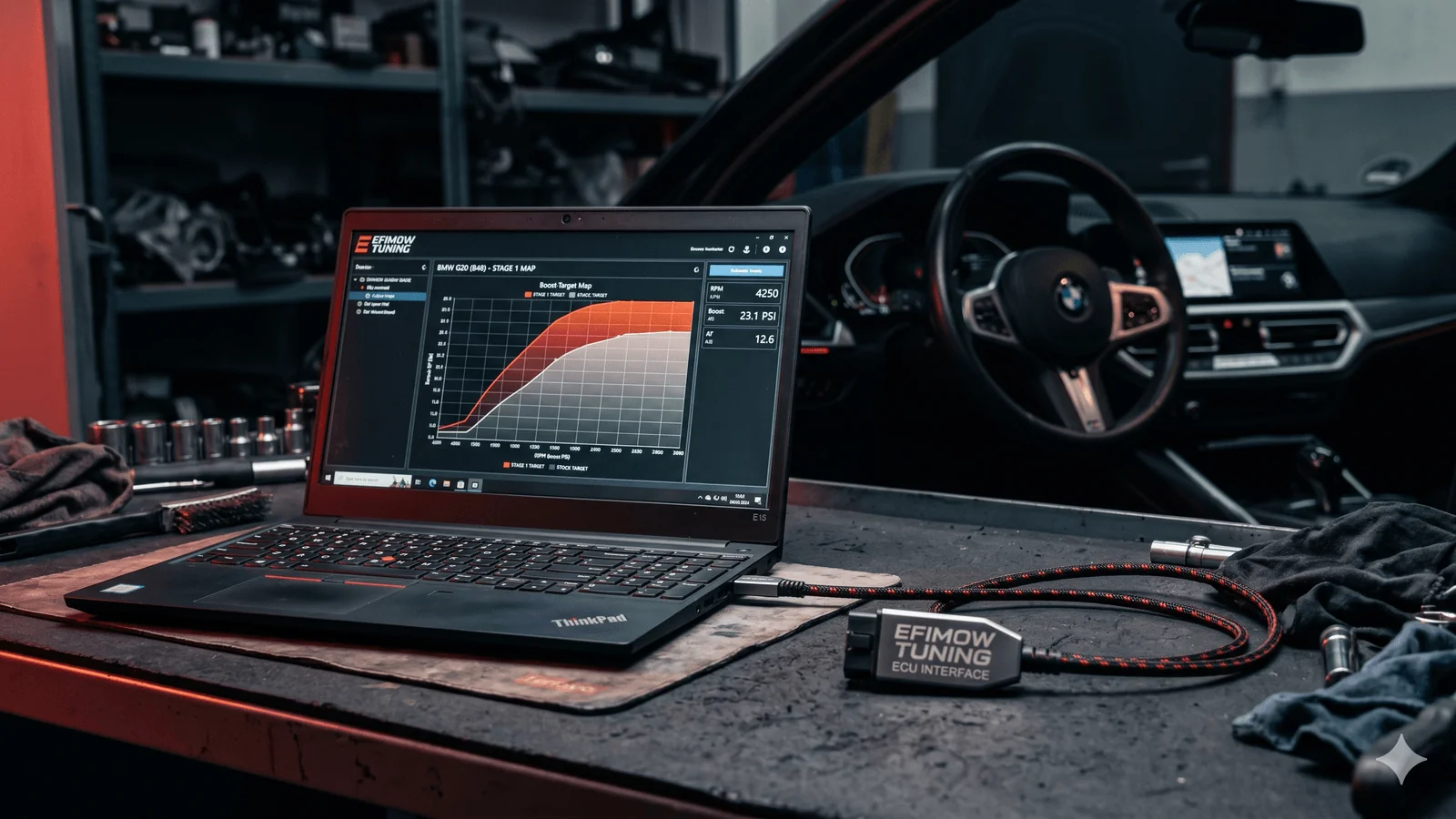
What is Stage 1 Chip Tuning?
Stage 1 is a software-only ECU recalibration inside the factory's existing reserves. What changes, what stays untouched, and which BMW engines benefit most.
July 29, 2024 by Leo Efimow
Stage 1 is by far the most common tuning stage, and the one with the most half-truths circulating around it. "Pure software," "just using the reserves," "no mechanical impact": all literally true, none of which actually explain what happens when the modified calibration is flashed back into the ECU. Stage 1 is a deliberate shift of setpoints in the ECU's calibration tables, inside the factory's existing margins, with the protection curves moved along. No hardware change, no extra sensor, no inline harness adapter. What changes is the list of numbers the engine uses to control combustion millisecond by millisecond.
What Stage 1 actually changes
A serious Stage 1 calibration touches a manageable core group of maps. First, the boost target maps (commanded manifold pressure as a function of rpm and load) on turbocharged engines, then injection quantities or injection timing, ignition advance on gasoline engines, and rail-pressure targets on diesels. On top of that the torque request structure (modern BMW ECUs run a layered torque model, the M_soll path, rather than a flat torque map) and the wastegate or VTG control curves that translate target boost into actuator position. For specifics: a Stage 1 calibration typically modifies 20 to 40 of the 80+ combustion-relevant tables present in the factory data set. The full layout of that table landscape is covered in the post "Map-Based Tuning: 80+ Maps Inside the ECU."
The crucial point: protection curves are retuned, not disabled. Knock correction, EGT (exhaust gas temperature) limits, torque caps, lambda targets stay active and are matched to the new load points. When the knock sensor fires, the ECU still pulls timing, only now from a higher starting point. That is the central difference between a real software tune and a tuning box, which only falsifies one sensor signal and leaves the factory protection logic running on lies.
Why factory reserves exist
BMW does not deliver its engines tuned to the edge. The reason isn't generosity. It is risk management across a global operating envelope. A B58 in an M340i has to function in Saudi Arabia at 50 °C ambient with 91-octane fuel, in Russia at minus 30 °C with questionable fuel quality, towing uphill, between sea level and 3,000 m altitude. The same software has to cover all of it, and has to do so for 200,000 km.
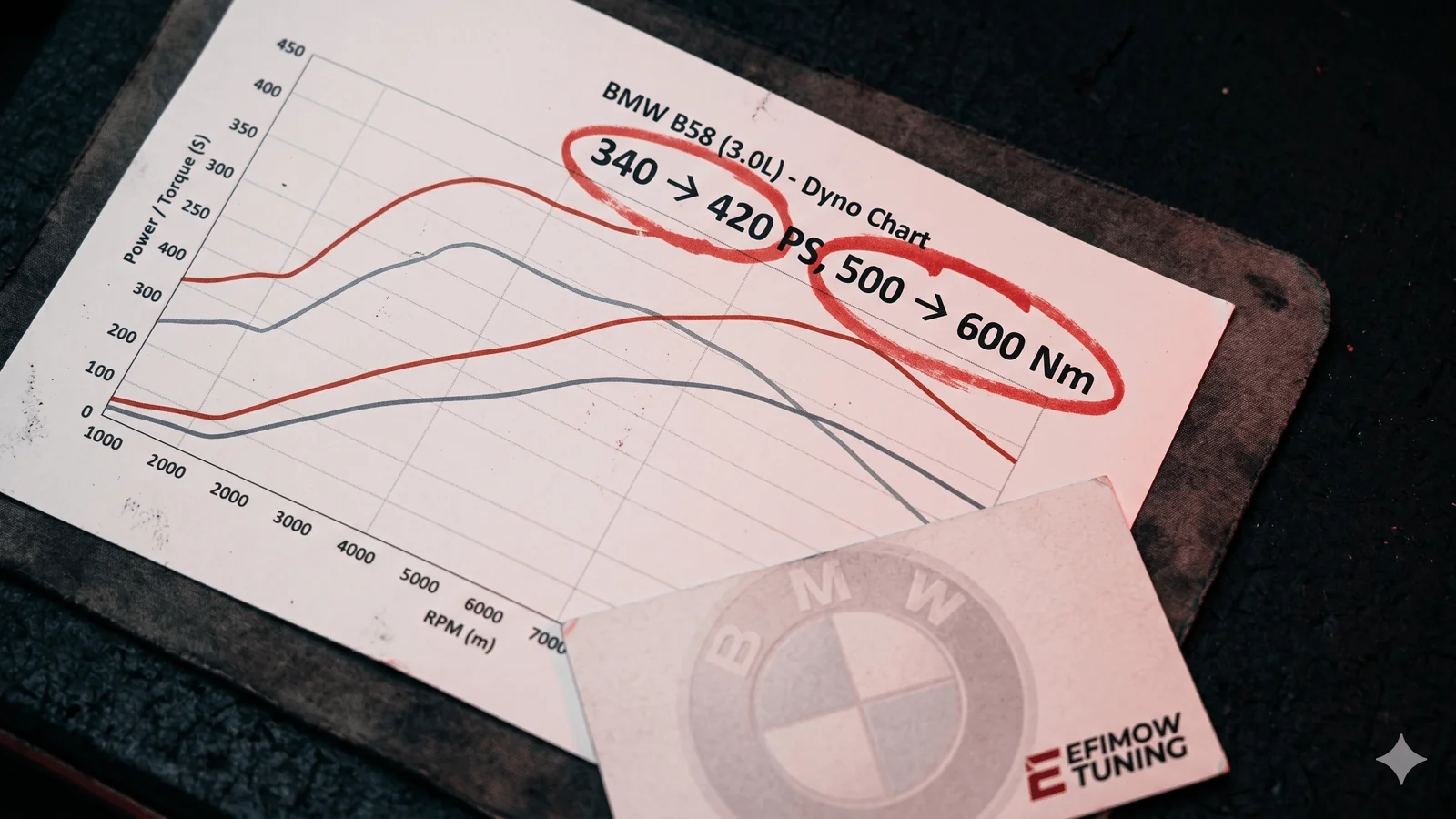
On top of that come marketing reserves: when the same engine appears in 320i, 330i, and M340i variants, the differentiation is primarily in software. From a hardware standpoint a 330i is already most of an M340i; the gap is a calibration question. Add comfort reserves for a flat torque plateau, regulatory reserves (CO₂ fleet averages, RDE testing) and thermal reserves for the hottest realistic load cases. The technical depth on that lives in "Thermal Reserves and Limits in BMW Engines." Stage 1 uses these reserves. Not all of them, but the share that stays mechanically and thermally safe under a calibrated, supported recalibration.
Realistic gains by BMW engine family
Blanket percentage figures are misleading because they paper over the difference between diesel torque character and gasoline power character. The orientation below applies to serious Stage 1 calibrations on mechanically healthy hardware:
- B47 (2.0 L diesel four, e.g. 320d, 520d): typically +25 to +35 hp, +60 to +80 Nm. The torque gain is far more noticeable than the power gain. The diesel stays a torque engine.
- B48 (2.0 L gasoline four, e.g. 330i, X3 30i): typically +40 to +55 hp, +60 to +90 Nm. The mid-rpm range benefits the most.
- B58 (3.0 L gasoline inline-six, e.g. M340i, Z4 M40i): typically +60 to +90 hp, +80 to +110 Nm. The B58 has by far the largest factory reserves, because it is engineered as a shared base all the way up to its S58 cousin.
- N20/N55 (predecessors): on a healthy engine with a clean service history, ranges similar to the B48 and B58 respectively, with wider variance depending on age and hardware condition.
Treat these numbers as orientation, not guarantees. Real-world output depends on hardware condition, fuel quality, and the specific calibration. Serious tuners publish ranges, not pinpoint figures.
What stays untouched
Stage 1 touches combustion control, but not everything around it. A clean calibration does not modify the TCU (transmission control unit), meaning shift points and clutch pressures stay factory; the chassis and brake control units stay factory; the HVAC and comfort modules stay factory; AdBlue dosing on diesels stays factory; and lambda monitoring diagnostics stay factory (only the lambda target table is part of the calibration, not the diagnostic logic). If you want a transmission tune (TCU calibration with higher clutch pressures and faster shift times), that is a separate service, and it is not part of a Stage 1 software calibration on its own.
Suitability for daily use
Stage 1 is the stage that fits daily drivers, leased cars, and commuters. It does not change hardware, it is reversible by reflashing the original calibration, and it keeps the engine in a load range that remains compatible with the factory maintenance strategy. That means oil-change intervals stay sensible, the cooling system stays adequate, and brake sizing stays appropriate. If you drive day-to-day and occasionally accelerate on the autobahn, Stage 1 will feel like a meaningful upgrade without changing the car's character.
For leased cars the picture is nuanced: a Stage 1 can be reflashed back before return, but modern BMW diagnostics can read the calibration version ID and checksum. If you want to be safe, save the original calibration up front or arrange the return-to-stock as part of the service.
On warranty: a software modification can affect a warranty claim if the failure is plausibly connected to the change. Sweeping statements like "tuning voids your warranty" are as wrong as "tuning is always harmless." The Cluster G post on warranty and goodwill covers the realistic legal frame.
What Stage 1 is not
Stage 1 is not a substitute for Stage 2, because it does not move the real hardware limits: exhaust back-pressure and intake-air temperature stay where they were. It is not a sound tune; pops, bangs and crackle maps are separate features. And it is not a repair for a tired engine. Running Stage 1 on a turbo with a failing bearing will finish the bearing faster, not fix it. Treated as what it is (a calibrated shift of setpoints within a healthy margin), Stage 1 is one of the most honest tuning options the market offers.