
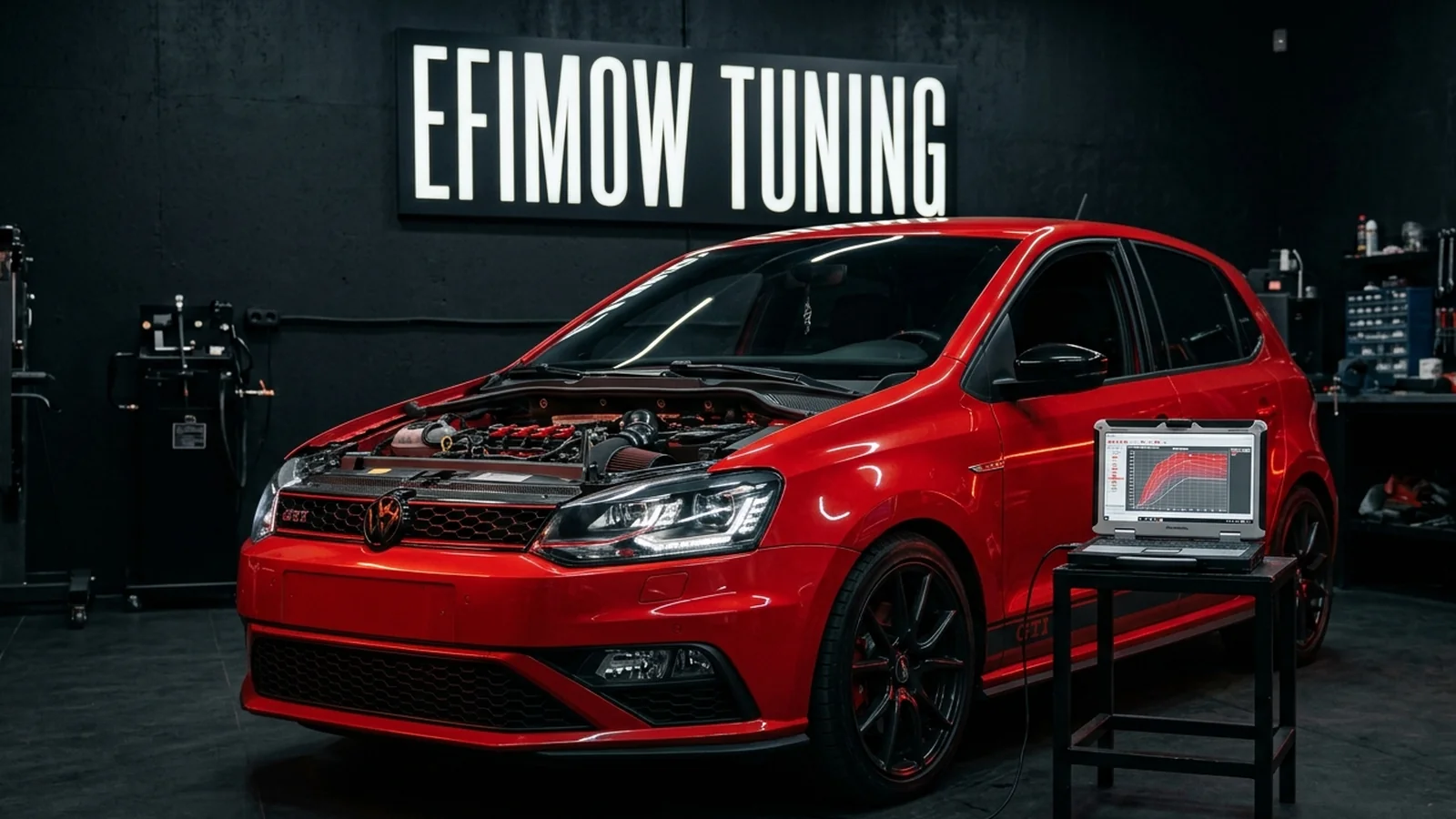
VW Polo GTI 6R/6C: Small Engine, Big Effect
Polo GTI 6R with the 1.4 TSI twincharger and MED17.5.5: what Stage 1 realistically delivers, where DSG and engine set limits, and how it works.
October 25, 2026 by Leo Efimow
The Polo GTI is the counterpoint to the big Golf: short, light, agile, and still powered by a turbo petrol engine that can do a lot more than its displacement suggests. In the Polo 6R (from 2009) it is the 1.4 TSI with engine code CAVE and 180 hp, a twincharger that combines a mechanical supercharger with an exhaust-driven turbocharger. It is managed by a Bosch MED17.5.5. If you are thinking about software tuning on the small GTI, it pays to understand how this engine is built, what the dual-clutch gearbox has to say about it, and where the real reserves are.
The engine: 1.4 TSI twincharger (CAVE)
The CAVE belongs to the EA111 engine family. Its signature is the double charging: at low rpm a belt-driven supercharger pushes air into the engine, in the mid and upper range the turbocharger takes over. A flap in between decides how much each charger contributes. The result is a very even torque curve from just above idle, and an engine with a high specific output for 1.4 litres.
For tuning, that means two things. First, there are more control variables than on a simple turbo engine: boost targets for both chargers, the handover between supercharger and turbo, ignition timing, injection quantities and the torque limiters. Second, the engine is already working fairly hard from the factory. A sound calibration therefore moves the targets with care and keeps the protection functions (knock control, component protection via exhaust temperature, lambda targets) active.
In our catalog you will also find the Polo 6R with the 1.4 TSI CAVB (170 hp), also on a MED17 ECU. Technically the two are very similar, but the software is always matched to the specific variant.
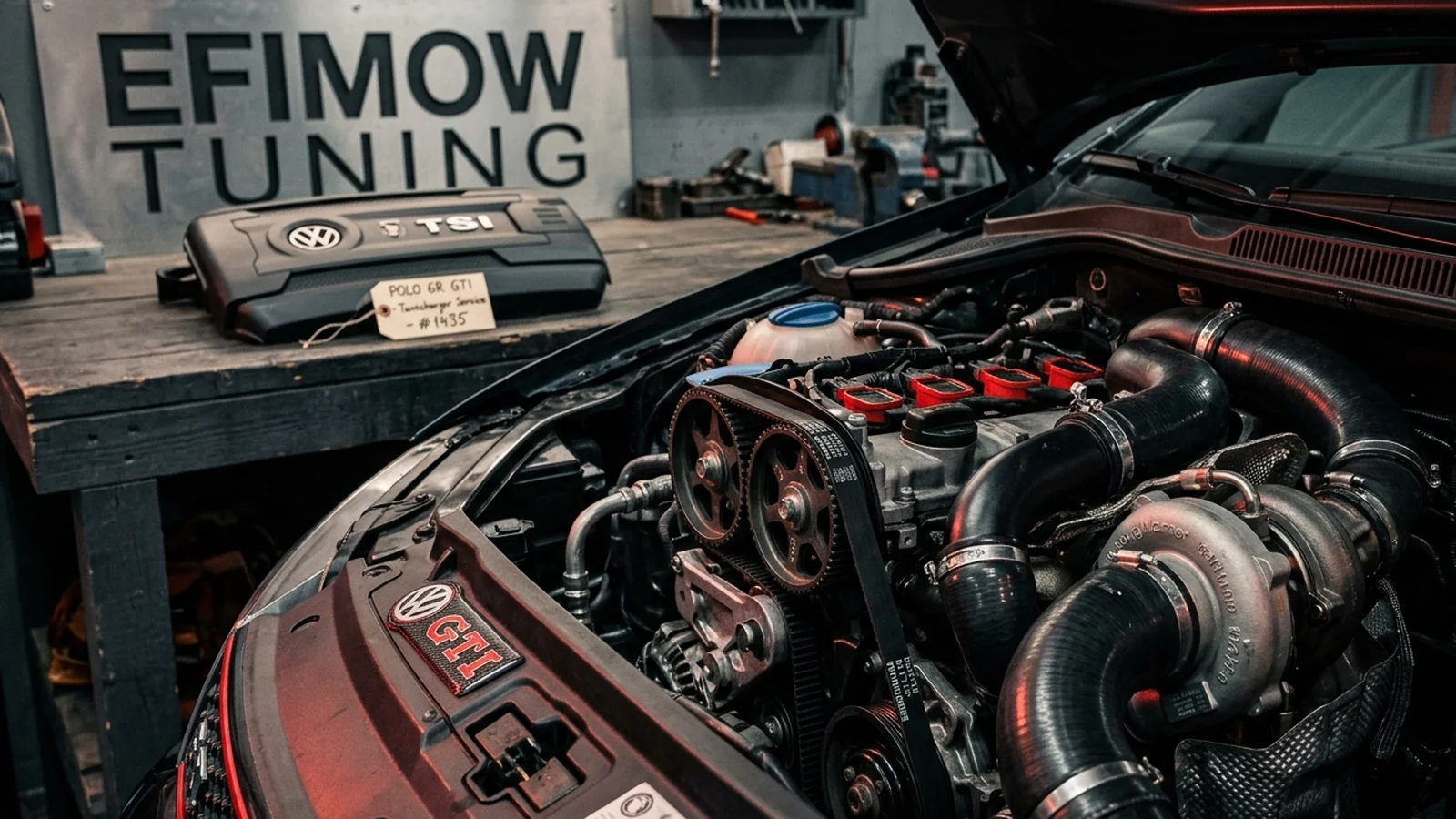
The ECU: Bosch MED17.5.5
The MED17 is Bosch's engine management for direct-injection petrol engines and is fitted to almost every VAG TSI engine of that era. It runs on a TriCore processor, verifies its data with checksums and, in the VAG 17.5.x variant, is well understood. On the Polo 6R it is usually reachable through the diagnostic port. How the MED17 is built internally and why it defines a whole engine generation is covered in Bosch MED17 explained.
With a MED17 the starting point for a clean calibration is good: the map structure is known, torque management is model-based, and changes can be made exactly where they are meant to work, instead of adding a few percent everywhere.
What Stage 1 realistically delivers
For the MED17 family on VAG turbo petrol engines, the typical guide values for a Stage 1 software are 20–35 % more power and 20–40 % more torque. These are ranges, not promises: where exactly your car ends up depends on engine condition, fuel quality, software version and the state of spark plugs, coils and intake.
You feel it mostly in the midrange. The Polo pulls noticeably harder out of corners and when overtaking, without changing its everyday manners. One point matters on the twincharger: don't judge the gain by the peak figure alone. An even, cleanly modelled torque curve is kinder to engine and gearbox than a sharp spike.
The DSG as the limiting factor
The Polo GTI 6R was sold exclusively with the seven-speed DQ200 dual-clutch gearbox. It is a dry-clutch DSG rated for a maximum input torque of around 250 Nm. The engine already delivers torque in that region from the factory, so the gearbox is close to its limit as standard.
For the calibration this means torque has to be capped so that the clutches don't slip under load. A responsible Polo GTI software therefore lifts mainly the midrange torque and keeps the maximum under control. Overdo it and you notice it first as juddering pull-away, slip at full throttle or faults in the transmission control. More on the differences between DQ200, DQ250 and DQ381 in DSG after engine tuning.
What about the Polo GTI 6C?
With the facelift (6C), VW moved the Polo GTI to a 1.8 TSI. This variant is not listed as a separate entry in our catalog. If you drive a 6C, select your car in the configurator or send an inquiry. We then check engine code and ECU to see what is possible.
Options for the Polo GTI 6R
For the MED17 family, the following options can be booked directly alongside Stage 1 and Stage 2:
| Option | Note |
|---|---|
| Stage 1+ | Fine-tuning beyond the Stage 1 calibration |
| Sharp Throttle | More direct throttle pedal map |
| Vmax removal | Check the tyre speed rating |
| DTC Off | Only for non-emissions-related fault codes |
| Hardcut Limiter | Motorsport only |
ECO tuning, launch control, no-lift shift, pops & bangs, popcorn limiter and anti-lag are available for this ECU family only on request after checking the file, because feasibility depends on the software version. All sound and limiter functions are intended exclusively for motorsport. Details are in the motorsport notice.
Not up for discussion: disabling the catalytic converter, lambda monitoring or the cold-start heating strategy is emissions tampering and prohibited on public roads.
Price and process
For the Polo V 1.4 TSI GTI (CAVE, 180 hp), Stage 1 starts at €250, Stage 2 at €325. The tier follows from the MED17 ECU generation. The exact price for your variant including options is shown on the Polo GTI product page.
The process is simple: you book online and either come to Stödtlen for an appointment of your choice, or you remove the ECU and send it in. The price is the same either way, because the work on the ECU is identical. The original file is saved before anything is written, so the stock calibration can be restored at any time.
Legally: the software change voids your vehicle's type approval; the software is intended for motorsport use only.
Check before tuning
On the twincharger in particular, a quick check before changing the software is worth it:
- Spark plugs and coils: more boost needs a clean spark. Old plugs cause misfires under load.
- Timing chain: EA111 engines are known for chain stretch. If the engine rattles after a cold start, sort that out first.
- Fuel: a tuning software is calibrated for high-octane fuel. With poorer fuel, knock control intervenes earlier and part of the gain is lost.
- DSG condition: if the gearbox already judders when pulling away in stock form, more torque won't make it better.
Conclusion
The Polo GTI 6R is a good example of how strongly small engines respond to software, and how the limit often isn't the engine but the drivetrain. With Stage 1 on the MED17.5.5, the small GTI gains mostly midrange pull. What matters is thinking about engine and gearbox load together: the DQ200 puts a clear ceiling on torque, and an honest calibration respects it.
If you want to know what is possible on your Polo, select it in the configurator. You'll see price, options and the way to an appointment.