
Bosch MED17 Explained: Mastering Petrol Direct Injection
What the Bosch MED17 controls, which VAG engines use it, how OBD and bench access work, and what is realistic when tuning it.
October 25, 2026 by Leo Efimow
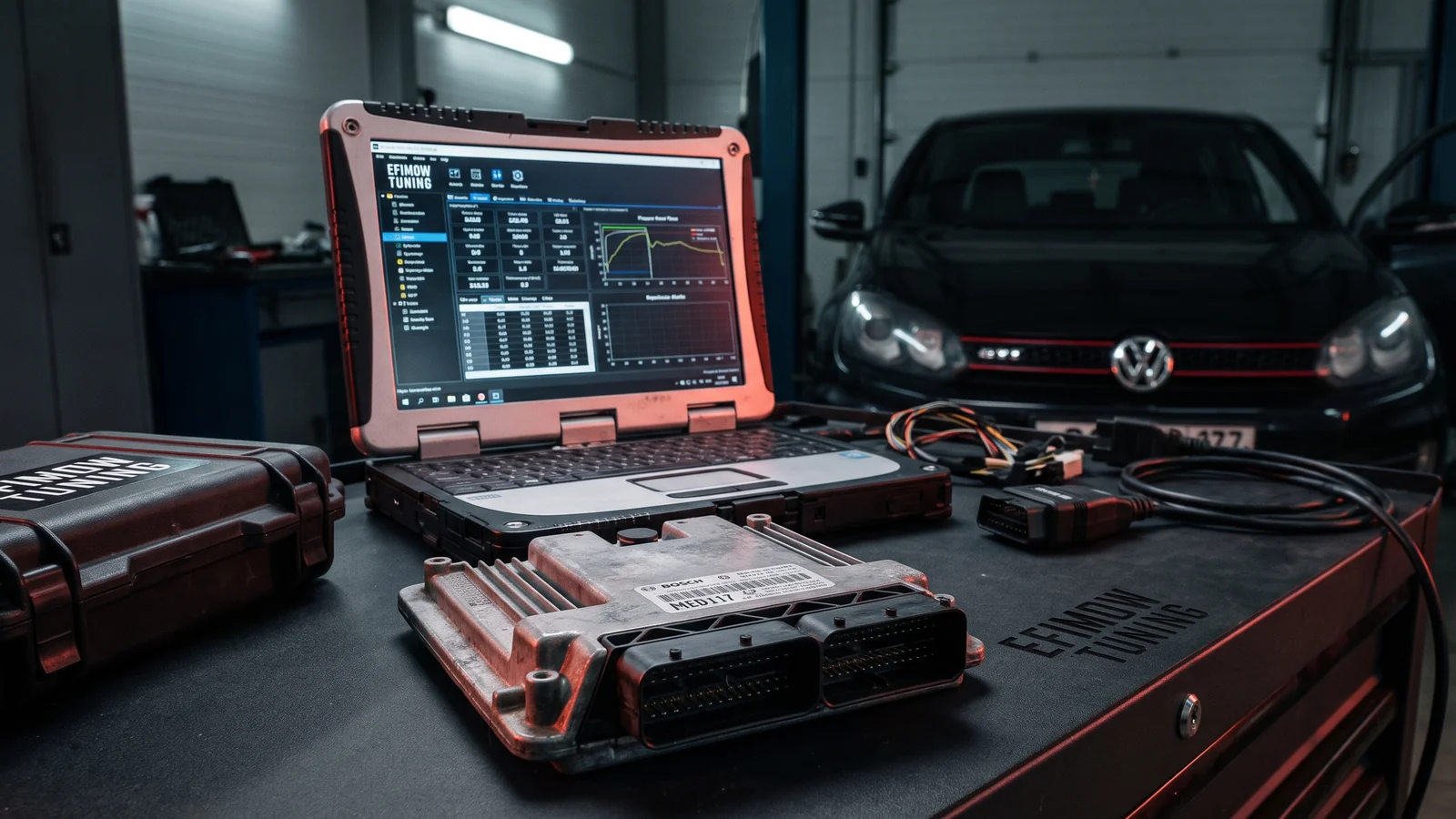
If you drive a Volkswagen Group petrol car built after 2008, there is a good chance a Bosch MED17 is working under the bonnet. The 1.4 TSI in the Golf VI, the 2.0 TSI in the GTI, the 1.8 TFSI in the Audi A4: all of them run variants of the same ECU family. For tuning, the MED17 is one of the best-understood control units there is. Still, it pays to know what it actually does, which variants exist, and why access no longer looks the same on every car.
What's behind the name
Bosch names its petrol engine management systems with a simple scheme. ME stands for Motronic with an electronic throttle (drive-by-wire), the D for direct injection. The 17 is the generation. Sub-versions such as 17.5.5, 17.5.21 or 17.1.1 follow, differing by manufacturer, installation and software. Close relatives are the ME17 for port-injected engines and (at BMW) the MEVD17 for engines with Valvetronic.
Technically, the 17 generation is built on processors from Infineon's TriCore family. It shares this architecture with its diesel sibling, the EDC17. That matters for tuning, because access routes and protection mechanisms are similar across both families.
What the MED17 controls
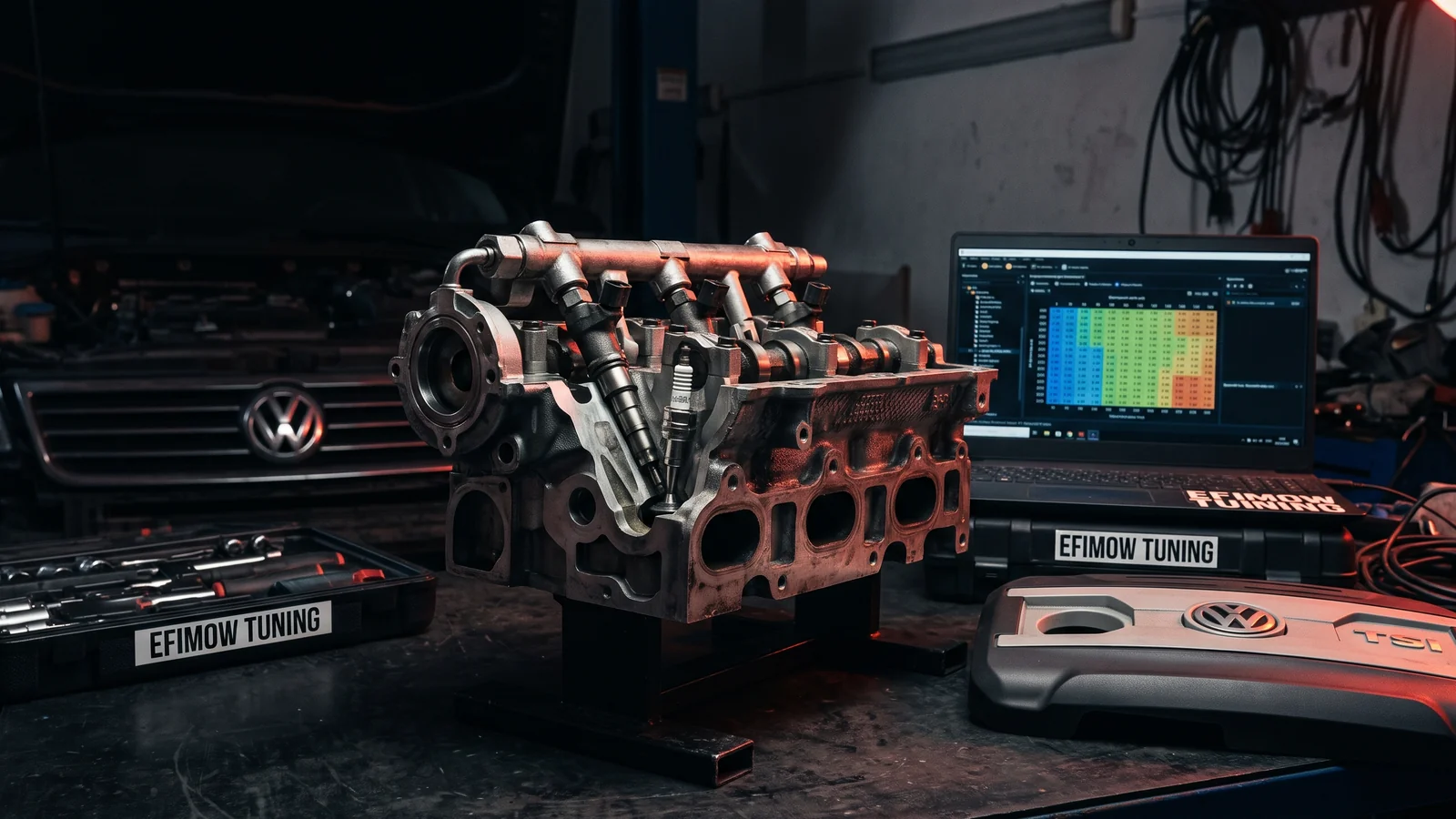
Petrol direct injection places high demands on the control unit. Fuel is injected at high pressure straight into the combustion chamber, and injection timing, quantity, ignition timing and cylinder filling have to match millisecond by millisecond. Among other things, the MED17 controls:
- Filling and boost: how much air enters the cylinder, via throttle, wastegate or supercharger bypass.
- Fuel high pressure: the rail pressure the high-pressure pump has to build.
- Injection: quantity, timing and, where used, multiple injections.
- Ignition timing: including per-cylinder knock control.
- Camshaft timing: intake and exhaust, depending on the engine.
- Exhaust aftertreatment: lambda control, catalyst heating after a cold start, diagnostics.
At its core is a torque-based structure: the ECU thinks in torque requests. Driver demand, gearbox, ESP and protection functions report what they need; the MED17 decides which torque is actually delivered and produces it via air, fuel and ignition.
Where the MED17 is fitted
In the VAG world there are two main branches. The MED17.5.x sits in transversely mounted engines: EA111 and EA211 TSI (1.2 to 1.4 litres) and first- and second-generation EA888, for example in the Golf VI GTI with the CCZB (211 hp) or the Octavia II 2.0 TSI. The MED17.1.x is found in longitudinal Audi engines, from the 2.0 TFSI up to large V8 and V10 units. On some longitudinal Audi engines such as the A4 B8 1.8/2.0 TFSI, a Simos 12 was fitted depending on the variant. There the ECU has to be clearly identified before tuning.
With the third EA888 generation and the MQB platform, VAG switched many engines to the Continental Simos 18. Why that makes a difference for tuning is explained in Simos 18 and boot mode.
Access: OBD, bench or boot
Early MED17 units could largely be read and written through the diagnostic port. From around 2012, an additional write protection (often called TPROT) was added; later software versions therefore require bench or boot access.
The PCMflash module list shows the VAG MED17.5.x under module 48 (UDS ECUs) and module 65 (older CAN TP2.0/K-Line variants). Reading there is virtual: instead of dumping the entire memory, the calibration area is reconstructed from a database of stock files. That works, but it requires the software version to be known. With an unknown version or protected variants, the route leads to bench or boot access on the removed ECU. The differences between the three routes are described in OBD, bench and boot compared.
Either way: the original file is saved before the first write, and after every change the checksums have to be correct, otherwise the ECU won't start.
What happens when tuning the MED17
A Stage 1 calibration touches a manageable group of maps: boost and filling targets, ignition timing, torque limiters and possibly the throttle pedal map. The protection functions stay active: knock control, component protection via modelled exhaust temperature and lambda targets are adapted to the new load points, not switched off.
For the VAG MED17 family, typical guide values are 20–35 % more power for TSI/TFSI turbo engines and 20–40 % more torque. Naturally aspirated engines with the ME17.5.2x, by contrast, gain only 3–8 %, because without a turbo, the boost lever is missing. These are ranges, not promises.
Options on the MED17
Bookable directly for this family: Stage 1+, Sharp Throttle, Vmax removal, DTC Off for non-emissions-related fault codes and the hardcut limiter. Stage 2 is feasible on turbo variants with hardware.
Dependent on the software version and therefore only on request after checking the file: ECO tuning, launch control, no-lift shift, pops & bangs, popcorn limiter and anti-lag. Hardcut, pops & bangs, popcorn limiter and anti-lag are intended exclusively for motorsport.
Technically, catalyst heating strategy, secondary air or swirl flaps can also be influenced in the MED17 software. These functions are part of the emissions control system; disabling them is emissions tampering and prohibited on public roads.
Common questions from the workshop
Can a dealer detect the tune? A modified calibration can generally be identified via software IDs and checksums. With the saved original file, however, the stock version can be written back at any time.
Does a dealer software update overwrite the tune? Yes, an update at the dealer usually overwrites the modified calibration. Afterwards the engine runs on stock software again.
Can I swap files between MED17 variants? No. Each variant has its own software and memory layout. A file only ever fits exactly the ECU and software version it was created for.
Do I need different fuel after tuning? A tuning software is calibrated for high-octane fuel. With a lower octane rating, knock control intervenes earlier. The engine protects itself but loses part of the gain.
Prices
The MED17 belongs to the price tier of the 17 ECU generation: Stage 1 from €250, Stage 2 from €325. Surcharges apply for engines from 300 hp, for newer model years from 2015 or 2019, and for ECUs that have to be opened. An example without surcharges is the Golf VI GTI with the CCZB: Stage 1 from €250. The configurator shows the exact price for your car.
You come to Stödtlen for an appointment of your choice or send the ECU in. The price is the same. Legally: the software change voids your vehicle's type approval; the software is intended for motorsport use only (motorsport notice).
Conclusion
The Bosch MED17 is the ECU of an entire petrol generation in the Volkswagen Group. Its torque-based structure and well-known maps make a clean, targeted calibration possible. Today the real question is less whether a MED17 can be tuned and more how it is reached: via OBD, bench or boot, depending on variant and software version. Clarify that up front and you know what you're getting into.
Whether your car has a MED17 and which access it needs is shown in the configurator once you select model and engine.