
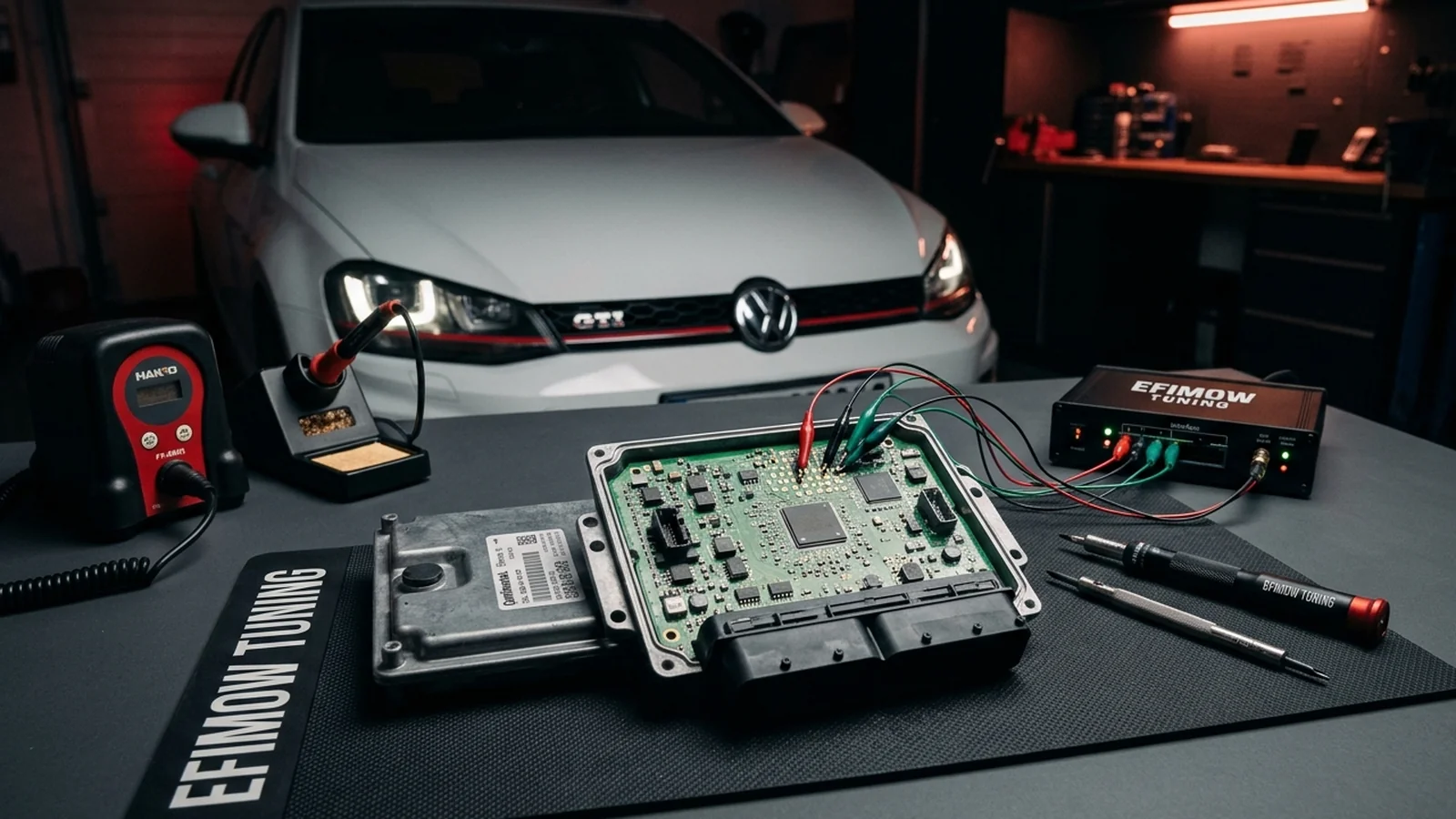
Simos 18: Why the ECU Has to Be Opened
Simos 18 in the Golf 7 GTI, R, Leon Cupra and S3: why tuning usually needs boot access on the opened ECU, and what that means for process and price.
October 25, 2026 by Leo Efimow
If you drive a Golf 7 GTI, a Seat Leon Cupra or an Octavia RS with the 2.0 TSI from the third EA888 generation, the question of software tuning quickly leads to one name: Simos 18. Continental's engine control unit replaced the Bosch MED17 on many MQB petrol engines. And it comes with a peculiarity that surprises many owners: for a clean tune, the ECU usually has to be removed and opened. This article explains why, what happens in the process, and what it means for you.
Where the Simos 18 is fitted
In our catalog, the Simos 18 appears mainly on the 2.0 TSI engines of the EA888 generation 3. Some examples:
| Vehicle | Engine code | Power | Stage 1 | Stage 2 |
|---|---|---|---|---|
| VW Golf 7 GTI | CHHB / CNTA | 220 hp | from €450 | from €550 |
| Seat Leon Cupra (5F) | CJXA | 280 hp | from €450 | from €550 |
| Skoda Octavia III RS | CHHB | 220 hp | from €450 | from €550 |
| VW Golf 7 R | CJXC | 300 hp | from €500 | from €600 |
| Audi S3 8V | CJXE | 301 hp | from €500 | from €600 |
Careful: not every Golf R or S3 of this generation has a Simos 18. The catalog also lists individual engine codes with a Simos 12, for example the Golf 7 R with CJXB or the S3 8V with CJXC. Different access routes and a different price tier apply there. What counts is always the ECU actually fitted.
How to find out which ECU is fitted
The easiest way is the engine code from the registration document or the data sticker, combined with the model year. With that, the ECU can usually be identified clearly in the configurator. More reliable still is a look at the ECU's own label, or reading the ECU identification over the diagnostic port. That works without touching the software.
Why it matters: between Simos 12 and Simos 18, not only the access route and price differ, but also the available options and the effort involved. Arriving or shipping an ECU on the wrong assumption costs time at best. If in doubt, clarify it in your inquiry beforehand.
Why it has to be opened
Modern engine ECUs protect their software on several levels. On the Simos 18, read and write functions over the diagnostic port are heavily restricted depending on the software version. A complete read of the original file and writing back a modified calibration are therefore often not reliably possible via OBD alone.
The safe route goes straight to the processor. Like Bosch's generation-17 units, the Simos 18 is based on a microcontroller from the TriCore family. These processors have a boot mode: if certain contacts on the circuit board are wired appropriately at start-up, the processor doesn't start the normal vehicle software but a loading and diagnostic mode. Via this route the memory can be fully read and written, regardless of the protection on the diagnostic port.
To reach those contacts, the housing has to be opened. That is not a hack and not a sign of sloppy work, but the usual workshop route for this ECU generation. The three access routes are compared in OBD, bench and boot compared.
What happens when it is opened
Boot access is precision work. This is what the workshop process typically looks like:
- Removal: the ECU is taken out of the car with the battery disconnected.
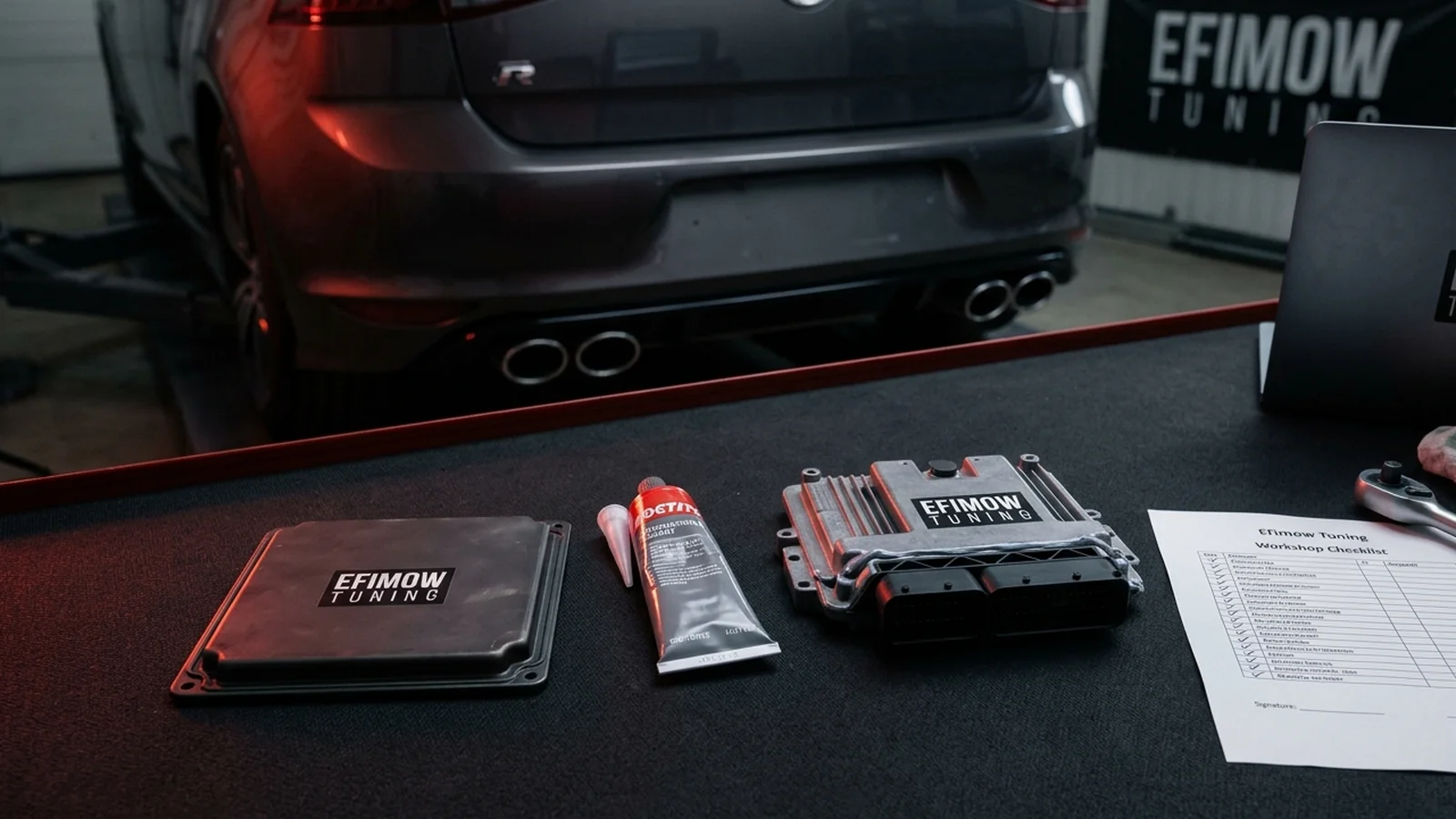
- Opening: the housing lid is carefully released. The unit is sealed against moisture; the seal must not be damaged.
- Contacting: on the opened unit, the boot contacts on the board are connected to the programmer, with a stable power supply and on an anti-static mat.
- Backup: the complete original file is read and saved. It is the fallback for everything else.
- Writing: the modified calibration is written with correct checksums.
- Closing: the housing is properly resealed and closed.
- Refitting and check: after refitting, fault memory and adaptations are checked.
The risks lie mainly in steps 2, 3 and 6: mechanical damage while opening, contact faults, voltage drops or a leaking housing seal. That's why this work belongs on a workbench with the right tools, not in a car park.
What you get from it
The effort is worth it because the EA888 Gen3 is a very potent engine. For the Simos turbo family, the research data gives typical guide values for the third-generation 1.8/2.0 TFSI engines of 25–40 % more power and 20–40 % more torque for Stage 1. These are ranges, not promises; condition, fuel and software version all play a part.
Another benefit of full access: with the original file saved, a return to stock is possible at any time.
Options on the Simos 18
The Simos 18 offers a wide range of directly bookable options:
- Stage 1+ and Stage 2+
- ECO tuning
- Sharp Throttle
- Vmax removal (check the tyre speed rating)
- DTC Off (non-emissions-related fault codes only)
- Launch control
- Hardcut limiter, pops & bangs and popcorn limiter: motorsport only
No-lift shift and anti-lag are only possible on request after checking the file. All sound and limiter functions are intended exclusively for motorsport; details in the motorsport notice.
From software versions around 2018 (Simos 18.10 and newer), many cars have a gasoline particulate filter (OPF). Disabling it or the secondary air system in software is emissions tampering and prohibited on public roads.
Price: why €50 more
In terms of price, the Simos 18 belongs to the newest ECU generation. On top comes a surcharge of €50 because the ECU has to be opened for bench or boot access. For the Golf 7 GTI with 220 hp that gives Stage 1 from €450. On engines from 300 hp such as the Golf R (CJXC) or the S3 (CJXE), the power surcharge is added, resulting in from €500.
The process is the same as for all cars outside the BMW online flow: you book online and come to Stödtlen for an appointment of your choice, or you remove the ECU and send it in. The price is the same either way. When shipping: pack the ECU well padded and in anti-static packaging.
Legally: the software change voids your vehicle's type approval; the software is intended for motorsport use only.
Conclusion
On the Simos 18, opening the ECU is not an extra risk to be avoided but the technically clean route to a complete original file and a reliably written calibration. What matters is that removal, contacting and resealing are done with care. Check beforehand whether your car really has a Simos 18. Especially on the Golf R and S3 there are variants with a different ECU.
Which ECU your car has and what it costs is shown in the configurator.