
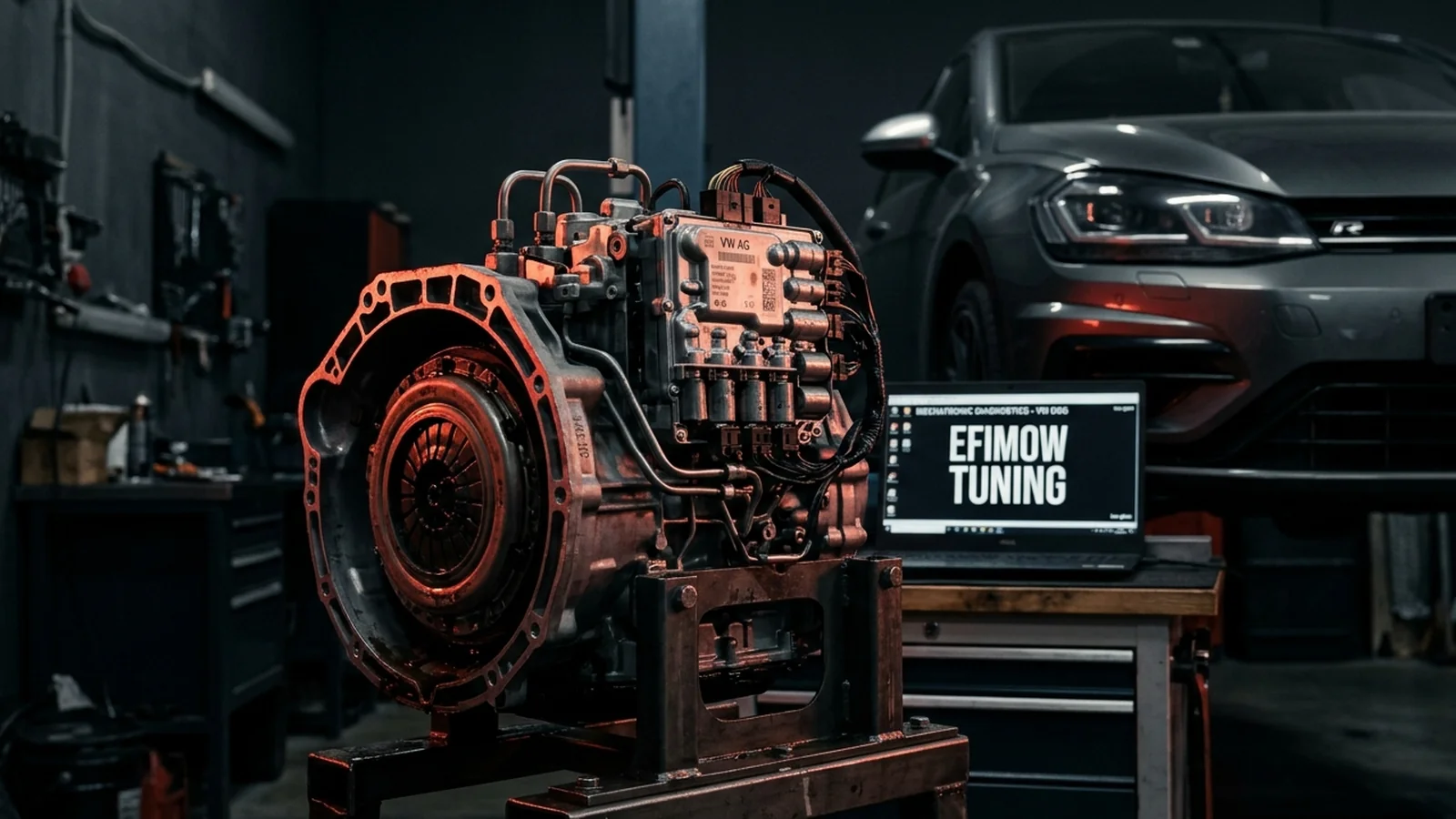
DSG DQ250/DQ381: Gearbox Software After Engine Tuning
More torque meets a DSG with a fixed limit: what DQ200, DQ250 and DQ381 can handle, what the gearbox control does and what you should watch out for.
October 25, 2026 by Leo Efimow
Engine tuning doesn't stop at the crankshaft. Every extra newton-metre the engine delivers has to pass through the gearbox, and in the Volkswagen Group, that is very often a dual-clutch gearbox, or DSG. Unlike a manual, a DSG has its own control unit with its own limits. It helps decide whether a tuned Golf GTI or Leon Cupra keeps shifting cleanly or whether the clutches start slipping under load. This article explains which DSG types exist, what they can handle, and what role the gearbox software plays.
The three most important DSG types
Three transversely mounted dual-clutch gearboxes are particularly common in the Volkswagen Group. The torque figures are rounded orders of magnitude, not exact limits:
| Gearbox | Gears | Clutches | Rated for around | Typical use |
|---|---|---|---|---|
| DQ200 | 7 | dry | 250 Nm | 1.2/1.4 TSI, smaller diesels, Polo GTI 6R |
| DQ250 | 6 | wet (oil bath) | 350 Nm | 2.0 TSI/TDI, e.g. Golf GTI and R before the facelift |
| DQ381 | 7 | wet | 420 Nm | newer 2.0 TSI/TDI, e.g. Golf 7 after the facelift |
For larger engines and vans there is also the seven-speed DQ500 with wet clutches and considerably higher torque capacity.
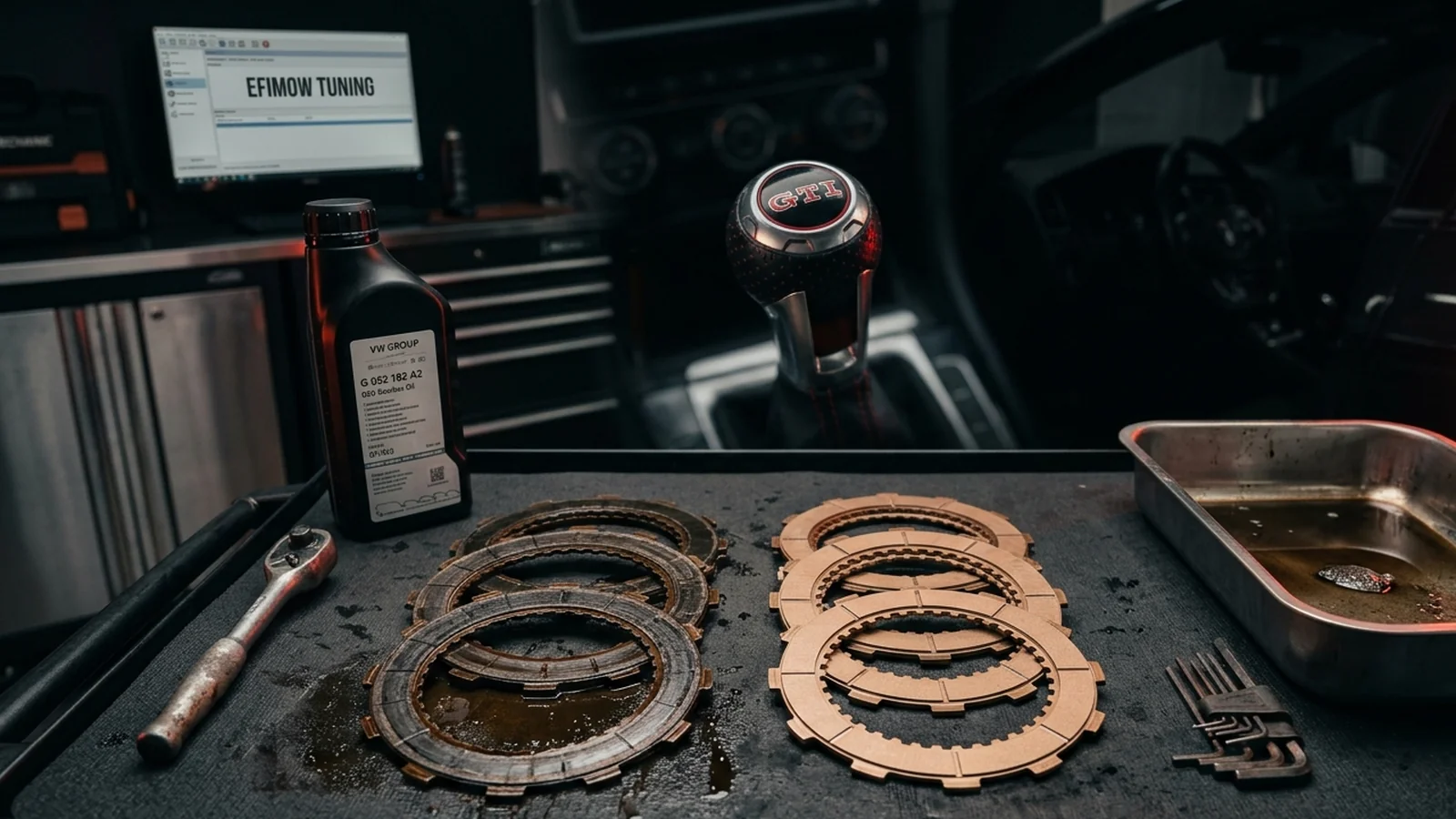
The difference between dry and wet clutches is central for tuning. Wet clutches run in an oil bath, are cooled and cope better with heat and slip. Dry clutches like those in the DQ200 are lighter and more efficient, but more sensitive to overload and heat, for example when pulling away uphill with a trailer.
What the gearbox control does
Every DSG has a mechatronic unit: hydraulics and control unit combined, mounted directly on the gearbox. Among other things it controls:
- Clutch pressure: how hard the plates are pressed together. It determines how much torque is transmitted without slip.
- Shift points and shift programs: when to shift up and down, depending on the drive mode.
- Overlap during shifts: how quickly one clutch opens and the other closes.
- Torque limits: which engine torque the gearbox accepts, possibly per gear.
- Adaptations: the gearbox continuously learns clutch wear and friction values and adjusts.
Engine and gearbox control constantly exchange data over the CAN bus. If the gearbox requests a brief torque reduction during a shift, the engine ECU executes it. If the engine reports more torque than the gearbox expects, the gearbox control reacts with protective measures.
What happens after engine tuning
When a Stage 1 software raises torque, there are three typical scenarios:
1. Torque stays within the gearbox reserve. Many sound engine calibrations deliberately cap torque so that the stock DSG can handle it. The gearbox keeps shifting cleanly and the clutches hold. With moderate Stage 1 calibrations, this is often the case.
2. Torque sits right at or above the limit. The symptoms show first under full load in higher gears: rpm flares briefly without the car accelerating accordingly: the clutch is slipping. Sometimes the gearbox control reduces engine torque, and the car feels held back despite the tune.
3. The gearbox is adapted too. In the gearbox software, mainly torque limits and clutch pressures are matched to the new engine torque, often shift points and shift times as well. That is a separate software on a separate control unit, independent of the engine software.
How this works in principle on a torque-converter automatic is described in the article on TCU adaptation at BMW. The principle is comparable for a DSG, but the mechanics are different.
What you should watch out for
Before you have your VAG petrol or diesel tuned, it's worth looking at the gearbox:
- Which DSG is fitted? That is usually in the vehicle data or can be clarified via the part number. A DQ200 has considerably less reserve than a DQ381.
- What condition is it in? Judder when pulling away, delayed engagement or harsh shifts in stock form are warning signs. A gearbox that is already struggling won't get better with more torque.
- Oil changes: the wet DSGs (DQ250, DQ381, DQ500) need regular oil changes. After a tune, thermal load rises; an oil change to the manufacturer's schedule (or rather earlier) makes sense.
- Adaptations: after a software change to the engine, it can help to let the gearbox relearn its adaptations in a controlled way.
- Launch control: many DSG cars have a factory launch function in the gearbox software. It puts heavy load on the clutches; frequent launches cost service life.
When you send us an inquiry for your car, feel free to mention the gearbox directly. Then we can clarify how the engine software fits the reserve of your DSG.
An example: Golf 7 GTI
The Golf 7 GTI with 220 hp uses a Simos 18 engine ECU; Stage 1 there starts at €450. For the Simos family, typical guide values are 25–40 % more power and 20–40 % more torque. These are ranges, not promises. Torque in particular shows why the gearbox has to be considered: whether a DQ250 or a DQ381 sits behind the engine makes a clear difference to the reserve.
On smaller engines with the DQ200, the margin is even tighter. How that plays out on the 1.4 TSI is covered in 1.4 TSI chip tuning.
Driving style and gearbox
How long a DSG lasts after tuning depends not only on the software but also on how you drive. Some habits put particular strain on the clutches:
- Creeping in traffic jams: rolling slowly without throttle keeps the clutch slipping. On the dry DQ200 that generates a lot of heat.
- Holding on a hill with throttle instead of the brake: here too the clutch slips continuously.
- Full load from low rpm: high torque peaks at low revs stress clutches and dual-mass flywheel more than revving up briskly.
- Frequent launches: a high peak load every time.
On the other hand, the gearbox benefits if you drive the first kilometres gently after a cold start until the gearbox oil is up to temperature. On wet DSGs in particular, oil temperature is decisive for shift quality and clutch wear.
Legal
Gearbox software is also a software change to the vehicle. The software change voids your vehicle's type approval; the software is intended for motorsport use only.
Conclusion
The DSG is not a side issue in VAG tuning. A DQ200 tolerates considerably less than a DQ250, and a DQ381 offers more reserve than both. A good engine calibration respects the limit of the fitted gearbox, either through deliberate torque limiting or through a matching adaptation of the gearbox software. Knowing the gearbox type and its condition before tuning avoids the typical consequential damage to clutches and mechatronics.
Which gearbox goes with your engine and what is possible for your car is easiest to clarify via the configurator and a short note about the gearbox in your inquiry.