
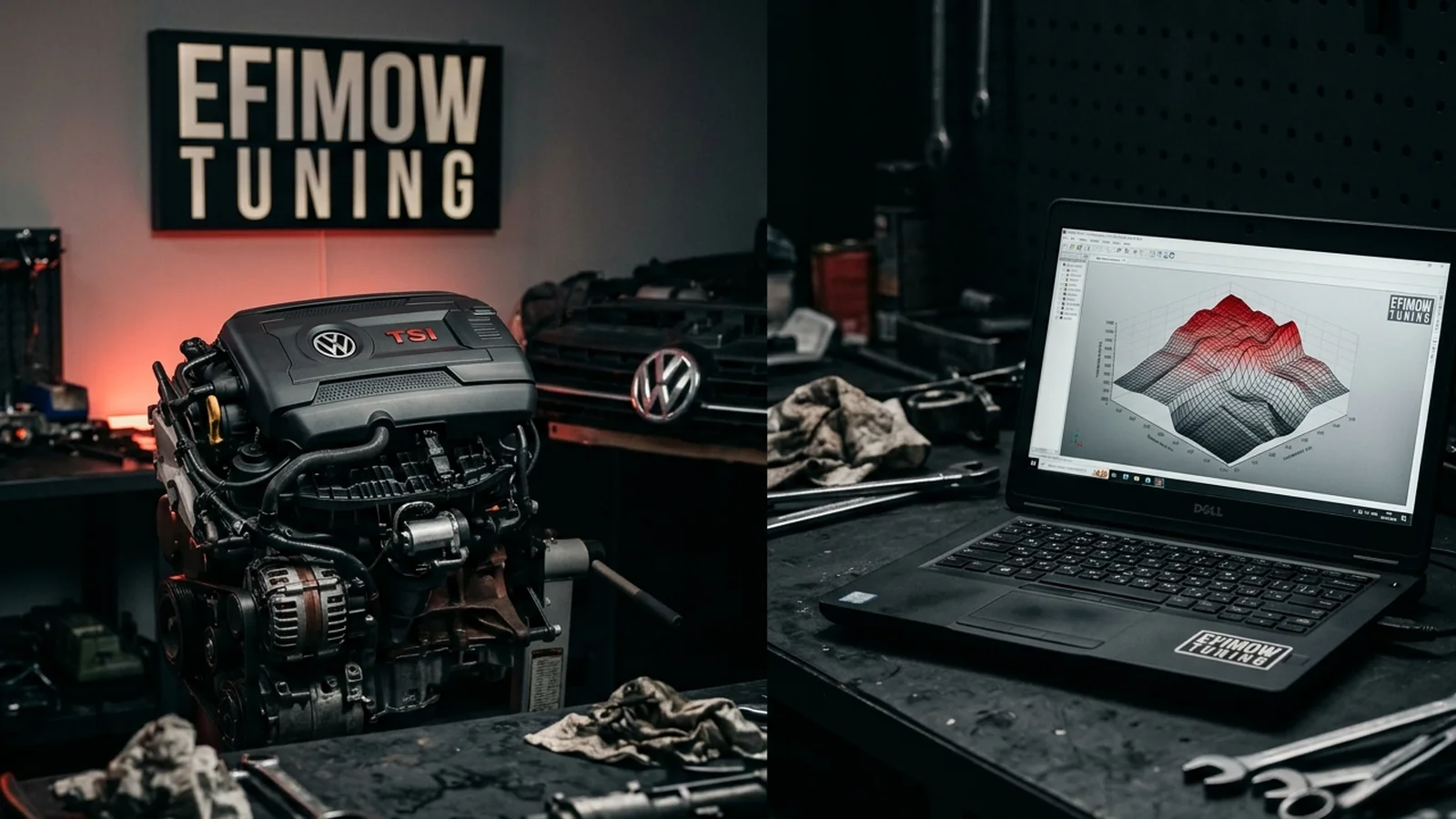
1.4 TSI (EA111/EA211) Chip Tuning: Potential and Limits
1.4 TSI from EA111 and EA211: which engines and ECUs are behind it, what software delivers, and where timing chain, knock and DSG set the limits.
October 25, 2026 by Leo Efimow
Hardly any engine sits in as many Volkswagen Group cars as the 1.4 TSI. Golf, Polo, Leon, Octavia, A3: for more than ten years the small turbo petrol was the workhorse of the compact class. For tuning it is a rewarding subject because it responds strongly to boost. At the same time, "1.4 TSI" is not one engine: behind the badge are two engine families, several charging concepts and different ECUs. Mix them up and you end up comparing apples with oranges.
Two families: EA111 and EA211
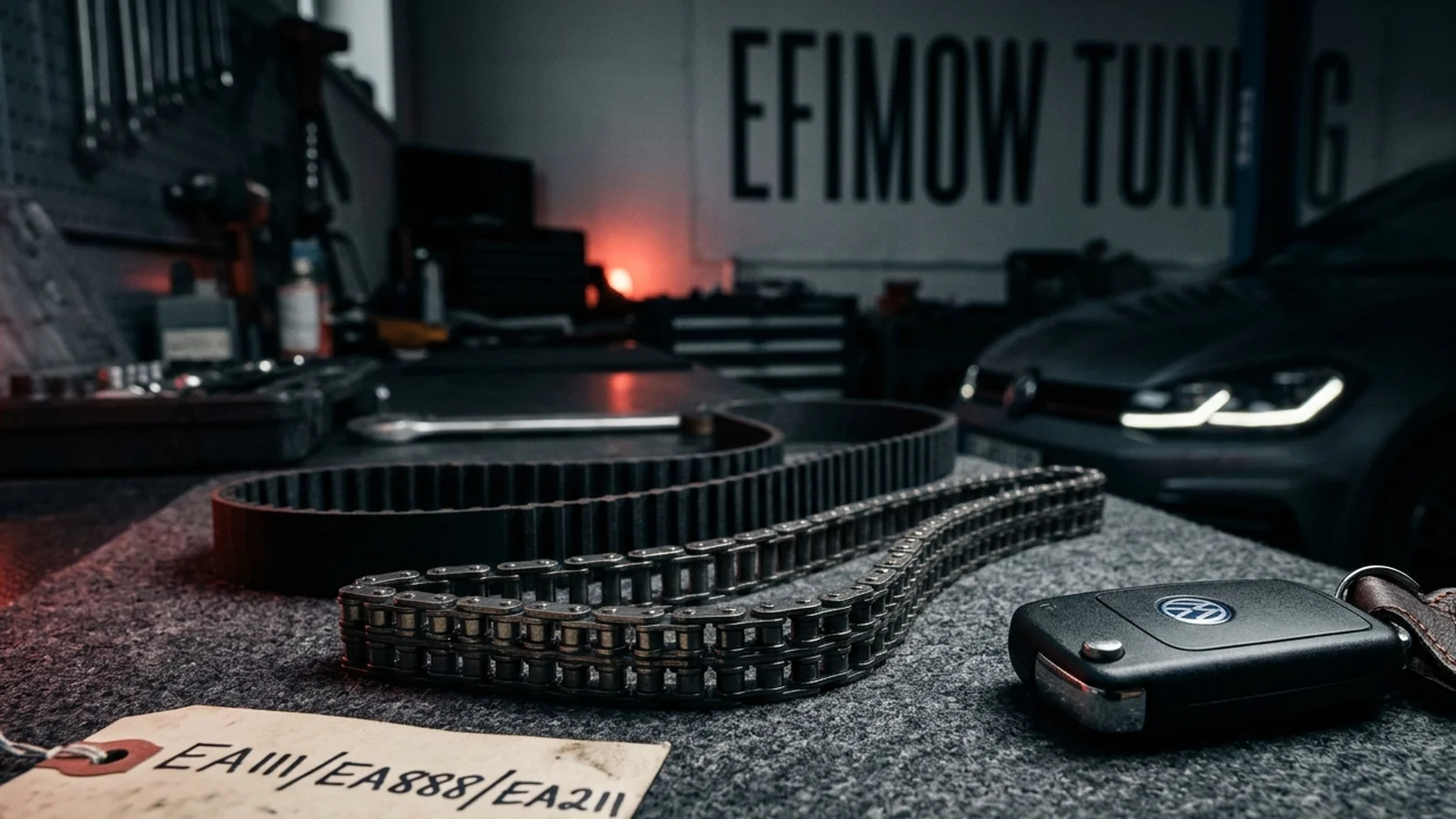
The older generation belongs to the EA111 family. Typical examples are the CAXA with 122 hp in the Golf VI and Octavia II, the CAXC with 125 hp, and the twincharger versions with supercharger plus turbo, such as the CAVD with 160 hp in the Golf VI or the CAVE with 180 hp in the Polo GTI 6R. On the EA111, the camshafts are driven by a timing chain.
With the MQB generation, from around 2012, came the EA211. It was a new design with an aluminium crankcase and a toothed belt instead of a chain. A well-known example is the CHPA with 140 hp in the Golf VII, which uses cylinder deactivation (ACT): at part load two cylinders are shut down.
For you this means: check the registration document or the engine code before comparing tuning offers. A 122 hp 1.4 TSI from a Golf VI and a 140 hp one from a Golf VII have little in common technically.
The ECUs: almost always Bosch MED17
The 1.4 TSI engines almost always use a Bosch MED17, in the variants MED17.5.5, MED17.5.20 or MED17.5.21. The smaller EA111 1.2 TSI engines, by contrast, often run a Siemens/Continental Simos 10. The very early twinchargers in the Golf V still used a Bosch MED9.5.10.
That matters for access. According to the PCMflash module list, the MED17.5.x can be reached through the diagnostic port (module 48 for UDS ECUs, 65 for older CAN TP2.0/K-Line variants); reading is virtual, meaning via a database of stock files. The MED9.5.10 of the Golf V twinchargers, on the other hand, is listed under module 77 as boot access, so the ECU has to be opened. The access methods in general are covered in OBD, bench and boot compared.
What software delivers on the 1.4 TSI
For the MED17 family on VAG turbo petrol engines, the typical guide values for a Stage 1 software are 20–35 % more power and 20–40 % more torque. For the 1.2/1.4 TSI variants with a Simos ECU, 15–30 % power is the guide value. These are ranges, not promises. Condition, software version and fuel all play a part.
You notice it mainly in the midrange. After a clean calibration, a 1.4 TSI drives more like a bigger engine: fewer downshifts, more reserve for overtaking, calmer cruising at motorway speed. The main changes are boost targets, cylinder filling, ignition timing and torque limiters.
The limits: where it gets tight on the 1.4 TSI
A small engine with high specific output naturally has less margin than a big one. These are the points to know:
- Timing chain (EA111): chain stretch on the EA111 is well known. An engine with a stretched chain needs a repair, not a tune.
- Knock resistance: small, highly boosted direct-injection engines are sensitive to poor fuel and high intake air temperatures. Knock control stays active and pulls ignition timing when needed, and part of the gain is gone. That is intended and protects the engine.
- Gearbox: many 1.4 TSI engines are paired with the dry seven-speed DQ200 DSG, rated for around 250 Nm. Torque then has to fit the gearbox limit. More in DSG DQ250/DQ381 after engine tuning.
- Clutch on manuals: a clutch that already slips won't get better with more torque.
- Ignition: spark plugs and coils should be in good condition, otherwise misfires under load follow.
Stage 2 on the 1.4 TSI?
The research data lists Stage 2 as feasible for the MED17 family, for turbo variants with hardware. On the 1.4 TSI, though, the headroom is smaller than on an EA888 two-litre: the turbo is compact, and the drivetrain often sets a limit before the engine does. Stage 2 here mainly means better charge cooling and exhaust flow after the turbo, with a catalytic converter and approval. Want more, and you quickly end up with modifications beyond the scope of an everyday car. The basics are covered in the "Stage 2 tuning" article on our blog.
What changes in everyday driving
A tuned 1.4 TSI doesn't feel fundamentally different in town. The differences show where the stock engine reaches its limits: accelerating onto the motorway, overtaking on country roads, with a fully loaded car or uphill. The engine needs to downshift less often and holds its torque across a wider rev range.
On fuel consumption: if you use the extra power regularly, you'll use more fuel. If you drive the same way as before, you often won't notice much difference, because at the same driving style the engine works in similar load ranges. On EA211 engines with cylinder deactivation, the ACT function stays active at part load; it is part of the stock strategy and a sound calibration leaves it alone.
Maintenance becomes more important, not less: oil changes on schedule, fresh spark plugs and a clean air filter are the best insurance for the small turbo.
Options and legal
For the MED17 family, the following can be booked directly alongside Stage 1: Stage 1+, Sharp Throttle, Vmax removal, DTC Off (non-emissions-related codes only) and the hardcut limiter (the latter for motorsport only). ECO tuning, launch control, no-lift shift, pops & bangs, popcorn limiter and anti-lag are only available on request after checking the file, because feasibility depends on the software version.
Disabling the catalytic converter's cold-start heating strategy, the secondary air system or lambda monitoring is emissions tampering and prohibited on public roads. And in general: the software change voids your vehicle's type approval; the software is intended for motorsport use only. Details in the motorsport notice.
Prices and process
The 1.4 TSI variants with MED17 fall into the price tier of the 17 ECU generation. Two examples from the catalog:
| Vehicle | Engine code | ECU | Stage 1 | Stage 2 |
|---|---|---|---|---|
| VW Golf VI 1.4 TSI, 122 hp | CAXA | Bosch MED17.5.5 | from €250 | from €325 |
| VW Golf VII 1.4 TSI, 140 hp | CHPA | Bosch MED17.5.21 | from €250 | from €325 |
For the Golf VII 1.4 TSI with 140 hp, price and options are shown on the product page. Newer models can be higher because of model-year surcharges. The configurator shows you the exact figure.
You either come to Stödtlen for an appointment of your choice, or you send the ECU in. The price is the same either way. The original file is saved before any change.
Conclusion
The 1.4 TSI responds well to software, but it is less forgiving than a big engine. The first question is which 1.4 TSI it actually is: EA111 or EA211, with or without supercharger, MED17 or another ECU. Then come condition and drivetrain: timing chain, ignition and above all the gearbox. Check those points honestly and you get a noticeably stronger everyday engine without overstretching the small turbo.
Which variant you drive and what is possible on it is shown in the configurator: select the engine code, see price and options.