
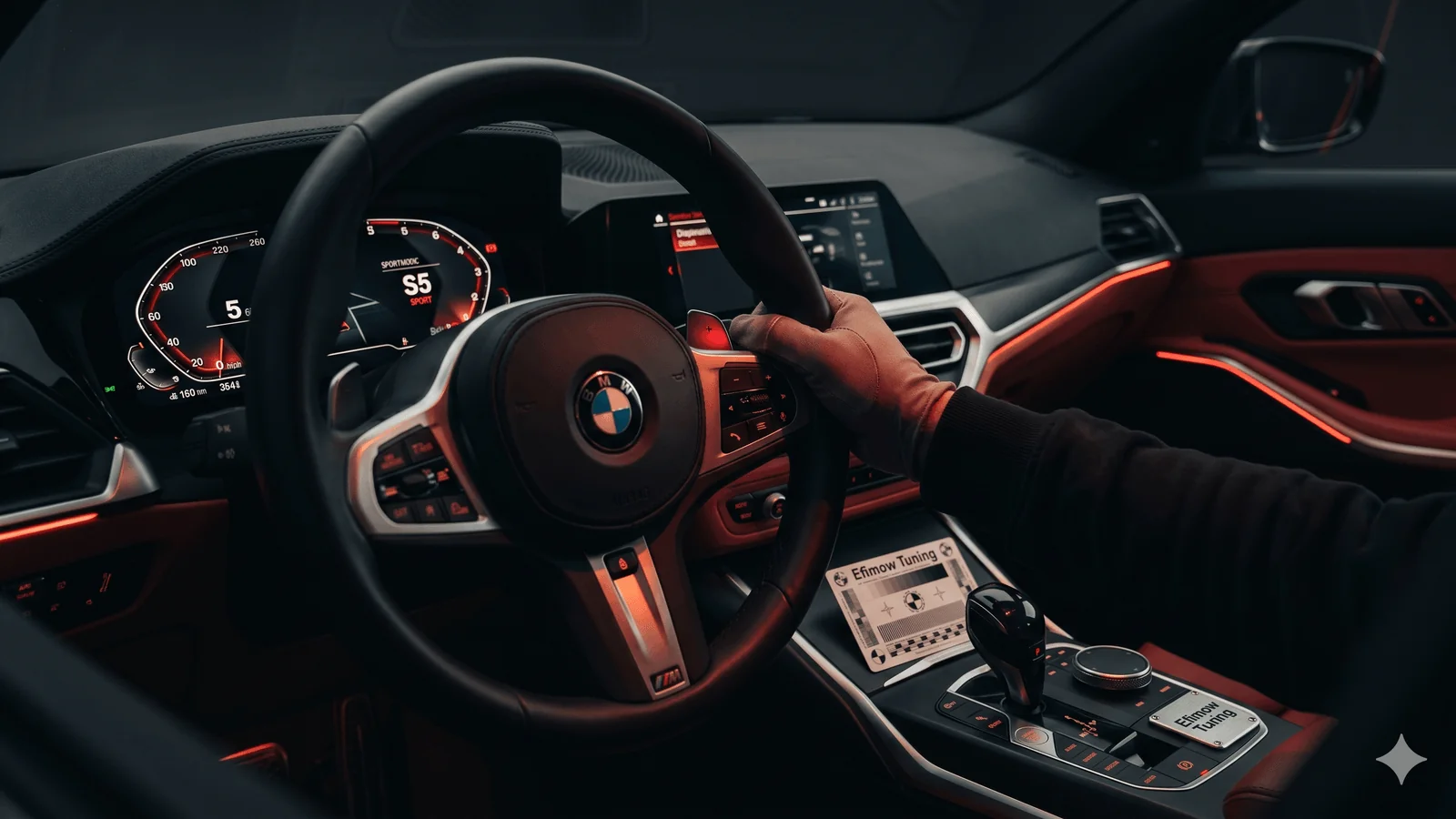
DSG/Steptronic TCU on BMW: Why the Transmission Software Must Be Tuned Too
Stage 1 without a TCU update feels great until the gearbox slips. What the TCU controls, what needs adjusting, and why it's a non-negotiable step.
May 6, 2026 by Leo Efimow
If you drive a BMW M340i with Stage 1 and put your foot down for the first time, you know the feeling: the engine pulls noticeably harder, the acceleration feels a class or two bigger. And after three or four kilometers, something in the drivetrain starts pushing back. Shifts get harsh, torque buildup gets visibly clipped, and in the worst case the car drops into limp mode. The cause is rarely the engine itself. It is the ZF 8HP Steptronic gearbox and its TCU, the controller that knows nothing about the extra torque the tuned engine is now delivering.
Why the gearbox becomes a brake without a TCU update
The ZF 8HP is one of the best torque-converter automatics ever built in series production. BMW uses variants in essentially every higher-output G-Series model, from the 330i up to the M340i. But each variant is engineered for a clearly defined maximum input torque, and equally for a specific torque profile across the rev range. The TCU, the Transmission Control Unit, holds those profiles as factory-calibrated maps.
When a Stage 1 tune lifts the B58 engine's torque from around 500 Nm to 600-650 Nm, the TCU sees a value it was never calibrated to expect. Two mechanisms fire at the same time: first, the ECU communicates a torque request to the TCU over the CAN bus, which the TCU interprets as an overrun, and the gearbox is forced to clip the torque via shift logic. Second, the factory-set clutch holding pressure (Kupplungs-Haltedruck) is no longer high enough to transfer the higher torque without slipping.
What the TCU actually controls
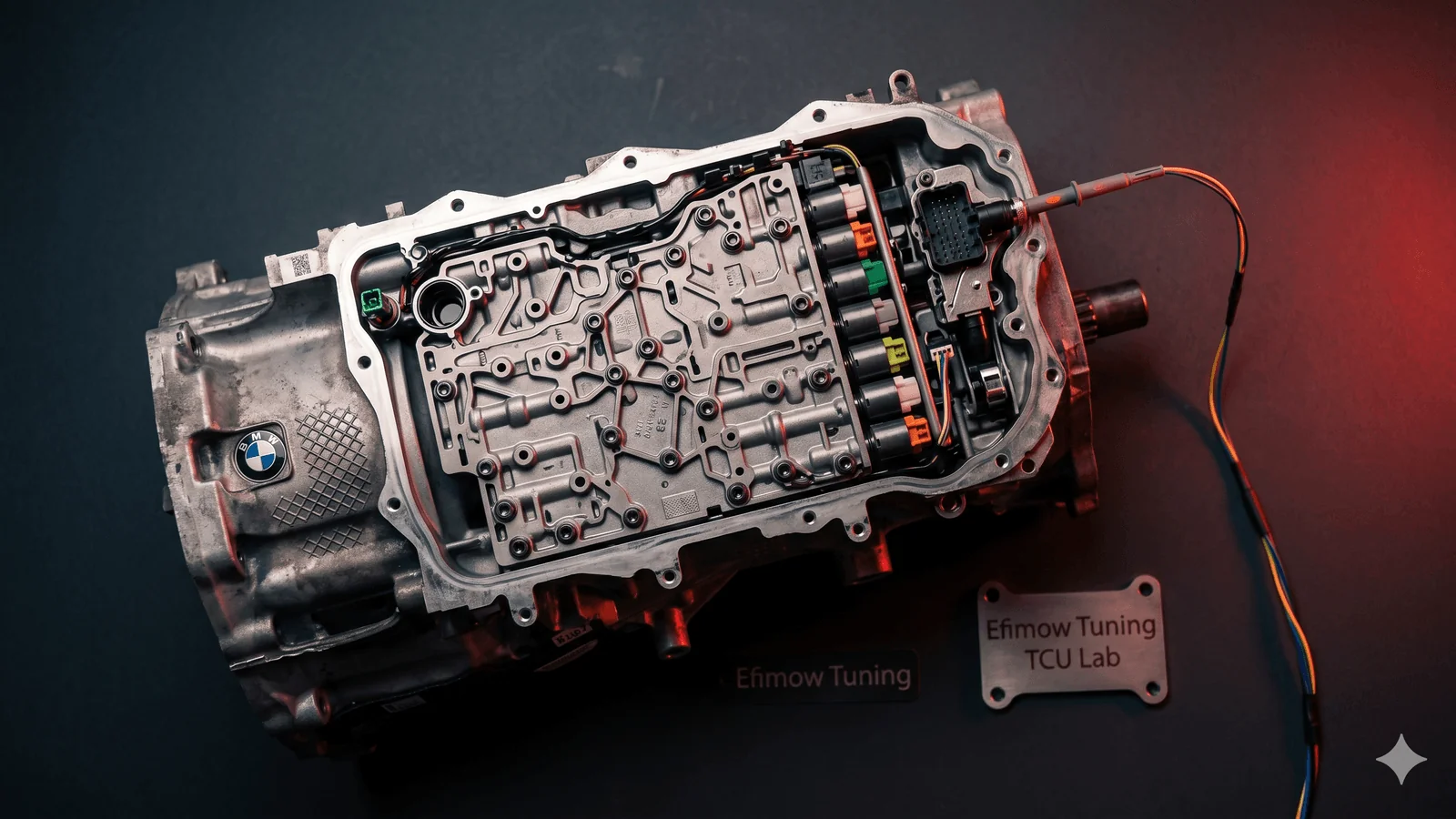
The TCU's job goes far beyond "engage a gear." Simplified, it controls four areas: the hydraulic pressure that closes the wet clutches; the shift timing (when an upshift or downshift fires); the shift profile (how fast and how hard the transition runs); and the torque management during the shift itself, where ECU and TCU briefly cut engine torque so the load step lands cleanly.
Each of these four areas has its own calibration maps. A professional TCU tune touches all four, not uniformly, but matched to the new torque profile coming from the ECU.
What a TCU adaptation actually does
A reputable TCU tune typically covers four interventions. First, the stored torque limit is raised so the TCU stops treating the new ECU values as an overrun. Second, clutch holding pressure (Kupplungs-Haltedruck) is increased, usually 10 to 20 percent, depending on the stage and input torque. This prevents clutch slip under load and extends the life of the clutch packs. Third, the shift logic is reworked: later shift points under full throttle, faster shifts in Sport mode, retained or slightly softer shifts in Comfort mode so daily driving does not suffer.
Fourth, the interplay between ECU and TCU is recalibrated. When the engine cuts torque during a shift, that cut has to match the duration of the shift exactly. If one value moves without the other tracking it, you get either a hard jolt or a torque hole.
What most providers skip but should not: an honest TCU tune includes adaptation handling. The ZF 8HP learns continuously in service: clutch wear, oil temperature, shift characteristics adapt over years and live in the controller. If the old adaptation values stay in place after the flash, the gearbox drifts back into the old patterns even with new software. A TCU reset or a controlled re-adaptation belongs at the end of every reputable tune.
What happens if the TCU is not adapted
The symptoms are systematic and reproducible. At first the car subjectively feels faster because the engine is delivering more. But rev climbs end early, because the TCU upshifts before the planned shift point to protect the torque limit. With repeated full-throttle pulls, hard slip appears in the wet clutch, audible as a brief flare in engine speed without matching acceleration.
Between 5,000 and 15,000 km after a Stage 1 tune without TCU work, workshops regularly see the first wear symptoms on the clutch packs. Transmission oil shows measurably more debris at the next service. In the worst case, limp mode kicks in: the car drops into a protective state under load, hard-clips torque, and stores a transmission fault.
TCU tuning as the professional standard
In reputable workshops, the pairing of ECU and TCU work is not an upsell; it is the norm. Typical extra cost sits at 200 to 400 Euro on top of the ECU tune. Measured against an avoidable clutch repair that quickly runs into four figures, that is very cheap insurance.
Worth knowing: a TCU adaptation is neither a guarantee of more wheel power nor a substitute for solid ECU tuning. It is the gearbox-side complement without which the ECU tune cannot put its potential on the road without collateral damage. Anyone running a B58 or N55 beyond Stage 1 (Stage 2 with downpipe, or higher) should plan the TCU adaptation as mandatory, not optional.
What to clarify before the tune
Three questions belong in every preliminary conversation with your tuner. First: is the TCU adaptation included in the package or billed separately? Second: which shift profiles are actually touched: Sport, Sport+, Comfort, or all of them? Third: how is the adaptation read and written: over OBD, or via bench mode on the removed controller? Both paths are valid, but the OBD route is more daily-driver friendly and reversible, while bench mode is sometimes the only option on more heavily locked controllers.
The TCU adaptation is the less visible part of a good Stage 1 package. But it determines whether you can still put that extra torque on the road confidently after 50,000 or 100,000 km, or whether you walk into a workshop bill after the first season.