
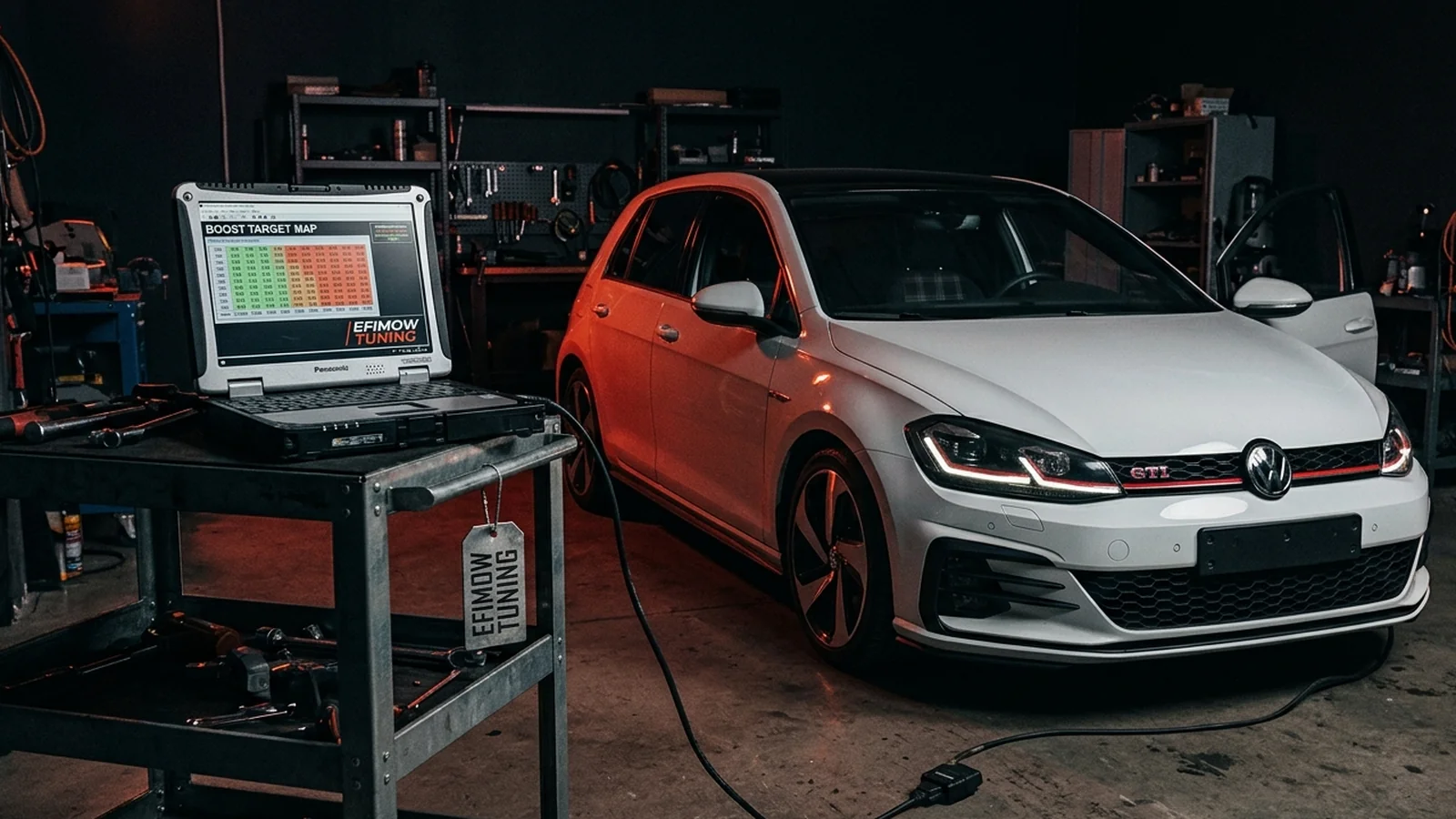
VW Golf 7 GTI (EA888): Stage 1 and Stage 2 at a Glance
Golf 7 GTI with EA888 and Simos 18: what Stage 1 and Stage 2 realistically deliver, why the ECU gets opened and what it costs.
October 25, 2026 by Leo Efimow
For many drivers, the Golf 7 GTI is the entry ticket into turbocharged petrol engines with real headroom. Under the bonnet sits the 2.0 TSI from the third generation of the EA888 family, controlled by a Continental Simos 18. From the factory it makes 220 or 230 PS depending on the version, and that spread alone shows that much of the difference between GTI and GTI Performance is software. If you want to optimise your GTI, don't just look at peak power, though. Look at three things: which ECU is fitted, how it is accessed, and whether gearbox and clutch match the new torque.
Which variants exist
Our catalog lists the Golf 7 (MK7) GTI in three variants, all with Simos 18:
| Variant | Engine code | Stock power | ECU | Stage 1 | Stage 2 |
|---|---|---|---|---|---|
| 2.0 TSI GTI | CHHB | 220 PS | Simos 18 | from €450 | from €550 |
| 2.0 TSI GTI | CNTA | 220 PS | Simos 18 | from €450 | from €550 |
| 2.0 TSI GTI (230 PS variant) | CHHA | 230 PS | Simos 18 | from €450 | from €550 |
The price is made up of the ECU generation plus a surcharge for opening the unit. Simos 18 belongs to the newest, write-protected generation, so it isn't written over OBD but in bench or boot mode. You'll find the details on the product page, for example for the Golf 7 GTI CHHB with 220 PS.
Why the EA888 Gen3 responds so well to software
The third-generation EA888 is a modular engine. The same base engine sits in the GTI, the Golf R, the Audi S3 and the Leon Cupra, with different turbochargers, cooling details and, above all, different software. In the GTI, the engine runs well below what the same mechanics deliver in other group models. That isn't a weakness, it's product policy: VW separates its models via boost pressure, torque limiters and cylinder-fill targets.
A Stage 1 calibration shifts exactly these targets: boost, fill, ignition timing and torque limiters. The protective functions (knock control, component protection for turbine and exhaust gas temperature, lambda targets) stay active and are re-tuned to the new load points. As a typical guide value, the EA888 Gen3 family with a Simos ECU gains roughly 25–40 % power and 20–40 % torque. These are ranges from our research per ECU family, not a promise for your car. Condition, fuel quality and software version decide where you end up.
Stage 1: the sensible standard
For most GTI drivers, Stage 1 is the right level. The hardware stays stock, and the engine gains noticeable pull mainly in the mid-range. You'll feel it more when overtaking on a country road or accelerating out of a motorway slip road than in the peak figure alone.
What you should check beforehand:
- Spark plugs and coils: Higher cylinder pressure is less forgiving of worn plugs. A fresh set with the correct heat range costs less before the tune than troubleshooting afterwards.
- Fuel: The calibration targets a specific octane rating. If you regularly fill up with 95-octane E10, say so beforehand.
- Oil changes and service history: A well-maintained engine is the foundation. Our post on oil change intervals after tuning goes into more detail.
- Clutch on manual cars: A worn stock clutch quickly shows itself after Stage 1 by slipping in a high gear under load.
Stage 2: when hardware comes in
Stage 2 relies on hardware: a downpipe with catalytic converter and approval certificate, a larger intercooler and a better intake. The software is then tuned to the lower flow losses and cooler intake air. The gain comes less from more boost at any price and more from an engine that can hold its boost when hot and over time.
On the GTI, Stage 2 mainly pays off for drivers who regularly run long full-load phases, on track for instance. For daily use, a good intercooler often brings more consistency than a downpipe. Important: an exhaust without a catalytic converter is not permitted on public roads, and that includes so-called "race downpipes". Our post on Stage 2 tuning explains the basic structure of the stages.
Access: why the Simos 18 is opened
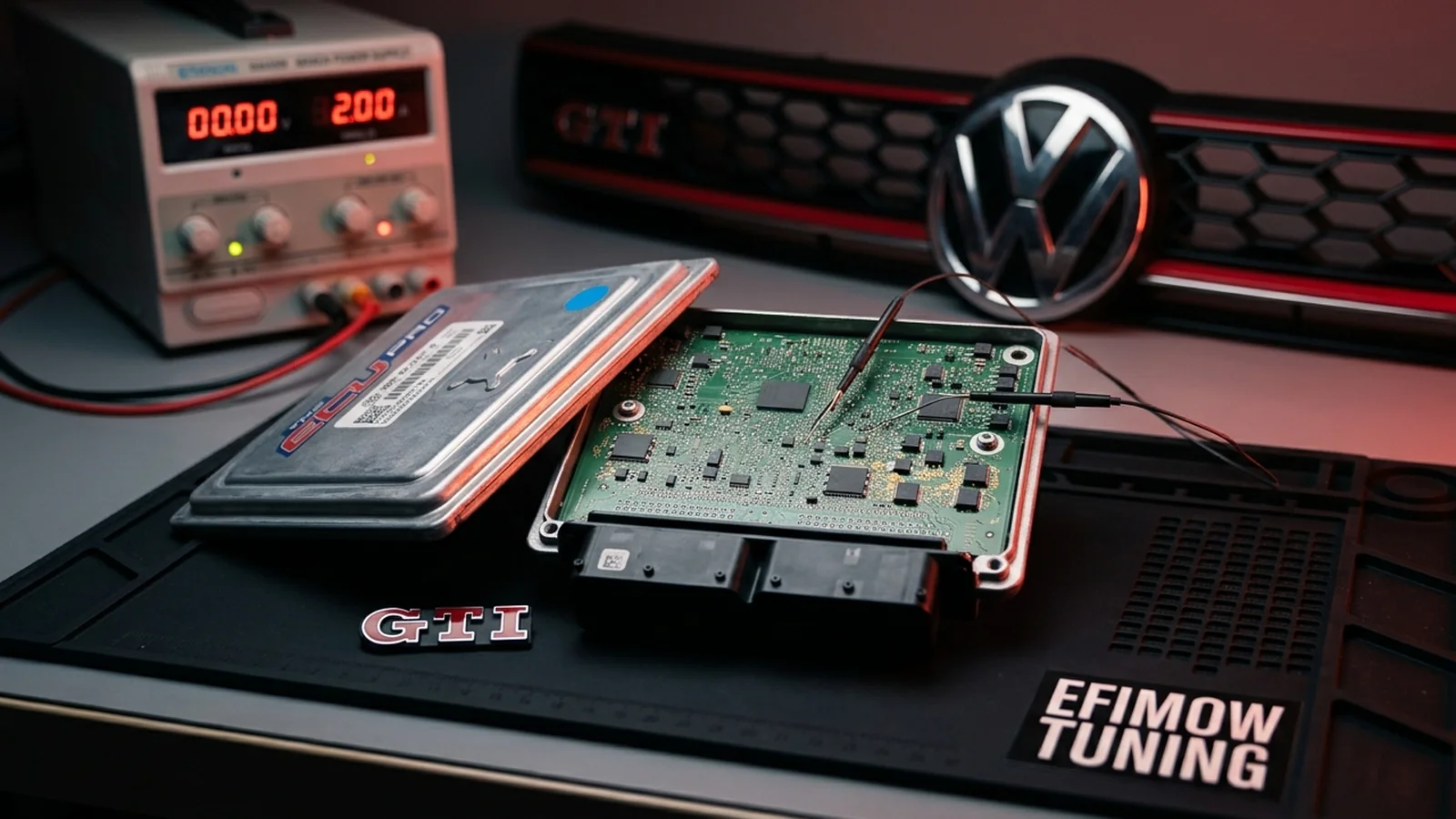
On the Simos 18, writing over the OBD port is blocked depending on the software version. To read the complete data and write the adapted software cleanly, the ECU is removed and handled on the workbench in bench or boot mode. The housing is opened and the Tricore processor is addressed directly. That sounds more involved than it is. What matters is clean removal, a stable power supply and proper resealing. The background is covered in Simos 18: why the ECU has to be opened.
For you, that means: either you come to us in Stödtlen and book an appointment that suits you, or you remove the ECU and send it in. The price is the same either way, and booking is done online via the configurator.
Options for the GTI
For the Simos family, the configurator offers these bookable options:
- Stage 1+ as a sharpened level on stock hardware
- ECO tuning with more torque at part load; on a petrol engine the fuel-saving effect is smaller than on a diesel
- Sharp Throttle for a more direct accelerator pedal
- Vmax removal: mind the tyre speed rating and registration requirements
- DTC Off only for non-emissions-related fault codes, for example after an approved conversion
- Launch Control, Hardcut Limiter, Pops & Bangs and Popcorn Limiter: strictly for motorsport on closed circuits
No-Lift Shift and Anti-Lag are only available on request after checking the file on the Simos 18, because they depend on the software version.
A word on emissions: later Simos 18 software versions from around 2018 work with a gasoline particulate filter, and some EA888 Gen3 engines have a secondary air system. Disabling these components in software or removing them is emissions tampering and prohibited on public roads, no matter how easy it would be technically.
DSG and clutch
Many GTIs run a wet-clutch DSG. The transmission control unit knows a maximum input torque and counteracts anything above it via shift logic and clutch pressure. After an engine optimisation it can therefore make sense to look at the gearbox software as well. Otherwise you'll mostly notice the new torque as harsher or slipping shifts. What happens there is described in our post on DSG DQ250 and DQ381. Whether your car needs an adjustment is something we clarify when we review your inquiry.
Law and type approval
The software change voids your vehicle's type approval; the software is intended for motorsport use only. That applies to Stage 1 as much as to Stage 2 and every additional function. You'll find the details in the motorsport notice.
Conclusion
With its EA888 Gen3 and Simos 18, the Golf 7 GTI is a very good base: plenty of headroom on stock hardware, a clear split between Stage 1 and Stage 2, and an ECU that has to be opened but in return gives full access to every relevant map. If your car is well maintained and you keep an eye on the gearbox, Stage 1 gives you a much stronger GTI without losing its everyday character.
If you want to know what applies to your GTI, pick model and engine code in the configurator. You'll see price and options there and can book an appointment in Stödtlen or shipping of the ECU right away.