
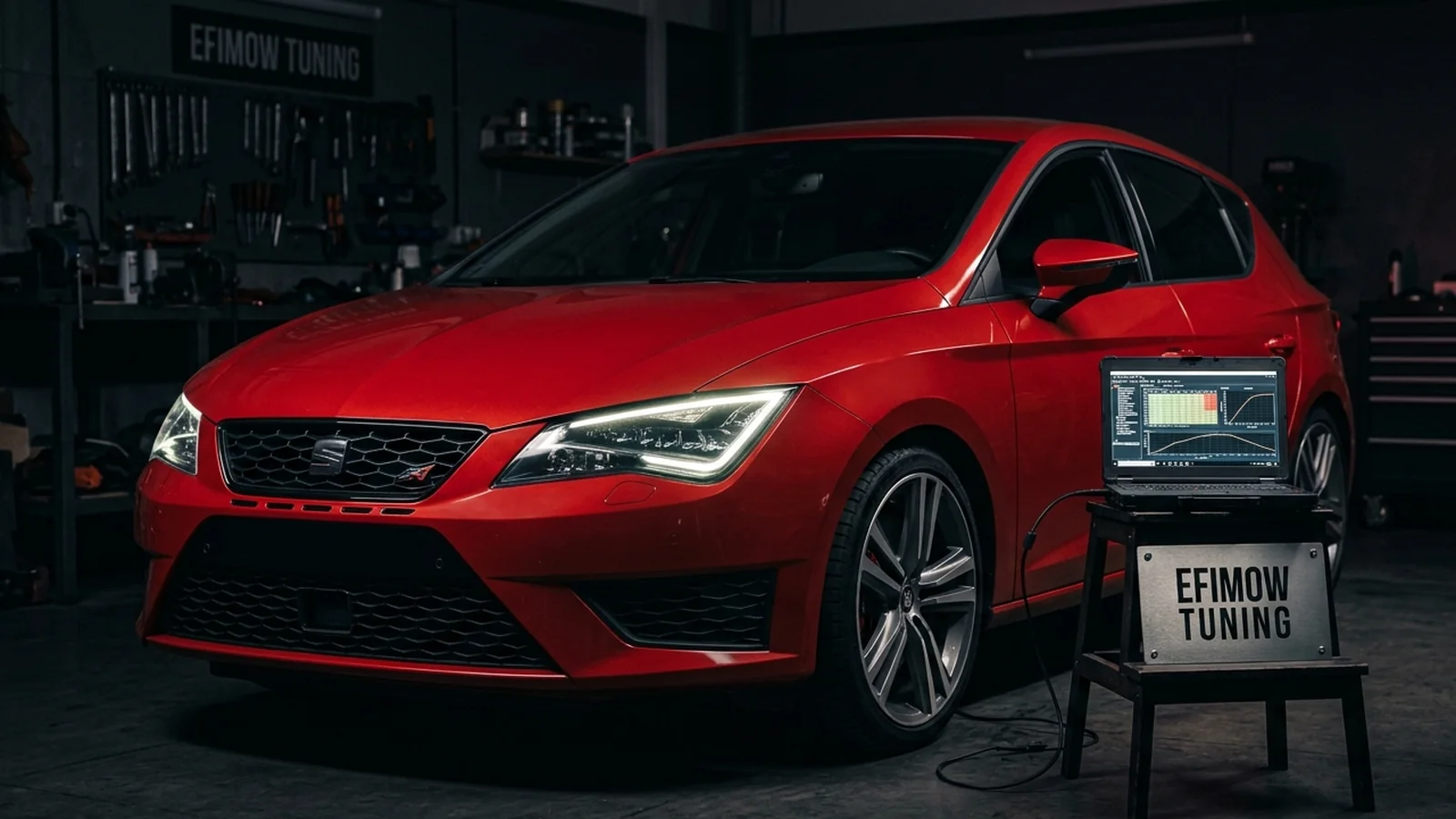
Seat Leon Cupra (5F): Software for the Sporty Spaniard
Leon Cupra 5F with 265 or 280 PS and Simos 18: realistic Stage 1 ranges, bench/boot access, options and how the 1P predecessor differs.
October 25, 2026 by Leo Efimow
The third-generation Seat Leon Cupra (5F) is the sporty offshoot of the Leon and shares its technology with the Golf GTI, Golf R and Octavia RS: a 2.0 TSI from the third-generation EA888 family, front-wheel drive and a Continental Simos 18 as engine ECU. From the factory the Cupra comes with 265 or 280 PS, clearly more than a Golf GTI, but with the same base engine. That makes it an interesting basis for software tuning, with a few particularities you should know about.
The variants in the catalog
Our catalog lists two engine codes for the Leon III (5F) Cupra:
| Engine code | Stock power | ECU | Stage 1 | Stage 2 |
|---|---|---|---|---|
| CJXE | 265 PS | Simos 18 | from €450 | from €550 |
| CJXA | 280 PS | Simos 18 | from €450 | from €550 |
Both variants are below 300 PS, so there is no power surcharge. The price includes the surcharge for opening the ECU, because the Simos 18 isn't written over OBD. The product page of the Leon Cupra CJXA with 280 PS shows you the breakdown in detail.
What the EA888 delivers in the Cupra
The EA888 Gen3 is a modular engine that runs at very different power levels across the group's models. In the Cupra it already works noticeably harder than in the GTI, but with front-wheel drive instead of all-wheel drive. That has consequences: the factory power release is also governed by traction, especially in the lower gears.
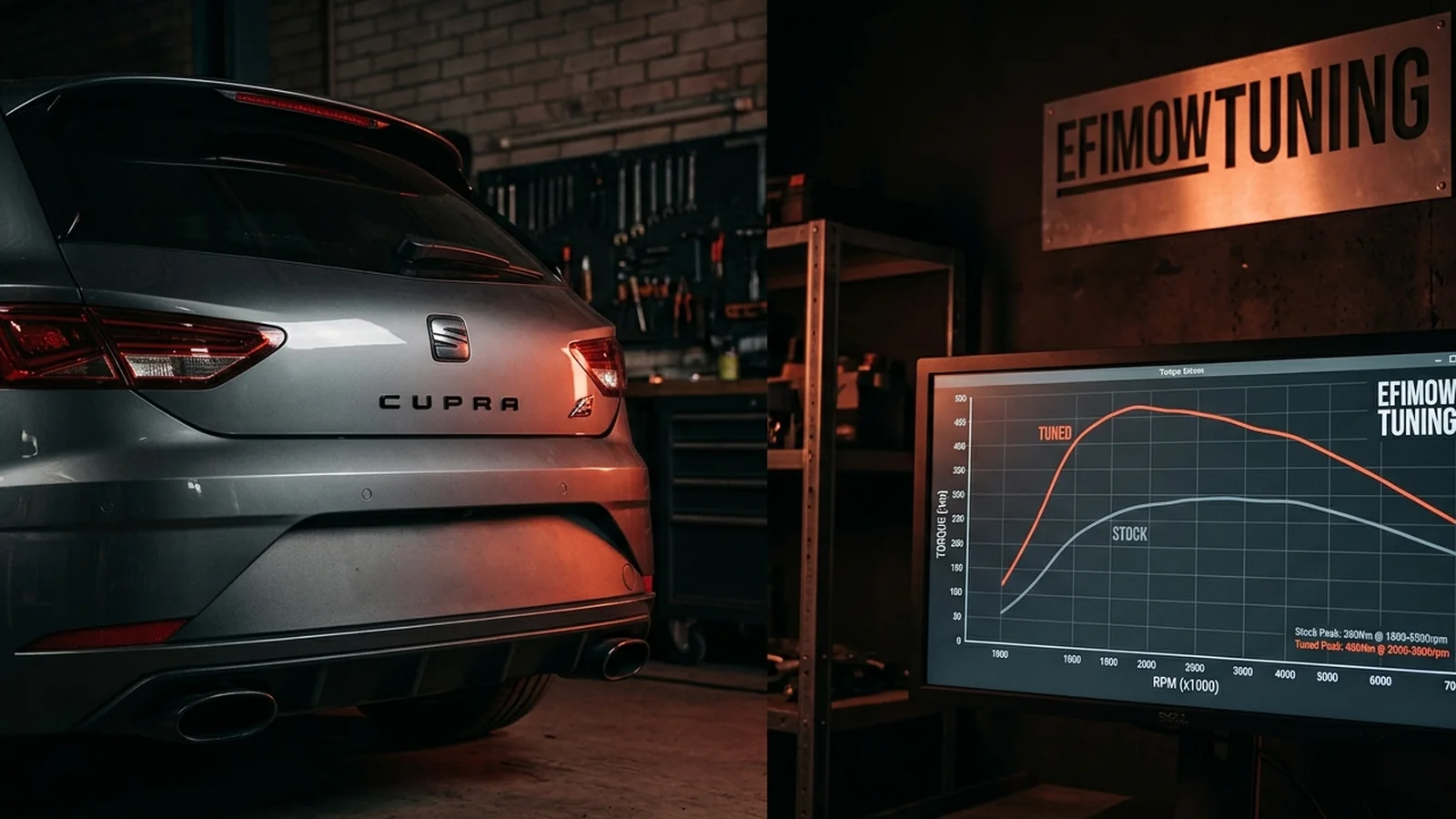
As a typical guide value, EA888 Gen3 engines with a Simos ECU gain 25–40 % power and 20–40 % torque at Stage 1. On the Cupra, with its already high stock output, the lower to middle part of that range is more realistic. Boost, cylinder fill, ignition timing and the torque limiters are adjusted, while knock control, component protection and lambda targets remain active.
On a front-wheel-drive car with this much power, a good calibration isn't the one that releases the most torque in first gear, but the one that shapes the torque build-up so the front wheels can actually transmit it. More torque in second and third gear brings far more in daily driving than a peak that ends in wheelspin.
Check before tuning
A Cupra is rarely driven gently. So a quick check before tuning is worthwhile:
- Spark plugs and ignition coils: With higher cylinder pressure, the EA888 is sensitive to old plugs.
- Tyres and suspension: Front-wheel drive plus more torque demands good tyres. Worn front tyres turn any calibration into a lottery.
- Clutch or DSG: Manual clutches and the DSG's transmission control have their torque limits. With a wet DSG it can make sense to look at the gearbox software; what lies behind that is explained in our post on DSG DQ250 and DQ381. Whether your car needs it is something we clarify when we review your inquiry.
- Fault memory and charge-air path: Leaks and old faults should be fixed before tuning.
Access to the Simos 18
On the Simos 18, writing over OBD is blocked depending on the software version. For complete reading and writing, the ECU is removed, opened and handled directly at the Tricore processor in bench or boot mode. That requires care during removal and a stable power supply on the bench. First, the original file is backed up. It is the basis for any later return to stock. Our post Simos 18: why the ECU has to be opened explains it in detail.
You have two routes: an appointment with us in Stödtlen at a time that suits you, or remove the ECU and send it in. The price is the same, and in both cases booking is done online via the configurator.
Stage 2
Stage 2 combines software with hardware: a downpipe with catalytic converter and approval certificate, an intercooler, a better intake. On the Cupra, the larger intercooler in particular keeps power stable under repeated full load. An exhaust without a catalytic converter is not permitted on public roads. Later Simos 18 software versions from around 2018 partly work with a gasoline particulate filter; disabling or removing it is emissions tampering and prohibited on public roads.
Options
For the Simos family you can book in the configurator: Stage 1+, ECO tuning, Sharp Throttle, Vmax removal and DTC Off (only for non-emissions-related fault codes). On top come Launch Control, Hardcut Limiter, Pops & Bangs and Popcorn Limiter, strictly for motorsport on closed circuits. No-Lift Shift and Anti-Lag are only available on request after checking the file, because they depend on the software version.
Launch Control in particular is a topic for the track, not the traffic lights, on a front-wheel-drive car: launching with a spooled turbo puts considerable load on clutch, gearbox and drive shafts.
And the 1P predecessor?
If you drive a Leon II (1P) Cupra, you technically have a different car: the 2.0 TFSI with 241 PS (BWJ) runs a Bosch ME9.1, the Cupra R with 265 PS (CDLA) a Bosch MED9.1.5. These are older ECU generations with correspondingly lower prices. You'll see the details in the configurator when you select the Leon II there.
Original file and return to stock
Before any change, the original file is backed up. On the Simos 18, complete reading via bench or boot access is the step that makes a later return to stock reliable. That matters if you want to sell the Cupra or set it back to stock.
Daily life after tuning
A tuned Cupra stays an everyday car if you keep a few things in mind:
- Cold start and warm-up: Full load only once the oil is up to temperature. That applies to every turbo engine, but all the more with extra power.
- Maintenance: Spark plugs and oil changes at somewhat shorter intervals are cheap insurance.
- Fault memory and shift behaviour: If new faults appear after tuning or the gearbox reacts unusually under load, get in touch early.
- Tyres: The front tyres wear faster with more torque. Plan for it.
Law
The software change voids your vehicle's type approval; the software is intended for motorsport use only. That applies to every stage and every additional function. More in the motorsport notice.
Conclusion
With the EA888 Gen3 and the Simos 18, the Leon Cupra 5F brings a very good technical basis. The key lies less in maximum percentages than in a calibration that suits front-wheel drive, and in a drivetrain that can take the extra torque. With healthy hardware and a good service history, the Cupra becomes noticeably stronger without losing its everyday usability.
Select your Leon and the engine code in the configurator to see price and options and book an appointment or shipping directly.