
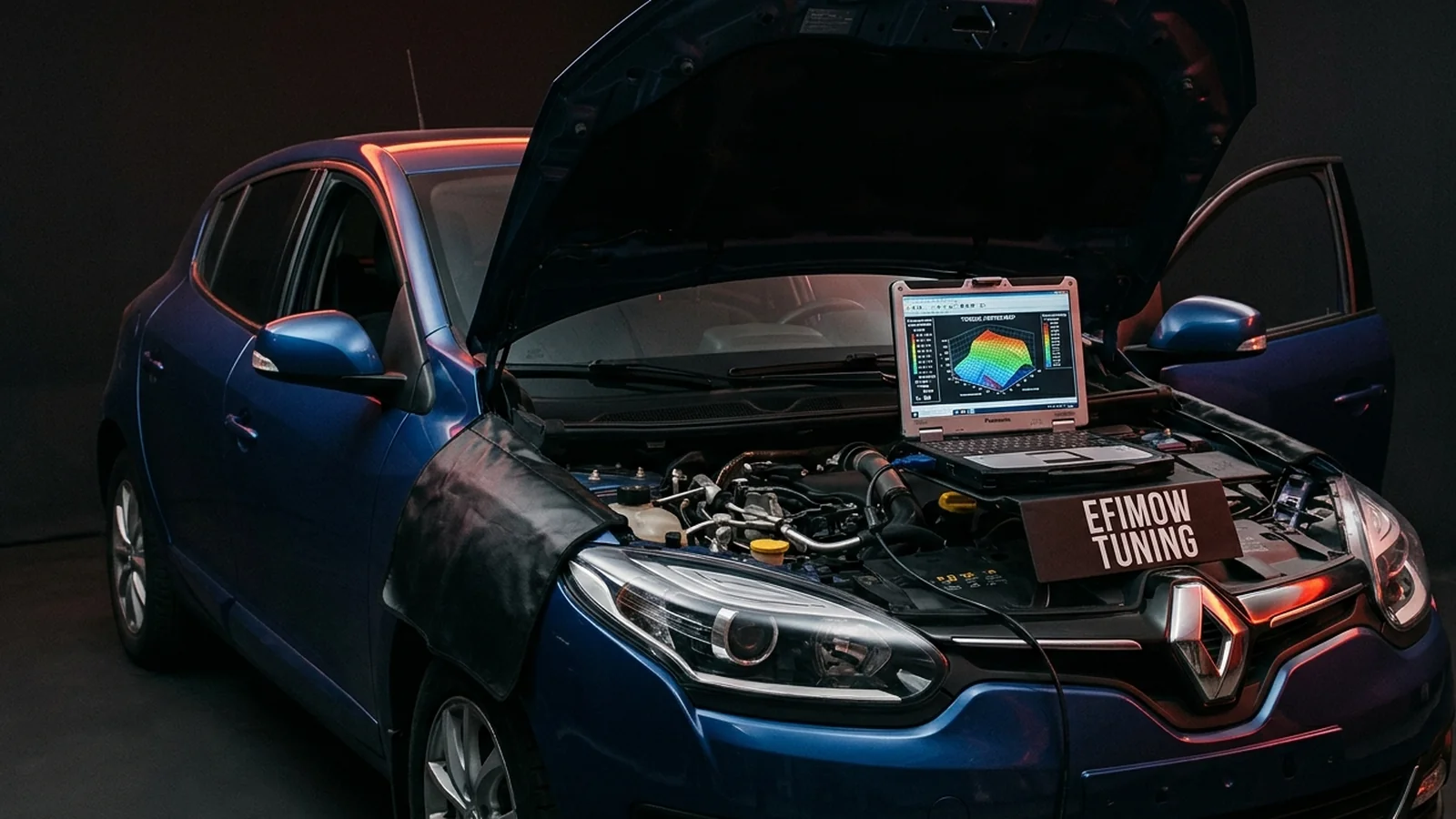
Renault 1.5 dCi (K9K): Tuning the Diesel That Is Everywhere
Clio, Megane, Duster, Qashqai: the K9K sits in countless models. Which ECUs exist, what software delivers and what you need to watch out for.
October 25, 2026 by Leo Efimow
Hardly any diesel engine is as widespread as Renault's 1.5 dCi. The four-cylinder with the engine code K9K arrived in the early 2000s and has since been fitted to the Clio, Megane, Scenic, Kangoo, Captur and Kadjar, the Dacia Logan, Sandero, Duster and Dokker, the Nissan Micra, Note, Juke and Qashqai, as well as vehicles from other manufacturers within the Alliance and its partnerships. For workshops it is everyday business. For tuning it means: there is no single "1.5 dCi", but many power levels, emission standards and, above all, ECUs.
The power levels
Our catalog lists the K9K in power levels from 57 to 110 hp. Roughly, three groups can be distinguished:
- Entry versions with 57 to 75 hp, mainly in early Kangoo, Clio and Logan models
- The middle with 82 to 90 hp, the most common range in the Clio, Megane, Scenic, Sandero and Duster
- The stronger versions with 103 to 110 hp in the Megane, Scenic, Kangoo, Laguna, Qashqai and Juke
On top of that come the newer Blue dCi versions with SCR and AdBlue, for example in the Clio V, Megane IV, Kadjar and Duster II.
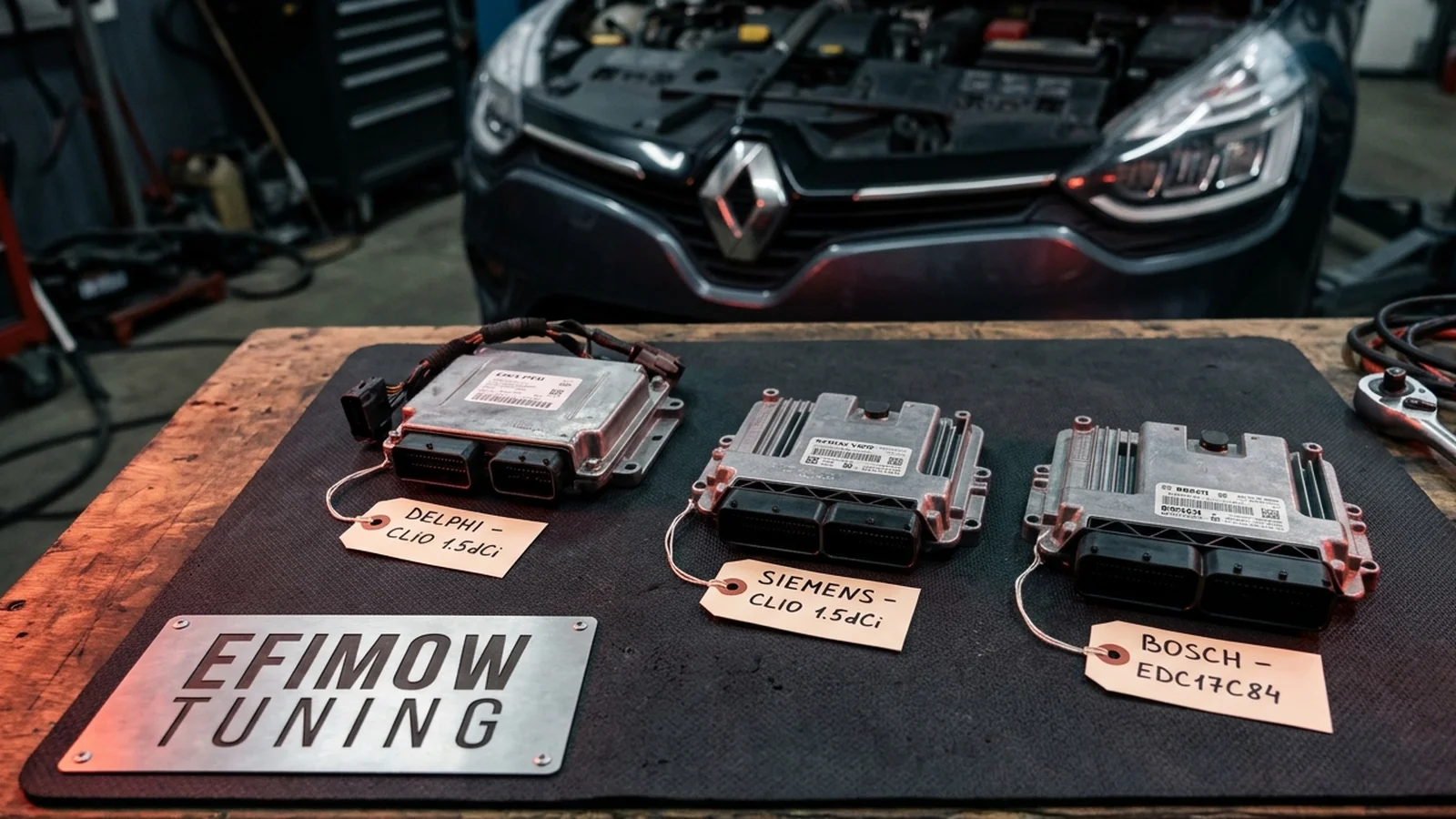
ECUs: Delphi, Siemens, Continental, Bosch
The K9K is a textbook example of why the engine code alone is not enough for tuning. Over its production life, several ECUs were fitted:
| ECU | Typical application (catalog) | Typical Stage 1 guide values |
|---|---|---|
| Delphi DDCR / DCM1.2 / DCM3.4 | early and mid Clio, Megane II, Kangoo, Logan, Sandero | approx. 20–30% power and torque |
| Siemens SID301–307 | Clio III, Megane II/III, Scenic, Kangoo II, Laguna III | approx. 20–30% |
| Continental SID310 | Blue dCi in Clio V, Megane IV, Kadjar, Duster II | approx. 20–30% |
| Bosch EDC17C42 | some Captur, Clio IV, Dokker, Sandero Stepway | approx. 20–30% (four-cylinder) |
The guide values are similar; the way there is not. Delphi DCM units are read via OBD or on the bench depending on the version, some only in boot mode. On the Siemens/Continental units, current tool drivers give access to torque monitoring, exhaust temperature limits and intake air temperature correction. We identify which version is in your car from the ECU identification. The type plate alone is often not enough, because identical power levels were built with different hardware.
What software changes on the K9K
The 1.5 dCi is not about peak power. It is an economy engine and should be calibrated as one. A good Stage 1 software mainly raises torque in the range between roughly 1,750 and 3,000 rpm, where the engine works in everyday driving. To do this, torque limiter, injection quantity, rail pressure and boost are matched to each other; the smoke limiter is adjusted so that the particulate filter is not loaded with additional soot.
On the entry versions in particular, the effect in daily use is clear: a loaded Kangoo or Logan that would otherwise have to change down on a hill holds its gear longer with adapted software. On the strongest 110 hp versions, the percentage gain over stock is similar, but larger in absolute terms.
Options and Stage 2
For the Delphi and Siemens families used in the K9K, the following are documented alongside Stage 1:
- ECO tuning with more torque in the low and mid range and unchanged peak power, often the better choice for commuters and fleets
- Sharp Throttle for a more direct throttle pedal
- Vmax removal (mind the tyre speed rating and registration)
- DTC Off only for non-emissions-related fault codes
Stage 2 only makes limited sense on the K9K. Turbo and injectors are designed for the small power class; for the Siemens ECUs our data therefore lists Stage 2 as only "partly" possible. If you want more than a clean Stage 1 on the 1.5 dCi, what you mainly buy is extra stress.
What to watch out for on the K9K
The 1.5 dCi has a reputation as an economical but maintenance-sensitive engine. Three points belong on the table before tuning:
Oil and servicing: The K9K is considered sensitive to extended oil-change intervals and the wrong oil. Crankshaft bearing damage on neglected engines is a well-known topic in the trade. A complete service history is worth more here than any software.
Particulate filter and EGR: Many K9Ks mostly do short trips. A clogged DPF or a coked EGR valve should be repaired before tuning. Disabling them is not an option, because that is emissions tampering and illegal on public roads.
Clutch and dual-mass flywheel: At high mileage, the DMF and clutch are often at the end of their reserves. With 20–30% more torque, you notice that sooner.
Process and prices
We work on Renault, Dacia and Nissan directly at the ECU: on site in Stödtlen at an appointment of your choice or by sending in the removed ECU. The price is identical, and booking is online.
A few examples from our pricing rules: the Clio III 1.5 dCi with 86 hp with a Delphi DCM1.2 starts from €175 for Stage 1, the Megane III 1.5 dCi with 110 hp with a Siemens ECU from €200. The Kadjar 1.5 Blue dCi with a Continental SID310 starts from €350 due to its generation and model year. The configurator shows the exact price for your version.
Legally: the software change voids the type approval. The software is intended for motorsport use only, see the motorsport notice.
Common questions from the workshop
Will my 1.5 dCi use more fuel after tuning? Not necessarily. If you use the extra power regularly, you will use more fuel. That is physics, not software. If you drive the same way as before, you often benefit from the engine having enough pull at lower revs and needing fewer gear changes. With ECO tuning, that is exactly the aim.
My Kangoo has 68 hp: does software make any difference at all? On the small power levels in particular, the difference is easy to feel in daily use, because the stock engine reaches its limits quickly. In percentage terms, the guide values are similar to the stronger versions. What matters is a healthy clutch and particulate filter.
How long does it take on site? That depends on the ECU. Units that can be written via OBD are done much faster than versions that have to be removed and worked on at the bench. We clarify this in advance from the ECU identification so you can plan the appointment realistically. In every case, the original state of the ECU is backed up before writing.
Conclusion
The 1.5 dCi is a rewarding candidate for a moderate Stage 1: typically 20–30% more power and torque, especially where the engine works in daily use. What matters is the right ECU, a well-maintained engine and a calibration that does not put extra load on the particulate filter. Stage 2 is hardly worth it on the K9K. For more on the ECUs, read our articles on Siemens/Continental SID and Delphi DCM; the glossary explains the engine name under dCi.