
Pumpe-Düse TDI with EDC16: What the Classics Can Still Do
1.9 and 2.0 TDI with unit injectors and Bosch EDC16: why the classics respond well to software, where the limits are and what to check first.
October 25, 2026 by Leo Efimow
Some engines are still talked about in workshops twenty years later. Volkswagen's Pumpe-Düse (unit injector) TDI is one of them. Golf V, Passat B6, Octavia II, A3 8P, Touran, Caddy: thousands of these cars are still running today with high mileages, and many of their owners deliberately want to keep driving them rather than replace them. So the question whether a software tune still makes sense on a classic like this is a fair one. The short answer: technically, hardly any diesel responds as clearly to a calibration as the PD TDI. The long answer depends on the condition of the car, and that is what this post is about.
What Pumpe-Düse means technically
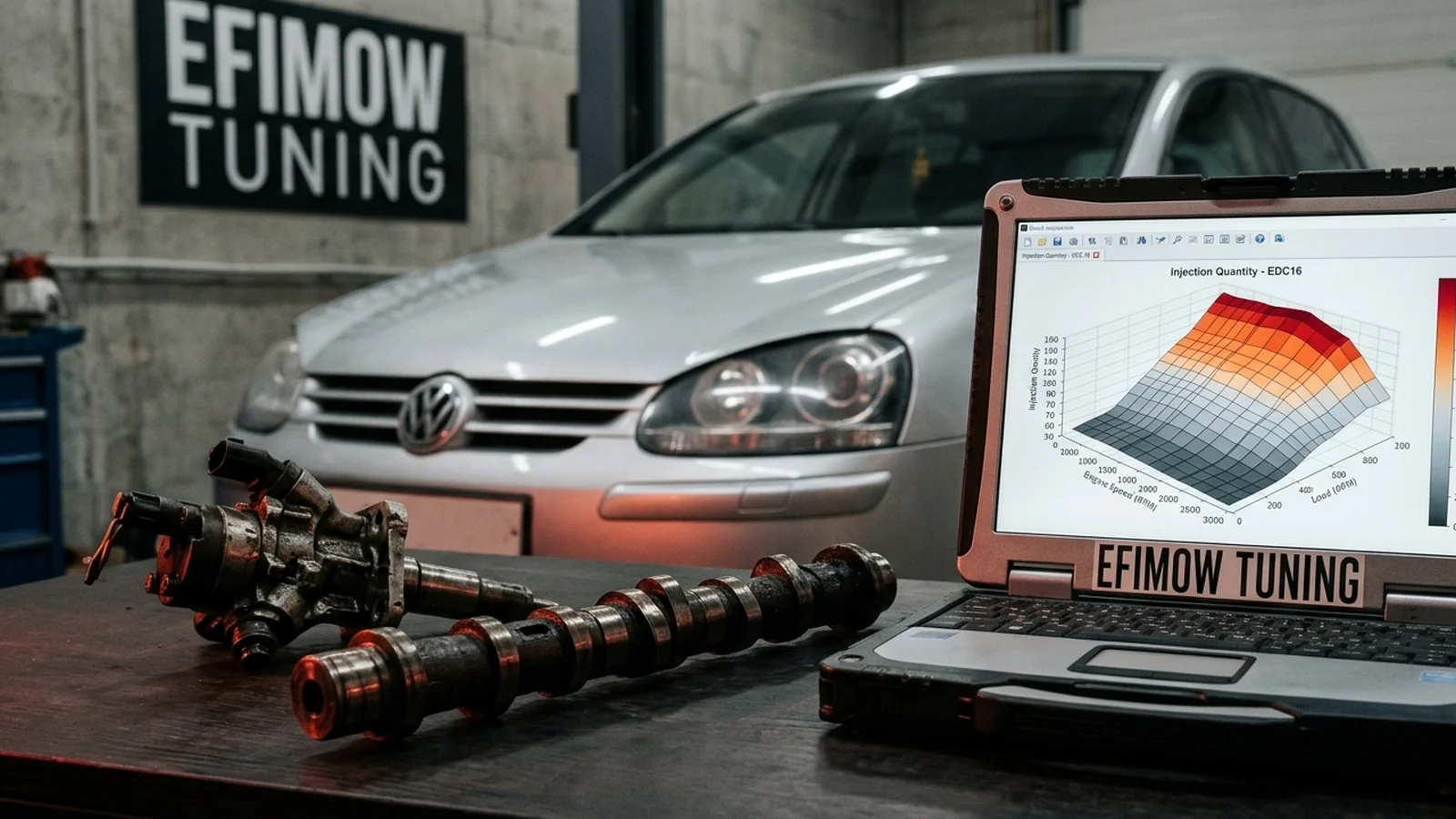
In the Pumpe-Düse system, each cylinder has its own unit combining a high-pressure pump and injector, sitting directly in the cylinder head. It is driven by additional lobes on the camshaft and rocker arms. Pressure is therefore not built up in a shared accumulator but at the moment of injection, reaching around 2,000 bar. A solenoid valve controls the start and duration of injection.
Two properties follow from this that matter for tuning. First, the PD engine is very direct: it turns extra fuel quantity straight into torque, especially in the mid-range. Second, it is mechanically bound: maximum injection pressure depends on camshaft speed and lobe profile and cannot be raised at will by software. Calibration therefore mainly works with injection quantity, start of injection, boost pressure and the limiters. You will find the detailed system comparison in the post Common rail vs. Pumpe-Düse.
Which ECUs sit in the PD engines
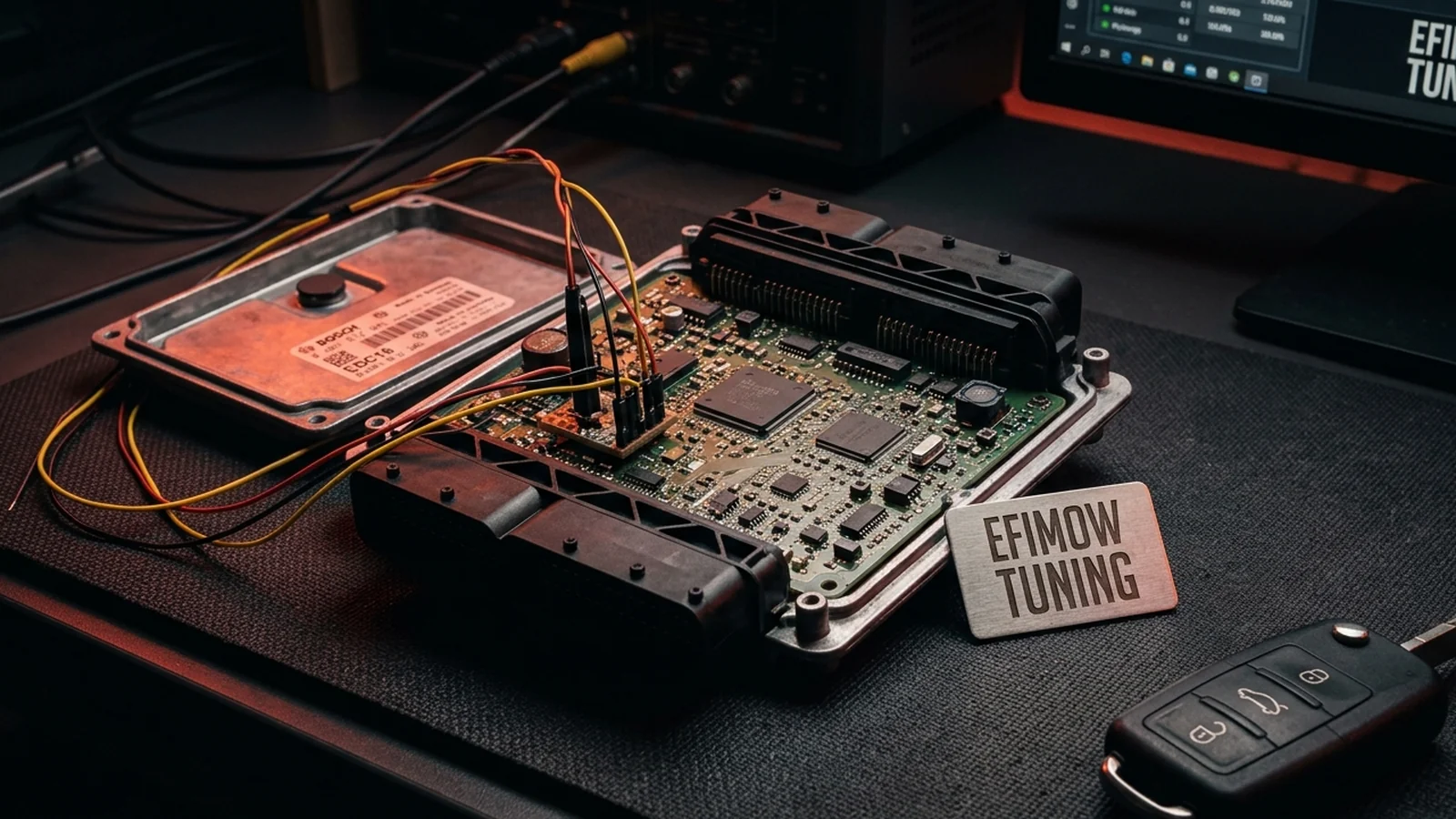
The term "PD TDI" covers several ECU generations. For calibration, access and price, that distinction is decisive:
| ECU | Typical vehicles (catalog examples) | Typical Stage 1 guide value |
|---|---|---|
| Bosch EDC15P+ | Golf IV 1.9 TDI (e.g. ARL, ASZ, AJM), Passat B6 1.9 TDI BPZ | 20–35 % |
| Bosch EDC16U / U31 / U34 | Golf V, Passat B6, Octavia II, A4 B7 with 1.9/2.0 TDI PD | 25–35 % |
| Siemens PPD1.x | 2.0 TDI PD with 170 PS (BMN, BMR, BRD) | 20–30 % |
The percentages are typical guide values for power and torque from our research per ECU family, not promises for an individual car. The EDC16 generation is the focus of this post because it is fitted to most of the Golf V era PD cars still on the road.
What a Stage 1 changes on a PD TDI
A serious Stage 1 on an EDC16 works on the familiar diesel maps: torque limiter, driver demand, injection quantity and start of injection, boost targets and boost limitation, and the smoke limiter. The smoke limiter deserves special attention on a PD. Because the engine responds so willingly to extra fuel, it is easy to make it smoke black. But more soot does not mean more power, it means higher exhaust gas temperatures and, on DPF versions, a filter that loads faster.
What brings little is raising the rev limit. PD engines do not like to rev anyway; their strength lies in the mid-range. A good calibration makes that range broader and stronger rather than stretching the curve upwards.
The real limit: clutch and dual-mass flywheel
On a PD TDI the engine is rarely the problem. The driveline behind it is. Our research on the EDC16 family states this explicitly: the clutch and dual-mass flywheel are often the limiting factor. There are two reasons. The PD delivers its torque early and with a steep rise, and many of these cars now have mileages at which the clutch is working at the end of its reserves even without tuning.
Before you have a PD classic tuned, check honestly:
- Clutch: Does it already slip at full throttle in a high gear? Then it certainly will after tuning.
- Dual-mass flywheel: Rattling at idle or vibration when pulling away are warning signs.
- Camshaft and rocker arms: They drive the unit injectors. Wear at this point is a known issue at high mileage and should not be ignored.
- Charge-air path and turbo: Leaking hoses or a tired turbo distort any calibration.
A PD in good condition handles a moderate Stage 1 well. A PD with a worn clutch needs a repair first, then software.
Access: OBD, bench or boot
The EDC16U generation is not always accessible over OBD. For some variants our catalog lists boot access, which means opening the ECU. This applies, for example, to the Golf V 2.0 TDI BKD. PCMflash also lists the EDC16U1/U31/U34 of the PD engines in module 77 with boot access. Other variants such as the Golf V 1.9 TDI BXE with EDC16U31 are listed without this note. Which route your ECU needs, we determine from the hardware and software number. In every case we back up the original file first.
Options and exhaust aftertreatment
For the EDC16 PD family our data lists as bookable: Stage 1+, ECO tuning, Sharp Throttle, Vmax removal and DTC Off for individual, non-emissions-related fault codes. Launch control and a hard limiter are only available on request after checking the file; the limiter is a motorsport-only function.
ECO tuning is particularly interesting for PD drivers with high annual mileage. It raises torque in the low and mid rev range and leaves top-end power unchanged. You drive at lower revs and more relaxed without taking the driveline to its limits. For a clutch with many miles on it, that is often the gentler choice compared to a full Stage 1. How much shows up in fuel consumption depends on your driving profile; there is no fuel-saving guarantee. Sharp Throttle, on the other hand, only changes the accelerator pedal curve: the engine responds more directly to your right foot without any change in power or torque.
Later PD variants have a diesel particulate filter, and all of them have exhaust gas recirculation. The 2.0 16V PD engines also have swirl flaps, which are part of the emissions strategy. Disabling the DPF or EGR is emissions tampering and prohibited on public roads. The age of the car does not change that.
Process and prices
We tune PD cars on site in Stödtlen on your preferred date or via an ECU you send in, at the same price, bookable via the configurator. Under our pricing rules the classics sit at the lower end: the Golf V 1.9 TDI BXE with EDC16U31 starts at Stage 1 from €200, the Golf V 2.0 TDI BKD with boot access at from €250, a Golf IV 1.9 TDI ARL with EDC15P+ at from €175. The configurator shows you the exact price for your variant.
Legally the classic is no exception: the software change voids your vehicle's type approval; the software is intended for motorsport use only (see the motorsport notice).
Conclusion
The Pumpe-Düse TDI is a rewarding engine for a software calibration: it turns extra fuel directly into torque, and the EDC16 family gives typical guide values of 25–35 % more power and torque. The limit is usually set not by the engine but by the clutch, the dual-mass flywheel and the general condition of a car with many years behind it. If you check that beforehand and choose a moderate, smoke-free calibration, you can get noticeably more out of your classic once again. Pick your model and engine code in the configurator. You will then see which ECU is fitted and what it costs.