
Common Rail vs. Pumpe-Düse: Why the Injection System Defines the Tune
Unit injector or common rail: how the two diesel injection systems build pressure, which levers tuning has and where the limits are.
October 25, 2026 by Leo Efimow
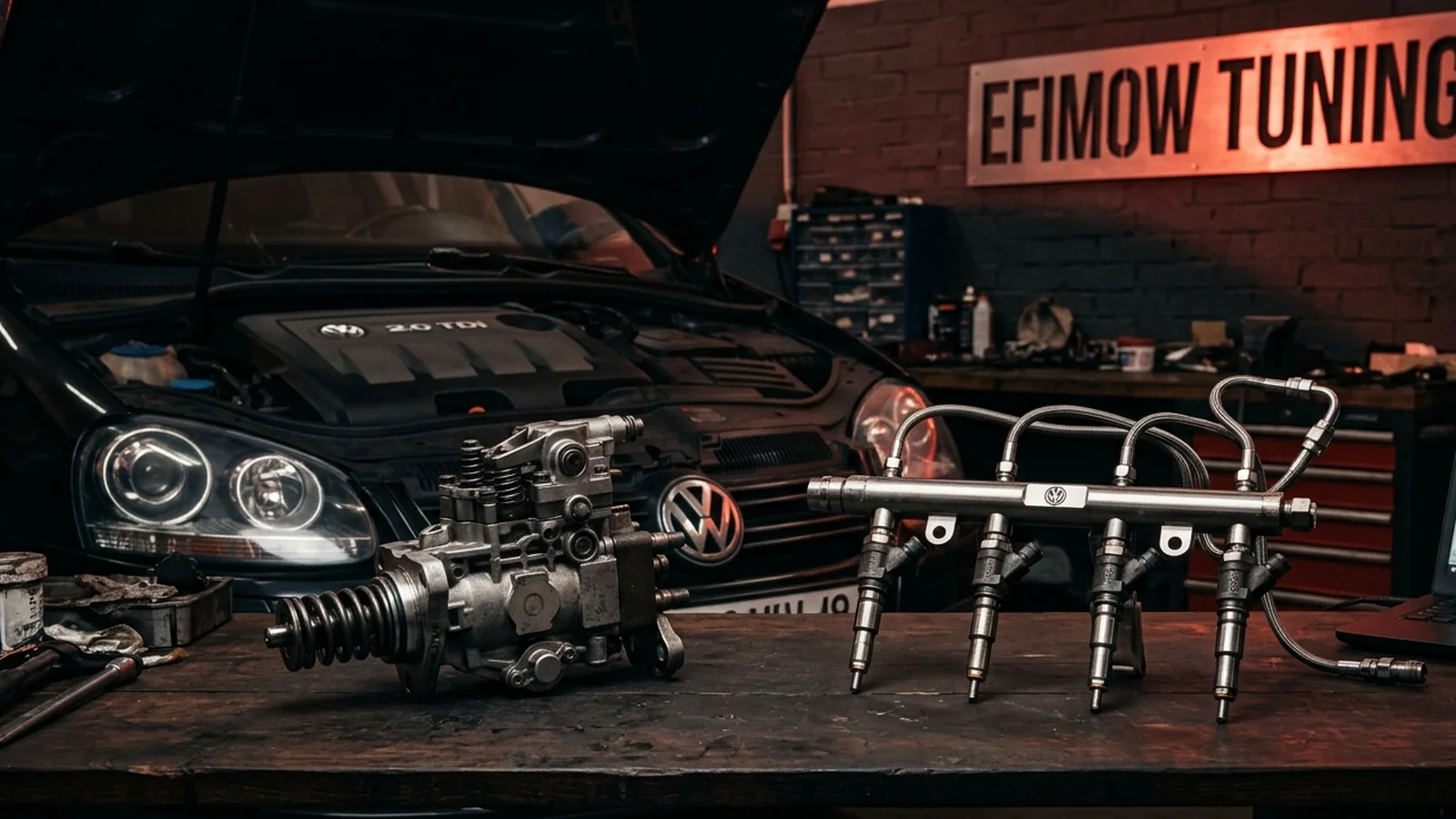
Two diesels with the same displacement, similar power and the same badge can behave completely differently when tuned. The reason usually lies not in the turbocharger or the ECU alone but one level deeper: in the injection system. At Volkswagen this is particularly clear, because the group switched from Pumpe-Düse (unit injector) technology to common rail within just a few years. A 2.0 TDI from the Golf V and a 2.0 TDI from the Golf VI carry almost the same name, but technically they are two different worlds. In this post we look at how the two systems work and why that determines what a software calibration can achieve.
Pumpe-Düse: pressure at the moment of injection
In the Pumpe-Düse system each cylinder has its own unit of pump plunger and injector, sitting directly in the cylinder head. It is driven by additional lobes on the camshaft via rocker arms. On every cycle the lobe pushes the plunger down and the fuel is brought to high pressure in an instant, up to around 2,000 bar. A solenoid valve in the unit decides when injection starts and how long it lasts.
The system is compact and produces very high peak pressures, but it has a built-in restriction: the pressure is mechanically tied to the camshaft. It depends on engine speed and lobe profile and rises during injection. Multiple injections are only possible to a limited extent, and the engine is audibly rougher. Volkswagen used Pumpe-Düse in the 1.4, 1.9 and 2.0 TDI engines of the 2000s, controlled by Bosch EDC15P+ and EDC16 and, on the 170 PS versions, by Siemens PPD1.
Common rail: pressure in reserve
In a common-rail system, pressure generation and injection are separate. A high-pressure pump delivers fuel into a shared accumulator, the rail, which holds a pressure regulated by the ECU. The injectors (depending on the engine with piezo or solenoid technology) open and close electrically and can inject several times per cycle: pilot injection, main injection, post injection.
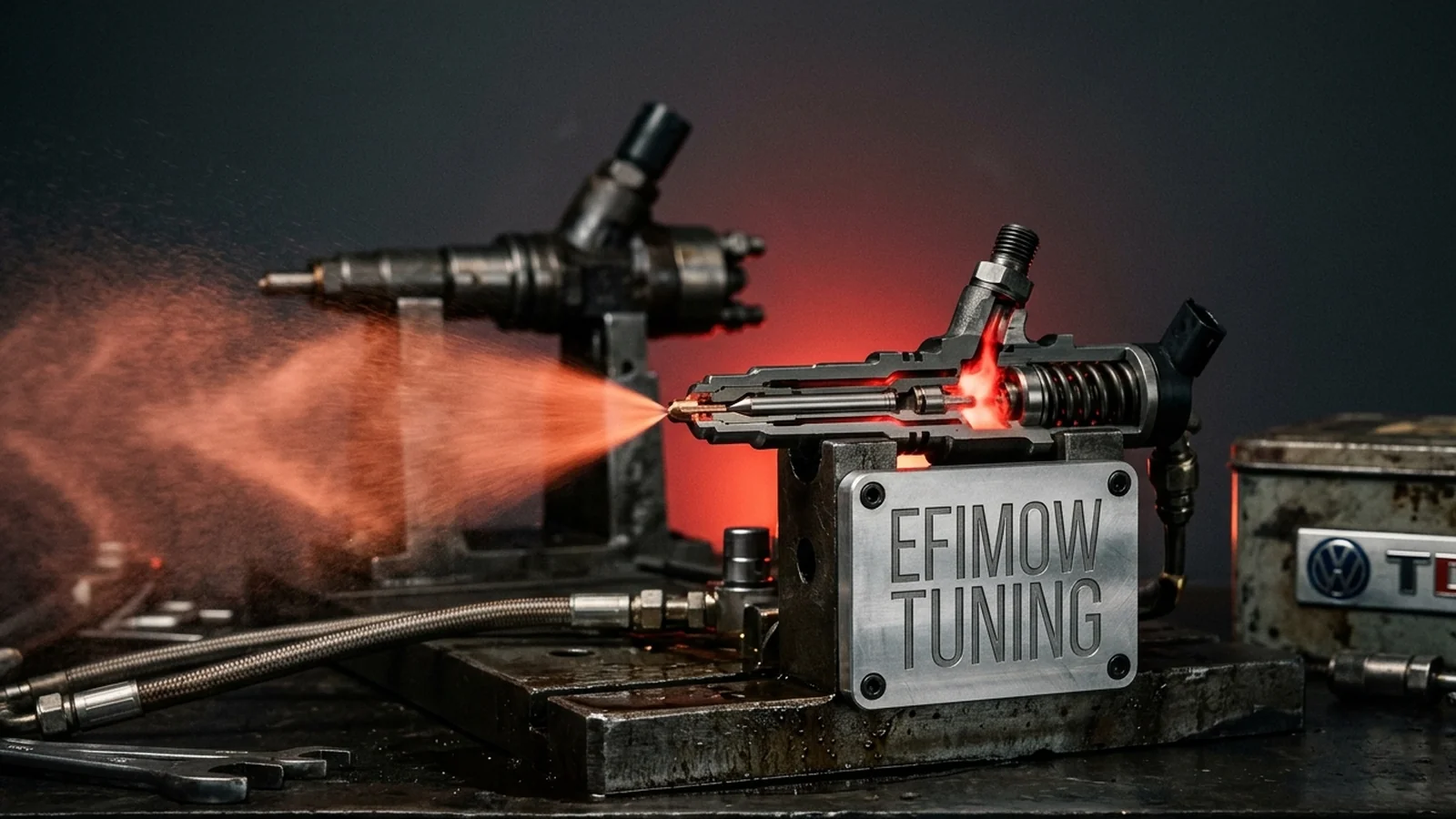
The advantage is freedom. Rail pressure can be set independently of engine speed, high pressure is available even at low rpm, and injection can be split finely into partial quantities. That makes the engine quieter, cleaner and better suited to strict emissions standards. At VAG the switch began with the 2.0 TDI of the EA189 family around 2008, followed later by the EA288. These engines are mostly controlled by a Bosch EDC17, some 1.6 TDIs by a Siemens/Continental PCR2.1.
What this means for the software calibration
The different technology leads to different levers:
| Pumpe-Düse | Common rail | |
|---|---|---|
| Pressure generation | mechanical, per cylinder, tied to the camshaft | high-pressure pump and rail, electronically regulated |
| Rail pressure via software | not adjustable as a separate value | targets adjustable within pump and injector limits |
| Main tuning levers | injection quantity, start of injection, boost, limiters | rail pressure, quantity, injection timing, boost, torque structure |
| Character after tuning | very strong mid-range, rough | smoother, broader delivery |
| Typical limit | clutch, dual-mass flywheel, camshaft | pump delivery, injector flow, exhaust aftertreatment |
On a Pumpe-Düse engine, calibration works mainly through quantity and timing. Because the engine responds very directly to extra fuel, the torque gains are clearly noticeable. Our research gives typical guide values of 25–35 % for power and torque for the EDC16 PD family. At the same time there is a real risk of opening the smoke limiter too far: a PD smokes quickly if the calibration is too greedy.
On a common-rail engine, rail pressure is added as a further lever. Higher pressure improves atomisation and allows more fuel in the same time. The limits here are set by the delivery rate of the high-pressure pump and the flow of the injectors, and by the exhaust aftertreatment with particulate filter and exhaust gas recirculation, which has to be considered in the calibration. For the VAG EDC17 family the typical guide values are 20–30 % for the 1.6 and 2.0 TDI. For a closer look at the ECU, see the post Bosch EDC17 explained.
How the difference feels in everyday driving
On the road you notice the systems even before any calibration. A PD TDI clatters audibly, pulls hard in the mid-range and gets breathless at the top. A common-rail TDI runs more quietly, builds its torque more evenly and revs a little more willingly. A software calibration tends to amplify these characters rather than change them. Tune a PD and you get an even stronger shove in the middle of the rev band. Tune a common-rail diesel and you get a broader plateau. Both can feel very good. What matters is that your expectations match the system.
The predecessor: distributor pump
For completeness: before the Pumpe-Düse era, many TDIs used a distributor injection pump, for example the 1.9 TDI ALH or AFN in the Golf IV with a Bosch EDC15V. Here a single pump builds the pressure for all cylinders, and the pressure is considerably lower. Our research gives 15–25 % as the typical guide value for this variant, less than the PD, because the pump limits the extra fuel quantity.
Mechanics: what to check before tuning
Depending on the system, a different look under the bonnet is worthwhile:
- Pumpe-Düse: On the torque-heavy PD, the clutch and dual-mass flywheel are often the limiting factor. Add to that the camshaft and rocker arms that drive the unit injectors, a known wear point at high mileage. More on this in the post Pumpe-Düse TDI with EDC16.
- Common rail: Injectors and high-pressure pump should be healthy; smooth idling is a good first indicator. A healthy particulate filter and working exhaust gas recirculation are prerequisites.
Whatever the system: disabling the DPF, EGR or AdBlue system is emissions tampering and prohibited on public roads. A serious calibration works with the exhaust aftertreatment, not against it.
Access and price depend on the ECU
The injection system defines the calibration; the ECU defines access and price. PD engines with EDC16 sit lower in our pricing rules than common-rail engines with EDC17: the Golf V 2.0 TDI BKD (Pumpe-Düse, EDC16U with boot access) starts at Stage 1 from €250, the Golf VI 2.0 TDI CFFB (common rail, EDC17C46) from €300. Whether your ECU can be reached over OBD or has to be opened, we check in advance using the hardware and software number.
You book online via the configurator; tuning is done on site in Stödtlen on your preferred date or via an ECU you send in, at the same price. Legally the same applies to both systems: the software change voids your vehicle's type approval; the software is intended for motorsport use only (see the motorsport notice).
Conclusion
Pumpe-Düse and common rail solve the same task in fundamentally different ways. The PD builds its pressure mechanically at the moment of injection and responds very directly to extra fuel, with a noticeable torque gain, but also more load on the clutch and dual-mass flywheel. The common-rail diesel offers more levers through freely adjustable rail pressure, a smoother result and a closer link with exhaust aftertreatment. If you know which system is in your TDI, you can realistically judge what a calibration will bring. You will find your car's engine code and the matching ECU in the configurator.