
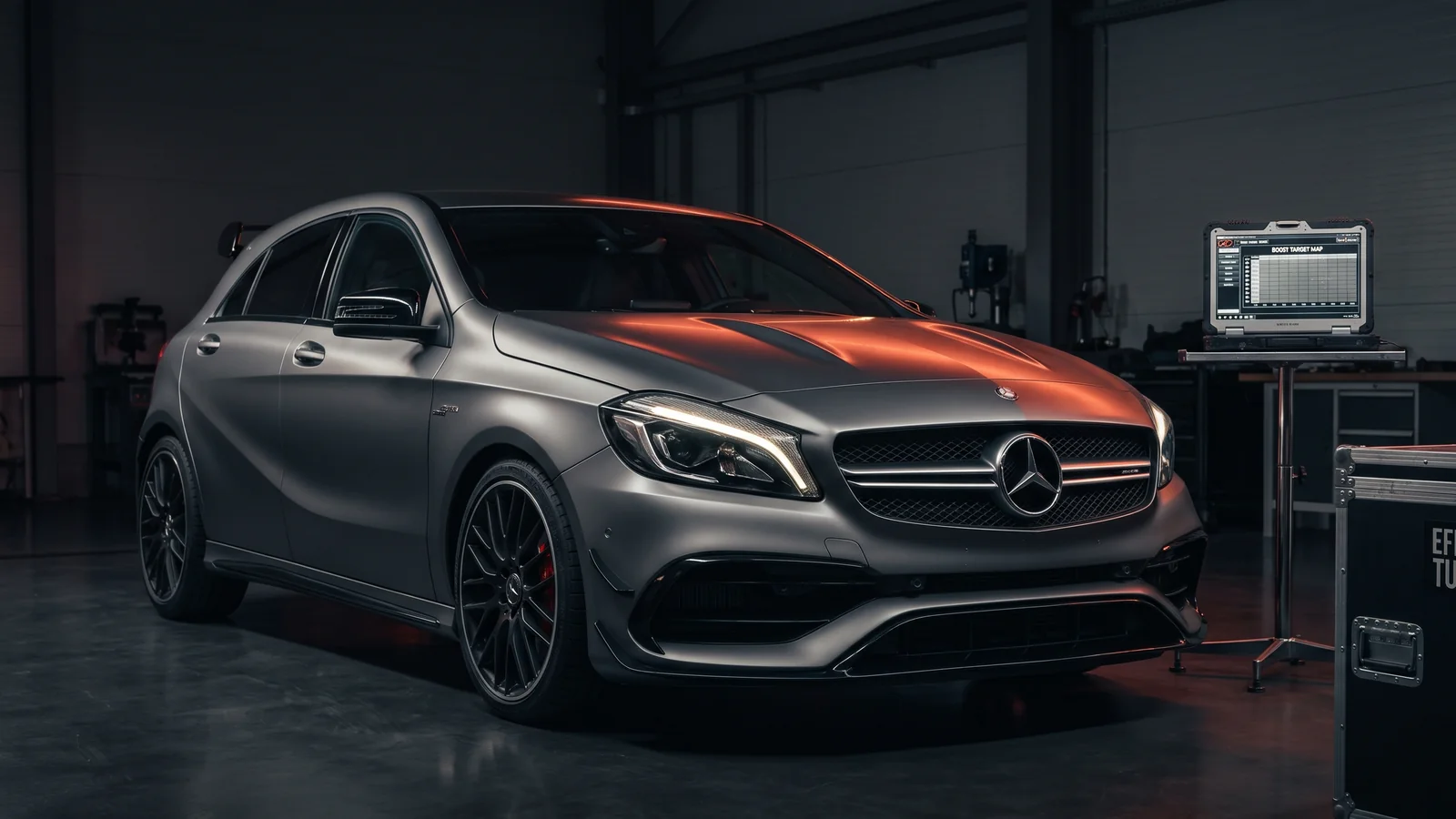
Mercedes-AMG A 45: What Is Left After the Factory
Mercedes-AMG A 45, CLA 45 and GLA 45 with M133 and MED17.7: reserves, limits of turbo, charge air and dual-clutch gearbox, options and process.
October 25, 2026 by Leo Efimow
When Mercedes-AMG presented the A 45 in 2013, the engine was a statement: a two-litre turbocharged four-cylinder that was considered the most powerful production four-cylinder in the world at its launch. The M133 was offered not only in the A 45 but also in the CLA 45 and the GLA 45, all with all-wheel drive and a dual-clutch gearbox. Anyone driving such a car eventually asks: what is left after the factory? The honest answer: quite a bit, but less than with an ordinary mass-production turbo, and with far more attention to temperatures and gearbox. This post explains why.
The M133 and its ECU
The M133 is a dedicated AMG engine with a reinforced crank train, twin-scroll turbocharger and petrol direct injection. It is controlled by a Bosch MED17.7, the same ECU family as the Mercedes mass-production petrol engines M270 and M274. That is good news for tuning: the MED17.7 is well documented, and read and write access is usually possible via OBD.
Our catalogue lists the M133 for three models:
- A 45 AMG (W176),
- CLA 45 AMG (C117),
- GLA 45 AMG (X156).
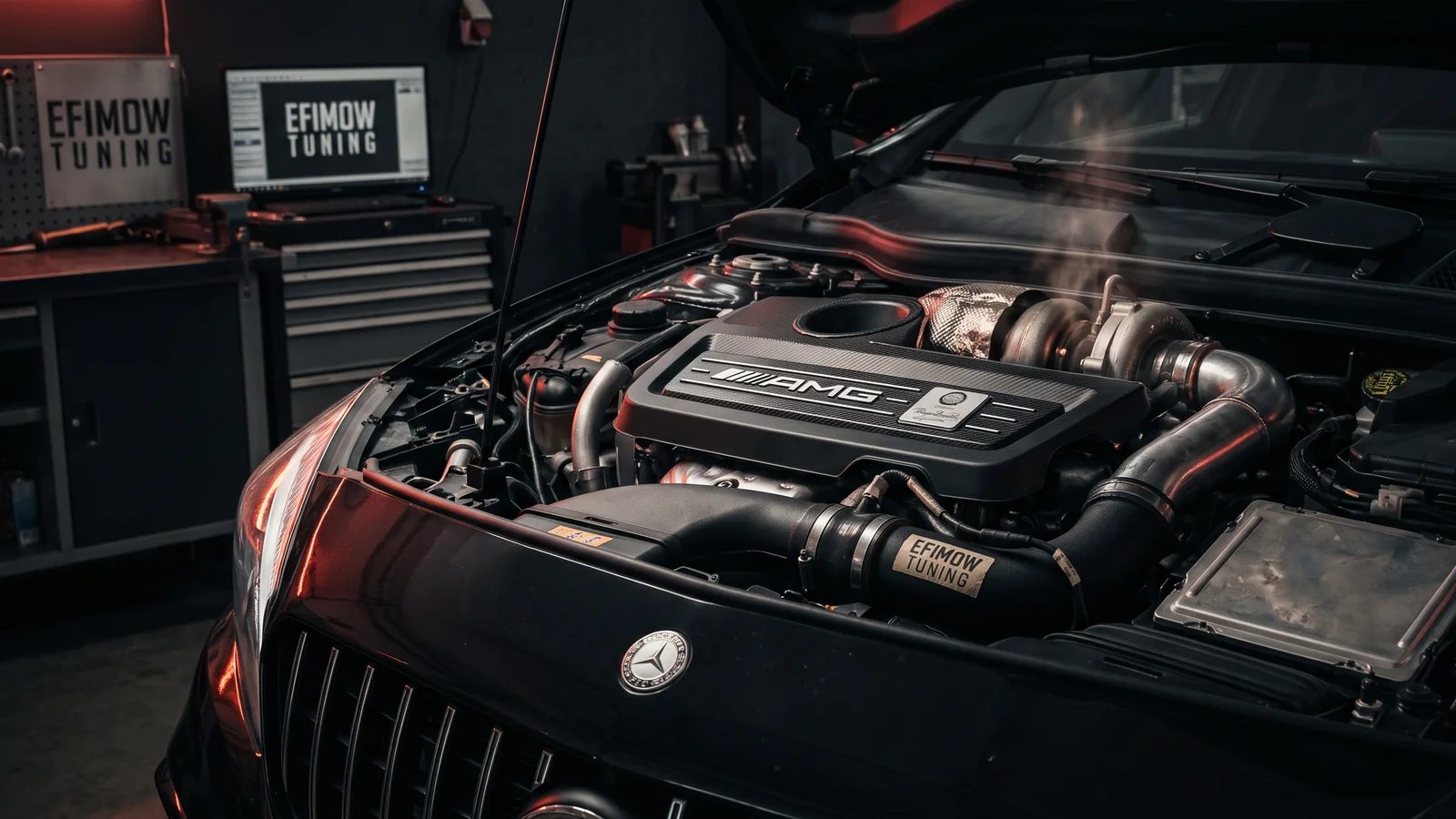
The successor, the A 45 of the W177 series with the new M139, is not yet included and is handled by request through the configurator.
What is realistic and why it is less than on a mass-production engine
For the MED17.7 family, our data gives a typical Stage 1 guide value for turbo engines of 15 to 30 percent more power and torque. On the M133, though, the upper end of that range is harder to reach than on an M274 in a weak power level. The reason is simple: AMG already pushed the engine a long way from the factory. The reserves that mass-production engines carry in their software for marketing and model-line reasons have largely been used on the top model already.
What remains are reserves for different fuel qualities, climate zones and load profiles. An M133 driven in Central Europe on 98-octane fuel has different margins than the factory calibration, which also has to cope with poorer fuel in hot countries. A serious calibration uses exactly these reserves, with active knock control that pulls timing as soon as the fuel is not up to it.
The real limits: air, heat, gearbox
On the A 45 it is rarely the software that limits, but the peripherals. Three points are decisive:
Charge-air temperature. The compact engine bay and the highly boosted four-cylinder mean that intake air warms up quickly under repeated full load. As temperature rises, the ECU pulls timing and boost, and power drops. A Stage 1 file cannot prevent this; it can only work within the temperature limits. Anyone who drives on track frequently therefore quickly ends up with a larger intercooler, and with that, Stage 2.
Turbocharger. The stock turbo is matched to the factory output. More boost means higher turbo speeds and exhaust temperatures. A clean calibration respects the limits of the turbo instead of running it flat out.
Dual-clutch gearbox. The M133 is paired with the AMG Speedshift DCT, a seven-speed dual-clutch gearbox. The gearbox has its own torque limit and its own clutch pressures. If engine torque rises significantly, it has to suit the gearbox. Otherwise slip, harsher shifts and, in extreme cases, a protection mode are the result.
When Stage 2 makes sense
On the A 45, Stage 2 does not simply mean "more software" but a calibration that responds to modified hardware. Typical building blocks are a larger intercooler, a modified intake and an exhaust system from the turbo back with a sports catalytic converter. Each of these parts moves a limit: the intercooler keeps intake air cooler under repeated load, the exhaust lowers the back pressure behind the turbo. Only then is it worth opening up boost and timing further.
Important: exhaust systems are only possible with a catalytic converter and with a parts certificate or type approval. A pipe without a cat is not permitted on public roads. And the higher the output climbs, the more important the gearbox becomes. With the dual-clutch gearbox, its torque limit decides how far Stage 2 can sensibly go.
Options for the MED17.7
For the A 45's ECU our data lists the following options:
| Option | Status |
|---|---|
| Stage 1+ / Stage 2+ | available |
| Sharp Throttle, ECO tuning | available |
| Vmax removal, rev limiter | available |
| Launch Control | available |
| No-Lift-Shift | on request (manual gearbox only) |
| Pops & Bangs, Hardcut, Popcorn limiter | available, motorsport only |
| Anti-lag (soft ALS) | on request, motorsport only |
The A 45 already comes with launch control from the factory as "Race Start"; an adjustment can change rpm and boost build-up at launch. No-Lift-Shift is practically irrelevant with the dual-clutch gearbox. Pops & Bangs, Hardcut, Popcorn limiter and anti-lag are motorsport functions: they put considerable load on catalytic converter, turbocharger and exhaust system and are not permitted on public roads. The details are in the motorsport notice.
Check before tuning
An A 45 has often already covered several years and many kilometres, not infrequently with a sporty history. Before tuning, it is worth looking at:
- fault memory of engine and gearbox,
- spark plugs and ignition coils (wear parts on highly boosted engines),
- tightness of the charge-air path,
- condition and oil-change history of the dual-clutch gearbox,
- all-wheel-drive system and rear differential.
An already modified software version (for example from a previous tuner) must be known. For a clean calibration we need the original data as the basis.
Process, price and legal
We tune AMG models directly on the ECU: on site with us in Stödtlen at an appointment of your choice, or by sending in the removed ECU. The price is the same in both cases, and you book online. Because power class and model year feed into the price, the configurator shows you the exact amount for your car.
Legally: the software change voids your vehicle's type approval; the software is intended for motorsport use only. If the car still has remaining warranty or is leased, clarify the consequences beforehand.
Conclusion
The A 45 still has reserves after the factory, but it is not a mass-production engine where the software is the main brake. The realistic margins lie within the typical MED17.7 range; the limits are set by charge-air temperature, turbocharger and dual-clutch gearbox. If you accept that and choose a calibration that keeps all protection functions active, you get a noticeably stronger but still durable AMG.
What is possible for your A 45, CLA 45 or GLA 45, you can see in the configurator.