
Gearbox Torque Limits After an Engine Tune
Mechanical rating, software limit, heat: which limits a gearbox has, how engine and transmission control negotiate them and what a good calibration does.
October 26, 2026 by Leo Efimow
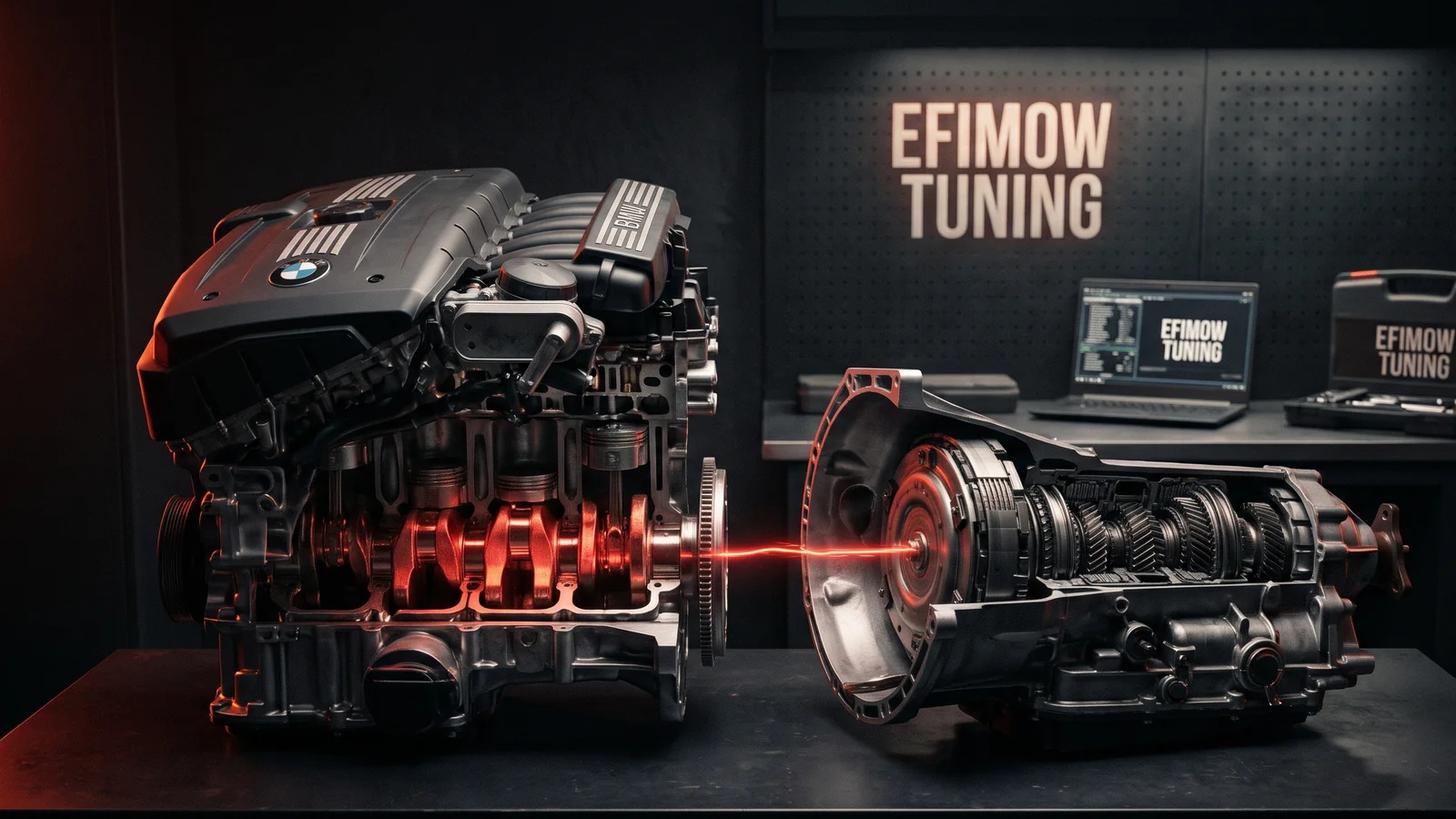
"How much can my gearbox take?" is one of the most common questions before a tune. The honest answer: there is no single number. A gearbox has several limits that act at the same time: a mechanical rating, a limit in the transmission software and a thermal limit that depends on how the car is driven. On top of that, the engine and transmission control units constantly negotiate how much torque is allowed at any moment. This article explains these limits and how they interact, without repeating the details of individual gearboxes, which have their own articles.
Limit 1: the mechanical rating
Every gearbox is designed for a maximum input torque. That means the torque it can transmit continuously over its planned service life, with a safety margin. In torque converter automatics the main limits are the multi-plate clutches, the converter and the oil pump; in dual-clutch gearboxes the two clutches; in manual gearboxes usually the clutch and the dual-mass flywheel.
Important: the rating is not a cliff edge beyond which the gearbox breaks immediately. It is the point from which wear accelerates and the reserves for heat, load peaks and age shrink. A gearbox that works permanently just above its rating often lasts a while, but not as long.
Limit 2: the limit in the transmission software
The transmission control unit, called the EGS at BMW, knows a maximum permissible input torque. It is stored in the software and is often staggered by gear, rpm or temperature. If the engine reports more, the gearbox reacts: it requests a torque reduction, changes its shift strategy or, in extreme cases, enters a protection mode.
For this to work, both control units must exchange data constantly. The engine control unit uses its torque model to calculate the torque the engine is currently delivering and reports it over the CAN bus. This torque is not measured; it is calculated from air mass, injection, ignition timing and other values. The transmission control uses the reported value to set clutch pressures: more reported torque means more clamping pressure.
Limit 3: heat
The third limit is the least visible. Slip in clutches and converter creates heat, and more torque creates more heat at the same slip. With spirited driving, towing or in traffic jams, fluid temperature rises. Many transmission controls reduce the permitted torque or change the shift strategy at high fluid temperature. Old fluid lowers this limit because it dissipates heat less well and loses its friction properties.
How engine and gearbox negotiate torque
All torque requests come together in the engine control unit: the driver's demand via the accelerator, interventions from ESP and traction control, component protection for engine and turbocharger and the limits reported by the gearbox. In this limiter chain, the lowest value always wins. That is why a tune that only looks at the engine side often doesn't deliver the expected result: the gearbox simply caps the extra torque again.
This leads to three typical cases after an engine tune:
| Case | What happens | Result |
|---|---|---|
| torque stays below both limits | reported and real torque match, gearbox works within its rating | clean driving behaviour, normal wear |
| reported torque above the software limit | gearbox requests a reduction or protects itself | missing power, especially in certain gears; sometimes fault messages |
| real torque higher than reported | clutch pressure doesn't match the actual torque | slip, heat, increased wear, often only noticeable after weeks |
The third case is the most dangerous because it stays inconspicuous for a long time. It arises, for example, when an add-on box falsifies sensor signals so the engine control unit calculates the wrong torque, or when a calibration doesn't keep the torque reporting consistent. Why tuning boxes have a fundamental problem here is explained in Tuning boxes and sensor manipulation.
What a good calibration does
A serious engine calibration treats the gearbox as an integral part of the concept. The main tools:
- Torque limitation per gear: in the lower gears, traction is the limit anyway. Capping torque there costs hardly any acceleration and protects the gearbox, shafts and differential.
- Limitation by rpm: high torque at low rpm is particularly hard on converters, clutches and dual-mass flywheels. A smooth rise instead of a spike helps.
- Consistent torque reporting: the reported torque must match the real torque so that the transmission control calculates correctly.
- Transmission software where it makes sense: if the target is above the software limit but still within the mechanical rating, the transmission software may need adjusting. How that looks on a BMW is described in TCU calibration on BMW.
- Hardware where necessary: if the target is above the mechanical rating, no software helps. Then it's about uprated clutches, a different gearbox or a lower target.
Orientation for BMW gearboxes
Reserves vary widely. A rough classification, with details in the respective articles:
- ZF 8HP: several torque classes; the right variant often has headroom for moderate targets. See ZF 8HP explained.
- ZF 6HP: solid mechanics, but often old; condition and fluid are decisive. See ZF 6HP in E-Series BMWs.
- Getrag 7DCT in the 1 Series, 2 Series and X1: rated around 300 Nm, little headroom with stronger engines. See Getrag 7-speed DCT.
- Aisin automatic in front-drive models: forgiving when torque is delivered cleanly. See Aisin automatics in front-wheel-drive BMWs and Minis.
- Manual gearbox: usually the clutch and dual-mass flywheel are the limit. See Clutch and dual-mass flywheel after tuning.
Warning signs after a tune
- revs rise during shifts or under full load without the car accelerating accordingly
- power is missing in certain gears although the engine pulls well in others
- harsh, delayed or jerky shifts that weren't there before
- gearbox fault messages or limp mode after prolonged full load
If any of these occur, don't just keep driving. Have the fault memory and fluid temperature checked and talk to your tuner.
Process and legal notes
For BMW you order the engine software via the configurator, flash it yourself via OBD and pay for the software only once it is finished. State your gearbox when ordering so the calibration can take it into account; a transmission software calibration is clarified on request. Legally: the software change voids the vehicle's type approval, and the software functions are intended exclusively for motorsport. Details in the motorsport notice.
Conclusion
A gearbox has three limits: the mechanical rating, the limit in the transmission software and heat. Engine and transmission control negotiate the permitted torque through the limiter chain, and the lowest value wins. A good calibration keeps torque reporting consistent, limits torque in the lower gears and at low rpm and includes the transmission software where necessary. More in the glossary under torque limitation and EGS.