
ZF 8HP Explained: the Automatic Gearbox in Almost Every BMW
Design, generations and variants of the ZF 8HP: how to tell which version your BMW has, and what that means for tuning and maintenance.
October 26, 2026 by Leo Efimow
If you have bought a rear- or all-wheel-drive BMW with an automatic in the last fifteen years, you are very likely driving a ZF 8HP. From the 318d to the V8, from the X3 to the 7 Series, the eight-speed torque converter automatic from Saarbrücken has become BMW's default. In practice we still often hear that "the 8HP" is a single gearbox. It isn't. There are several generations and torque classes, and which one sits in your car helps decide what makes sense after an engine tune. This article explains the design, the variants and what to watch for in everyday use.
Where the 8HP comes from
ZF introduced the 8HP at the end of the 2000s; its first series application was the V12 BMW 7 Series of the F01 generation. From around 2010 the gearbox spread across the wider F generation, including the 5 Series, 3 Series, X3 and many other models, replacing the six-speed ZF 6HP. Revised generations followed, roughly from 2014 and from 2018, and are still used in today's G generation.
BMW is not the only customer. The 8HP is also found in longitudinal Audi models, at Jaguar and Land Rover, Alfa Romeo and Maserati, in Rolls-Royce models and, built under licence, at Stellantis. The Toyota Supra A90 uses it too, technically closely related to the BMW Z4 G29. That works in your favour as an owner: parts, replacement mechatronic units and know-how are widely available.
The design in plain words
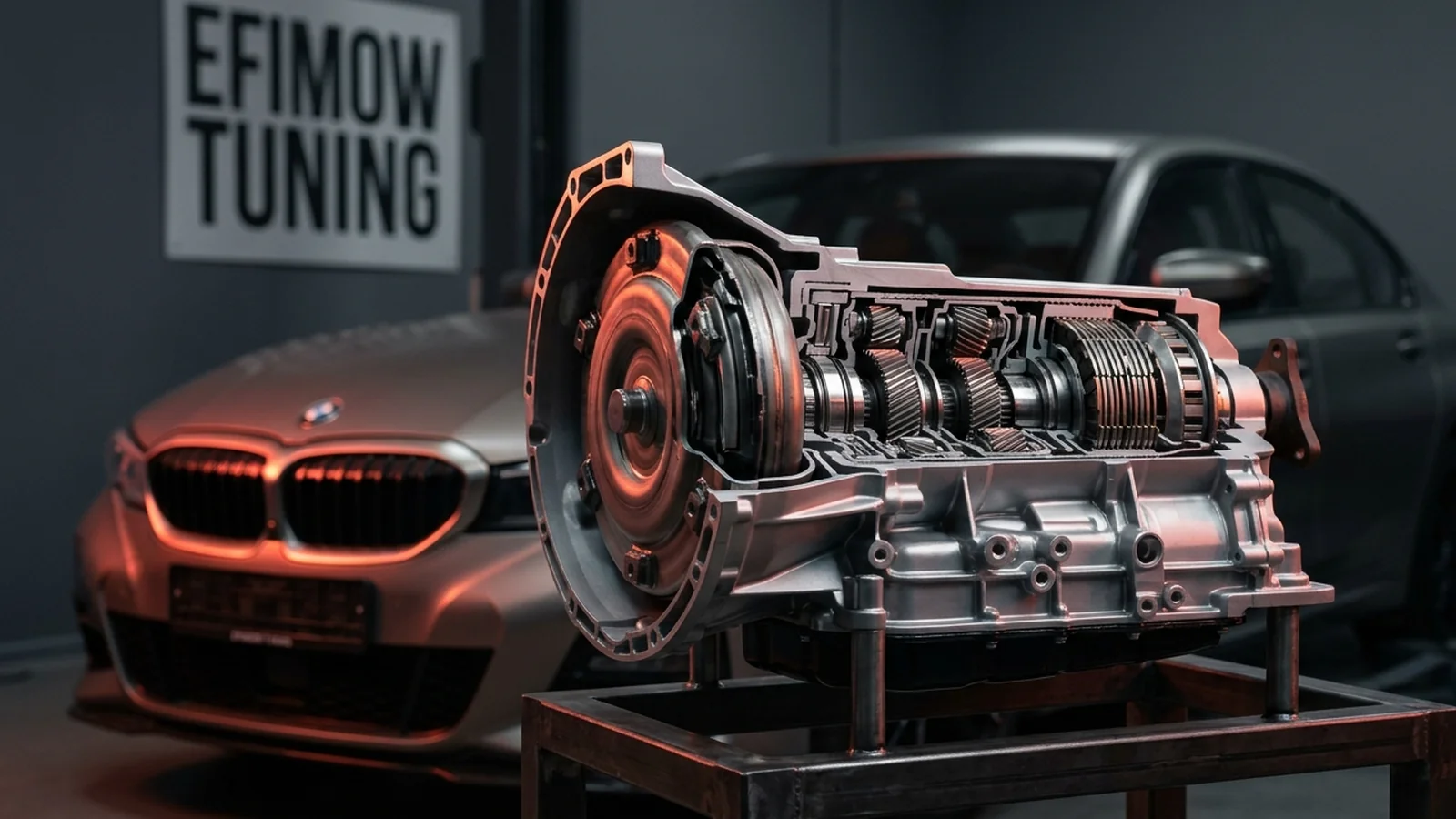
The 8HP is a classic torque converter automatic, but a very efficient one:
- Torque converter with lock-up clutch: it gives smooth take-off and locks up early so that little slip is lost.
- Four planetary gear sets: they produce the eight forward gears and reverse.
- Five shift elements: two brakes and three multi-plate clutches. In every gear only two of them are open. That reduces drag losses and is one reason why the 8HP is so efficient and shifts so quickly.
- Mechatronic unit: hydraulic control and transmission control unit form one assembly inside the gearbox. BMW calls this control unit the EGS (electronic transmission control).
On many BMWs with start-stop, the 8HP also has a hydraulic accumulator that provides oil pressure the moment the engine restarts, so the car pulls away without delay.
Generations and torque classes
The number after "8HP" roughly describes the torque class. The higher the number, the more input torque is intended. Exact approved values depend on the vehicle, engine and generation, so the table only shows the order of magnitude:
| Class | Example designations | typically behind |
|---|---|---|
| smaller class | 8HP45, 8HP50, 8HP51 | four-cylinder petrol and diesel engines, many base six-cylinders |
| middle class | 8HP70, 8HP75, 8HP76 | strong six-cylinders, high-torque diesels, V8 |
| upper class | 8HP90, 8HP95 | luxury-segment V8 and V12 |
The last digit usually indicates the generation: 45/70/90 for the first, 50/75/95 for the second, 51/76 for the later revision. There are also versions for all-wheel drive, hybrids and M models, where BMW markets the automatic as "M Steptronic". Not every M model uses it: the M3 F80 and M4 F82, for example, had a Getrag dual-clutch gearbox, explained in the glossary under DKG.
Which 8HP is in your BMW?
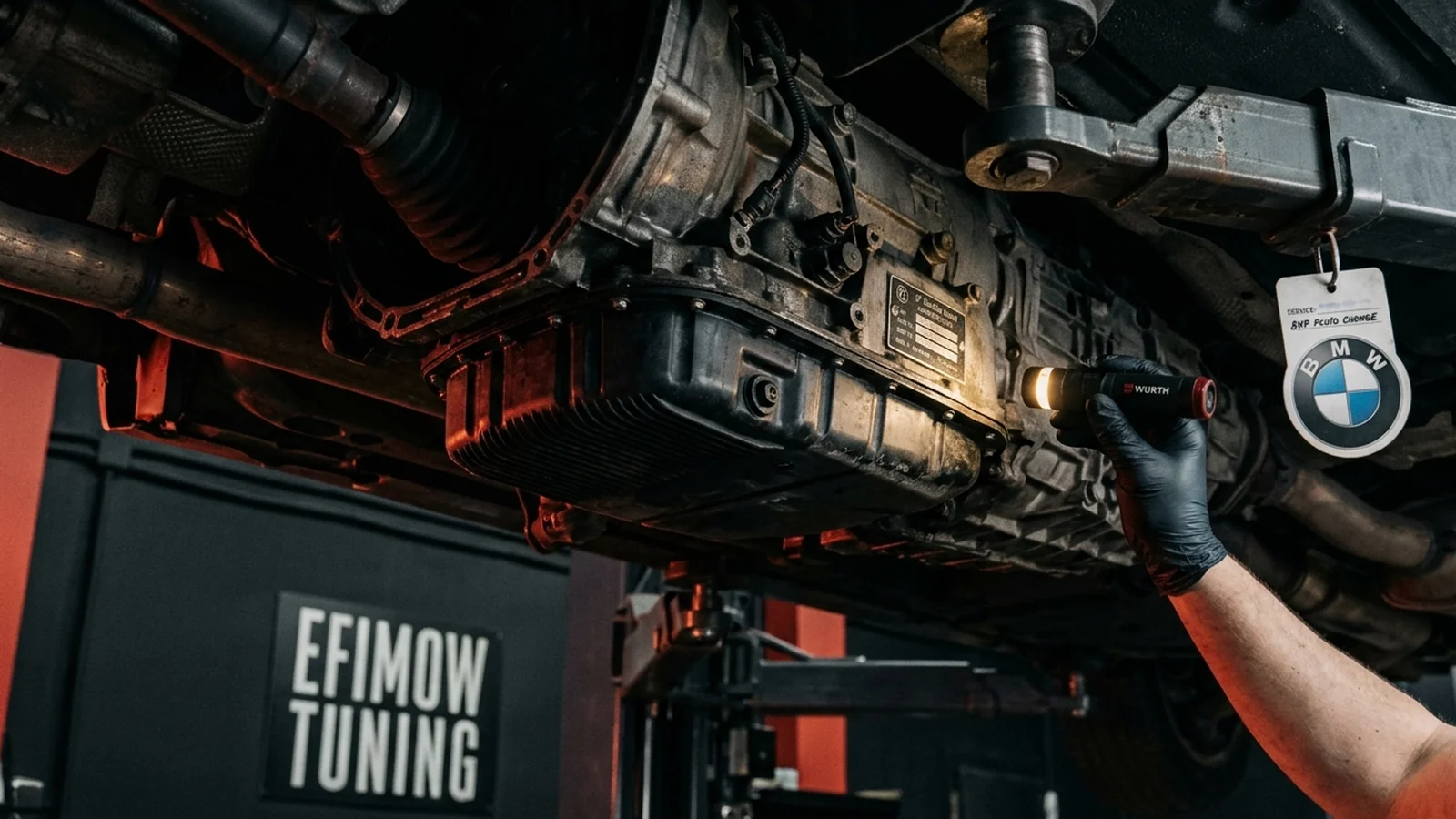
The most reliable source is the type plate on the gearbox housing, which shows the gearbox type and part number. Without a lift, the vehicle data help: the VIN lets you look up the equipment, and the gearbox appears as a BMW code in the form "GA8HP…Z".
For a first estimate the engine is often enough. A BMW 330d (G20/G21) has high factory torque and therefore gets a stronger variant than a 318d. The same applies to the M340i (G20/G21). For a tuning project, though, don't rely on forum rules of thumb; check the actual designation. Within one model series, a different variant may be fitted depending on model year and drivetrain.
What matters about the 8HP when tuning
The 8HP has a well-deserved reputation for being robust. Planetary sets and shafts are rarely the problem. After an engine tune, three things count:
- The torque class of your variant. A smaller 8HP behind a four-cylinder has less headroom than a mid-class variant behind a six-cylinder that stays below its rating from the factory.
- The transmission software. The EGS knows a maximum input torque and calculates clutch pressures from the torque reported by the engine control unit. How the two interact and why the software should often be adjusted too is covered in detail in the article on TCU calibration on BMW.
- Condition. Old fluid, adaptation values learned over a hundred thousand kilometres and a converter that already judders slightly won't improve with more torque.
In practice, a suitable 8HP is usually uncritical with moderate Stage 1 calibrations, provided the engine software limits torque cleanly and the torque reported to the gearbox is correct. The higher the target, the more important it becomes to calibrate both control units together.
Typical weak spots and care
The 8HP has no well-known factory weakness in the classic sense, but there are a few points worth knowing:
- "Lifetime fill": BMW specifies no fixed fluid change, while ZF recommends changing it at regular intervals. More in the article Automatic gearbox fluid change and tuning.
- Oil pan with integrated filter: the pan is plastic and is replaced as a whole during a fluid change. Leaks at the pan or at the mechatronic connector are among the more common reasons for a workshop visit.
- Converter judder: a slight vibration at constant speed around lock-up can point to aged fluid or a worn lock-up clutch.
- Adaptation values: the 8HP keeps learning. After software changes or a fluid change, a controlled relearn can make sense. When it helps and when it doesn't is explained in Resetting gearbox adaptations.
Process and legal notes
For BMW you order the engine software online, flash it yourself via OBD and pay for the software only once it is finished. If you are also thinking about transmission software, state your gearbox when ordering in the configurator or write to us beforehand; whether and how it can be done for your car is clarified case by case. Legally: the software change voids the vehicle's type approval, and the software functions are intended exclusively for motorsport. Details in the motorsport notice.
Conclusion
The ZF 8HP is not one gearbox but a family with several generations and torque classes. All variants share the efficient layout with four planetary sets, five shift elements and an integrated mechatronic unit. For tuning, what counts is which class sits behind your engine, how the transmission software handles the new torque and how well the gearbox has been maintained. If you check the type plate, fluid condition and shift behaviour beforehand, the 8HP gives you one of the most durable drivetrains in mass production. More in the glossary under 8HP and EGS.