
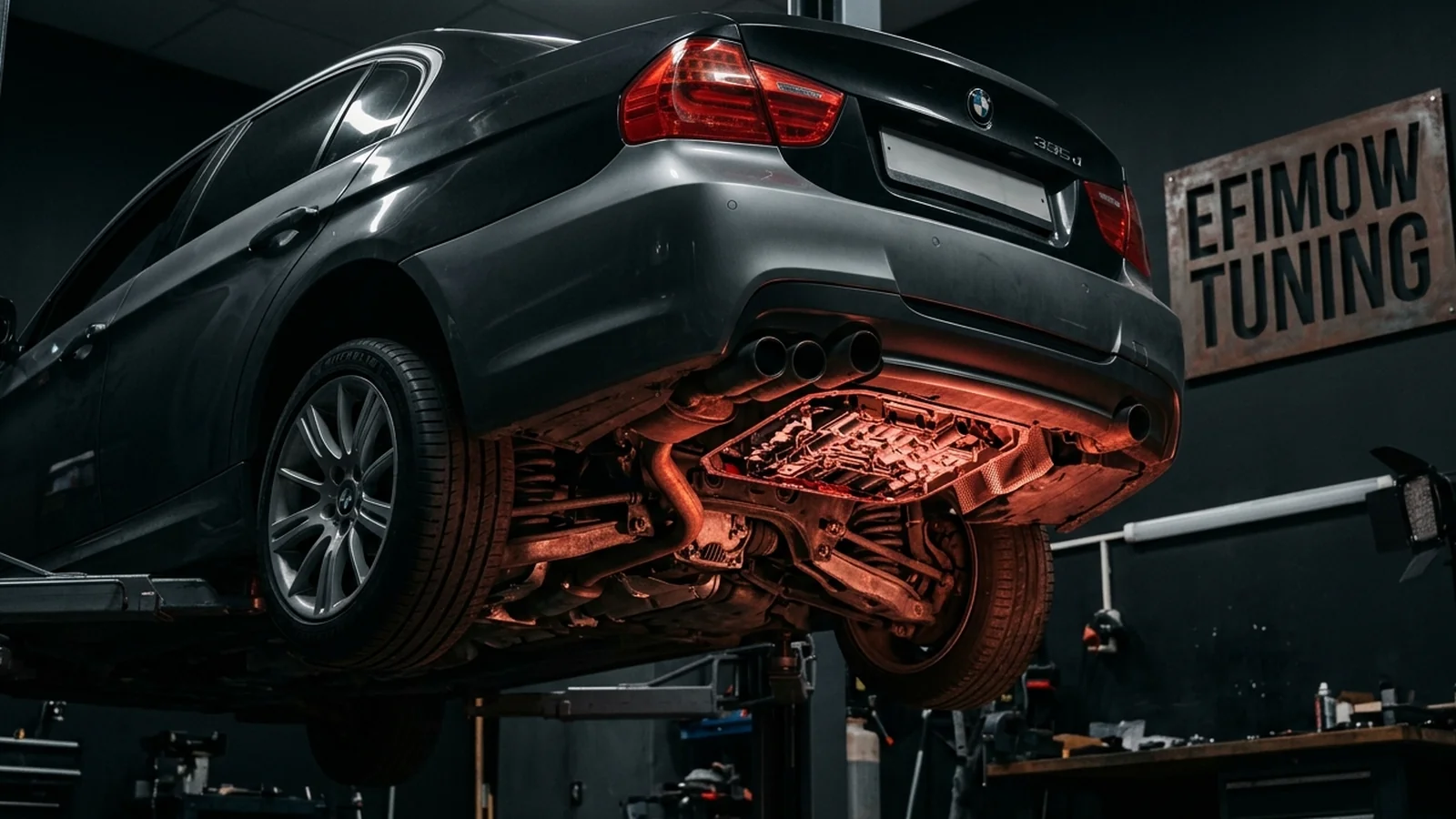
ZF 6HP in E-Series BMWs: Strengths, Limits, Tuning
The ZF 6HP sits in many E60, E90, E70 and E83. What the six-speed automatic does well, where it ages and what to check before an engine tune.
October 26, 2026 by Leo Efimow
BMW's E generation is more popular than ever with enthusiasts and tuners. A 330d or 535d with a six-cylinder diesel, a twin-turbo 335i or an X5 E70 have one thing in common when ordered with an automatic: behind the engine there is very often a ZF 6HP. In many cars that gearbox is now fifteen to twenty years old and has the mileage to match. That is exactly why an honest look at it pays off before an engine tune. This article explains what sets the 6HP apart, which variants exist, where it typically ages and how to prepare it for more torque.
A gearbox that set the benchmark
ZF introduced the 6HP in the early 2000s; its first series application was the BMW 7 Series E65 in 2001. It was the first six-speed automatic in a production passenger car. Over the following years it moved into almost every BMW model series with a longitudinal engine: 5 Series E60/E61, 6 Series E63/E64, 3 Series E90 to E93, X3 E83, X5 E70, X6 E71 and more. BMW sold it as Steptronic. Audi, Jaguar and Land Rover also used the 6HP in large numbers.
From around 2010 the eight-speed ZF 8HP gradually replaced the 6HP. Some late E models, such as the facelifted E70, already received the 8HP. So even within one model series, you need to check the actual car.
Design and variants
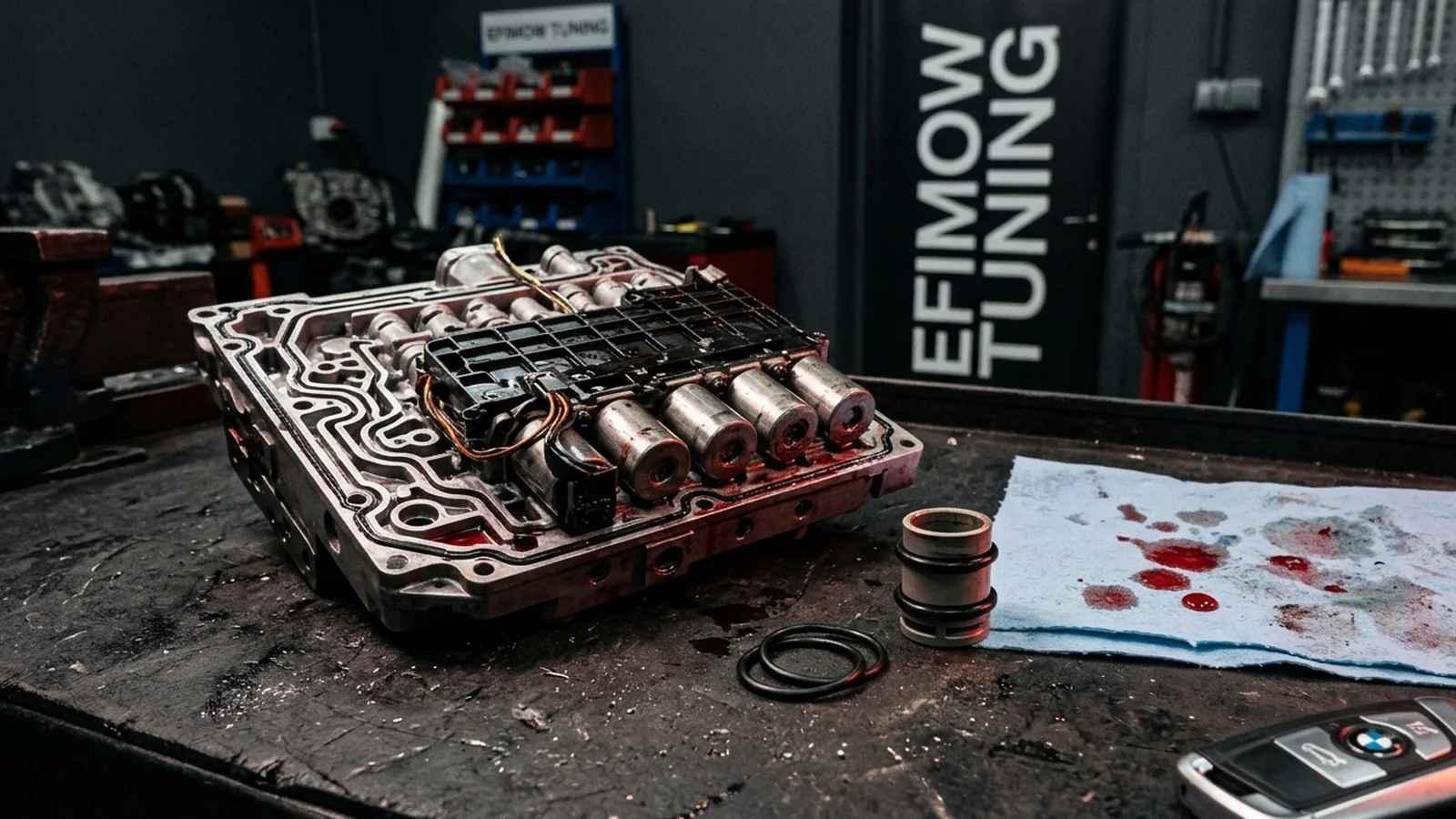
The 6HP uses a torque converter with lock-up clutch, a simple and a double planetary gear set (Lepelletier principle) and five shift elements. The transmission control sits as a mechatronic unit directly inside the gearbox, under the oil pan, together with the hydraulic valve body. At BMW this control unit is called the EGS.
There are two generations. The first carries designations such as 6HP19 and 6HP26; the revised second generation from the mid-to-late 2000s is called 6HP21 and 6HP28. The number roughly stands for the torque class:
| Variant | Class | typically behind |
|---|---|---|
| 6HP19 / 6HP21 | smaller and middle class | four- and six-cylinder petrols, smaller diesels |
| 6HP26 / 6HP28 | higher class | V8 petrols, high-torque six-cylinder diesels and turbo petrols |
| 6HP32 | top class | luxury-segment V12 |
At BMW the designation appears in the vehicle data in the form "GA6HP…Z". The type plate on the gearbox gives the definitive answer.
What the 6HP does well
In practice the 6HP has proven solid when it is maintained. The mechanical core, meaning planetary sets, shafts and housing, is strongly built. Many units go well beyond 250,000 kilometres with regular fluid changes. Shift quality is good for its generation, and early converter lock-up keeps losses in check.
Where the 6HP ages
The weak spots are well known, and almost all of them relate to fluid, hydraulics or seals:
- Aged fluid: for a long time BMW spoke of a lifetime fill. In practice the fluid loses its friction properties and additives over the years. Harsh or jerky shifts are often the first result.
- Leaking connector sleeve: where the mechatronic connector passes through the housing there is a sleeve with O-rings. When it leaks, the gearbox slowly loses fluid, which can also creep into the connector. A classic on E models.
- Wear on clutch plates and valves: at high mileage, wear shows up as a flare in revs during shifts, delayed engagement of drive or reverse, or jerky downshifts in town.
- Converter: vibration at constant speed in the middle gears can point to the lock-up clutch.
Some of these symptoms improve noticeably with fresh fluid, a new oil pan with filter and relearned adaptations. If wear is behind them, that only helps so much.
The 6HP and more torque
The high-torque E models in particular invite tuning: a BMW 335d (E9x), a 535d (E6x) or a 335i (E9x). With these engines the factory torque is already much higher than with the base engines, so the fitted 6HP variant works closer to its rating.
What happens after an engine tune follows the familiar pattern: the transmission control knows a maximum input torque and calculates clutch pressures from the torque reported by the engine control unit. If the reported and real torque differ, or the reported value exceeds the limit, the gearbox intervenes or the clutches start to slip. The basic principle is covered in Torque converter automatics after tuning; the role of the transmission software is explained in TCU calibration on BMW.
With the 6HP, age comes on top. A gearbox with 200,000 kilometres, old fluid and slight slip is a poor basis for more torque, however good the software is. So with this gearbox in particular:
- Check condition first: read the EGS fault memory, judge shift behaviour cold and warm, watch for rev flares.
- Change the fluid before tuning: if the last change is unknown or long ago, this is the most important step. More in Automatic gearbox fluid change and tuning.
- Limit torque sensibly: engine software that limits torque especially in the lower gears and at low rpm protects the converter and clutch plates.
- Let the adaptations relearn: after a fluid change and a software change, the learned values no longer fit. When a reset makes sense is explained in Resetting gearbox adaptations.
Transmission software on the 6HP
On the 6HP, too, the transmission software allows the torque limit, shift points, shift times and lock-up behaviour to be adjusted. Whether that makes sense for your car depends on variant, condition and goal. Mention that you drive a 6HP when ordering in the configurator, or contact us beforehand; we clarify it case by case. For BMW the usual process applies: order online, flash yourself via OBD, pay for the software only once it is finished.
Legally: the software change voids the vehicle's type approval, and the software functions are intended exclusively for motorsport. Details in the motorsport notice.
Conclusion
The ZF 6HP is a proven gearbox with strong mechanics, but in many E models it has now got on in years. Its typical weaknesses are fluid ageing, the leaking connector sleeve and wear at high mileage. If you check its condition before an engine tune, change the fluid, limit torque to suit the variant and let the adaptations relearn, a 6HP can give you plenty of enjoyment in a tuned E model. More in the glossary under 6HP and torque limitation.