
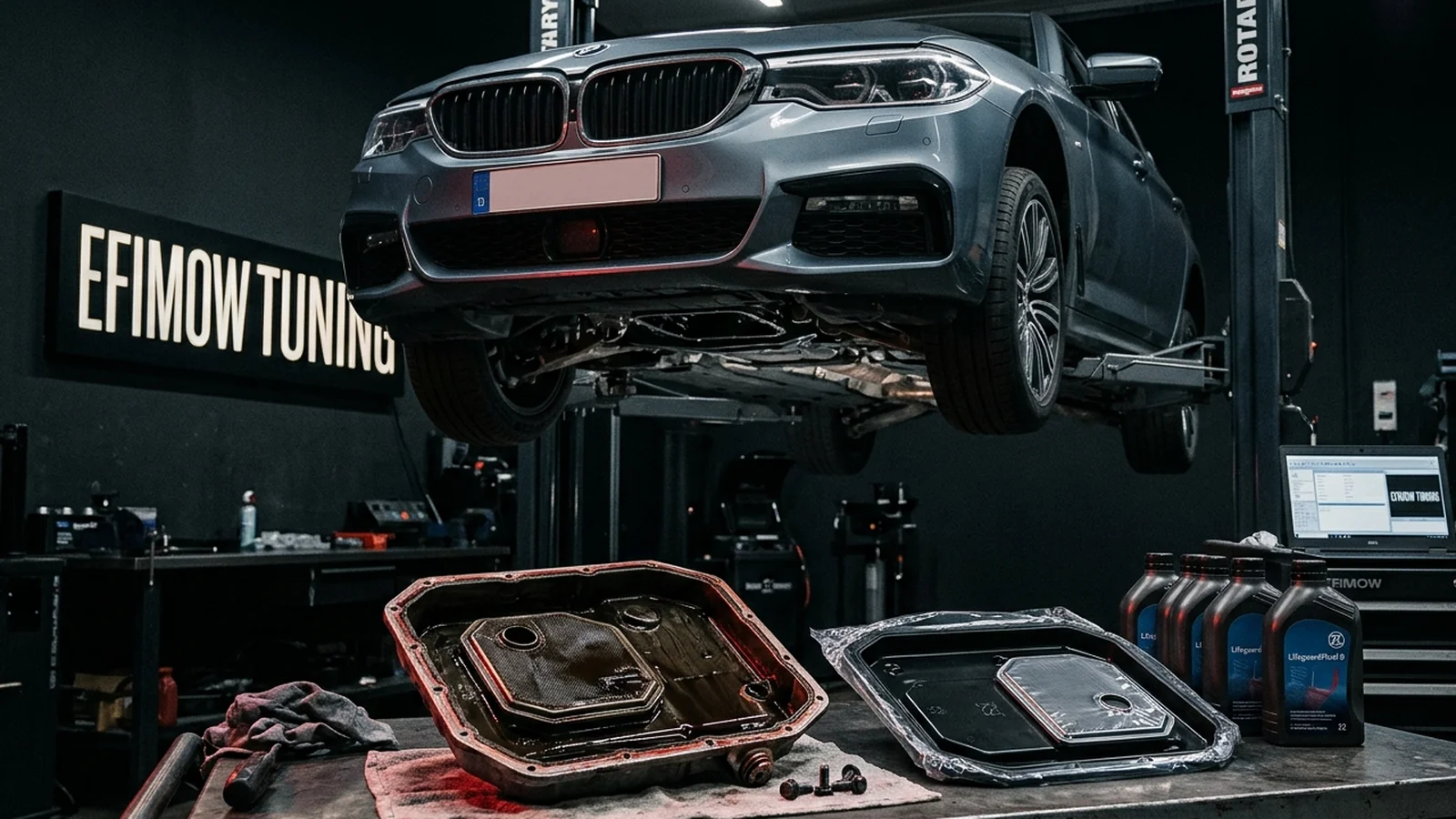
Automatic Gearbox Fluid Change: "Lifetime" Fill and Tuning
What a "lifetime fill" in an automatic gearbox really means, when a fluid change makes sense, how it's done properly and why tuning raises the stakes.
October 26, 2026 by Leo Efimow
Many service books list no fluid change for the automatic gearbox. The fluid is considered a lifetime fill. Many owners read that as "never change it". Gearbox manufacturers and specialist workshops see it differently. And as soon as an engine delivers more torque, the question carries extra weight, because the gearbox fluid has to carry away more heat. This article explains what's behind the lifetime fill, when a change makes sense, how it's done properly and what role it plays before and after a tune.
What "lifetime fill" really means
"Lifetime" is not a physical property of the fluid but a design assumption. It refers to the service life the vehicle manufacturer plans for, typically the period of warranty, leasing and first ownership. For many cars that are now twelve or fifteen years old and have covered 200,000 kilometres or more, that period is long over.
ZF, maker of the 6HP and 8HP, describes its automatic gearboxes as designed to be maintenance-free, yet still advises a fluid change in its service notes: depending on load, typically in the range of 80,000 to 120,000 kilometres or after about eight years. With spirited driving, towing or a lot of full load, sooner.
What happens to the fluid in the gearbox
Fluid in an automatic is not just a lubricant. It does several jobs at once:
- Hydraulic fluid: it transmits the pressures that close the clutches.
- Friction medium: the clutch plates are matched to a specific friction value of the fluid. The additives make sure clutches engage smoothly and don't grab.
- Coolant: it carries heat away from the converter and clutches.
- Transport medium: it carries wear particles to the filter and magnet.
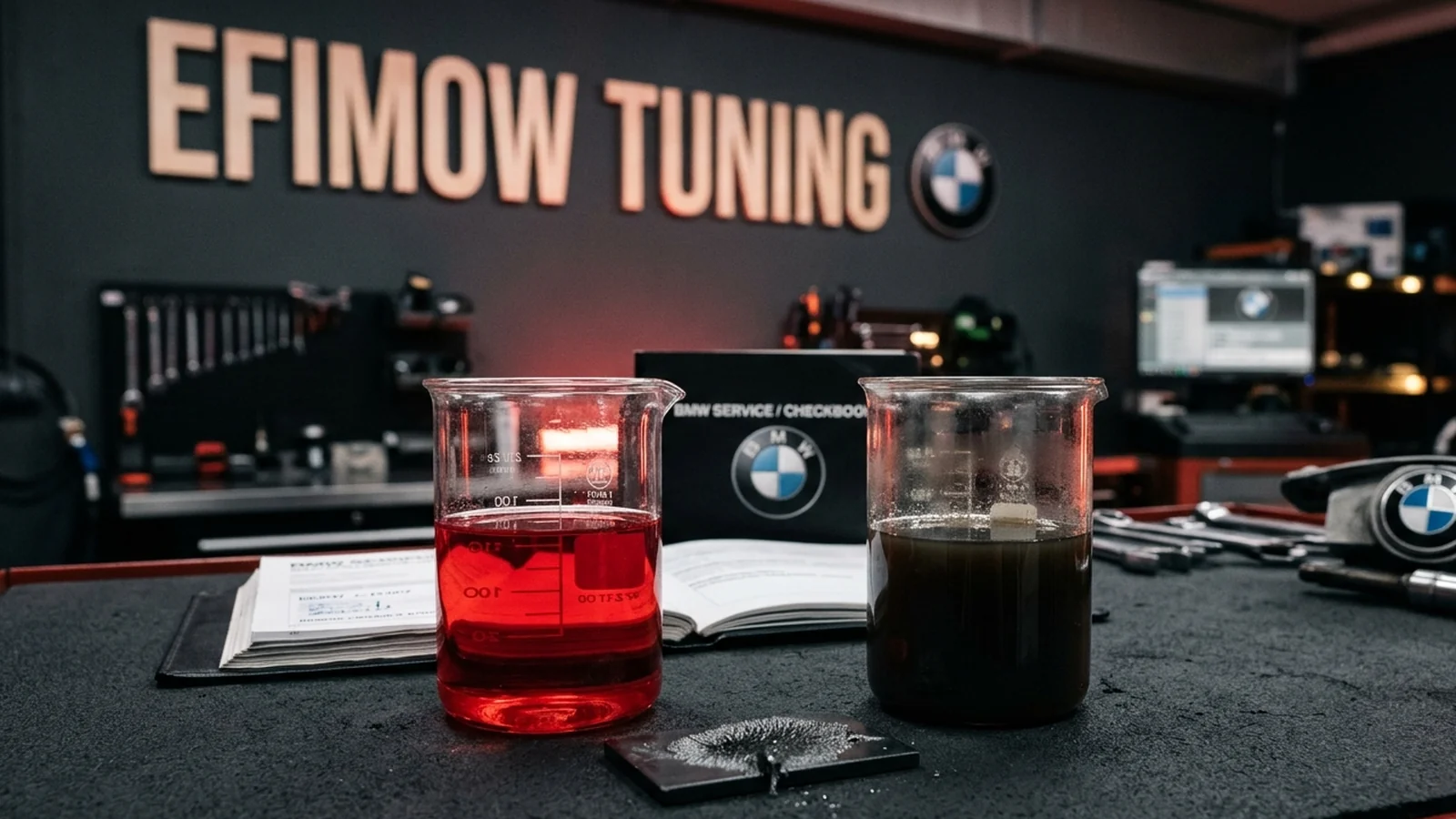
Over time the additives age, the fluid oxidises under heat and wear debris accumulates. The consequences creep in: shifts get harsher or jerkier, converter lock-up starts to judder, the gearbox runs hotter. Because the transmission control compensates for a lot through its adaptations, you often don't notice for a long time.
Why tuning raises the stakes
More torque means more heat in the converter and clutches at the same slip. At the same time, a tuned car is often driven harder. Both increase the thermal load on the fluid, and heat is the main ageing factor. Fluid that would just about have coped in standard form becomes a weak point faster after a tune.
There's a second point: aged fluid shifts the gearbox's limits. Clutches whose fluid has lost its friction properties transmit less torque at the same pressure. If you raise engine torque while the gearbox has already lost reserve because of old fluid, you load it twice over. More in Gearbox torque limits after an engine tune.
The right order before a tune
- Check condition: read the fault memory, judge shift behaviour cold and warm.
- Change the fluid if it's due or unknown: with a car of unclear history, changing it before the tune is the sensible way.
- Look at the old fluid: colour, smell and debris on the magnet say a lot about condition. Very dark, burnt-smelling fluid or a lot of debris is a warning sign; repair first, then think about more torque.
- Let the adaptations relearn: after a fluid change and a software change, the learned values no longer fit. When a reset makes sense is explained in Resetting gearbox adaptations.
- Then the software: tuning only pays off on a healthy basis.
How a fluid change is done properly
An automatic gearbox fluid change is not a quick engine-oil service. On the ZF gearboxes in BMWs it roughly looks like this:
- Replace the oil pan with filter: on the 6HP and 8HP the filter is integrated into the plastic pan. Pan and seal are replaced as a unit.
- Only approved fluid: every gearbox has a fluid specification. The wrong fluid with a different friction value can harm shift quality and clutches. Universal fluids with long approval lists are not a good idea here.
- Fill and check level with the engine running: the level is checked with the engine running within a narrow temperature range specified by the manufacturer. Check it cold or too hot and you'll fill incorrectly. Too little fluid causes shift problems, and so does too much.
- Multiple changes on long-neglected gearboxes: a simple drain leaves part of the fluid in the converter and hydraulics. Some workshops therefore change it in several rounds or use a flushing procedure. Which approach fits depends on the gearbox and its condition.
- Check the connector sleeve and seals: on the 6HP it's worth looking at the mechatronic connector sleeve while you're at it. More in ZF 6HP in E-Series BMWs.
A frequently heard argument goes: "Never change the fluid at high mileage or the gearbox will fail." Behind it is the observation that some gearboxes fail shortly after a late fluid change. As a rule, the gearbox was already worn, and the old fluid merely masked the damage. A healthy gearbox doesn't hold a professional fluid change against you.
Dual clutch and SMG
In wet dual-clutch gearboxes such as the Getrag 7DCT in the 1 Series, 2 Series and X1, the fluid is even more directly tied to the clutches: it cools the friction surfaces directly. A change to the manufacturer's specification, and sooner after a tune, makes particular sense here. The SMG II in the M3 E46 has a dry clutch but a hydraulic system with its own fluid, which also ages. More in SMG II in the E46 M3.
After the tune: adjust the intervals
If you drive a tuned car with an automatic or dual clutch, don't rely on the factory figure. A sensible guide is the manufacturer's recommendation for severe conditions, meaning the lower end of the intervals, especially with frequent full load, towing or track use. Engine oil has its own article: Oil change intervals after tuning.
Our process and legal notes
When ordering in the configurator, state which gearbox you have and when the fluid was last changed. For BMW you order online, flash yourself via OBD and pay for the software only once it is finished. Legally: the software change voids the vehicle's type approval, and the software functions are intended exclusively for motorsport. Details in the motorsport notice.
Conclusion
"Lifetime fill" doesn't mean "never change", it means "designed for the planned first use". Gearbox manufacturers recommend regular changes, and after a tune the thermal load on the fluid rises. The right order is: check condition, change the fluid, let the adaptations relearn, then the software. With approved fluid, a correctly measured level and adjusted intervals, even a tuned automatic gearbox stays healthy for a long time. More in the glossary under 8HP and 6HP.