
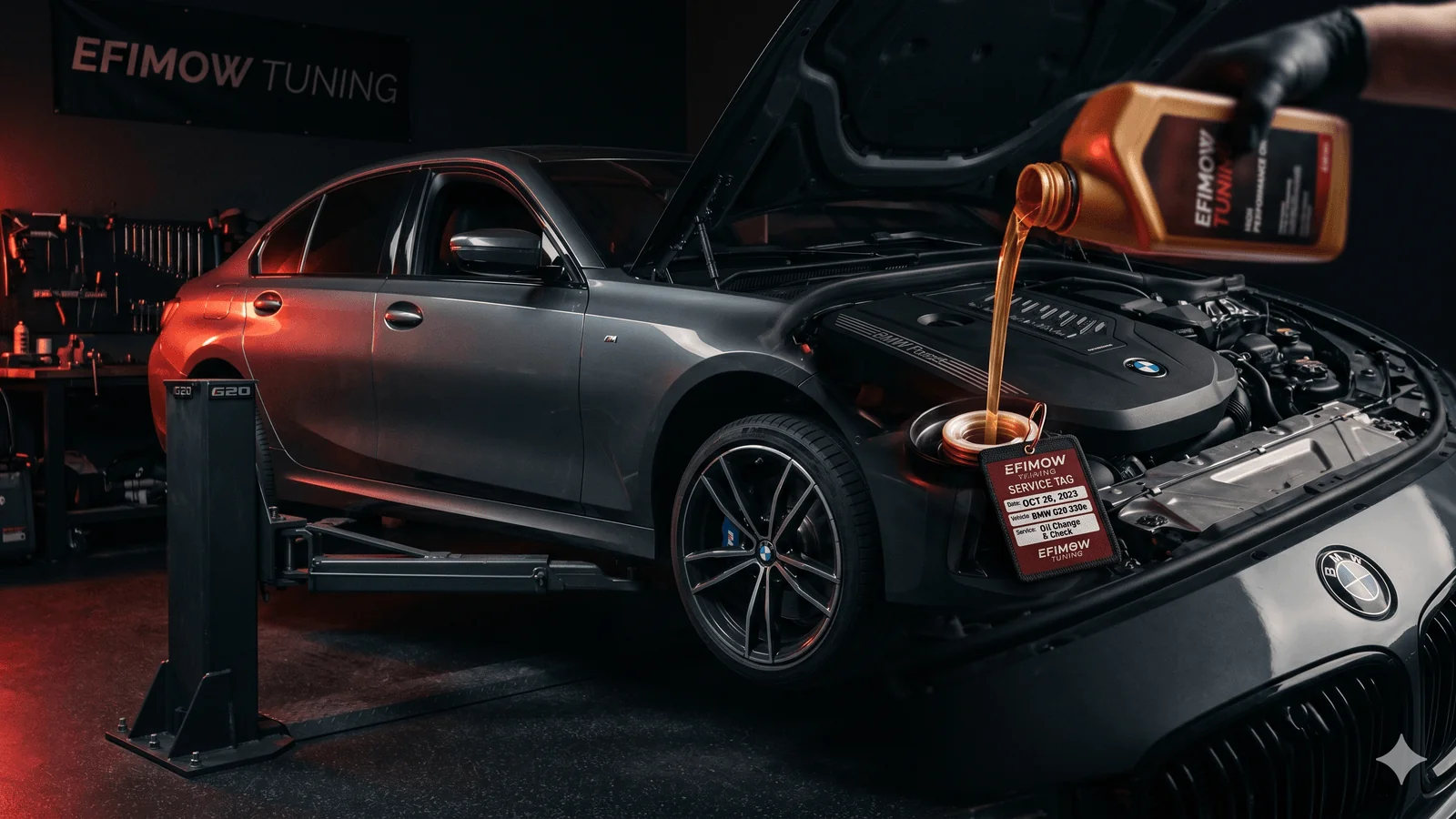
Oil Change Intervals After Tuning: Why Longlife Is Now a Liability
30,000 km Longlife intervals are too long for tuned engines. What actually happens to the oil, which viscosity makes sense, and how often you really should change it.
May 6, 2026 by Leo Efimow
If you drive a BMW on Stage 1 or Stage 2 and still hold to the factory recommendation of roughly 30,000 km Longlife intervals, you are running your engine against physics. More torque, higher boost, and higher combustion temperatures do not just press on pistons and turbochargers. They press hardest on the oil that carries friction between all those parts. Oil does not age in a straight line. Skipping an interval adjustment after a tune does not save money. It just moves the bill from the service book to a future repair invoice.
What actually happens inside the oil when the engine makes more power
Engine oil in a modern BMW inline-six or B48 four-cylinder does four jobs at once: lubricate, cool, seal, and clean. In factory trim, a modern Longlife oil handles that for 25,000 to 30,000 km, because the thermal and mechanical load stays inside a tightly defined window.
A Stage 1 calibration shifts that window upward in a way you can feel and measure. Boost typically rises by 0.2 to 0.4 bar, torque by 80 to 120 Nm. Oil temperature under sustained load climbs by 10 to 20 °C, and that temperature is the lever that ages the oil. A tribology rule of thumb: above 100 °C, every additional 10 °C roughly doubles the oxidation rate. A residual service life of 30,000 km can collapse to 15,000 km, without the driver noticing anything in daily use.
On top of that comes mechanical stress. The turbocharger rotor spins past 200,000 rpm under load. Its bearing rides entirely on an oil film. If that film loses viscosity through shearing or oxidation, the hydrodynamic margin collapses exactly where you can least afford it.
Why 30,000 km Longlife no longer fits a tuned engine
The BMW Longlife concept is a cost-saving measure: for the manufacturer, not for the engine. Long intervals reduce in-warranty service expense and look good in fleet contracts. The model assumes the engine spends most of its life inside the factory torque envelope and that the oil only briefly visits its thermal limits.
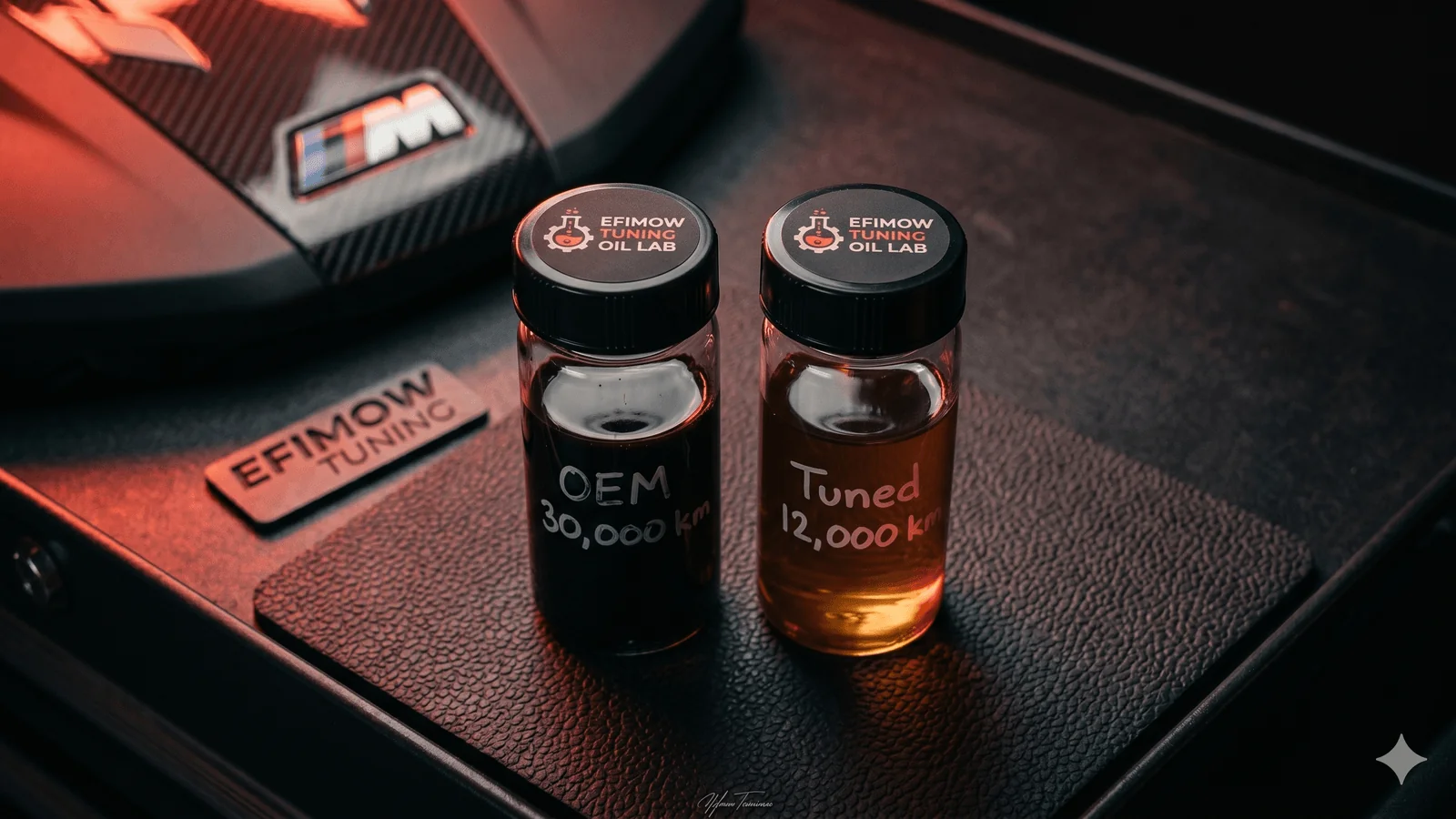
That assumption breaks after a tune. An M340i delivering 480 Nm from the factory and 580 Nm after an honest Stage 1 sees full load far more often. The result is measurable: an oil analysis at 25,000 km on a tuned engine routinely shows elevated iron and copper, a reduced TBN (Total Base Number), and visible fuel dilution, particularly on direct-injection engines that see short trips.
In practice, 10,000 to 15,000 km is the honest interval after a tune. If you run frequent full load, tow regularly, or see track time, you should be thinking closer to 8,000 to 10,000 km (every 12,000 km / ~7,500 miles is a sane upper anchor for street use). This is not marketing. It is the consequence of what the oil sees.
Which viscosity actually makes sense after tuning
This is where it gets interesting, because many BMW models ship with ultra-thin oils chosen for fleet fuel-economy targets, not for thermal headroom. Three specifications keep coming up in the BMW world, and the differences matter once the engine has been tuned.
LL-01 (Longlife-01) is the classic specification used on older naturally aspirated engines and many early turbo applications. Typical viscosity: 5W-30 or 5W-40. High shear stability, robust additive package. From today's perspective the better compromise for tuned engines, where the model release allows it.
LL-04 is built around modern engines fitted with gasoline particulate filters and SCR systems: low sulfated ash, moderate viscosity (often 0W-30 or 5W-30). For a tuned engine the weakness sits in the high-temperature region, specifically the HTHS viscosity, which is exactly where the oil film inside the turbo bearing actually does its work.
LL-FE (Fuel Economy) is the thinnest of the three, often 0W-20. It is optimized for the factory consumption cycle. After a tune it offers the weakest compromise: maximum protection traded for a small economy gain.
If your model leaves the factory on LL-FE, switching to LL-01 or LL-04 in 5W-40 or 0W-40 is worth the conversation, provided the release is valid and your shop can verify the specification. Brands like Mobil 1, Liqui Moly Top Tec, Castrol Edge, or Motul X-Cess cover this territory seriously. The brand on the bottle matters less than the HTHS number on the data sheet: 3.5 mPa·s or higher is a reasonable anchor after tuning.
What else belongs in an oil service after tuning
An oil change alone is not enough. Three points belong in every post-tune service. First, a genuine OEM-quality oil filter, not the cheapest aftermarket box. The filter sees more particles in a tuned engine and needs to keep its bypass reserve at higher flow. Second, the drain plug with a fresh sealing washer: a few cents at the BMW counter, but the most common cause of slow seepage if reused. Third, a visual check of the drained oil and the magnetic plug if the engine has one. Sparkle on the magnet is normal. A wide ribbon of swarf is not.
If you are serious about it, run an oil analysis once a year. Labs like Polaris Laboratories, OELCHECK, or Blackstone deliver a report for around 30 dollars or euros that says more about your engine than any visual check. Iron, aluminum, silicon, viscosity at 100 °C, TBN, fuel content: those numbers tell you whether the interval fits or runs too long. On a tuned engine, the first year is especially worth the effort, because it lets you calibrate the right interval empirically rather than by feel.
Bottom line
Tuning is not just an ECU question. It is a question of the entire operating regime, and the oil carries the largest share of that load. Holding 30,000 km Longlife after a tune saves on one side and pays on the other. The realistic numbers are 10,000 to 15,000 km, a viscosity adjusted toward 5W-40 or 0W-40 with adequate HTHS reserve, an OEM filter, and an oil analysis in the first year. That is not over-servicing. It is the honest consequence of what is actually happening inside the engine under full load.