
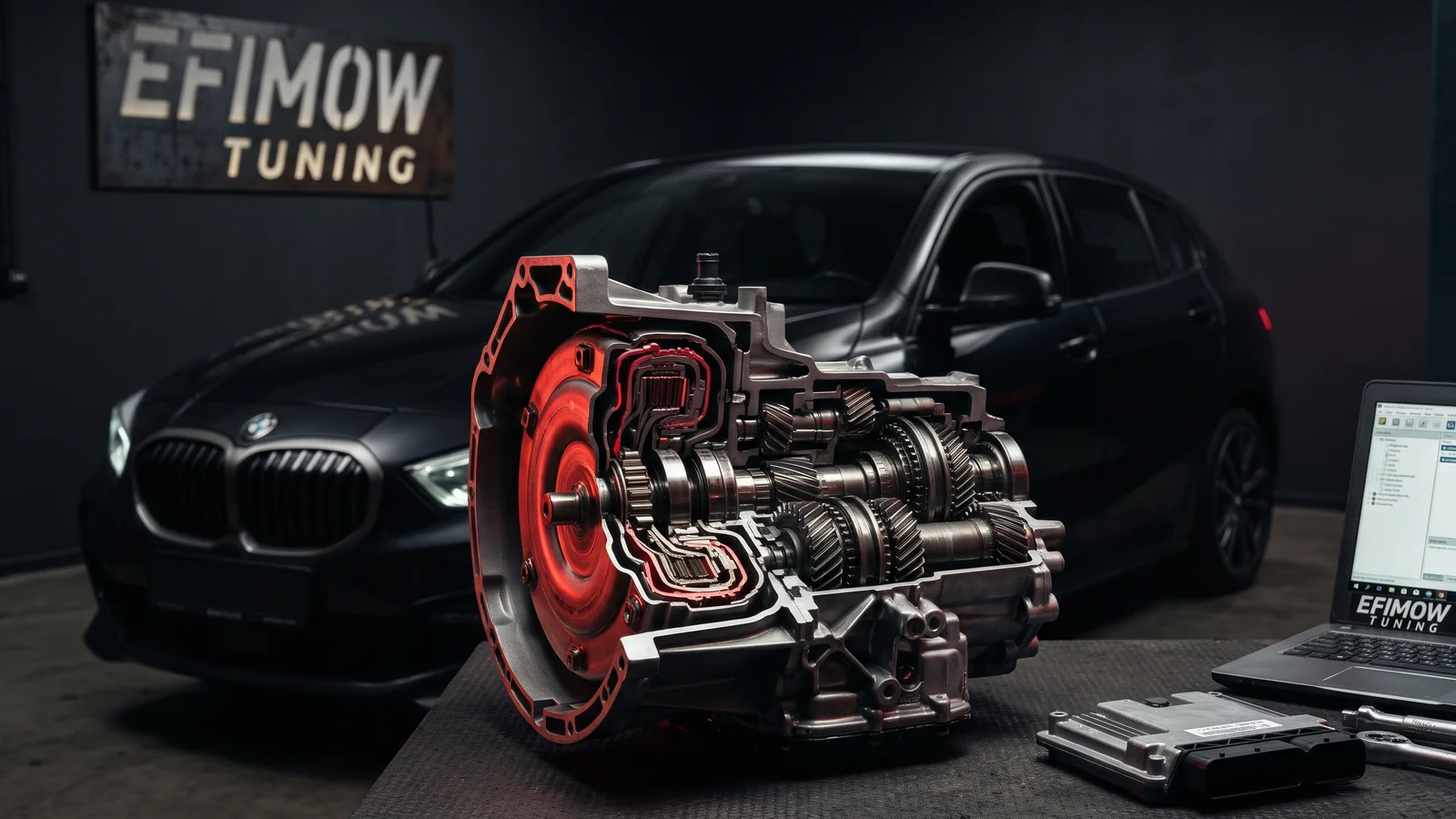
Getrag 7-Speed DCT in the 1 Series, 2 Series and X1 (F4x)
The seven-speed dual-clutch gearbox in front-drive BMWs: design, rating, how it differs from the M DCT and what matters after an engine tune.
October 26, 2026 by Leo Efimow
If you drive a BMW 118i, an X1 sDrive18i or a current Mini Cooper with an automatic, you may not have a classic automatic at all. Since around 2018, BMW has used a seven-speed dual-clutch gearbox in many petrol models on its front-drive platform. BMW calls it "7-speed Steptronic with double clutch"; it is built by Getrag, which has been part of the supplier Magna since 2016. For tuning, the gearbox is interesting because its rating sits closer to the engines it is paired with. Here you'll learn how it is built, how it differs from the DCT in M models and what to watch for with more torque.
Where the gearbox is used
Getrag calls this dual-clutch gearbox the 7DCT300. It is designed for transverse installation and BMW uses it on the front-drive platform (UKL): 1 Series F40, 2 Series Gran Coupé F44, 2 Series Active Tourer, X1 F48, X2 F39 and many Mini models from the 2018 facelift. Other manufacturers use it too, Renault for example under its own name.
At BMW, the 7DCT mainly sits behind the three-cylinder petrols and the mid-range four-cylinder petrols, and occasionally behind small diesels. The stronger versions, meaning the diesels with the B47 four-cylinder and the M Performance models, get an Aisin torque converter automatic instead. More in Aisin automatics in front-wheel-drive BMWs and Minis.
Typical examples from the catalogue are the BMW 118i (F40) and the X1 sDrive18i (F48), if ordered with an automatic. Whether your car has a dual-clutch gearbox or a torque converter automatic is shown in the vehicle data for your VIN. In daily driving you can also feel it: when you release the brake, the DCT creeps off noticeably more hesitantly than a converter.
Design: two clutches in an oil bath
At its core, a dual-clutch gearbox is a manual gearbox with two sub-gearboxes. One clutch serves the odd gears, the other the even gears. While one gear is active, the next one is already preselected. During a shift one clutch opens while the other closes, without interrupting drive.
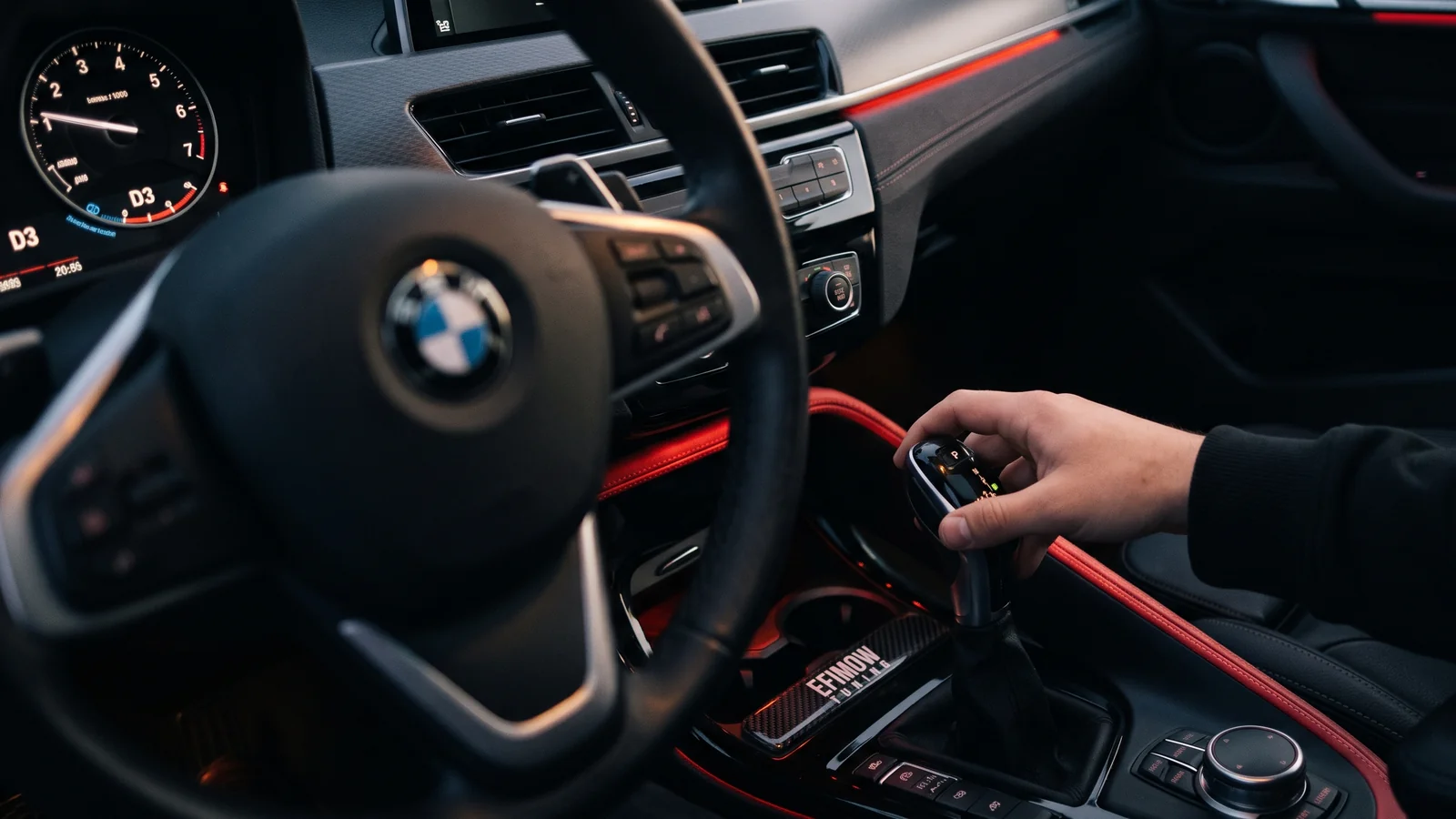
In the 7DCT300 both clutches run wet, meaning in an oil bath. The fluid cools the friction surfaces and makes the gearbox less sensitive to heat than dry dual-clutch designs. Everything is managed by a transmission control unit, which at BMW, like all transmission controls, is called the EGS. It controls clutch pressures, the overlap during gear changes, gear preselection and pulling away.
The number in the name: 300 Nm
The "300" in the designation is no coincidence. Getrag designed the 7DCT300 for a maximum input torque of around 300 Nm. How much of that is approved in a specific vehicle is decided by the vehicle manufacturer.
For tuning, this figure is the most important piece of information in the whole article. A three-cylinder with moderate factory torque still has some headroom up to the design limit. With the stronger four-cylinders behind this gearbox, however, factory torque is already close to the rating. Raise engine torque significantly there and you quickly end up above what the gearbox was built for.
Don't confuse it with the M DCT
BMW also uses the term DCT (DKG in German) for the dual-clutch gearboxes of the M models, for example in the M3 E9x or the M3 F80 and M4 F82. Those gearboxes also come from Getrag but are a completely different design: longitudinal, for rear-wheel drive and rated for much higher torque. Experience from the M world therefore doesn't transfer to the 7DCT in the 1 Series or X1. You'll find more on the M DCT in the glossary under DKG.
What happens after an engine tune
The mechanisms are the same as with any dual-clutch gearbox and are described in detail in DSG DQ250/DQ381: transmission software after an engine tune: the transmission control calculates clutch pressure from the reported engine torque. If real torque is higher than reported, or the reported value exceeds the stored limit, slip, torque reduction or protective reactions follow.
For the 7DCT in front-drive BMWs this means in practice:
- Limit torque rather than hunting for the limit: serious engine software for these cars is guided by the gearbox rating, not by the most the engine could deliver.
- Relieve the lower gears: with front-wheel drive, traction is the limit anyway. More torque in first gear loads the clutch and drive shafts without making you faster.
- Smooth torque build-up: peaks at low rpm are harder on the clutches than an even plateau.
Whether a transmission software calibration makes sense and is feasible in your case is clarified on request. Mention your gearbox when ordering in the configurator.
Driving style and care
Dual clutches are loaded most heavily when they slip. A few habits help the gearbox:
- Avoid creeping in traffic jams: better to leave a gap and pull away briskly than roll for minutes with a slipping clutch.
- Use the brake on hills: holding the car with the throttle keeps the clutch slipping continuously.
- Warm up: take the first kilometres after a cold start gently until the fluid is up to temperature.
- Fluid change: wet dual clutches depend on the condition of their fluid. Even if no fixed interval is specified, a change at higher mileage makes sense, and sooner after a tune. More in Automatic gearbox fluid change and tuning.
- Adaptations: after a clutch replacement, a repair or a software change, the gearbox must relearn the clutches. More in Resetting gearbox adaptations.
Process and legal notes
For BMW you order the engine software online, flash it yourself via OBD and pay for the software only once it is finished. Legally: the software change voids the vehicle's type approval, and the software functions are intended exclusively for motorsport. Details in the motorsport notice.
Conclusion
The Getrag 7DCT300 is a compact, wet-running dual-clutch gearbox for transverse installation, found in many petrol versions of the 1 Series, 2 Series, X1, X2 and Mini. Its rating of around 300 Nm is close to factory torque on the stronger engines. For tuning that means the engine software must respect the gearbox limit, limit torque in the lower gears and build it up smoothly. With well-kept fluid and a considerate driving style, the gearbox remains a pleasant everyday companion. More in the glossary under torque limitation.