
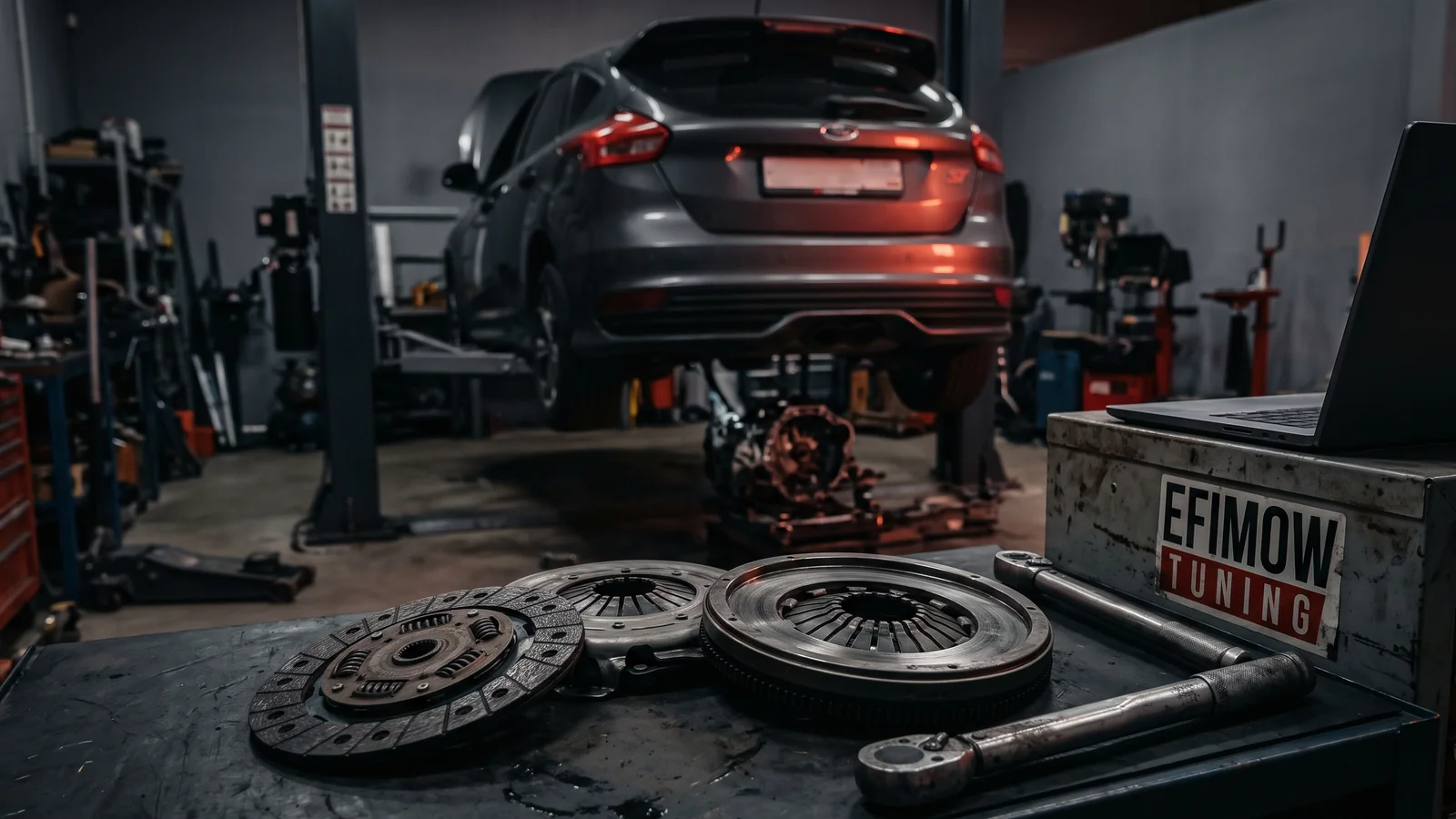
Clutch and Dual-Mass Flywheel after Tuning
How much torque can the stock clutch take? How to spot slipping, what role the dual-mass flywheel plays and when an upgrade becomes necessary.
October 25, 2026 by Leo Efimow
On cars with a manual gearbox, the clutch is the first component to notice that the engine now delivers more torque. It has to transmit power by friction, and friction has a limit. On most modern cars there is also the dual-mass flywheel, which damps vibrations and can reach its own limits in the process. Here you learn how much reserve stock parts typically have, how to recognise problems and when an upgrade makes sense.
How a clutch transmits torque
A single-plate dry clutch consists of pressure plate, clutch disc and flywheel. The pressure plate clamps the disc against the flywheel with spring force. How much torque can be transmitted depends essentially on three factors: the clamping force, the friction coefficient of the lining and the effective diameter of the disc.
Manufacturers design clutches with a safety margin above maximum engine torque. How large this margin is varies a lot. If the same clutch is also used for a more powerful engine variant, there is often headroom. If the clutch is tailored to exactly this engine, it quickly gets tight.
What the dual-mass flywheel does
The dual-mass flywheel (DMF) consists of two flywheel masses connected by arc springs. It filters the engine's torsional vibrations before they reach the gearbox. Without a DMF, modern diesels and small turbo petrols would run much rougher at low revs, and the gearbox would rattle.
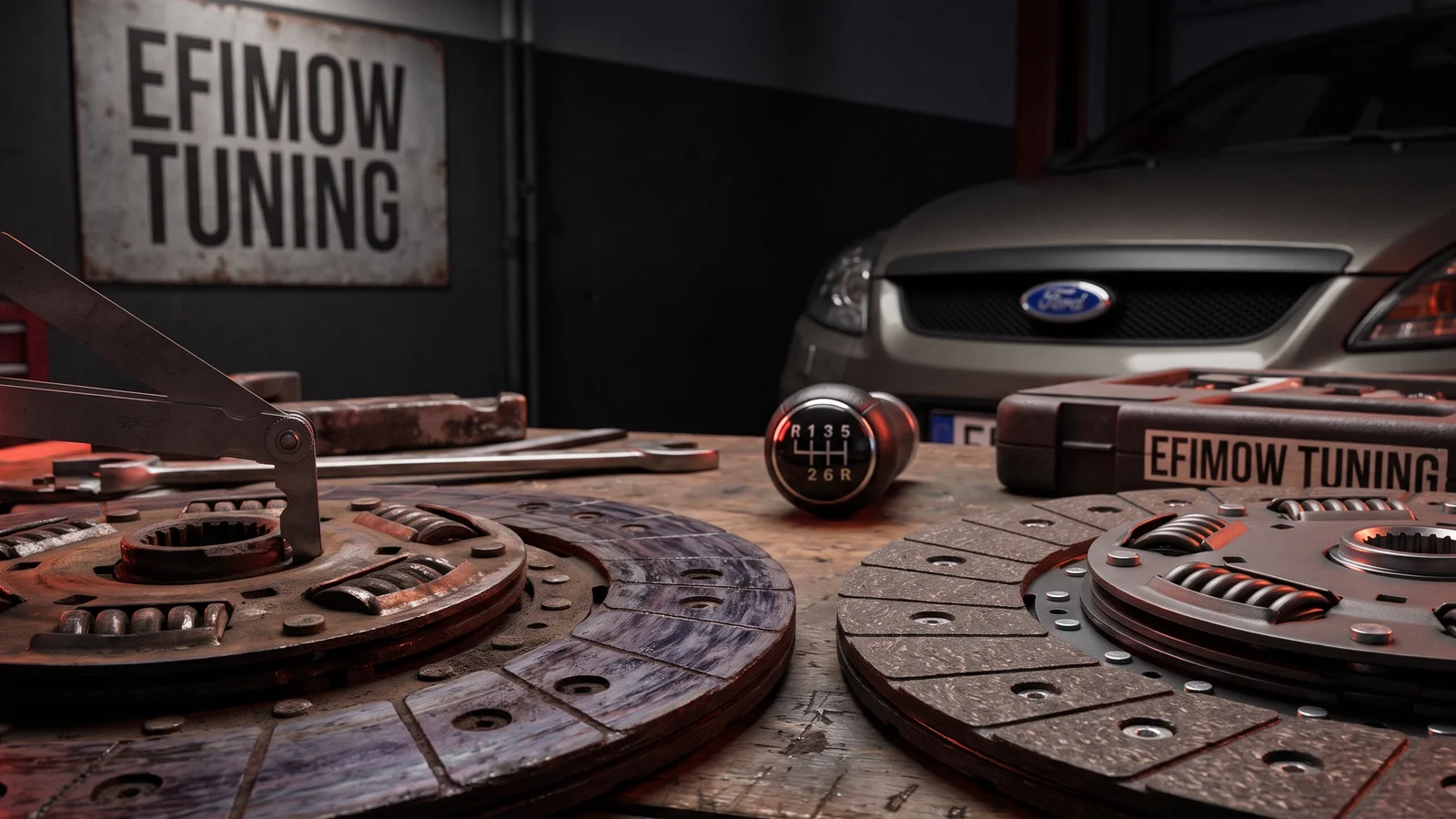
The DMF also has a torque limit. If it is exceeded regularly, the springs hit their end stops. The result: rattling, vibration and eventually failure. Especially on torquey diesels that have considerably more low-end torque after tuning, the DMF is often more sensitive than the clutch itself.
Typical symptoms after tuning
| Symptom | Possible cause |
|---|---|
| Revs rise in a high gear at full load without the car going faster | clutch slipping |
| Burning smell after brisk acceleration | clutch slipping, lining overheated |
| Rattling at idle that disappears when you press the clutch | worn DMF |
| Strong vibration when pulling away or switching the engine off | worn DMF |
| Judder when pulling away | clutch or DMF, glazed lining |
The classic sign of a slipping clutch is the high-gear test: at around 2,000 rpm, floor the throttle. If revs climb faster than speed, the clutch is slipping.
How a calibration spares the clutch
A proper calibration does not simply release more torque everywhere. There are several levers to spare the drivetrain:
- Torque limit per gear: in the lower gears more torque often brings little because traction is the limit. Limiting it there spares clutch, DMF and driveshafts.
- Gentle torque build-up: a torque curve without a spike at low revs is much kinder to the DMF than a steep rise.
- Plateau instead of peak: an even torque plateau often feels just as good in everyday driving and puts less load on the parts.
When an upgrade is needed
With a moderate Stage 1 on a healthy drivetrain, the stock clutch often holds. With Stage 2 and bigger torque jumps, or with an already tired clutch, an upgrade is often the sensible route. Options are reinforced pressure plates with higher clamping force, discs with a different lining, or clutch kits replaced together with a matching flywheel.
Converting to a single-mass flywheel is common in motorsport but a compromise for daily use: the clutch holds more, but vibration and gearbox rattle come back. For an everyday car a reinforced DMF kit is usually the better choice.
Before tuning: check the condition
- How old is the clutch, has it been replaced before?
- Does it already slip in the high-gear test?
- Is there rattling at idle that disappears when you press the clutch?
- How does pulling away feel, clean or juddery?
If the clutch is due soon anyway, it pays to choose a part designed for the higher torque straight away. The labour for the swap is the biggest cost factor regardless.
Driving style makes the difference
Even with the best calibration, your foot has a big influence: do not pull away with a slipping clutch and high revs, do not floor it in a high gear at very low revs, and use launch starts sparingly. Low revs with high load are the hardest load for the DMF.
Process and legal
When ordering in the configurator, state whether you drive a manual and whether clutch or flywheel are already uprated. For BMW you order online and flash it yourself via OBD; you pay for the software only once it is finished. For other brands you come to Stödtlen or send in the ECU. Legally: changing the engine software voids the type approval, and our software functions are intended exclusively for motorsport. Details in the motorsport notice.
Conclusion
On a manual car, clutch and dual-mass flywheel are the first components to feel more torque. With healthy parts and a calibration that limits torque in the lower gears and builds it up gently, the stock parts often cope well. Slipping, burning smell, rattling or vibration are warning signs. With Stage 2 or a clutch that is due anyway, a reinforced kit is the better investment. More in the glossary under clutch and flywheel.