
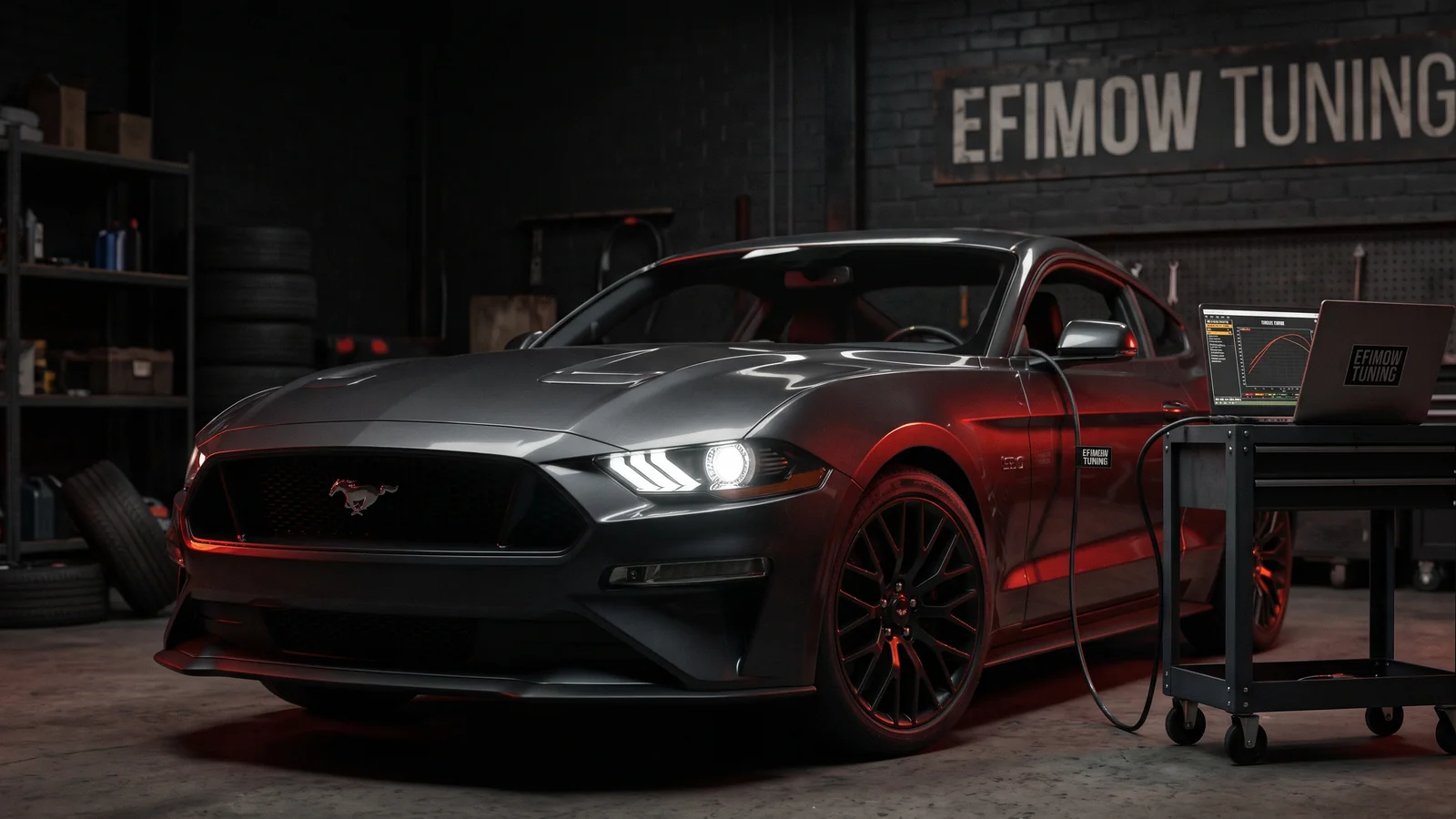
Ford Mustang S550: 2.3 EcoBoost and 5.0 V8 Tuning Check
Mustang S550 with 2.3 EcoBoost or 5.0 Coyote V8: which ECU is fitted, what software does for the turbo and the naturally aspirated V8, and what it costs.
October 25, 2026 by Leo Efimow
The sixth-generation Mustang, internally S550, was the first Mustang Ford officially brought to Europe in large numbers. From 2015 to 2023 it was sold here with two fundamentally different engines: the 2.3-litre four-cylinder turbo from the EcoBoost family and the 5.0-litre "Coyote" V8 as a classic naturally aspirated engine. Both can be optimised by software, but expectations have to match the engine concept. A turbo reacts to a new calibration completely differently from a large-displacement naturally aspirated engine. This article sorts out what is technically possible, which ECUs are fitted and what you should check before tuning.
Two engines, two philosophies
The 2.3 EcoBoost is a turbocharged direct-injection gasoline engine. Its output is largely defined by boost pressure, and the ECU sets it. This is exactly where software tuning comes in: more boost, adapted air charge, matching ignition timing and raised torque limiters change the engine's character noticeably, especially in the mid-range.
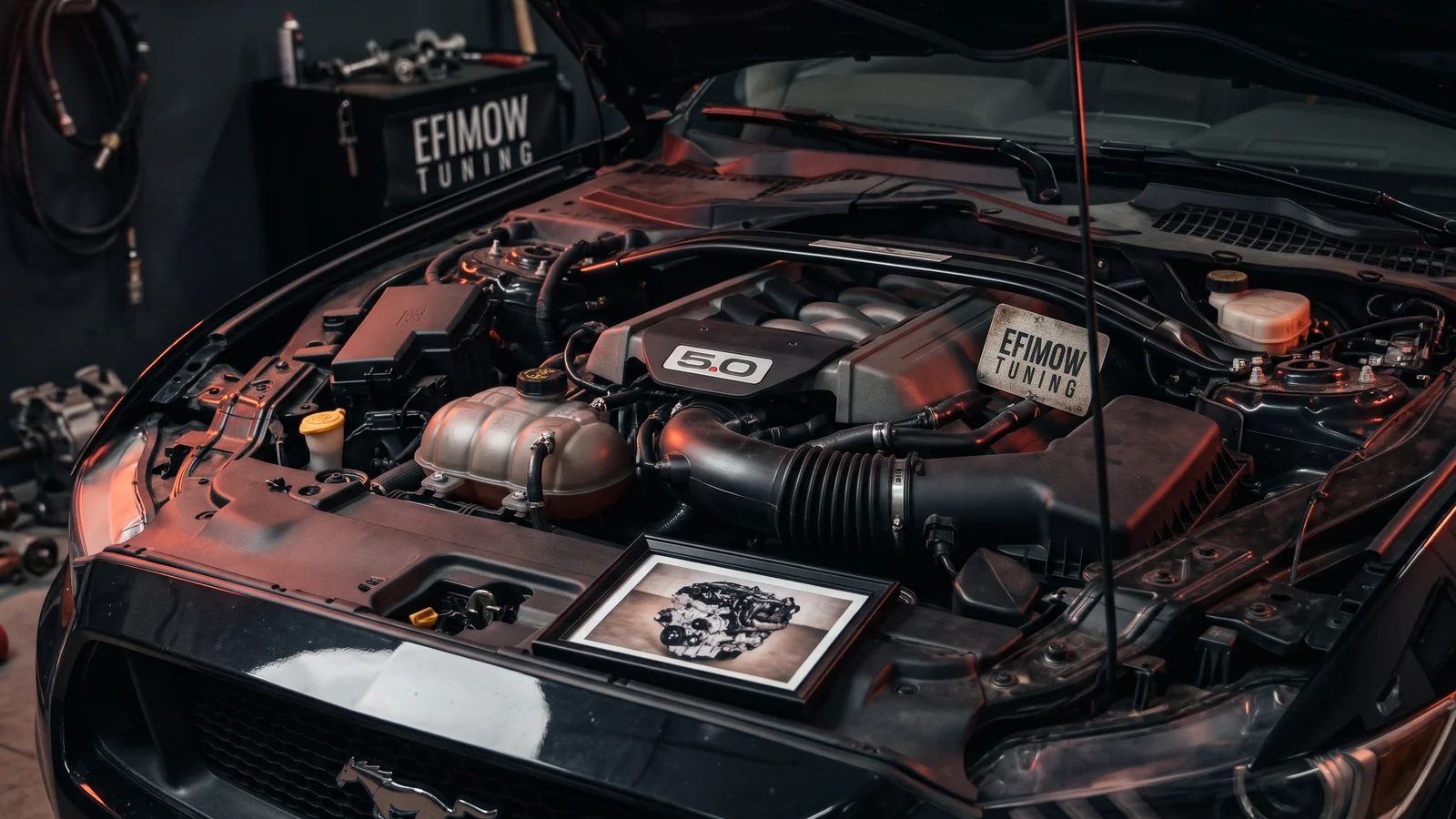
The 5.0 Coyote V8, on the other hand, breathes without forced induction. Without a charger there is no boost to raise; the air mass is defined by displacement, rpm, cam timing and the intake and exhaust side. Software can optimise ignition timing, cam timing, the throttle map and limiters, but it cannot conjure extra air into the engine. Gains are correspondingly smaller. The effect lies more in response and throttle feel than in big numbers.
Which ECUs are fitted
Depending on engine and model year, the S550 uses different Bosch ECUs:
| Variant | ECU | Access per catalog | Stage 1 from |
|---|---|---|---|
| 2.3 EcoBoost (314 hp) | Bosch MEDG17.0 | checked before the appointment | €350 |
| 2.3 EcoBoost | Bosch MG1CS017 | OBD | €450 |
| 5.0 Coyote V8 | Bosch MG1CS019 | OBD | €450 |
The prices follow from our pricing rules: the MG1 ECUs belong to the newest, most strongly protected generation, plus the surcharge for vehicles from model year 2015. The MEDG17 entry with 314 hp adds a power surcharge from 300 hp. Which ECU is actually fitted in your Mustang can be determined clearly from the software ID. That is the first step before any calibration.
The MG1 generation uses secure boot and cryptographically verified software. Whether and how a given software version can be written depends on the tool and possibly on an unlock. The only serious process is one in which the complete original file is backed up first.
What is realistic on the 2.3 EcoBoost
For MG1 ECUs, typical Stage 1 guide values are around 15 to 30 percent more power and 20 to 30 percent more torque. These are ranges across the ECU family, not a measurement on your car. On the Mustang, the car is heavy and puts its power down through the rear axle. More torque at low rpm also means more work for traction control.
On the four-cylinder the limits are set mainly by charge-air temperature, fuel quality and knock tendency. The factory intercooler is sufficient for a moderate Stage 1; if you are often on track or plan a Stage 2, you should think about better charge-air cooling. For Stage 2 on MG1 engines, a downpipe or sports catalytic converter, intake and intercooler are also options, but a modified exhaust only with a catalytic converter and certification.
What is realistic on the 5.0 V8
On the Coyote V8 you should deliberately keep expectations low. For naturally aspirated engines, guide values for software-only optimisation in our data are typically in the single-digit percentage range. For older Mustang generations with a Ford EEC ECU, such as the Mustang GT with 4.6 V8, the guide values for V8 engines are around 5 to 10 percent. The S550 should be assessed similarly: the engine is already well utilised from the factory.
What the V8 can still gain from software is a more direct pedal map, an adapted rev limiter and a more harmonious torque curve. Bigger steps on a naturally aspirated engine only come with mechanical changes or with a supercharger, which is then a complete project with its own calibration, fuel supply and registration.
Options and gearbox
For MG1 ECUs our data lists a range of options as feasible besides Stage 1 and Stage 2: Stage 1+ and Stage 2+, ECO tuning, Sharp Throttle, Vmax removal, a higher rev limit, suppressing non-emissions-related fault codes and Launch Control. No-lift shift for manual gearboxes depends on the software version and is therefore on request.
Pops & bangs, hardcut limiter and popcorn limiter are technically possible but intended exclusively for motorsport. They belong on a closed track, not on the road. Details are in the motorsport notice.
The gearbox deserves a look too. The S550 was available with a six-speed manual and with an automatic; the ten-speed automatic arrived with the facelift. Every gearbox has a torque limit and its own control logic. An engine calibration delivering significantly more torque should suit the gearbox. On manual cars the condition of the clutch matters as well.
What to check before tuning
Before a Mustang gets a new calibration, a short check is worthwhile:
- Fault memory: Existing faults, for example related to ignition, lambda sensors or boost, are fixed first. Tuning is not a repair.
- Spark plugs and coils: On the turbo four-cylinder the demands on the ignition system rise with boost; worn plugs show up first as misfires under load.
- Tyres and brakes: More torque at the rear axle demands more from the tyres; with Vmax removal the speed rating must match.
- Fuel: The calibration is designed for a specific octane rating. If you regularly fill up with lower-grade fuel, say so beforehand.
Legal aspects
The software change voids your vehicle's type approval; the software is intended for motorsport use only. For road use, a power increase requires an inspection and registration, and Vmax removal must be registered too. Removing or disabling emissions-related components (catalytic converter, lambda control and, on more recent EU models, possibly a gasoline particulate filter) is emissions tampering and prohibited on public roads.
Process
We tune the Mustang directly on the ECU: either on site in Stödtlen at a date of your choice, or you send us the ECU. The price is the same in both cases and can be booked online. The product pages for the 2.3 EcoBoost and the 5.0 Coyote V8 show the details for each engine.
Conclusion
On the Mustang S550 the engine decides the potential. The 2.3 EcoBoost is the more rewarding candidate: as a turbo it responds clearly to a new calibration, provided charge-air cooling, fuel and drivetrain play along. With software, the 5.0 V8 remains an engine for fine-tuning: better response, a cleaner torque curve, but no big jumps. In both cases: identify the ECU and back up the original file first, then calibrate.
If you want to know which variant is in your Mustang and which options can be booked for it, select your car in the configurator.