
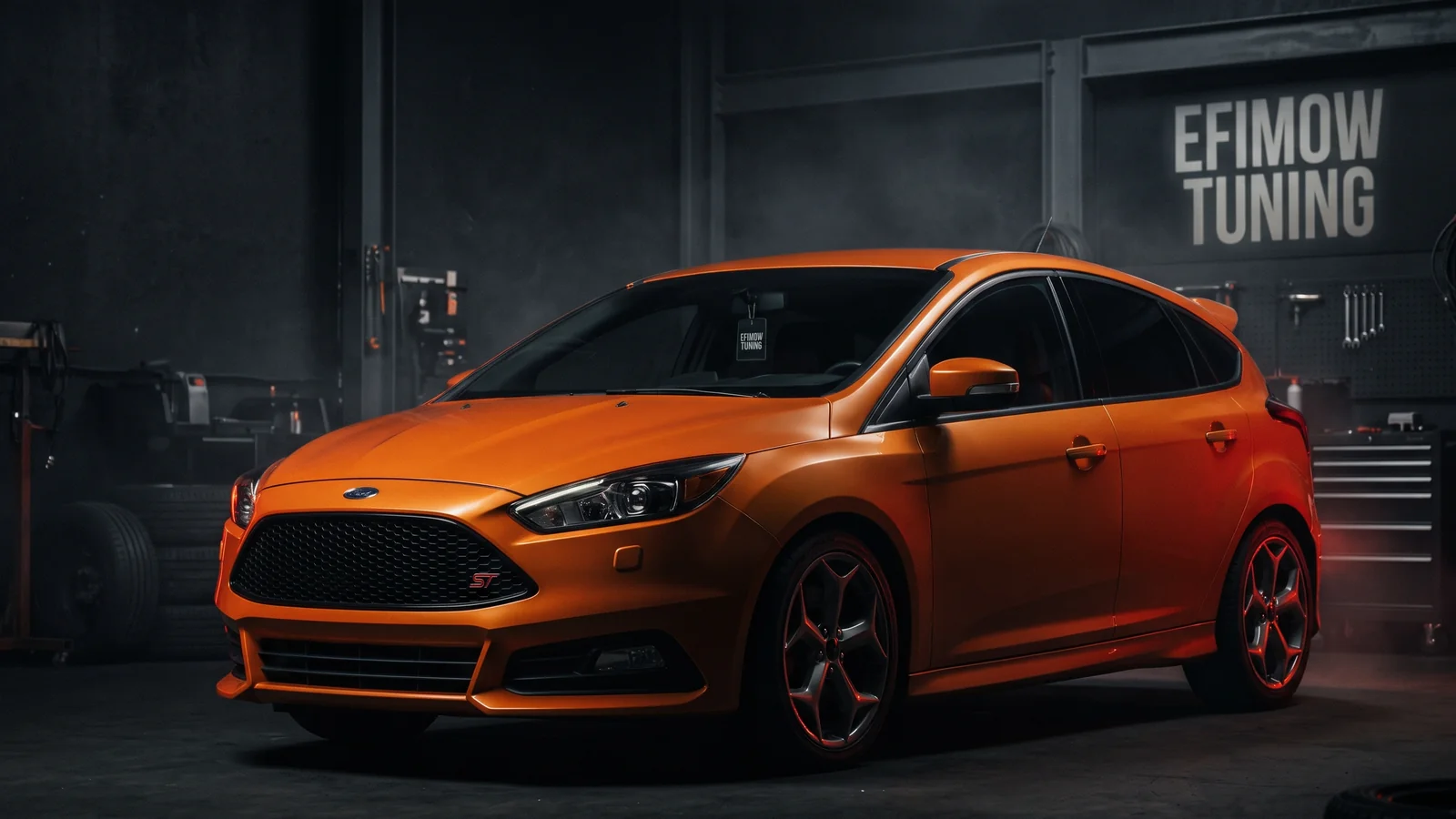
Ford Focus ST Mk3 2.0 EcoBoost Tuning
The Focus ST Mk3 with 2.0 EcoBoost and Bosch MED17.2: what Stage 1 realistically adds, where intake heat and clutch set limits, and which options exist.
October 25, 2026 by Leo Efimow
The third-generation Ford Focus ST is one of the hot hatches that turn up in tuning workshops most often. The reason is simple: under the bonnet sits a 2.0 EcoBoost with turbocharger and direct injection, controlled by a Bosch MED17.2. That combination responds well to a software adjustment, because boost, cylinder charge and ignition timing are entirely determined by the ECU. At the same time the car has a few typical limits (above all intake air temperature and the clutch) that you should know before turning up the power. In this post we look at what is realistic on the Focus ST Mk3 and what matters.
The basis: Focus ST Mk3 with the 2.0 EcoBoost
Our vehicle catalog lists the Focus ST (III) with the following data:
| Feature | Value |
|---|---|
| Production | 2012–2018 |
| Engine | 2.0 ST EcoBoost, engine code R9DA |
| Factory output | 250 PS |
| ECU | Bosch MED17.2 |
| Access | OBD |
The engine is a four-cylinder turbo petrol with direct injection and variable cam timing. Power goes through a six-speed manual gearbox to the front wheels. That front-wheel drive matters for tuning: more torque low in the rev range does not automatically mean more drive at the front axle, but often first more wheelspin and more torque steer.
What a Stage 1 calibration changes
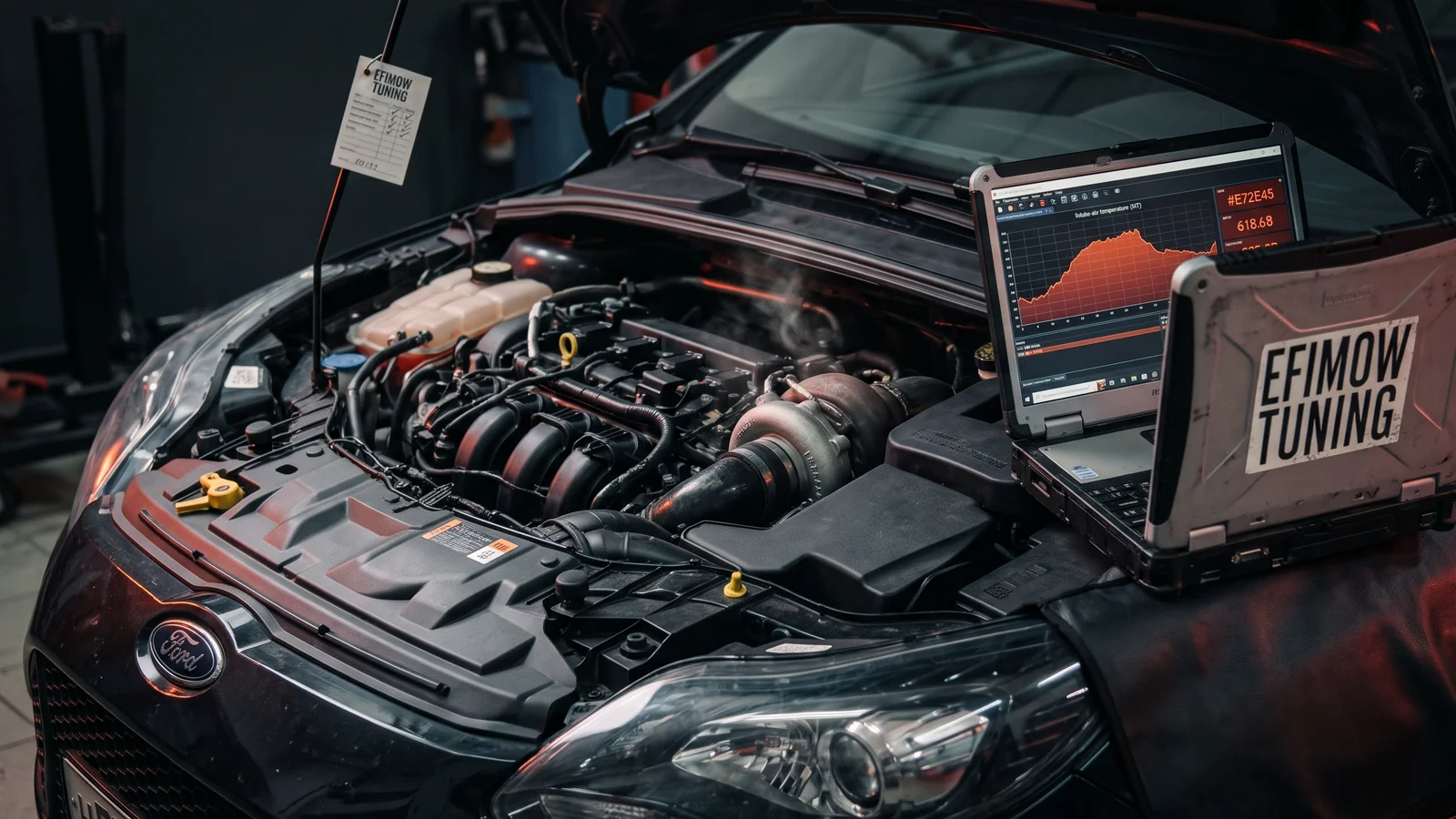
A serious Stage 1 adjusts the maps that control combustion: boost targets, cylinder charge, ignition timing, torque limiters and wastegate control. The hardware stays stock. For EcoBoost engines with Bosch MED17, our data lists 20 to 35 percent more power and torque as a typical guide value.
That sounds like a lot, and on the Focus ST it is noticeable. What matters, though, is what the calibration does not do: knock control, component protection and temperature limits stay active. If the engine starts to knock at high intake temperature or on poor fuel, the ECU still pulls timing. That is the difference between a calibration that lasts in daily use and one that only looks good on paper.
The typical limits of the Focus ST Mk3
Intake air temperature
The stock intercooler is designed for stock power. Under full load, in summer or during several pulls in a row, intake air temperature rises. The result is well known: heat soak, timing pulled, less power. More boost amplifies this effect. A larger intercooler is therefore one of the most common hardware additions if you want to go beyond Stage 1.
Clutch and driveline
The stock clutch is designed for stock torque. A healthy clutch usually copes with a moderate Stage 1, but a worn clutch quickly shows that it is at its limit. If the clutch already slips at full load in third or fourth gear before tuning, it should be replaced first.
Fuel and ignition
Turbocharged direct-injection engines are sensitive to fuel quality. The calibration has to match the octane you actually fill up with. On tuned turbo engines, spark plugs should be changed rather earlier than the stock interval.
What changes in daily driving
Peak power is only part of the result. In everyday driving you notice a good calibration mainly in the mid-range: the engine pulls earlier and more evenly when overtaking, you need to change down less often, and torque build-up feels less held back. This is the effect most drivers notice first, before they ever use peak power.
At the same time, stay realistic about fuel consumption. If you use the extra power, you use more fuel. That is physics. Driving the same way, consumption usually changes only slightly. Cold-start behaviour, warm-up and exhaust aftertreatment also remain unchanged with a clean calibration.
One point that is often underestimated is traction. More torque in second and third gear leads to wheelspin sooner in the wet, and traction control steps in more often. Good tyres are therefore at least as important on a tuned Focus ST as the software itself.
Stage 2: what is needed in addition
Our data lists Stage 2+ for the EcoBoost family as "on request": yes for turbo versions, but only with suitable hardware. Typical are a larger intercooler, a modified intake and an exhaust from the turbo back. For downpipe and exhaust: only with a catalytic converter and with a parts certificate or ABE. A system without a Kat is prohibited on public roads, and disabling catalyst monitoring is emissions tampering.
Which options are possible on the MED17.2
For the Bosch MED17.2 in the Focus ST our data lists these additional options:
- directly bookable: Sharp Throttle (sharper throttle map), Vmax removal, rev-limiter increase, suppressing individual non-emissions-related fault codes (DTC)
- on request: ECO tuning, Launch Control, No-Lift Shift
- motorsport only: hardcut limiter and, depending on software version, pops & bangs, popcorn limiter and a so-called soft anti-lag
The motorsport functions significantly increase the thermal load on catalytic converter and turbocharger and are intended exclusively for closed tracks. What exactly that means is in the motorsport notice.
Launch Control and No-Lift Shift in particular are frequently requested for the Focus ST. On a front-wheel-drive car with a manual gearbox, though, both functions are an extra load on clutch and driveshafts, not just a fun factor.
Process and price
Our data lists the Focus ST Mk3 with OBD access. So the ECU usually stays in the car, the original file is saved and the modified file written. You can come to us in Stödtlen on a date of your choice or send in the ECU. The price is the same, and booking is online.
For the Focus ST Mk3 2.0 EcoBoost with 250 PS, Stage 1 starts at €250 and Stage 2 at €325. The price follows from the ECU generation; the Bosch MED17.2 belongs to the generation of modern petrol ECUs.
Legally: the software change voids your vehicle's type approval; the software is intended for motorsport use only.
Check before the appointment
- Read the fault memory, clear up misfires and boost deviations
- Check spark plugs and ignition coils
- Inspect the charge-air path for leaks: loose clamps are not unusual on the EcoBoost
- Test the clutch under load
- Check the condition of tyres and brakes
Conclusion
The Focus ST Mk3 is a good basis for a software tune: turbo engine, Bosch MED17.2, OBD access. The typical guide values of 20 to 35 percent are realistic if the car is technically sound. The real limits are set by intake temperature, clutch and traction at the front axle. If you know them, you get a car that is noticeably stronger without losing its everyday character.
You can see options and the price for your Focus ST in the configurator.