
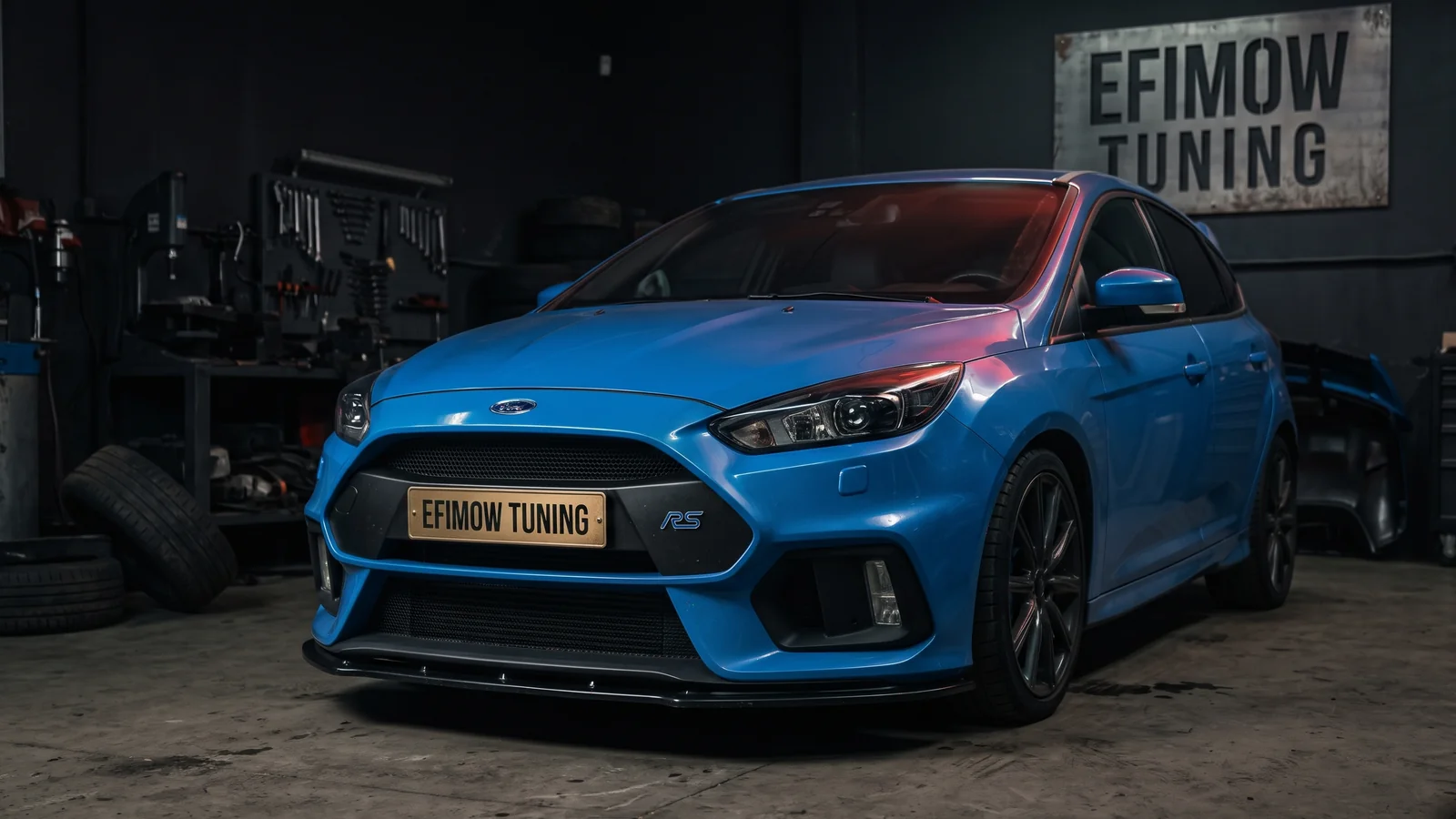
Ford Focus RS Mk3: All-Wheel-Drive EcoBoost with Reserves
Focus RS Mk3 with 2.3 EcoBoost and AWD: where the tuning potential lies, what cooling and drivetrain dictate and how it works without a catalog entry.
October 25, 2026 by Leo Efimow
The third-generation Ford Focus RS was the top model of the Focus range from 2016 to 2018: a 2.3 EcoBoost with 350 PS, all-wheel drive with a rear axle that splits torque between the wheels through two multi-plate clutches, and a six-speed manual gearbox. A car that can already do a lot from the factory, and still regularly turns up at the workshop with the question of what software can add. The honest answer: quite a bit, but limited less by the engine than by cooling, drivetrain and the condition of the individual car. And there is one particularity we want to disclose right away: the Focus RS Mk3 is not yet listed as a separate model in our vehicle catalog. What that means for the process is explained below.
Technology: what defines the Focus RS Mk3
The 2.3-litre four-cylinder belongs to the EcoBoost family: turbocharger, petrol direct injection, variable cam timing. In the Focus RS, Ford set the engine up for more power than in other applications, among other things with a larger turbocharger and a more capable intercooler.
The all-wheel-drive system is the second big topic. Instead of a classic centre differential, the rear drive unit distributes torque through two electronically controlled clutches. This system has its own limits (thermal and mechanical), and it is controlled by its own control units, not by the engine software.
Where the tuning potential lies
On the engine, a Stage 1 calibration works on the same maps as on any other EcoBoost: boost targets, cylinder charge, ignition timing, torque limiters and wastegate control. How much reserve there is also depends on the ECU generation. For the Bosch MED17 ECUs of the EcoBoost family our data lists 20 to 35 percent as a typical guide value; for the newer Bosch MG1 generation, as fitted in the Mustang with the 2.3 EcoBoost, 15 to 30 percent more power. Which generation sits in your RS is something we clarify from the ECU identification before making any statement about potential.
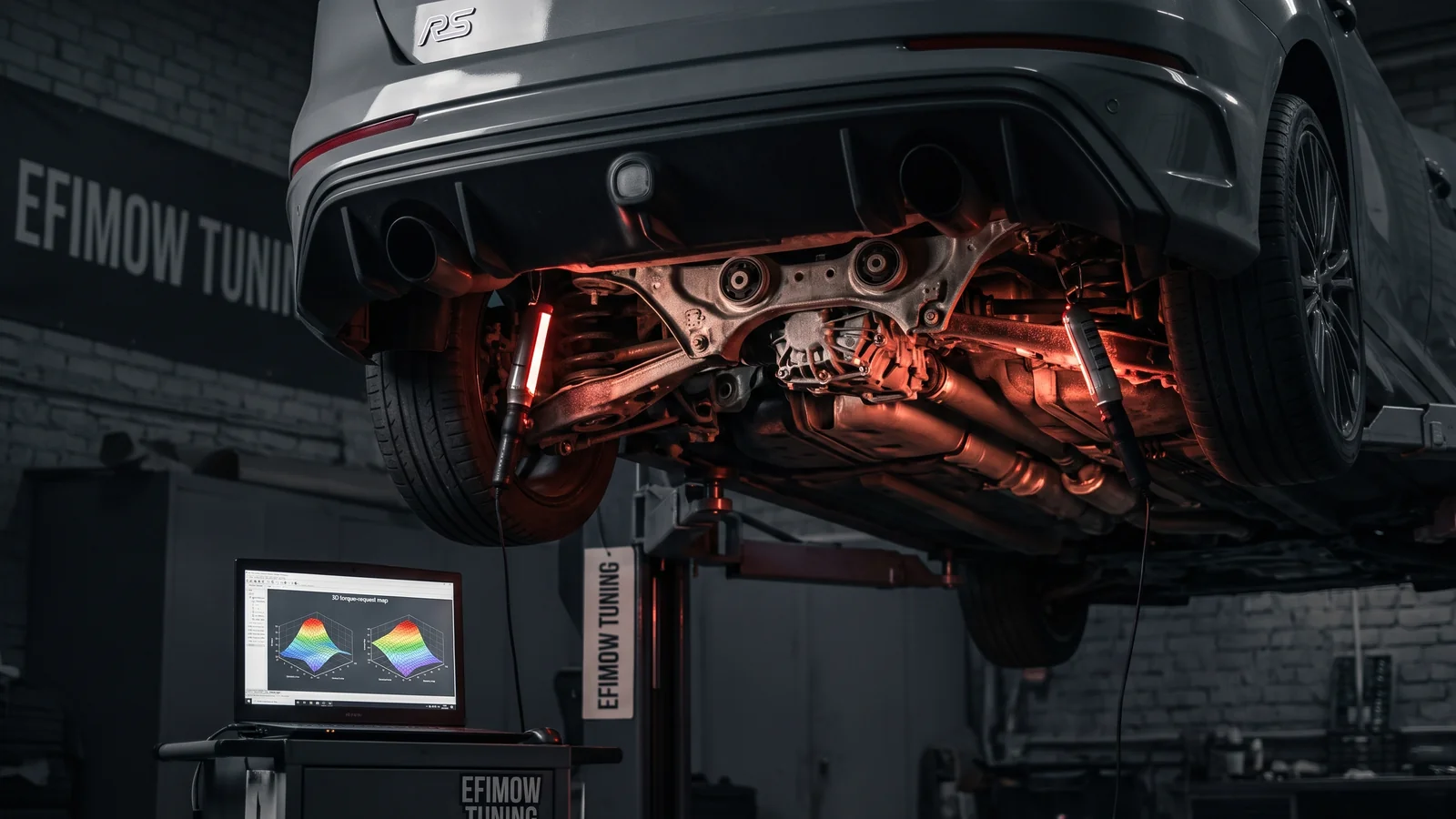
With the Focus RS in particular: these percentages refer to a base that is already high from the factory. The absolute loads on clutch, gearbox and rear axle rise accordingly.
What cooling and drivetrain dictate
Charge air and oil temperature
A 2.3 EcoBoost under full load produces a lot of heat. As intake air temperature rises, knock control pulls timing: the power gain shrinks as soon as it gets warm. On track, oil temperature comes on top. A calibration that only looks good with cold air does not help much in summer.
Clutch and manual gearbox
The stock clutch is designed for stock torque. With more torque it is often the first component to reach its limit. A clutch that already shows signs of slip before tuning should be replaced first.
Rear drive unit
The rear axle with its multi-plate clutches is thermally stressed by frequent full load and track use. More engine torque increases that stress. The rear-axle control itself is not part of an engine software adjustment.
Known weak points
On early examples of the Focus RS Mk3, problems with coolant loss in the area of the head gasket became known. If you want to tune an RS, have the coolant level and any irregularities (white smoke on cold start, coolant loss without a visible leak) checked first.
What a software adjustment cannot do on the RS
Engine software changes combustion, not the physics of the rest of the car. We hear three expectations about the Focus RS again and again, and none of them can be met through the engine ECU:
- Different torque distribution: how much power goes to the rear axle is controlled by the AWD system. The engine software only supplies the torque that gets distributed.
- More endurance on track: when oil, charge air or rear axle get hot, more power does not help. Quite the opposite. Endurance comes from cooling and maintenance, not from a map.
- Compensating for wear: a tired clutch or an engine losing coolant does not get better with software, it just fails sooner.
If you know these points, you can use the calibration where it works: in the mid-range torque curve, in throttle response and in clean, repeatable power delivery.
Options and motorsport functions
Which additional options are possible depends on the ECU. For the EcoBoost family our data lists, among others, a sharper throttle map (Sharp Throttle), Vmax removal, a rev-limiter increase and suppressing individual non-emissions-related fault codes. Launch Control and No-Lift Shift are available directly or on request depending on the ECU.
Hardcut limiter, pops & bangs, popcorn limiter and soft anti-lag are intended exclusively for motorsport. They put heavy thermal stress on catalytic converter and turbocharger and are not permitted on public roads. Details in the motorsport notice.
For emissions components the rule is the same as on any car: catalytic converter and lambda sensors stay active, and so does their monitoring. Removing or disabling them is emissions tampering and prohibited on public roads.
Legally: the software change voids your vehicle's type approval; the software is intended for motorsport use only.
The process without a catalog entry
Because the Focus RS Mk3 is not yet a separate model in our catalog, there is no product page with a fixed price for it yet. That does not change the process, only the order: you send an enquiry via the configurator, we clarify access, options and price from the ECU identification, and only then is it booked. As with all non-BMW vehicles, you can then come to us in Stödtlen on a date of your choice or send in the ECU. The price is the same in both cases.
For reference, two related vehicles that are in the catalog:
- The predecessor Focus RS Mk2 with the 2.5 Duratec RS, a five-cylinder turbo with Bosch ME9, Stage 1 from €220.
- The Mustang VI with the 2.3 EcoBoost with Bosch MG1, Stage 1 from €450.
The price for your RS, as everywhere, depends on ECU generation, power, model year and access.
Checklist before tuning
- Read the fault memory of all relevant control units, including AWD and gearbox
- Check coolant level and loss, clear up irregularities
- Check spark plugs and ignition coils
- Check the charge-air path for leaks
- Test the clutch under load
- Document the rear drive unit oil change according to the manufacturer's schedule
Conclusion
With the 2.3 EcoBoost, the Focus RS Mk3 offers a turbocharged base that responds to software. The typical guide values of 15 to 35 percent, depending on ECU generation, are only realistic if cooling, clutch and rear axle play along and if the engine is healthy. If you know your RS and check it beforehand, you get a noticeably stronger car without provoking its weak points.
For a concrete assessment of your car, send an enquiry in the configurator. We will get back to you with ECU, options and price.