
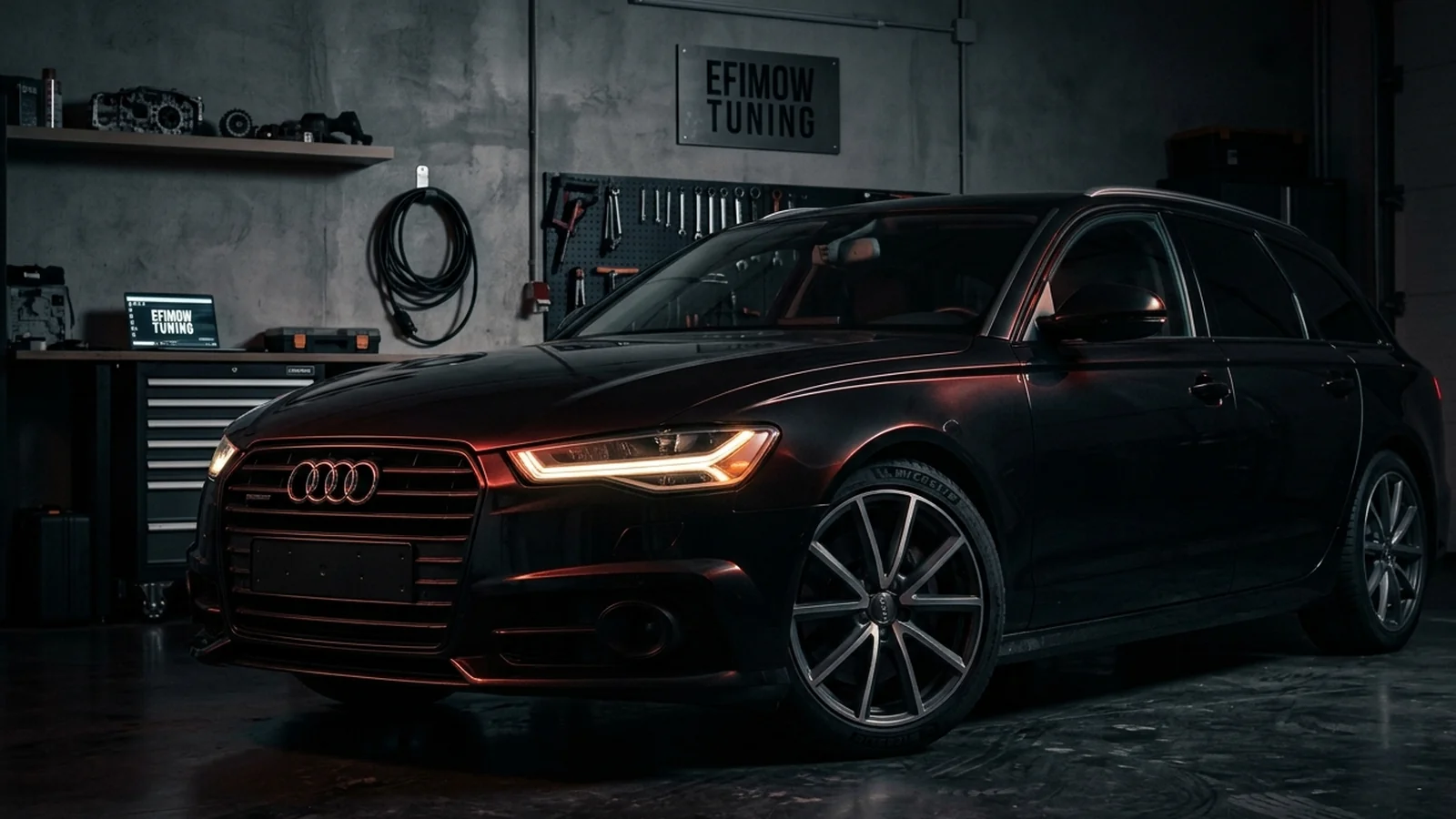
Audi A6 C7 3.0 TDI: Calibrating the V6 Diesel Properly
Audi A6 C7 3.0 TDI from 204 to 313 PS: EDC17CP20/CP44/CP54 ECUs, typical Stage 1 guide values for the V6, options, limits and prices.
October 25, 2026 by Leo Efimow
A V6 diesel in an Audi A6 is not a car that lacks power out of the box. Even so, the A6 C7 3.0 TDI is one of the cars for which a software optimisation is requested particularly often, usually by high-mileage motorway drivers and by owners who tow a caravan or horse trailer. The appeal lies less in a figure on paper than in character: the big diesel should push even more calmly. Getting there without overloading the gearbox and exhaust system takes a calibration with a sense of proportion. This article shows what to consider.
The 3.0 TDI variants in the A6 C7
According to our catalogue, the A6 IV (C7) ran from 2011 to 2018. The 3.0 TDI V6 came in several power levels with different Bosch ECUs:
| Engine code | Power | ECU |
|---|---|---|
| CLAA / CLAB | 204 PS | Bosch EDC17CP20 |
| CDUC / CKVB | 245 PS | Bosch EDC17CP20 |
| CRTD | 272 PS | Bosch EDC17CP54 |
| CGQB | 313 PS | Bosch EDC17CP44 |
The 313 PS version is the biturbo diesel; the other variants use a single turbocharger. All ECUs belong to the Bosch EDC17 family for VAG TDI. With the V6 in particular it pays to know the exact engine code: the spread from 204 to 313 PS shows how strongly Audi differentiated power through software and peripherals.
Why the V6 is calibrated differently from the four-cylinder
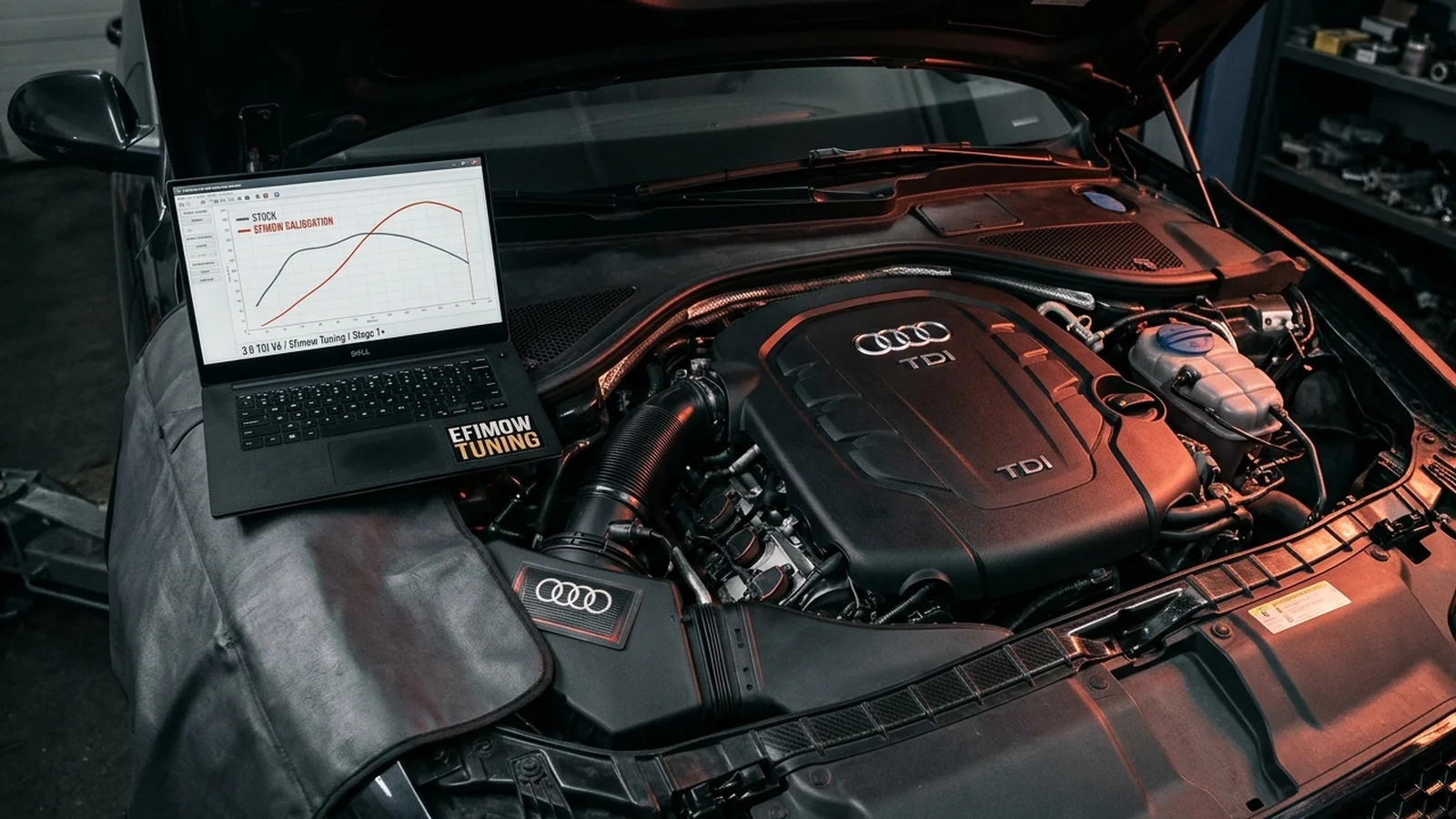
On the four-cylinder TDI, the clutch or dual-mass flywheel is often the first part to reach its limits. On the V6 in the A6, the focus shifts: torque is already high from the factory, and the gearboxes have their own fixed torque limits. A good calibration therefore does not simply raise peak torque; it shapes the curve: a soft rise from low revs, a broad plateau, a clean transition into the upper range.
Thermal questions come on top. A large diesel under sustained load, for example towing uphill or at high motorway speed, produces a lot of heat. Exhaust temperature and turbo speed are the values a serious calibration watches. The EDC17's protection functions stay active and are adapted to the new load points.
What is realistic
For the V6 TDI engines, our research on the EDC17 family gives typical guide values of around 15–25 % more power and around 20–30 % more torque. The power headroom is slightly smaller in percentage terms than on the four-cylinder because the base is higher. In practice the gain is still clearly noticeable. These values apply to healthy engines on stock hardware and are not a promise for your car.
With the 313 PS variant in particular: the factory hardware is already well exploited and gearbox load is high. A conservative calibration is usually the smarter choice here than the maximum figure.
Bookable options
Besides Stage 1, the following options can be booked for the ECUs in the A6 C7:
- Stage 1+: a slightly more aggressive calibration
- ECO tuning: more torque low down and in the mid-range, peak power unchanged; on the big diesel often the right choice for long distances and towing
- Sharp Throttle: a more direct pedal, noticeable especially where response feels sluggish in comfort mode
- Vmax removal: observe the tyre speed rating and registration requirements
- DTC Off: only for individual, non-emissions-related fault codes
Launch control and hardcut limiter are only partly feasible on these units and therefore only available on request after the file has been checked. Both are intended for motorsport only.
Clean diesel, AdBlue and particulate filter
Some of the later V6 TDIs with EDC17CP44 and CP54 work as "clean diesel" with an SCR catalyst and AdBlue; all variants have a particulate filter and exhaust gas recirculation. Technically, software can influence these systems. Disabling or removing them, however, is emissions tampering and prohibited on public roads. Functioning exhaust aftertreatment is a precondition for proper tuning: a clogged DPF raises back pressure and exhaust temperature and does not go well with extra power.
Checks before tuning
On a high-mileage A6, clarify the following beforehand:
- Fault memory: fix entries for boost pressure, rail pressure, exhaust temperature, DPF or the AdBlue system first.
- Gearbox: check shift quality and oil change history. Jerky or delayed shifts are a warning sign that tuning will not solve.
- Intake and EGR: carbon build-up costs airflow and thus exactly the reserve the calibration needs.
- Cooling system: a big diesel under load needs intact cooling, all the more when towing.
- Maintenance: keep oil and filter changes up to date.
If you are thinking about hardware changes later, the basics are covered in the article TDI Stage 2: intercooler, turbo, clutch.
Access, price and process
The CP44 and CP54 ECUs are listed with OBD access in our catalogue; depending on the software version, bench access may still be required. If the ECU has to be opened, a 50 € surcharge applies. The original file is saved before any change.
Stage 1 prices: for the 204, 245 and 272 PS variants (for example the 3.0 TDI CDUC with 245 PS) from 300 €, Stage 2 from 375 €. For the biturbo CGQB with 313 PS, the surcharge for engines from 300 PS applies: Stage 1 from 350 €, Stage 2 from 425 €.
Booking is done online in the configurator. You come to us in Stödtlen on a date of your choice or send in the ECU. The price is the same in both cases.
And Stage 2?
Stage 2 is also possible on the EDC17 units, but only together with hardware. Typical parts are a larger intercooler, an exhaust from the turbo back with catalyst and particulate filter and, depending on the goal, a larger turbocharger. Exhaust parts are only an option with type approval or an expert report; a pipe without catalyst or DPF is not Stage 2 but emissions tampering. Stage 2+ can also be booked for these ECUs. Important: more hardware also means more load on the clutch, gearbox and driveshafts. On the V6 in the A6 it is mainly the gearbox that sets the limit, not the engine. As with Stage 1, the software and hardware changes void the type approval; Stage 2 is intended for motorsport use only.
Legal framework
The software change voids your vehicle's type approval; the software is intended for motorsport use only. Details in the motorsport notice. For use on public roads, an inspection and registration of the power increase would be required.
Conclusion
The Audi A6 C7 3.0 TDI has reserves, but its potential lies in the curve, not the peak. As typical guide values, around 15–25 % more power and 20–30 % more torque are realistic on the V6 if gearbox, cooling and exhaust aftertreatment play along. The stronger the starting variant, the more important a measured calibration becomes, all the more so on the 313 PS biturbo. ECO tuning and Sharp Throttle are the sensible additions for many A6 drivers.
Which engine code your A6 has and which options are available for it is shown after selecting your car in the configurator.