
VW Golf 7 R: How Much Headroom the EA888 Really Has
Golf 7 R with 280 or 300 PS: Simos 12 or Simos 18, realistic Stage 1 ranges, all-wheel drive and DSG, plus what to check before tuning.
October 25, 2026 by Leo Efimow
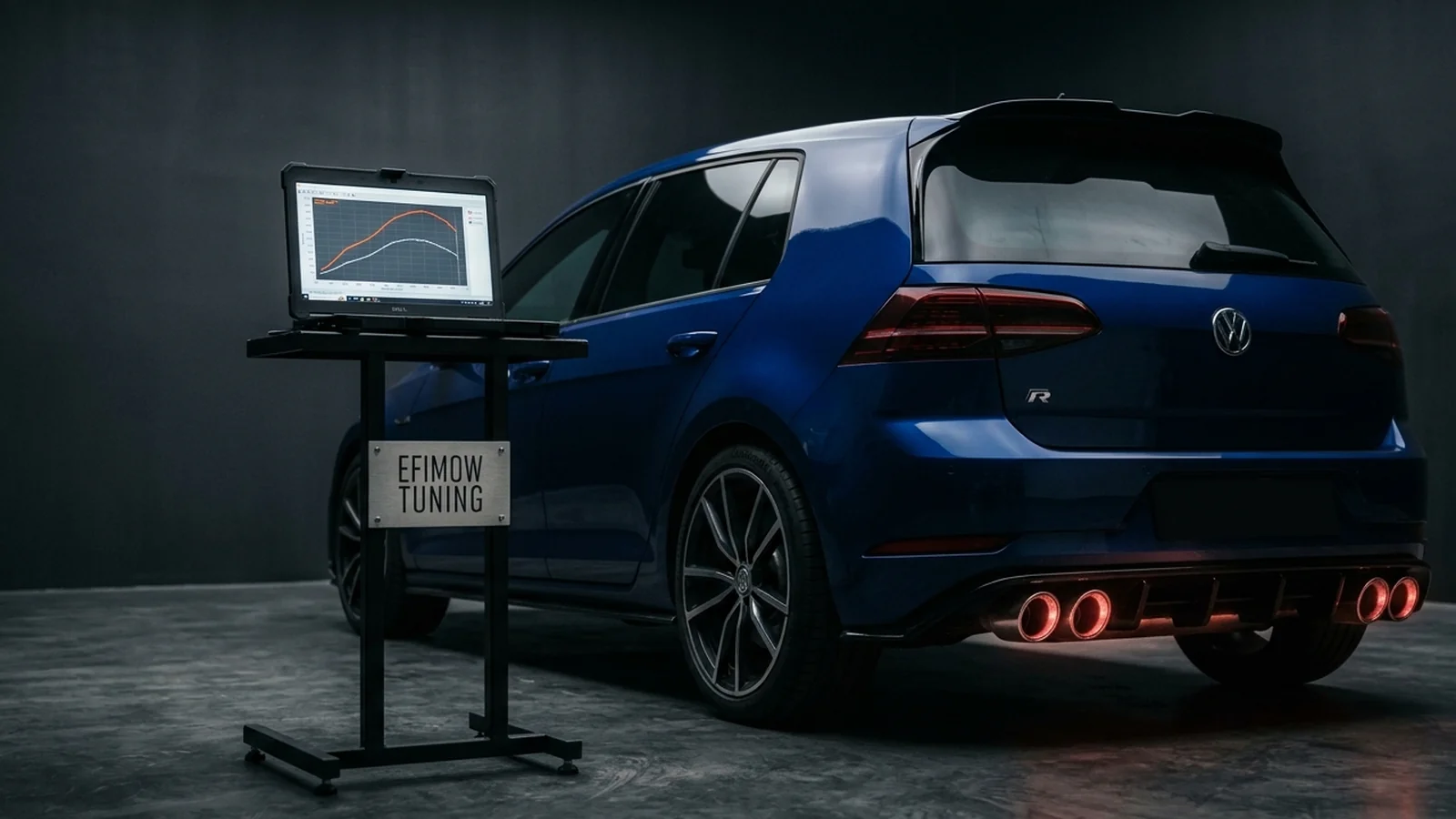
The Golf 7 R is the range-topping model of the series: a 2.0 TSI from the EA888 family, all-wheel drive, 280 to 300 PS from the factory. That puts it closer to an Audi S3 than to a GTI, and in the tuning scene it is regarded as one of the most rewarding compact performance cars. That isn't down to some secret recipe but to solid mechanics that VW deliberately capped in software. Before you get excited about percentages, though, take a close look at your car: which engine code, which ECU, which gearbox, and what condition is the hardware in?
Two engine codes, two ECUs
Our catalog lists the Golf 7 R in two variants, which differ mainly in the ECU:
| Variant | Engine code | Stock power | ECU | Stage 1 | Stage 2 |
|---|---|---|---|---|---|
| 2.0 TSI R 4Motion | CJXB | 280 PS | Simos 12 | from €250 | from €325 |
| 2.0 TSI R 4Motion | CJXC | 300 PS | Simos 18 | from €500 | from €600 |
There are two reasons for the price difference. First, the Simos 18 belongs to the newest, protected ECU generation, the Simos 12 to the previous one. Second, two surcharges apply to the CJXC: one for the power class from 300 PS and one because the Simos 18 has to be opened for reading and writing. For the Golf 7 R CJXC with 300 PS you can see the breakdown directly on the product page.
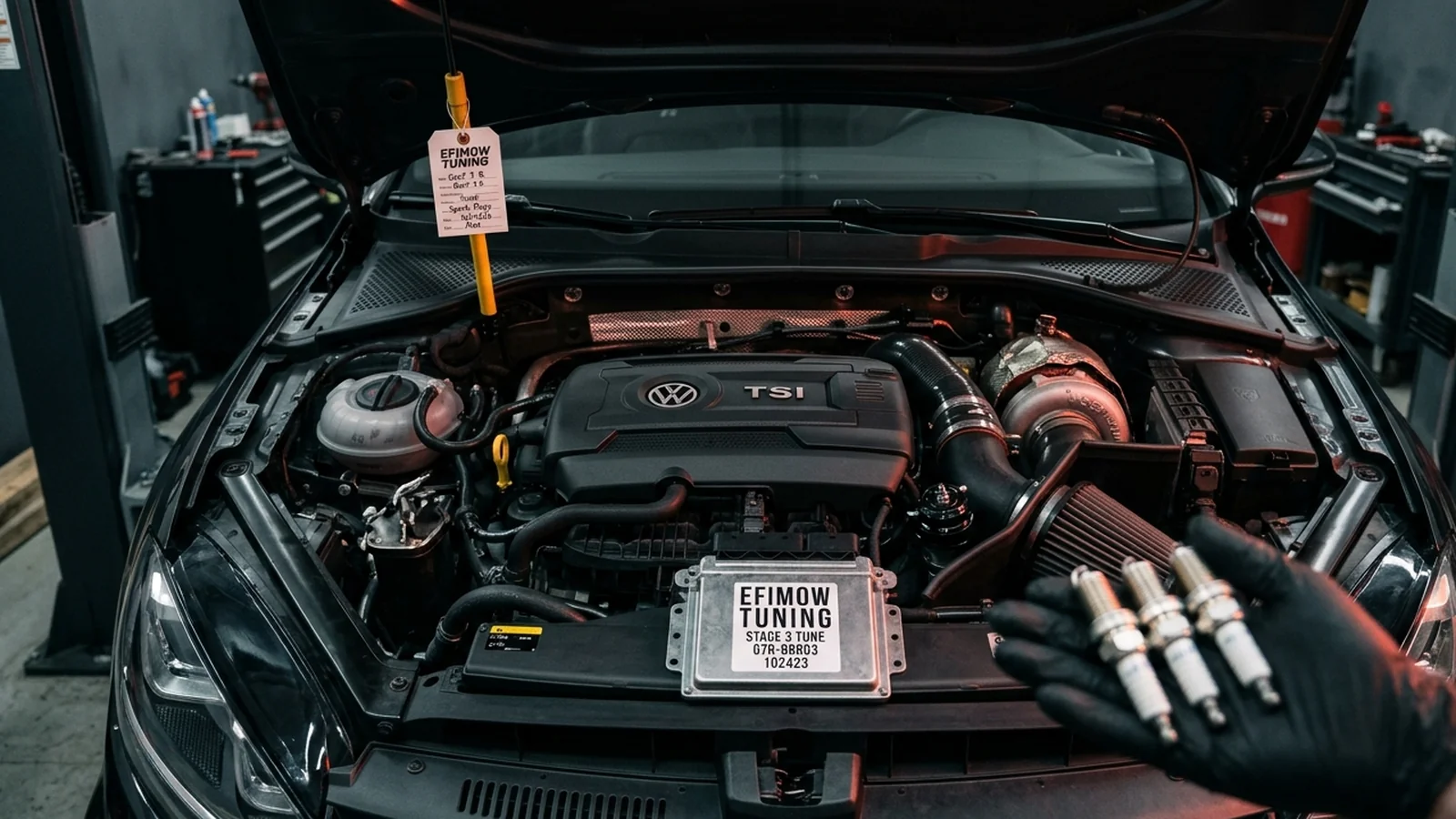
Which ECU is in your car depends on the engine code and the software version. You'll find the engine code in the service book, on the data sticker in the boot or via the type code in your registration document. If you're unsure, select the vehicle in the configurator and enter the engine code you found.
How much headroom is realistic
The third-generation EA888 shares its basic design with the GTI, but in the R it gets a different turbocharger, revised cooling and a higher power release. In other words, part of the headroom that still lies unused in the GTI is already used by the R from the factory. There is still room, though.
As a typical guide value for the EA888 Gen3 family with a Simos ECU, we quote 25–40 % more power and 20–40 % more torque at Stage 1. With the R you tend to land in the lower to middle part of that range, because the stock calibration already sits higher. That's not a drawback: an engine starting from 300 PS doesn't need to be shifted as far in percentage terms to feel clearly stronger.
What changes are the targets for boost, cylinder fill and ignition timing, plus the torque limiters. Knock control, component protection and lambda targets remain active. On the R, with its higher baseline, the quality of this protective logic decides whether the power stays stable in summer heat and over several consecutive pulls.
All-wheel drive and gearbox: the real bottlenecks
The R sends torque to the rear axle via an all-wheel-drive system with a multi-plate clutch. That helps enormously in putting the power down; traction is rarely the R's problem. The limits lie elsewhere:
- DSG: Most Golf Rs use a wet-clutch DSG. Depending on the model year, a 6-speed or a 7-speed unit is fitted. Both have a stored torque limit in the transmission control unit. Exceed it clearly and the gearbox counteracts or starts to slip. What happens technically is described in our post on DSG DQ250 and DQ381.
- Clutch on manual cars: The manual R is rarer, but here the clutch is the first part to feel the extra torque.
- Drive shafts and Haldex service: All-wheel-drive couplings need their oil and filter changes. A neglected service shows up faster after a tune.
Whether a gearbox software adjustment makes sense for your car is something we clarify when we review your inquiry.
Before tuning: checklist
An R has often been through a fair bit. Before you have the software changed, tick off a few points:
- Spark plugs and coils: a classic weak spot on the EA888 under load when the plugs are old.
- Charge-air path: leaking hoses or clamps cost boost and trigger fault messages.
- Fault memory: existing faults should be fixed before tuning, not after.
- Fuel: tell us whether you always run Super Plus or regular Super as well.
Stage 2 on the Golf R
Stage 2 combines software with hardware: a downpipe with catalytic converter and approval certificate, a larger intercooler, a better intake. On the R, the intercooler is often the most sensible first step, because otherwise the engine pulls power back via intake air temperature during repeated full-load runs. An exhaust without a catalytic converter is not permitted on public roads. Some EA888 Gen3 engines, including the Golf R's, have a secondary air system. Disabling or removing it is emissions tampering and prohibited on public roads.
Options
For the Simos family (both Simos 12 and Simos 18), the configurator offers: Stage 1+, ECO tuning, Sharp Throttle, Vmax removal and DTC Off (only for non-emissions-related fault codes). On top come Launch Control, Hardcut Limiter, Pops & Bangs and Popcorn Limiter. These functions are intended strictly for motorsport on closed circuits. No-Lift Shift and Anti-Lag are only available on request after checking the file. Vmax removal requires matching tyres and registration.
Process and access
On the Simos 18 (CJXC), the ECU is removed and handled in bench or boot mode, because writing over OBD is blocked depending on the software version. For the Simos 12 we clarify the access route based on your vehicle data. You have two options: book an appointment with us in Stödtlen, or remove the ECU and send it in. The price is identical either way, and booking is done online.
Original file and return to stock
Before anything in the software is changed, we back up your ECU's original file. It is the basis if you later want to go back to stock, before a sale, for example, or if you want to use the car differently. On the Simos 18, complete reading in bench or boot mode is part of the process for exactly this reason: only with a complete, clean backup is a return to stock possible without surprises. Keep the documents for your car and your order yourself too, so it's clear later which software version was in the car.
After tuning
The first miles after tuning aren't a running-in phase, but they're a good opportunity to drive attentively: do cold start and idle run cleanly, does the gearbox shift unobtrusively, does the fault memory stay empty? If you notice anything, get in touch sooner rather than later.
Law
The software change voids your vehicle's type approval; the software is intended for motorsport use only. That applies to every stage and every additional function. More in the motorsport notice.
Conclusion
The Golf 7 R has less untapped headroom than a GTI, but a much stronger starting point and a drivetrain that puts power down with ease. What matters is which ECU is fitted (Simos 12 or Simos 18) and whether DSG or clutch can handle the new torque. Clarify that beforehand and you get an R that feels noticeably stronger in every gear.
Pick model and engine code in the configurator to see price and available options for your Golf R and book directly.