

Toyota Hilux and Land Cruiser: Diesel Tuning for Workhorses
2.5 and 3.0 D-4D, 2.4 and 2.8 D-4D: what software does for the Hilux and Land Cruiser, why Denso ECUs are special and what tow drivers should watch for.
October 25, 2026 by Leo Efimow
The Hilux and Land Cruiser have a reputation other manufacturers would need decades to earn: indestructible, reliable, even in harsh conditions. Anyone who drives one usually uses it that way: with a trailer, on building sites, off-road or as an overland vehicle with a roof tent and a full payload. More torque is not a luxury here but a matter of composure. Toyota does bring one peculiarity, though: Denso ECUs. They work differently from the Bosch units familiar from European diesels.
The engines at a glance
Our catalog lists these D-4D diesels for the Hilux and Land Cruiser:
| Model | Engine | Engine code | Output (catalog) | ECU |
|---|---|---|---|---|
| Hilux (2005–2015) | 2.5 D-4D | 2KD-FTV | 144 hp | Denso |
| Hilux (2005–2015) | 3.0 D-4D | 1KD-FTV | 170 hp | Denso |
| Hilux (from 2016) | 2.4 D-4D | 2GD-FTV | depends on version | Denso (P5, UDS) |
| Hilux (from 2016) | 2.8 D-4D | 1GD-FTV | depends on version | Denso (P5, UDS) |
| Land Cruiser J150 | 2.8 D-4D | 1GD-FTV | depends on version | Denso (P5, UDS) |
The older KD engines (2KD, 1KD) are robust common-rail diesels of an earlier generation. The GD engines (2GD, 1GD) are the modern successor family with stricter emission standards and a newer ECU generation.
Why Denso is different
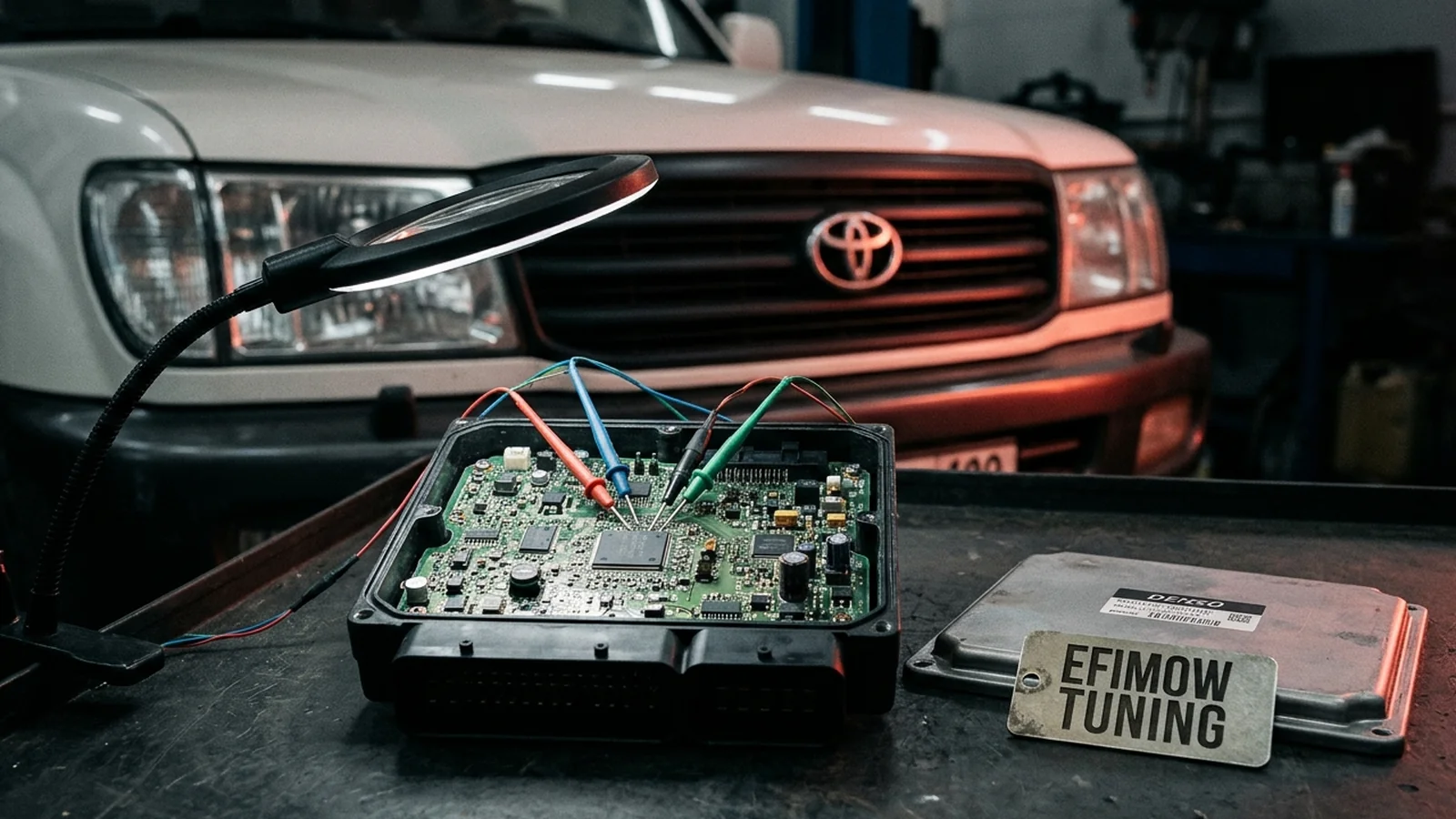
For a long time, Denso ECUs were hard to access. Many generations are encrypted, the map structures differ from Bosch and tuning tool coverage is patchier. That does not mean tuning is impossible. But it does mean we check the readability of your specific ECU before making an offer. Depending on the software version, the ECU may have to be removed and worked on at the bench.
This is particularly relevant for the modern generation with the P5 platform and UDS diagnostics, i.e. the current Hilux and the Land Cruiser J150 with the 2.8 D-4D. These units are much better protected than their predecessors.
What software delivers on the D-4D engines
For the Denso diesel family, our data gives a typical 15–25% more power and 20–30% more torque as a Stage 1 guide value. The torque gain is the decisive part on work vehicles: a Hilux with a full load bed or a Land Cruiser towing a caravan drives in a higher gear with adapted software, without the engine having to work hard.
A good calibration for these vehicles has a clear profile:
- Early torque build-up in the range used for towing and off-road driving
- Controlled exhaust temperature under sustained load, for example on long climbs with a trailer
- A clean smoke limiter, so that the particulate filter on newer models is not put under extra load
- No peak figures at any price: durability is the selling point of these vehicles
Options
For the Denso diesel family, the following are documented alongside Stage 1:
- ECO tuning with more torque in the low and mid range and unchanged peak power, often the better choice for work vehicles
- Sharp Throttle for a more direct throttle pedal
- DTC Off only for non-emissions-related fault codes
- Vmax removal: only partly feasible on Denso, so on request; tyre speed rating and registration are particularly important with AT tyres
Stage 2 with hardware is possible in principle, but will rarely make sense on a Hilux or Land Cruiser. Heavy towing benefits more from a clean Stage 1 or ECO tuning.
Drivetrain and exhaust aftertreatment
On manual vehicles, the clutch is the point where extra torque is felt first, especially when towing. On automatic models, a serious calibration respects the gearbox's torque limits. Before tuning, the clutch, charge-air path and injectors should be in good order.
The newer Hilux and Land Cruiser models have a particulate filter and, depending on the market, other exhaust systems. Disabling the DPF, EGR or SCR system is emissions tampering and illegal on public roads, even on a vehicle that spends a lot of time off-road.
Process and prices
We work on Toyota directly at the ECU, on site in Stödtlen at an appointment of your choice or by sending in the removed ECU. The price is the same in both cases, and booking is online. Because Denso units vary in readability, we check in advance using the ECU identification.
Under our pricing rules, the Hilux 2.5 D-4D with 144 hp and the Hilux 3.0 D-4D with 170 hp start from €175 for Stage 1. The Hilux from 2016 with the 2.8 D-4D comes to €225 due to its model year, and the Land Cruiser J150 2.8 D-4D starts from €175. The configurator shows the exact price.
On the legal side: the software change voids the type approval. The software is intended for motorsport use only, see the motorsport notice.
Common questions from the workshop
Does tuning help with towing capacity? The permitted towing capacity is stated in the vehicle documents and does not change through software. What changes is how easily the engine moves the permitted load: more torque at low revs, fewer gear changes, more reserve on gradients. The limits of axles, clutch and brakes remain the same.
Why do you need the ECU identification in advance? With Denso ECUs, readability depends heavily on the hardware and software version. With the identification we check whether our tools support the specific unit and which access method is needed. That spares you an appointment where it only turns out on site that it cannot be done.
What should I consider at high mileage? Many Hilux have very high mileages, and the engines are designed for it. Before tuning, injectors, charge-air path and clutch should still be checked. An engine that smokes heavily on a cold start or runs roughly needs a diagnosis first. We back up the original state of the ECU before writing.
Conclusion
The Hilux and Land Cruiser are workhorses, and the software should be too: early torque, controlled temperatures, no experiments. The D-4D diesels offer a typical 15–25% power and 20–30% torque as a guide value. Denso ECUs require more preparation than Bosch units, so checking readability comes first. More in our article Denso ECUs: why Japanese units work differently and in the glossary under Denso.