
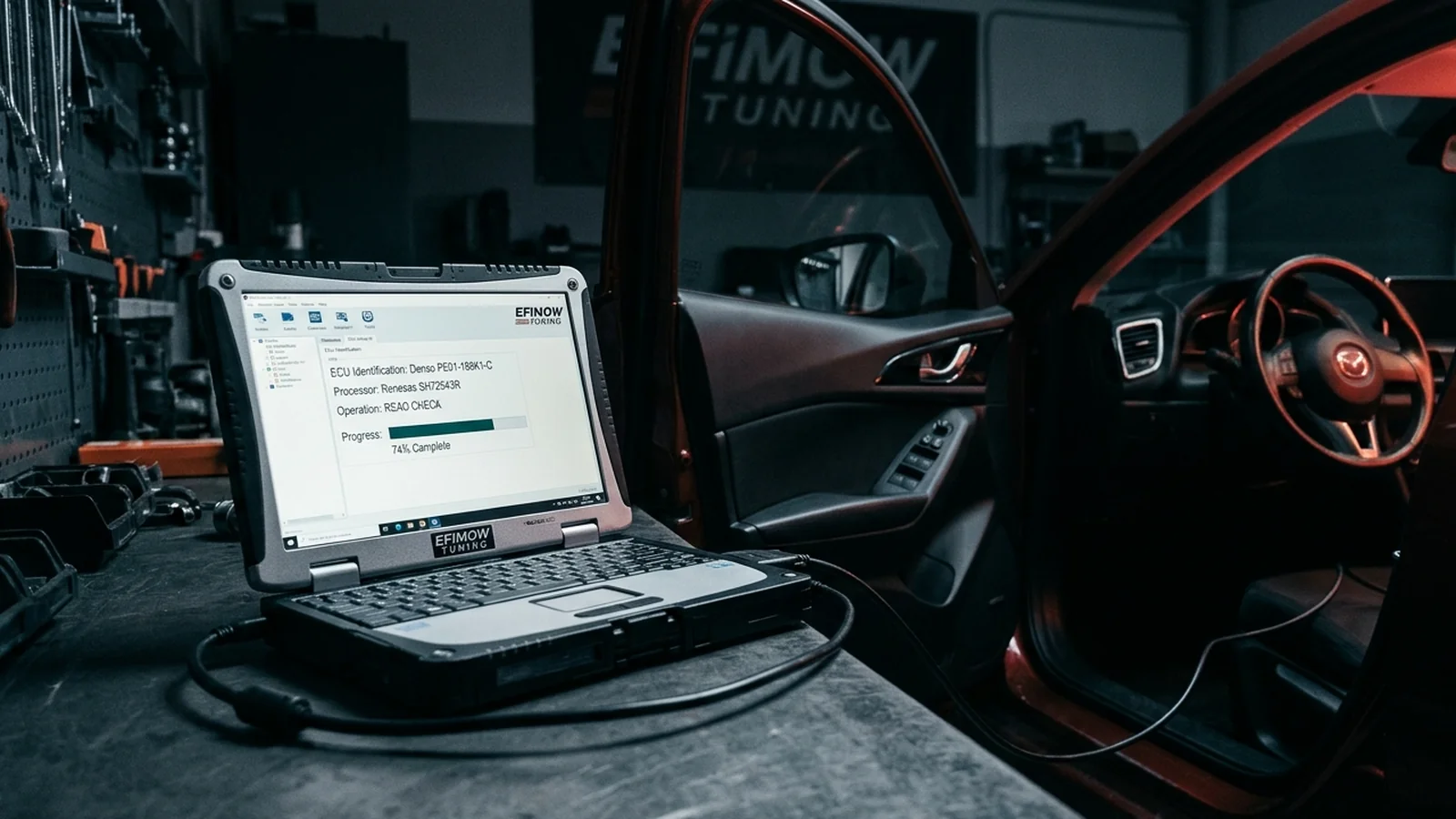
Denso ECUs: Why Japanese Units Work Differently
Toyota, Mazda, Subaru, Mitsubishi, Isuzu: why Denso ECUs differ from Bosch for tuning, what encryption means and what is realistic.
October 25, 2026 by Leo Efimow
If you come from the European tuning world, ECUs mean Bosch, Siemens/Continental, Delphi or Marelli. Japanese vehicles are a different world: Toyota, Lexus, Mazda, Subaru, many Mitsubishi and Nissan models and even Opel diesels with Isuzu engines use a Denso ECU. And Denso works differently. Not in terms of physics (a turbodiesel is still a turbodiesel), but in terms of access, tools and data structure.
Who Denso is
Denso is one of the world's largest automotive suppliers and closely linked to the Toyota Group. In diesels, Denso is one of the pioneers of common-rail technology and, like Bosch and Delphi, supplies complete injection systems including the ECU. In petrol engines, Denso controls the engines of many Japanese manufacturers, from Toyota's naturally aspirated engines to Subaru boxers and the supercharged V8s of Jaguar and Land Rover.
Where Denso appears in our catalog
Our catalog lists around a hundred diesel and as many petrol versions with Denso ECUs. The distribution:
| Area | Most common brands (catalog) | Typical engines |
|---|---|---|
| Diesel | Mazda, Toyota, Opel, Nissan, Subaru, Isuzu, Mitsubishi | MZR-CD, Skyactiv-D, D-4D, 1.7 CDTI, EE20, DI-D |
| Petrol | Mazda, Subaru, Jaguar, Toyota, Land Rover | Skyactiv-G, FA20, EJ, VVT-i, AJ-V8 |
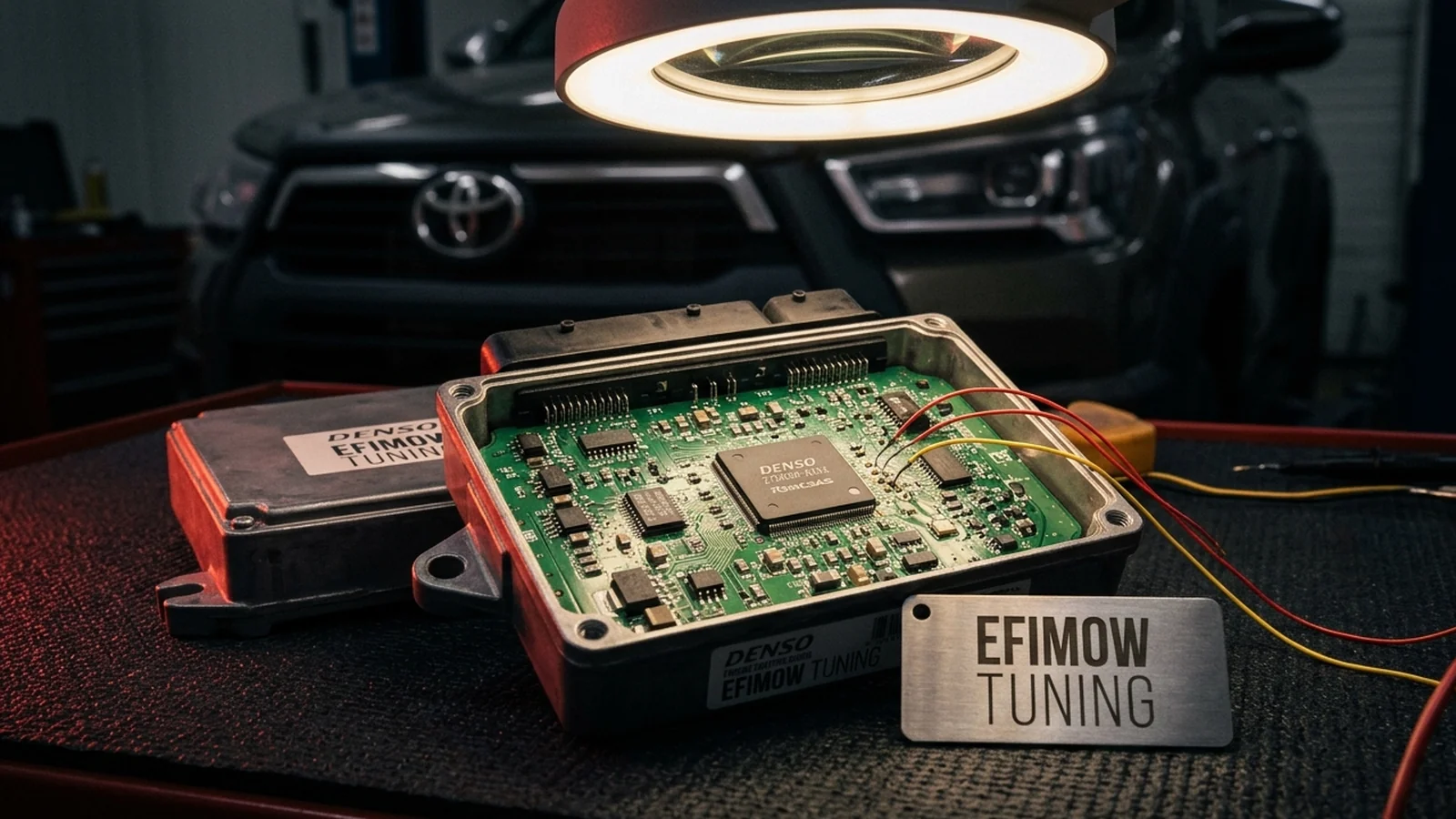
For diesels, Transtron should also be mentioned: it supplies ECUs for Isuzu's 4J-family engines, for example in the D-Max. In our data, Denso and Transtron form a joint diesel family.
Why Denso is different
Different processors: while many Bosch ECUs of the EDC17 and MED17 generation are based on Infineon Tricore processors, Denso units often use Renesas processors. Designations such as SH7058, SH7059 or SH72543 appear in our catalog, and on the newest generation R7F701216 with the P5 platform and UDS diagnostics. For tuning, this means different read and write methods and different tool drivers.
Encryption: several Denso generations are encrypted. The catalog contains versions explicitly marked as "crypted". Such units can only be handled with tools that support the respective method, and that is not the case for every software version.
Patchy tool coverage: Bosch ECUs have been thoroughly documented in the tuning industry for decades. With Denso, coverage is patchy depending on tool and generation. That is why a readability check always comes first with Denso.
Different data structure: the maps are organised differently from Bosch. The physical quantities are the same (injection quantity, rail pressure, boost, ignition timing), but where they sit and how they interact differs. Experience with Bosch files cannot be transferred one to one.
What software delivers on Denso engines
For the Denso families, our data gives the following typical Stage 1 guide values:
- Denso/Transtron diesel: around 15–25% more power and 20–30% more torque
- Denso petrol, forced induction (e.g. Subaru WRX/STi, JLR 5.0 supercharged): around 15–25%
- Denso petrol, naturally aspirated (e.g. Toyota VVT-i, Mazda Skyactiv-G, Subaru FA20): only around 3–8%
For diesels, ECO tuning, Sharp Throttle and DTC Off for non-emissions-related fault codes are documented; Vmax removal is only partly feasible. On naturally aspirated petrol engines, software is rarely worth it for power, more for response. Functions such as hardcut, pops & bangs or the popcorn limiter are intended exclusively for motorsport, and disabling the particulate filter, EGR or catalyst is emissions tampering and illegal on public roads.
What that looks like in the price
Our pricing rules classify Denso by generation and access too. Some examples: the Mazda 3 (BM) 2.2 Skyactiv-D with 150 hp and the Isuzu D-Max 2.5 with 163 hp start from €300 and €200 respectively for Stage 1. The ECU generation decides. On the Toyota Hilux from 2016 with the 2.8 D-4D, a surcharge applies for the model year (from €350). Versions with encrypted ECUs or an opened housing are priced higher. The configurator shows the price for your car.
The work is done directly at the ECU: on site in Stödtlen at an appointment of your choice or by sending it in, at the same price and bookable online. The software change voids the type approval; the software is intended for motorsport use only (motorsport notice).
What you can do in advance
Because readability is decisive with Denso, any information before the appointment helps: the part number from the ECU label, registration document details, model year and (if known) the software version after the last workshop visit. Access can change, especially after manufacturer software updates.
Common questions from the workshop
Does "encrypted" mean tuning is impossible? No. It means the specific unit can only be handled with tools that support the respective method. For some software versions that support exists, for others not, or not yet. That is why we check in advance and tell you honestly if it cannot currently be done on your car.
Why does the check take longer with Denso than with Bosch? With Bosch units, the designation alone usually makes clear which route works. With Denso, part number and software version say more than the unit designation, and the same hardware can be accessible to different degrees depending on the software. The check is an intermediate step that spares you a wasted appointment.
Are the maps fundamentally different on Denso? The physics is the same: injection quantity, rail pressure, boost, ignition timing. What differs is the structure, naming and interplay of the maps, as well as the checksum logic. Experience with Bosch files helps with understanding but does not replace experience with Denso. The original state of the ECU is backed up before any writing.
Conclusion
Denso ECUs are neither worse nor better than Bosch, but different: different processors, partial encryption, their own data structure and thinner tool coverage. On diesels, a typical 15–25% power and 20–30% torque is a realistic guide value; on naturally aspirated petrol engines only a few percent. The first step is always checking whether the specific ECU can be read. Related vehicle articles: Toyota Hilux and Land Cruiser, Mitsubishi DI-D and Subaru boxer; in the glossary under Denso.