
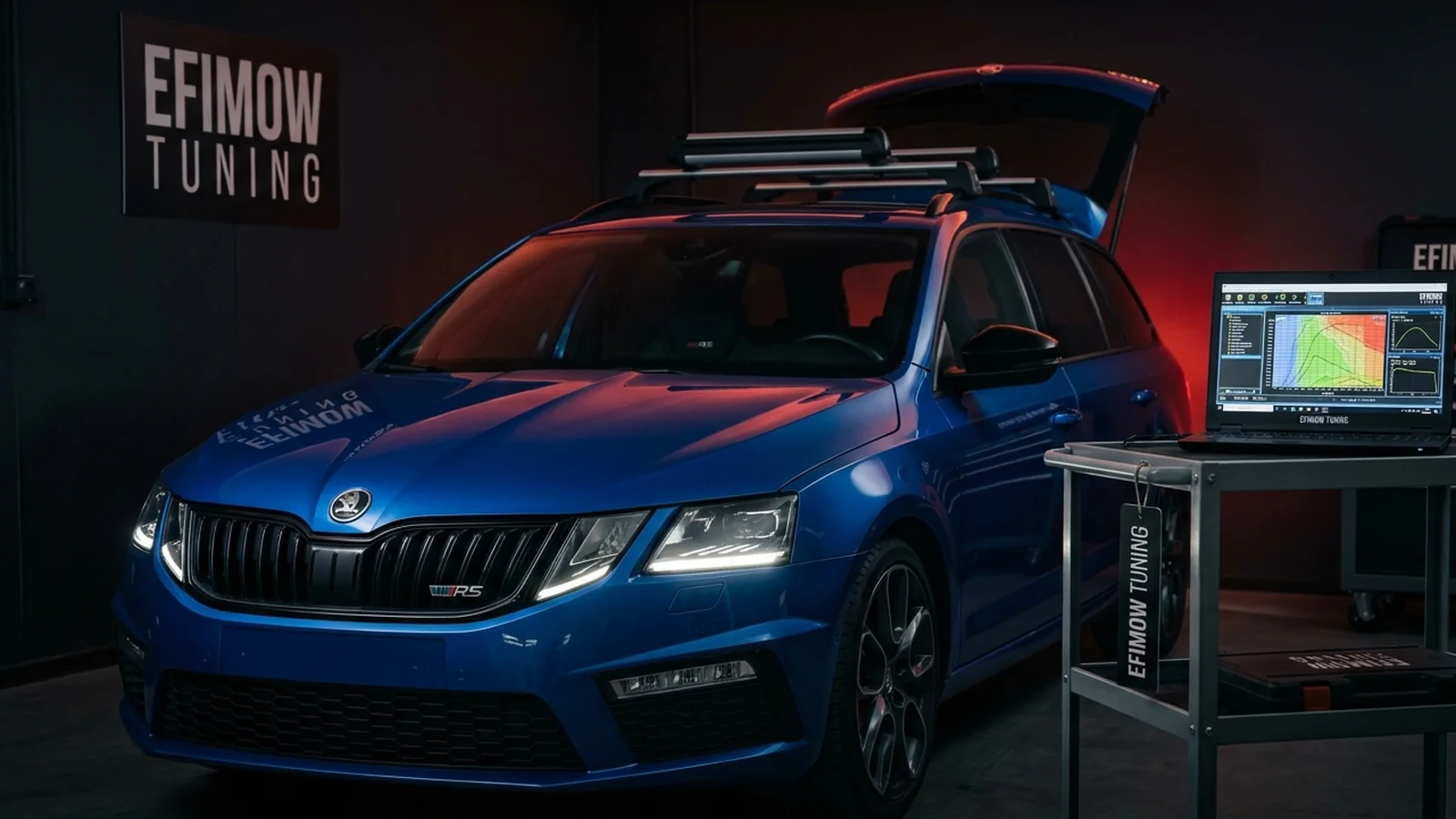
Skoda Octavia RS 2.0 TSI: More Power, with Good Judgement
Octavia RS with 2.0 TSI: Simos 18 in the Octavia III, MED17.5 and MED9.1 in the Octavia II: ranges, prices, options and limits for the family sports car.
October 25, 2026 by Leo Efimow
The Octavia RS is proof that a family estate can be fun. Over several generations, Skoda gave it the 2.0 TSI from the Golf GTI, along with a huge boot and a chassis tuned more for daily life than for the track. That's exactly why tuning an RS should be done with good judgement: the engine can do more, but the car is often driven fully loaded, with a trailer or on long holiday trips. A good calibration takes that into account.
Which petrol Octavia RS variants exist
Our catalog lists three relevant variants with the 2.0-litre petrol engine:
| Generation | Engine | Engine code | Stock power | ECU | Stage 1 | Stage 2 |
|---|---|---|---|---|---|---|
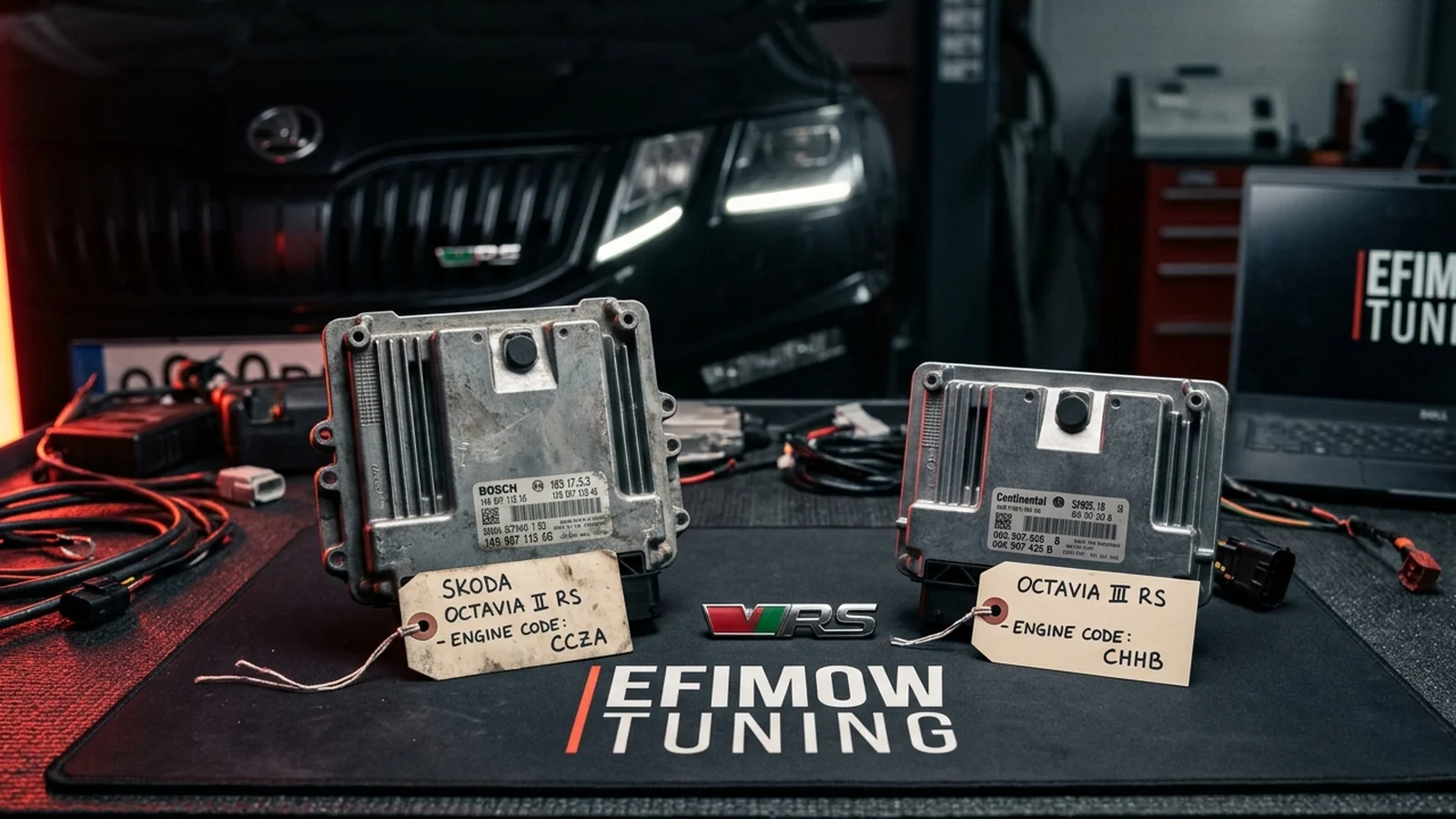
| Octavia III (5E) RS | 2.0 TSI | CHHB | 220 PS | Simos 18 | from €450 | from €550 |
| Octavia II (1Z) | 2.0 TSI | CCZA | 200 PS | Bosch MED17.5 | from €250 | from €325 |
| Octavia II (1Z) | 2.0 TFSI | BWA | 200 PS | Bosch MED9.1 | from €220 | from €270 |
The prices follow from the ECU generation and the access route. For the Octavia III RS with Simos 18, the surcharge for opening the ECU is included; the same applies to the older BWA engine with MED9.1, because that ECU is also handled in boot mode. The CCZA with MED17.5 is priced without this surcharge. For the current RS, go straight to the product page of the Octavia III RS CHHB.
Octavia III RS: EA888 Gen3 with Simos 18
The third-generation RS uses the EA888 Gen3, just like the Golf 7 GTI. As a typical guide value for this engine family with a Simos ECU, Stage 1 brings 25–40 % more power and 20–40 % more torque. These are ranges from our research per ECU family, not a promise for your car.
Boost, cylinder fill, ignition timing and torque limiters are adjusted. Knock control, component protection and lambda targets remain active. On the Simos 18, writing over OBD is blocked depending on the software version, so the ECU is removed, opened and handled in bench or boot mode. The background is explained in Simos 18: why the ECU has to be opened.
Octavia II RS: two ECU generations
On the predecessor, the engine code deserves a close look. The BWA is a 2.0 TFSI from the older EA113 series with a Bosch MED9.1, the CCZA a 2.0 TSI from the EA888 family with a Bosch MED17.5. For both, the typical Stage 1 guide value is 20–35 % more power; for torque the range is 20–35 % on MED9 and 20–40 % on MED17.
An Octavia II RS usually has plenty of miles behind it. Before tuning, spark plugs, ignition coils, the charge-air path and the fault memory should therefore be checked. On older direct-injection engines the high-pressure fuel pump is also a topic: if fuel pressure is already at its limit in stock form, more power won't improve things.
Good judgement: the daily life of an estate
An RS is used differently from a Golf GTI. Typical everyday situations: fully loaded on the motorway, with a roof box or towing a trailer uphill. For these cases, a calibration that improves mid-range torque without exhausting the thermal reserves makes sense. A few points you should plan for:
- Clutch or DSG: On a manual car, the clutch is the first part to feel more torque. With a wet DSG, the transmission control knows a torque limit; whether adjusting the gearbox software makes sense is something we clarify when we review your inquiry.
- Brakes and tyres: More power in a loaded estate means more work for the brakes.
- Fuel: Tell us which octane you fill up with day to day. The calibration is based on it.
- Maintenance: Shorter oil change intervals never hurt a tuned turbo petrol engine.
Stage 2
Stage 2 combines software with hardware: a downpipe with catalytic converter and approval certificate, a larger intercooler, an improved intake. On an RS used for towing or long full-load stretches, the intercooler is the most sensible hardware measure. An exhaust without a catalytic converter is not permitted on public roads. Later Simos 18 software versions from around 2018 partly work with a gasoline particulate filter; disabling or removing it is emissions tampering and prohibited on public roads.
Options by ECU
What you can book depends on the ECU family:
- Octavia III RS (Simos 18): Stage 1+, ECO tuning, Sharp Throttle, Vmax removal, DTC Off (only for non-emissions-related fault codes) plus Launch Control, Hardcut Limiter, Pops & Bangs and Popcorn Limiter. No-Lift Shift and Anti-Lag only on request after checking the file.
- Octavia II RS (MED17.5 and MED9.1): Stage 1+, Sharp Throttle, Vmax removal, DTC Off and Hardcut Limiter. ECO tuning, Launch Control, No-Lift Shift, Pops & Bangs, Popcorn Limiter and Anti-Lag only on request after checking the file.
Launch Control, Hardcut Limiter, Pops & Bangs, Popcorn Limiter and Anti-Lag are intended strictly for motorsport on closed circuits.
Process
In the configurator you choose your Octavia's generation and engine code, see price and options, and decide on an appointment with us in Stödtlen or on sending in the ECU. The price is the same either way.
Original file and return to stock
Especially on a family car that will be sold or passed on at some point, the original file matters. It is backed up before any change. On the Simos 18 and the MED9.1, complete reading via bench or boot access is the step that makes a later return to stock reliably possible. So if you want to set your RS back to stock one day, a clean backup makes that straightforward.
After tuning
During the first few days, watch cold start, idle, shift behaviour and the fault memory. Full load only with warm oil. That applies to every turbo engine, and all the more when towing or fully loaded. If you notice anything unusual, get in touch early.
Law
The software change voids your vehicle's type approval; the software is intended for motorsport use only. More in the motorsport notice.
Conclusion
The Octavia RS with 2.0 TSI has solid headroom in both generations. On the Octavia III RS the Simos 18 means more involved access; on the Octavia II the engine code decides between MED17.5 and MED9.1. If you use your RS as a family car, you're best served by a calibration that brings mid-range torque, respects the thermal reserves and keeps an eye on clutch or DSG.
In the configurator you'll find your Octavia with engine code, price and options, and can book an appointment or shipping directly.