
Nissan Qashqai J10/J11: Optimising the Diesels and the DIG-T
1.5 dCi, 1.6 dCi, 2.0 dCi or 1.2 DIG-T: which Qashqai engines benefit from software, which ECUs they use and what it costs.
October 25, 2026 by Leo Efimow
Few models have shaped Europe's compact SUV segment like the Qashqai. Accordingly, plenty of them are on the road: as family cars, commuter cars or tow vehicles for a small caravan. If you want more pulling power, the Qashqai is a good starting point: almost all engines are turbocharged and come from the Alliance with Renault. The differences lie in the ECUs, and those determine effort, price and headroom.
Qashqai J10 (2007–2013)
The first generation was offered with three diesel engines and several petrol units. Our catalog lists:
| Engine | Output (catalog) | ECU | Family |
|---|---|---|---|
| 1.5 dCi (K9K) | 105 hp | Siemens SID / Delphi DCM | Siemens/Delphi |
| 1.6 dCi (R9M) | 130 hp | Bosch EDC17C42 | Bosch EDC17 |
| 2.0 dCi (M9R) | 150 hp | Bosch EDC16CP33 | Bosch EDC16 |
| 1.6 / 2.0 petrol | - | Hitachi | Naturally aspirated |
1.5 dCi: The small K9K diesel is the most economical engine in the Qashqai, but rather modest for the SUV's weight. For the Siemens SID family, our data gives a typical 20–30% more power and torque as a Stage 1 guide value. This is exactly where software adds noticeable composure in daily driving.
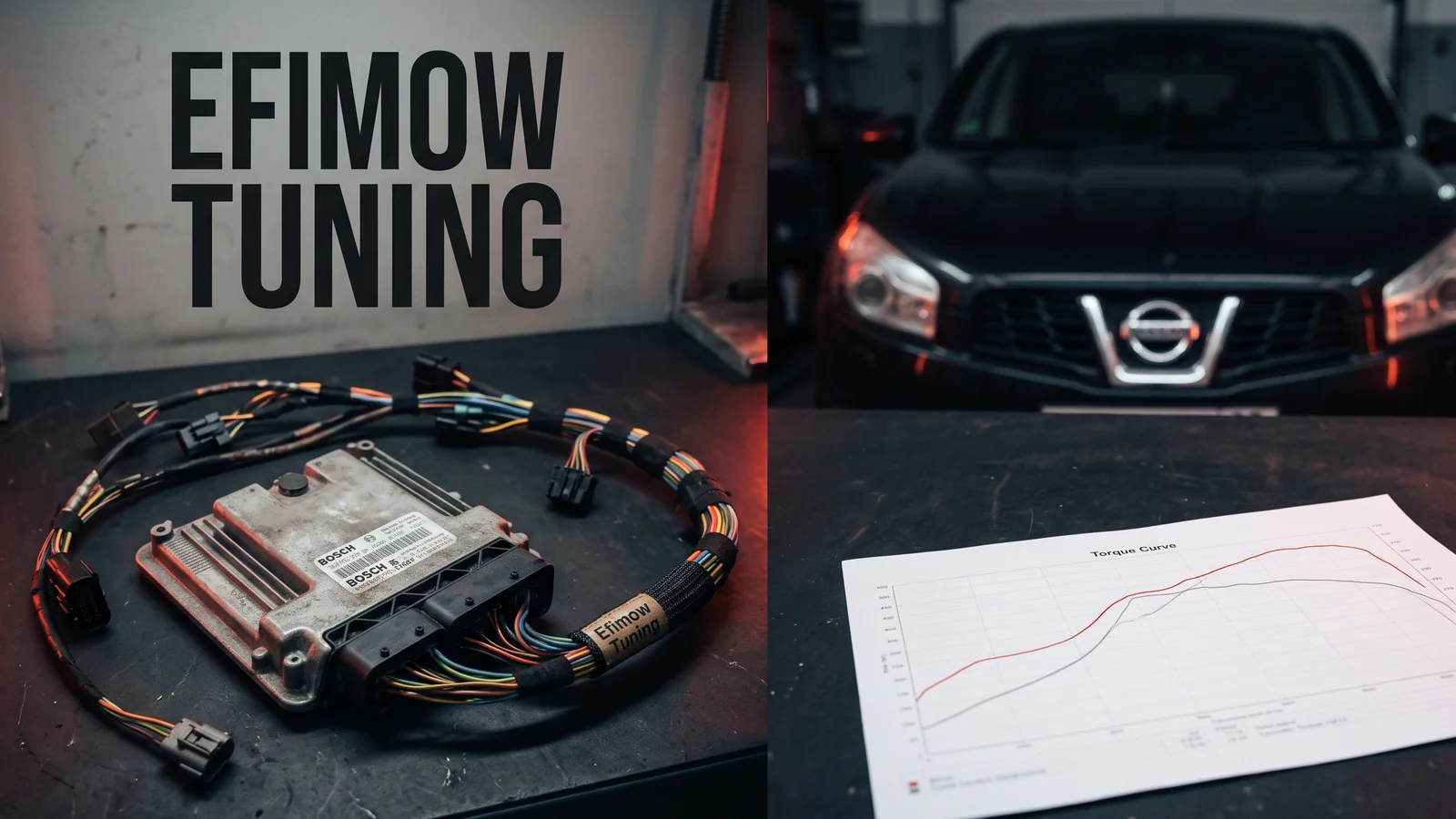
1.6 dCi: The R9M arrived towards the end of the first generation and uses a Bosch EDC17C42. For the EDC17 family outside the VW Group, our data gives a typical 20–30% for four-cylinder engines.
2.0 dCi: The M9R is the strongest diesel in the J10, often combined with four-wheel drive or an automatic gearbox. The Bosch EDC16 common-rail family is very well documented; a typical 20–30% more power and torque is a realistic guide value, and Stage 2 with hardware is possible in principle.
The petrol engines: The naturally aspirated 1.6 and 2.0 with Hitachi ECUs gain very little. For naturally aspirated engines our data gives only around 3–8%. As a rule, that is not worth it.
Qashqai J11 (2014–2021)
The second generation relies more on downsizing. In the catalog:
| Engine | ECU | Family |
|---|---|---|
| 1.2 DIG-T | Continental EMS3155 | Siemens/Continental petrol |
| 1.5 dCi (K9K) | Continental SID310 | Siemens/Continental SID |
| 1.6 dCi (R9M) | Bosch EDC17C84 | Bosch EDC17 |
| 2.0 / 2.5 petrol | Hitachi | Naturally aspirated |
1.2 DIG-T: The small turbo petrol is the most interesting petrol engine in the Qashqai range. For forced-induction engines in the Continental petrol family, our data gives a typical 15–30% more power and 20–30% more torque. A small turbo with a big car on top responds noticeably to more mid-range torque.
1.5 dCi with SID310: Typically 20–30% as a guide value, as on the J10. The SID310 is the newer Continental generation, also used in the Renault Kadjar, the J11's technical sibling.
1.6 dCi with EDC17C84: The EDC17C84 belongs to the newer Bosch generations with stronger protection. We classify it accordingly higher, which is reflected in the price.
Options
For the Qashqai's diesel ECUs, the following are documented alongside Stage 1:
- ECO tuning: more torque low down and in the mid-range, unchanged peak power
- Sharp Throttle for a more direct throttle pedal
- Vmax removal (mind the tyre speed rating and registration)
- DTC Off only for non-emissions-related fault codes
- Stage 1+ as a finer calibration step
On the 1.2 DIG-T, the petrol families add further functions such as a raised rev limiter. Sound functions such as pops & bangs or a hardcut limiter are intended exclusively for motorsport and do not belong on the road, though on a family SUV the question rarely comes up anyway.
Drivetrain: CVT, automatic, all-wheel drive
The Qashqai is often driven with the continuously variable CVT gearbox (Xtronic). These gearboxes have their own torque limits, monitored by the transmission control unit. A serious calibration takes this into account and builds the extra torque so that the gearbox does not hit its protection limit. On high-mileage manual cars, clutch and dual-mass flywheel should be checked first; on all-wheel-drive models, the coupling in the rear drive.
Exhaust aftertreatment
All Qashqai diesels from Euro 5 onwards have a particulate filter. A Qashqai used mainly for short trips often has a heavily loaded DPF. That should be sorted before the software is adapted. Disabling the DPF, EGR or catalyst is emissions tampering and illegal on public roads.
Process and prices
We work on Nissan directly at the ECU: on site in Stödtlen at an appointment of your choice or by sending in the ECU. The price is the same in both cases, and booking is online.
Under our pricing rules, the Qashqai 2.0 dCi with 150 hp starts from €200 and the Qashqai 1.6 dCi with 130 hp from €300 for Stage 1. On the J11, the 1.2 DIG-T starts at €250 and the 1.5 dCi at €300; the 1.6 dCi with EDC17C84 comes to €400. Everything else is in the configurator.
On the legal side: the software change voids the type approval. The software is intended for motorsport use only (see the motorsport notice).
Common questions from the workshop
Can the CVT handle more torque? The CVT has its own limits, monitored by the transmission control unit. A serious calibration stays within these limits and builds torque so that the gearbox does not go into protection. Regular gearbox oil changes according to the manufacturer's schedule also matter, as aged CVT fluid copes worse with extra load.
My Qashqai is a 1.6 dCi J11. Why does it cost more? Our price is based on the ECU generation. The Bosch EDC17C84 in the late 1.6 dCi belongs to the newer, more strongly protected generations, which take more work. That applies regardless of brand and is the same for comparable ECUs from other manufacturers.
Is there anything I need to watch for when driving after tuning? Not fundamentally. As with any turbo engine: warm the engine up before using full power, and after a fast motorway run do not switch off immediately but let it idle briefly. On a diesel with a particulate filter, an occasional longer drive helps so that regeneration can complete.
Conclusion
On the Qashqai, software pays off mainly on the diesels and the 1.2 DIG-T: typically 20–30% and 15–30% respectively as guide values, in exactly the rev range where an SUV works in everyday use. We honestly leave the naturally aspirated petrol engines alone. What matters is the right ECU, a gearbox that can handle the extra torque and intact exhaust aftertreatment. More on the small diesel in our article on the Renault 1.5 dCi and in the glossary under dCi.