
Reading Bosch numbers: 0 261, 0 281 & co.
What the numbers on a Bosch ECU mean: Bosch part number, OE number, type designation and what they tell you about your car.
October 26, 2026 by Leo Efimow
Hold a Bosch ECU for the first time and the label shows a whole row of numbers: a long sequence starting with 0 261 or 0 281, a number from the vehicle manufacturer, a designation like EDC17 or MED17, plus barcode and serial number. Not all of them matter equally for tuning, but together they paint a fairly precise picture. This article explains which number means what and what to watch out for when reading them.
Why Bosch of all suppliers?
Bosch has been the largest supplier of engine control units in Europe for decades. The Jetronic injection systems and later the Motronic, which first went into series production in the 1979 BMW 732i, shaped electronic engine management. Today Bosch ECUs control diesel and petrol engines from almost every European manufacturer: as EDC16, EDC17 and MD1 on diesels, as ME7, MED9, MED17, MEVD17 and MG1 on petrol engines. Accordingly, Bosch labels land on our bench very often.
The numbers on a Bosch label
A typical Bosch label carries several markings that answer different questions:
| Item | Example format | What it tells you |
|---|---|---|
| Bosch part number | 0 261 … or 0 281 … (ten digits) | Which Bosch unit it is; roughly: petrol or diesel |
| Vehicle manufacturer's OE number | brand-specific format | The number under which the car brand lists the part |
| Type designation | e.g. EDC17C46, MED17.5.25 | Which ECU family and variant the unit belongs to |
| Other details | barcode, serial number, production date | Traceability of the individual unit |
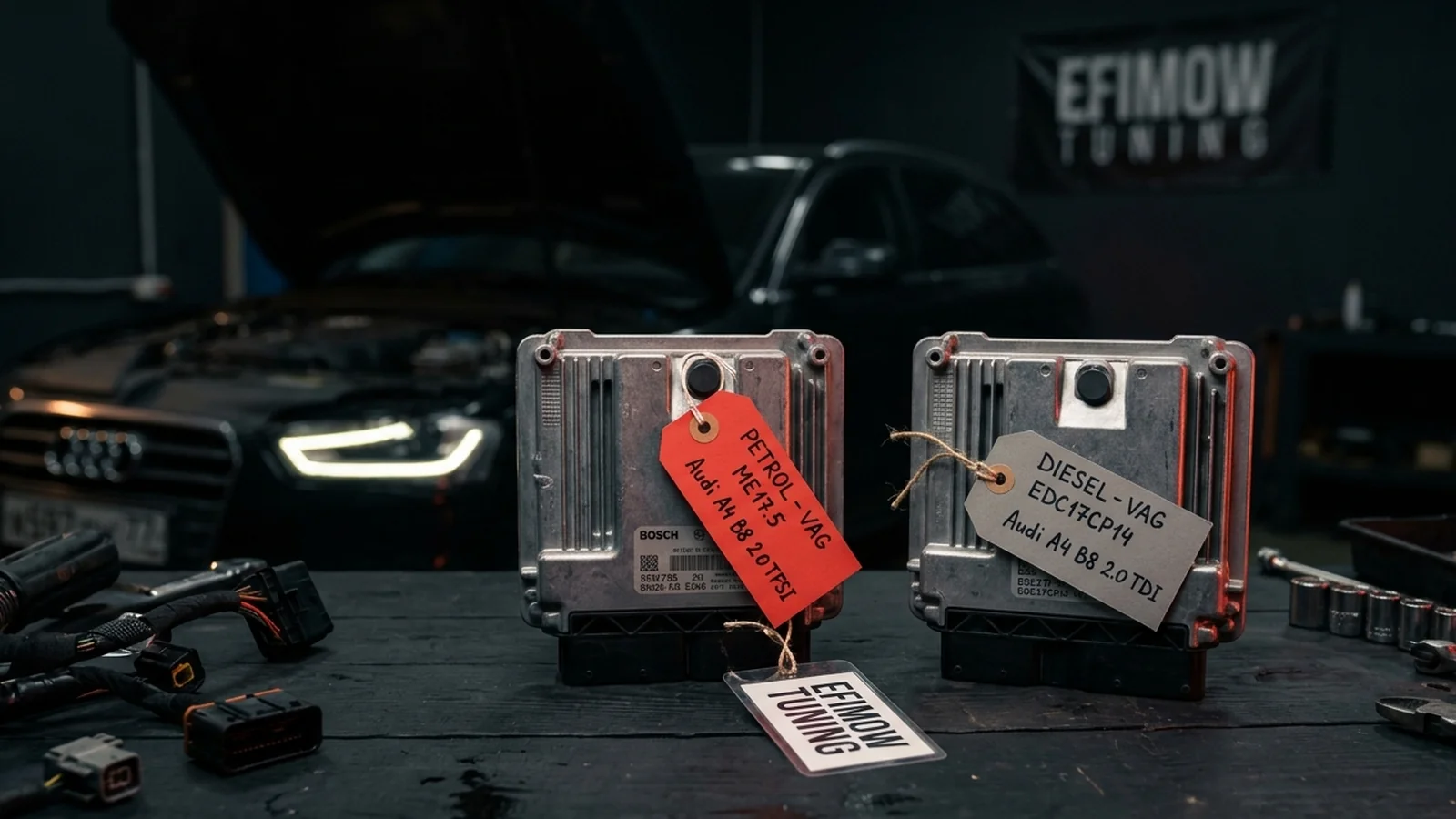
Not every label shows everything equally clearly. With some car brands the OE number is prominent and the Bosch number small underneath; with others it's the other way round.
0 261 and 0 281: the rule of thumb
The best-known rule is: Bosch engine control units for petrol engines carry a part number starting with 0 261, units for diesel engines one starting with 0 281. Parts and repair directories agree on this, and it matches our workshop experience.
Two caveats belong with it:
- It's a rule of thumb, not a blueprint. The prefix gives a rough classification; the full number decides. Newer units also have letters in the number, such as 0 261 S…, which doesn't change the basic split.
- The prefix says nothing about the generation. A 0 281 can be an EDC15 from the nineties or an EDC17 from the last decade. Only the type designation or the full number tells you the family.
Still, the rule is useful day to day. If someone offers an ECU for a petrol car and the number starts with 0 281, that's a contradiction worth clearing up before you buy.
The type designation: family and variant
For tuning, the type designation is usually the most telling item. Bosch names its ECUs according to a scheme that has largely held across generations:
- EDC stands for Electronic Diesel Control, the number after it for the generation: EDC15, EDC16, EDC17. The successors are called MD1.
- ME stands for Motronic with electronic throttle, MED for Motronic with direct injection, MEVD for the BMW variants with Valvetronic. The successors are called MG1.
- The letters and numbers after that (such as C46, CP14 or 17.5.25) denote the specific variant.
The EDC17 shows why the variant matters: the VAG TDI engines alone use numerous variants with different hardware. On some, OBD access is routine; others need the bench or an opened housing. More in the articles on the Bosch EDC17 and the Bosch MED17.
The vehicle manufacturer's OE number
Besides the Bosch number, the label carries the car brand's part number. Every brand has its own format: with Mercedes it starts with "A", with VW, Audi, Seat and Skoda it's a mix of digits and letters with an index at the end, BMW has its own numbering logic.
The OE number is interesting for you for two reasons:
- It links ECU and vehicle. You'll find the part under this number in the brand's parts catalogue, and workshops work with it.
- It can change with the software. With some brands, the same Bosch unit gets a new OE number or index when different software is installed at the factory, for a different power level, a different gearbox or a different emissions standard.
This leads to a point that's often overlooked: same Bosch hardware doesn't mean same software. Two cars can have the same unit with the same Bosch number and still carry different software versions. More in Same car, different software.
What the numbers don't tell you
As helpful as the label is, it has limits:
- The current software version isn't reliably shown on the label. It describes the as-delivered state. Workshop updates change the software; the label stays the same.
- Whether the unit has already been modified can't be read from the label.
- The access route isn't determined by the number alone, but by variant and software version together.
That's why in practice we always combine label and read-out: the label says what the unit is; the read-out says what runs on it.
Practical tips for reading the label
- Photograph the whole label, not just the line that seems important to you.
- Watch spaces and dots. Bosch numbers are often written in groups (0 281 0…); online listings sometimes drop the spaces. It's the same number.
- Don't confuse the serial number with the part number. The serial number is unique to each unit and doesn't help identify the type.
- When buying used: compare not only the Bosch number but also the OE number with your old unit. A replacement ECU must match the vehicle and usually needs to be coded to the immobiliser and car. That's a job for a specialist workshop.
Common questions from the workshop
My ECU has a 0 261 number but the engine is a diesel. Can that be right? That's worth checking carefully. As a rule it points to a mix-up, such as a different control unit in the car or a typo. A photo of the label clears it up quickly.
Is the Bosch number enough for a price quote? It's a good start. Our price depends on the ECU generation. Once the generation is clear from the type designation or vehicle data, the configurator shows the price for your car.
Does the scheme apply to other suppliers too? No. Siemens/Continental, Delphi, Marelli or Denso use their own number formats. With them, the type designation (such as SID807, DCM3.5 or MJD6F3) and the OE number are usually the better clues. An overview is in Who builds which ECU.
Conclusion
A Bosch label isn't a riddle once you know which number answers which question. 0 261 and 0 281 roughly separate petrol and diesel, the type designation names family and variant, the OE number links the unit to your car. Only the read-out shows the current software version. Send us a complete photo of the label in advance and you'll get the fastest and most accurate answer. How to get this information is described in Which ECU do I have?.