
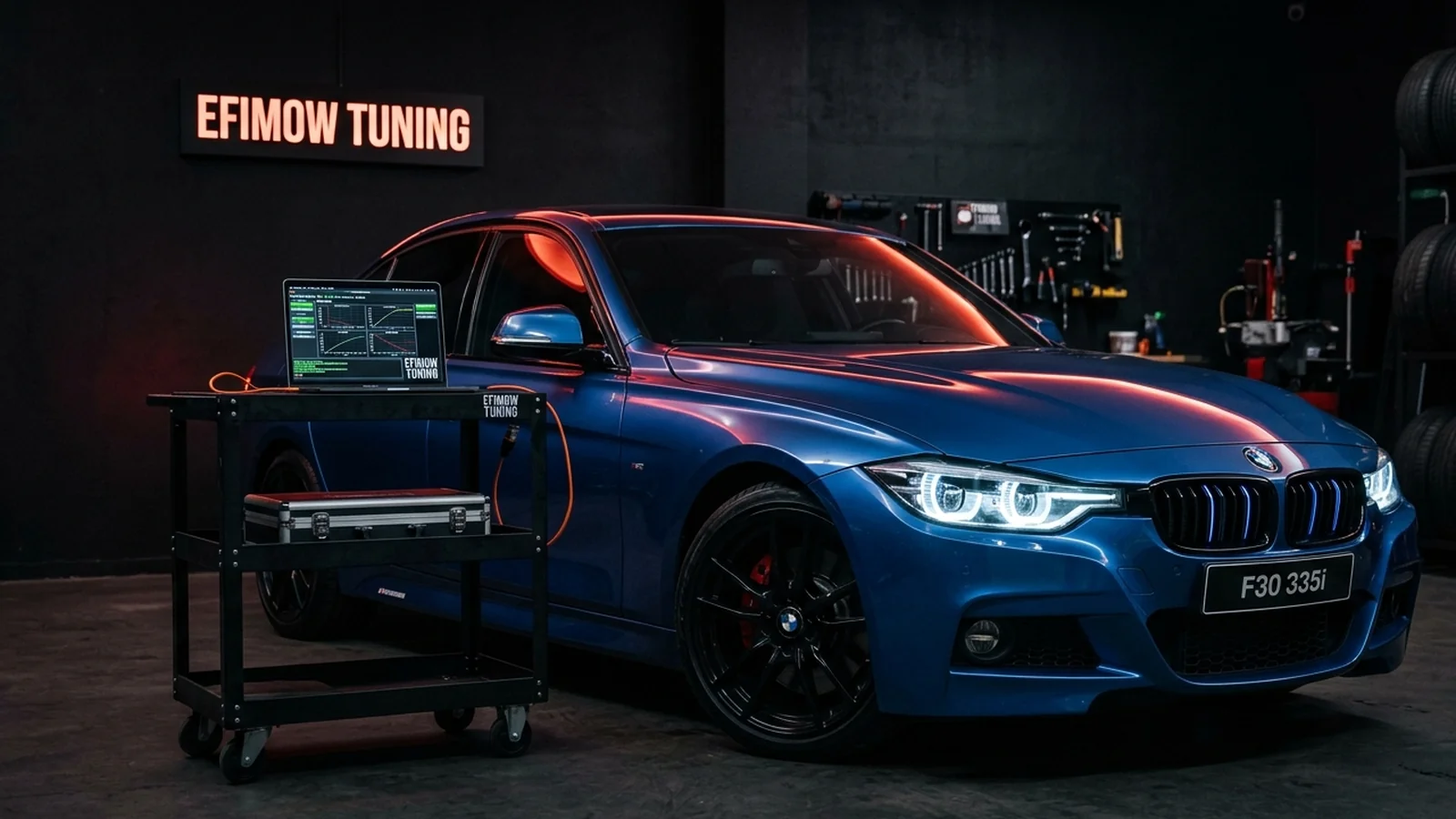
Bosch MEVD17.2: Tuning the N20 and N55 in the F-Series
The Bosch MEVD17.2 controls the N20 and N55 in the F30, F10, F20 and late E9x. Why these turbo engines have so much headroom and what to check first.
October 26, 2026 by Leo Efimow
With the Bosch MEVD17.2, BMW returned to Bosch for its petrol engines after several Siemens generations. The control unit is one of the most important of the last 15 years: it controls the four-cylinder turbo N20 and the inline-six N55, the engines that power a large part of the F-series, from the 320i and the 528i to the M135i. Both engines respond very well to software. That is exactly why it pays to look closely at what the DME does and what should be right before tuning.
What MEVD stands for
The name describes the tasks: Motronic, Electronic throttle, Valvetronic, Direct injection, generation 17. The MEVD17 is closely related to the MED17 that many know from VAG cars, extended with control of the variable valve lift. Technically it is based on a processor from Infineon's Tricore family.
"MEVD17.2" is followed by sub-versions that differ by engine and application. For the N20, for example, the product page lists MEVD17.2.4; the S55 in the F8x-generation M3 and M4 and early engines of the B series also use variants of this family.
Which cars are affected
The N55 arrived around 2009 and replaced the N54. It powers the 335i (facelifted E9x and F3x), the 535i (F10/F11), the M135i (F2x), the X3 and X5 of that generation and the first M2, among others. The N20 followed from around 2011 as the successor to the naturally aspirated four-cylinders and to the six-cylinder in entry-level models: 320i and 328i (F3x), 520i and 528i (F10), 125i (F2x), X1, X3 and Z4.
| Car | Engine | Stock | Stage 1 (reference) | Stage 2 (reference) |
|---|---|---|---|---|
| 320i (F3x) | N20B20 | 184 hp / 270 Nm | approx. 230 hp / 359 Nm | approx. 254 hp / 397 Nm |
| 328i (F3x), 528i (F10) | N20B20 | 245 hp / 350 Nm | approx. 306 hp / 466 Nm | approx. 338 hp / 515 Nm |
| 335i (F3x/E9x), 535i (F10) | N55B30 | 306 hp / 400 Nm | approx. 373 hp / 520 Nm | approx. 413 hp / 568 Nm |
| M135i (F2x) | N55B30 | 320 hp / 450 Nm | approx. 390 hp / 585 Nm | approx. 432 hp / 639 Nm |
The values come from the product pages and are calculated reference values, not dyno measurements.
What the MEVD17.2 controls
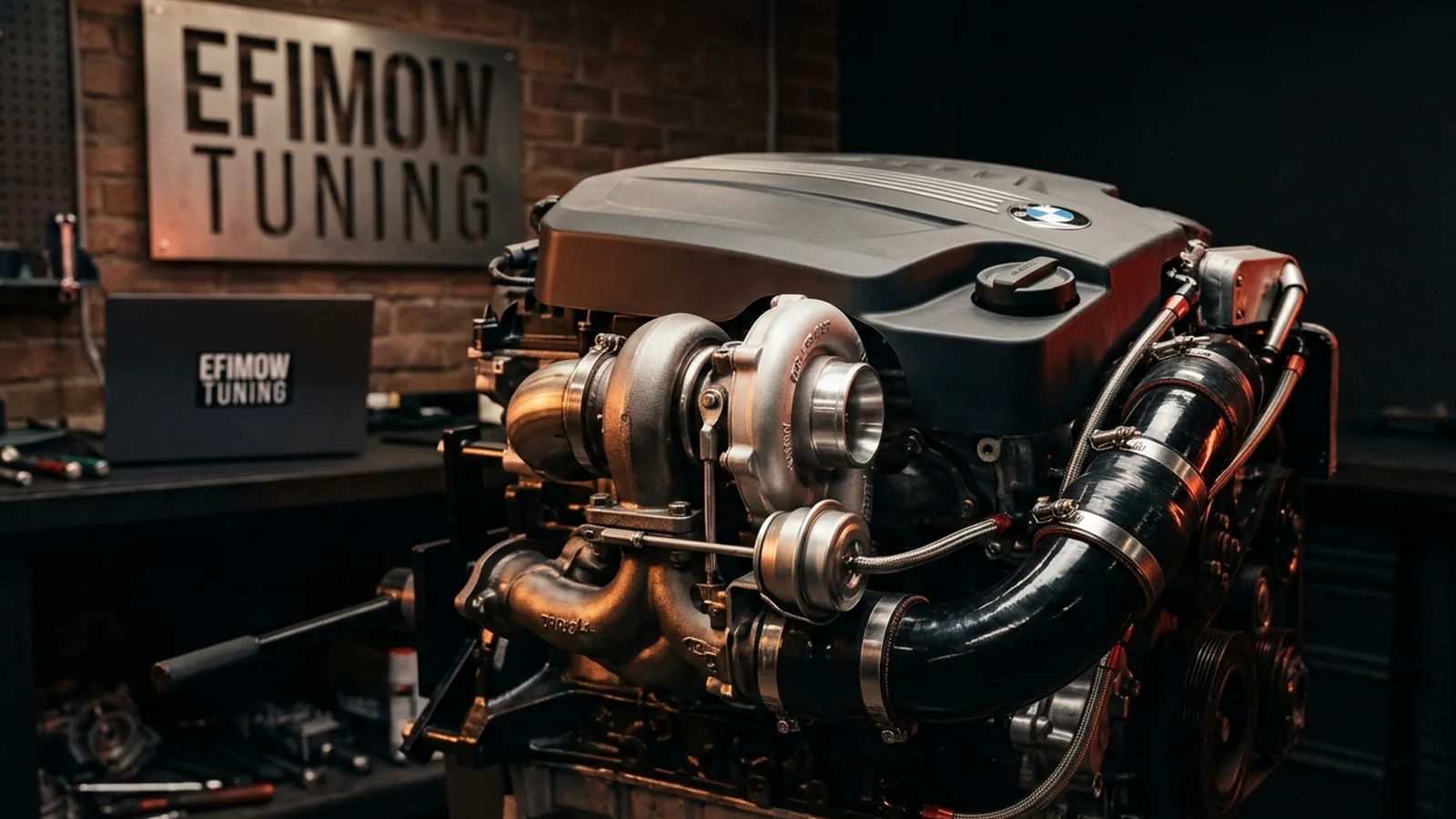
The N20 and N55 combine three technologies that previously existed separately: turbocharging, petrol direct injection and Valvetronic. Both engines use a twin-scroll turbocharger, in which the exhaust flows of two or three cylinders respectively are led separately onto the turbine wheel. That improves response at low revs.
The DME works torque-based. It calculates a target torque from driver demand and distributes it across the actuators: Valvetronic lift and throttle for charge, wastegate for boost, rail pressure and injection for fuel, ignition angle with knock control for combustion. On top come protection functions for exhaust gas temperature, charge air temperature and components, as well as communication with the transmission control unit, which on many cars is a ZF 8HP.
Why the N20 and N55 have so much headroom
The main reason is hardware sharing. A 320i and a 328i have essentially the same N20; the 184 and 245 hp power levels differ mainly in software. The N55 is similar: the same engine delivers 306 or 320 hp depending on the model. The factory calibration therefore deliberately leaves reserves, which a Stage 1 calibration uses: raised boost targets, adapted torque limiters and matching ignition. Why manufacturers do this is explained in Same engine, five power levels.
Stage 2 requires hardware: a more capable intercooler and/or a downpipe with a sports catalytic converter. Exhaust parts need approval or an expert report. With an automatic transmission, it is worth including the gearbox in the plan, because the higher torque arrives there too.
What should be right before tuning
Many N20s and N55s now have high mileage. We frequently see these points in practice:
- Timing chain on the N20: Early N20s are known for wear on the timing chain and guide rails. A rattling noise after a cold start should be clarified before tuning.
- Charge pipe on the N55: The plastic charge pipe is a known weak point and can burst under more boost. Many owners replace it with an aluminium version.
- Wastegate: A worn wastegate linkage makes boost control imprecise.
- Ignition: Spark plugs are wear parts on turbo engines; more boost requires healthy plugs and coils.
- Cooling system and oil changes: Electric water pump, thermostat and a clean service interval are the basis.
Access and software level
On most F-series cars with the MEVD17.2, you read out the original file via OBD with an ENET cable; on the late E9x with the N55 you need a K-DCAN cable, as on the rest of the E-series. Depending on the software level, there can be exceptions that require an unlock on the removed control unit. An update at a dealer can overwrite an adapted file; that is why the backed-up original file always belongs with it.
Typical questions from the workshop
Does the automatic transmission have to be adapted too? For Stage 1 on a healthy 8HP it is not mandatory, but it makes sense if the gearbox shifts early at full load or cuts torque. At higher stages, the transmission software belongs in the plan. Background is given in our article on BMW TCU adaptation.
Do I need premium fuel? Yes, the calibration is designed for high-octane fuel. With a lower octane rating, knock control pulls ignition.
What happens at the next dealer visit? A DME software update overwrites the calibration. Mention it before the appointment, or keep your adapted file so you can flash it again afterwards.
Can I go back to stock? Yes, at any time, with the backed-up original file.
Process and price
You configure your car, pay only for hardware and a €5 deposit today and upload the original file in the customer portal. We adjust it by hand, usually within 48 hours. You pay for the software only once it is finished and flash it yourself via OBD.
According to the product pages, software for the N20 costs from €250 for Stage 1 and €325 for Stage 2, and for the N55 from €300 and €375, for example on the BMW 328i (F3x) or the BMW 335i (F3x). The price for your configuration is shown in the configurator.
Legally: the software change voids your vehicle's type approval; the software is intended exclusively for motorsport (motorsport notice).
Conclusion
The MEVD17.2 controls two of the most rewarding tuning engines of the F-series. Because the N20 and N55 were built in several power levels with largely identical hardware, software delivers much more here than on the naturally aspirated engines before them. The prerequisite is a healthy engine with an intact timing chain, a tight charge air path and good ignition. Where the MEVD17 sits in the line of BMW control units is shown in the overview of DME generations.