
Why Manufacturers Sell the Same Engine in Five Different Power Tiers
The software segmentation of the auto industry, using the BMW B48 and VW 2.0 TDI as case studies. Why your 320i runs nearly the same engine as a 330i.
May 6, 2026 by Leo Efimow
When you spec out a 320i, 330i, or M340i in the BMW configurator, you appear to be choosing between three different cars. Under the hood the truth is more sobering: the 320i and 330i run the same 2.0-liter four-cylinder B48, the same block, the same head, and across many model years the same Mitsubishi turbocharger and the same injectors. What you are paying for is to a large extent not a hardware difference but a software decision in the engine control unit: a calibration file flashed onto the same hardware at the end of the assembly line. The same logic applies to the Volkswagen 2.0 TDI in the EA288 family and to virtually every other modern manufacturer. Once you see this clearly, factory power claims look very different.
The BMW B48 as a Textbook Case
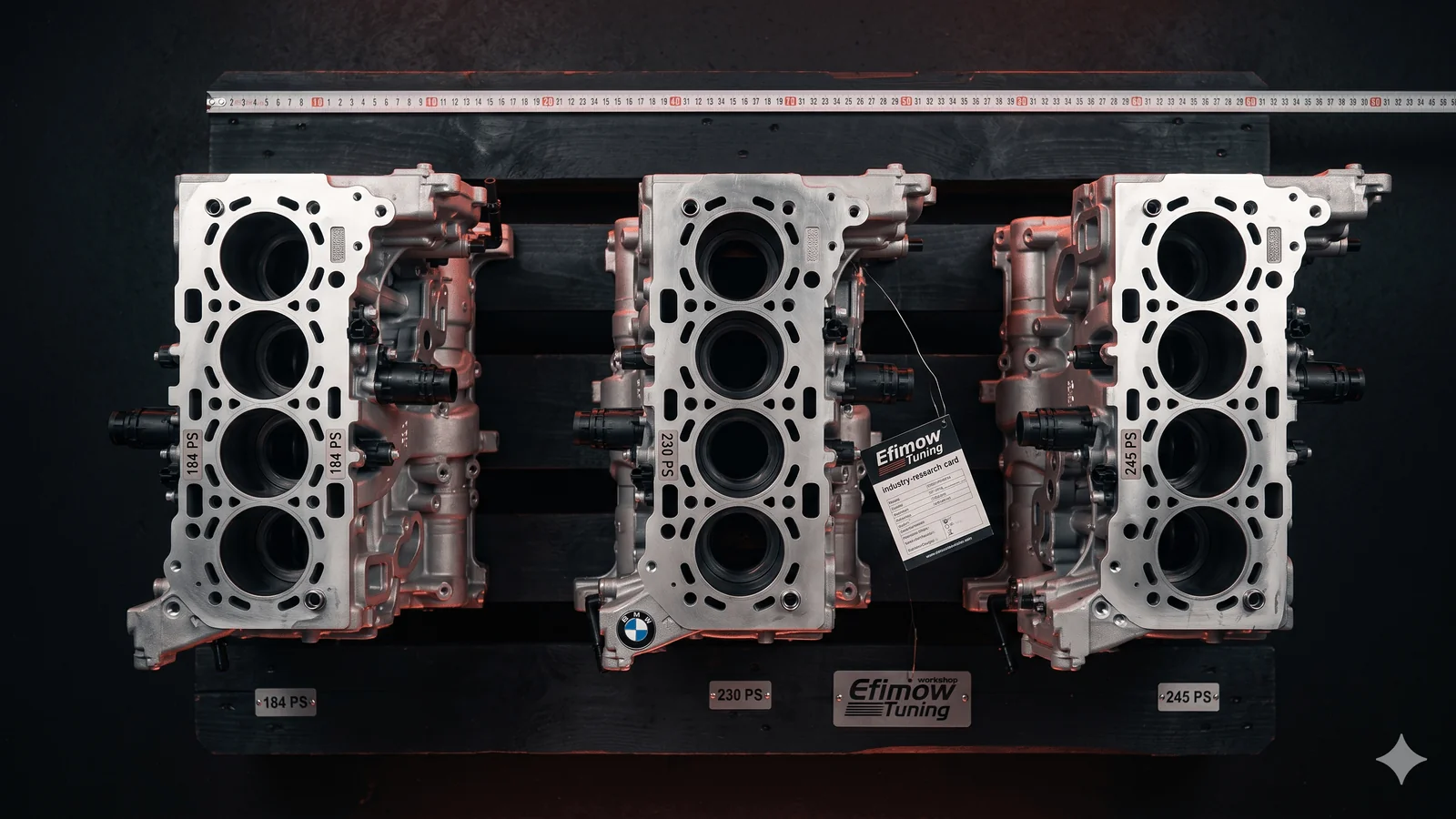
The B48 is a 1,998 cc inline-four with a twin-scroll turbo, direct injection at rail pressures up to 200 bar, and Valvetronic variable valve lift. It sits transverse and longitudinal across most of the BMW lineup: 1 Series, 2 Series, 3 Series, 4 Series, 5 Series, X1, X2, X3, X4, Z4. Within that family, the same engine appears in at least five publicly marketed power ratings. In the G20 generation of the 3 Series, that means 184 hp in the 320i, 252 hp in the 330i, and intermediate steps in some markets such as 218 hp or 230 hp in the 230i and 530i. The M340i moves to the larger inline-six B58, a different hardware family that sits outside this comparison.
If you compare the workshop documentation across B48 power tiers, the differences between the 184-hp and 252-hp versions are surprisingly small. The block is identical, the crankshaft is identical, the connecting rods are identical, the cylinder head is identical. In most variants both tiers share the same turbocharger and the same intercooler. What changes is, first and foremost, software: requested boost pressure, ignition timing maps, lambda target under full load, torque limiters, and the coolant temperature at which the ECU starts pulling power. Put simply, you are paying for different numbers in a table.
Why Manufacturers Build It This Way
The first reason is development cost. Certifying a modern engine family (emissions, noise, crash, durability, hot-and-cold climate testing) runs into the high hundreds of millions of dollars. That investment only pays off when it is amortized across as many model variants as possible. A second hardware variant would require an entire second certification path. A second software variant costs almost nothing.
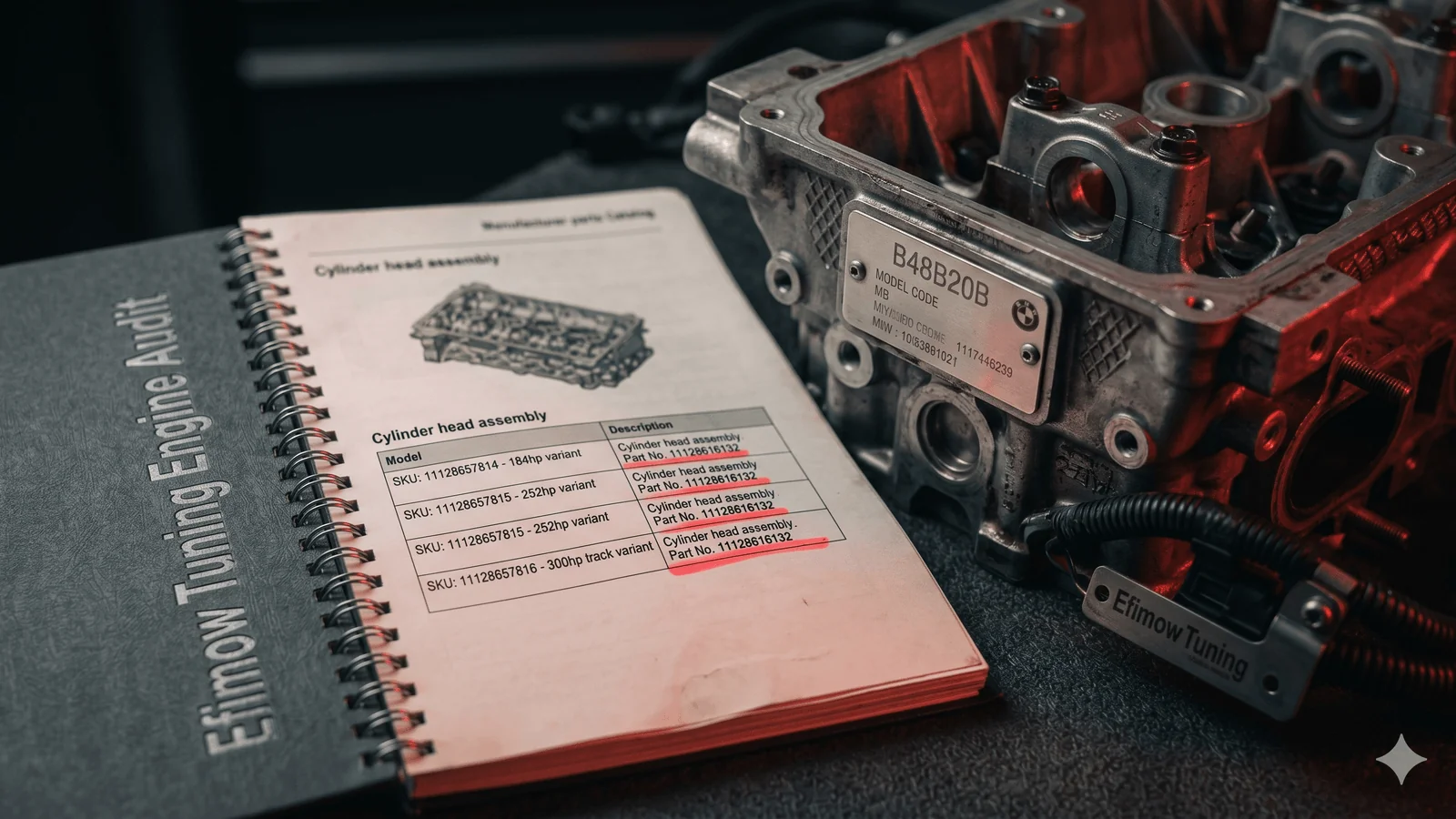
The second reason is market segmentation. BMW needs a clear price ladder between the 320i and the 330i in the premium segment so that customers willing to pay more get a "better" car. If both models were technically identical, the manufacturer would either have to drop the price gap or invest in honest hardware differentiation. Both options eat margin. A power tier capped in software is the cheapest way to justify a premium upcharge. That is exactly why the 184-hp B48 drives better than the spec sheet suggests in most reviews. It feels artificially restrained because, technically, it often is.
The third reason is risk management. When a manufacturer drops a generously specified engine into a low power tier, component stress, thermal load, and warranty cost across the lifecycle all drop. A 184-hp B48 in real-world service sees fewer turbocharger failures, fewer high-pressure pump problems, and fewer clutch issues than the 252-hp variant, simply because, in factory state, it runs further away from the limits the hardware was designed for.
VW 2.0 TDI: the Same Story in Diesel
In the Volkswagen Group, the same logic plays out with the 2.0-liter TDI in the EA288 family. One and the same block runs in power tiers from roughly 110 hp to over 200 hp, from the Caddy commercial van to the sporty Tiguan and the Skoda Octavia RS. The high-pressure common-rail injection comes from the same supplier across many tiers, with peak rail pressures around 2,500 bar. The variable-geometry turbocharger is often the same part number, and the fuel cooler and intercooler are identical in several variants. What separates the 150-hp TDI from the 200-hp TDI is overwhelmingly a calibration: an updated injection map, a higher boost target, different torque limiters across the rev range. The hardware is within reach in both tiers; the factory ECU just addresses it differently.
What This Means for the Tuning Question
Anyone bringing a 320i up to 330i levels is, in most cases, operating inside a hardware corridor the manufacturer has already certified. A Stage 1 calibration on a B48 typically lifts 184 hp to roughly 230–240 hp. That sits closer to the factory 330i dataset than to an aggressive tuning file, and it draws on exactly the reserves that BMW already taps in the higher factory tier. The same applies to the 110- or 150-hp TDI, which can take on the data set of a 184- or 200-hp sibling on comparable hardware.
There are, however, hardware details that genuinely vary inside the same engine family and that you have to know about. In some B48 tiers the piston coating or ring configuration was adjusted, in certain models the oil-to-water cooler is sized up, and individual injectors or the high-pressure fuel pump can differ between tiers. These differences are rarely large enough to forbid a Stage 1 increase, but they are large enough that a serious tuning file has to know and respect them. That is also where good tuners separate themselves from bad ones: anyone who does not have the hardware sheet for the specific model tier in their head is risking exactly the components the manufacturer trimmed in the lower trim.
Bottom Line
A modern engine living in five factory power tiers is not a secret and not a corporate conspiracy. It is an industrially rational answer to development cost and market segmentation. For a tuning customer, the practical takeaway is that the lowest variant in an engine family is rarely the most honest expression of its hardware. A clean software increase does not "pull more out of the engine than it has"; it moves the engine into territory the same manufacturer has already certified for the more expensive trim. Lifting a 320i to 330i levels means paying in software for what BMW already calculated for the 330i dataset, only routed through your tuner instead of the configurator.