
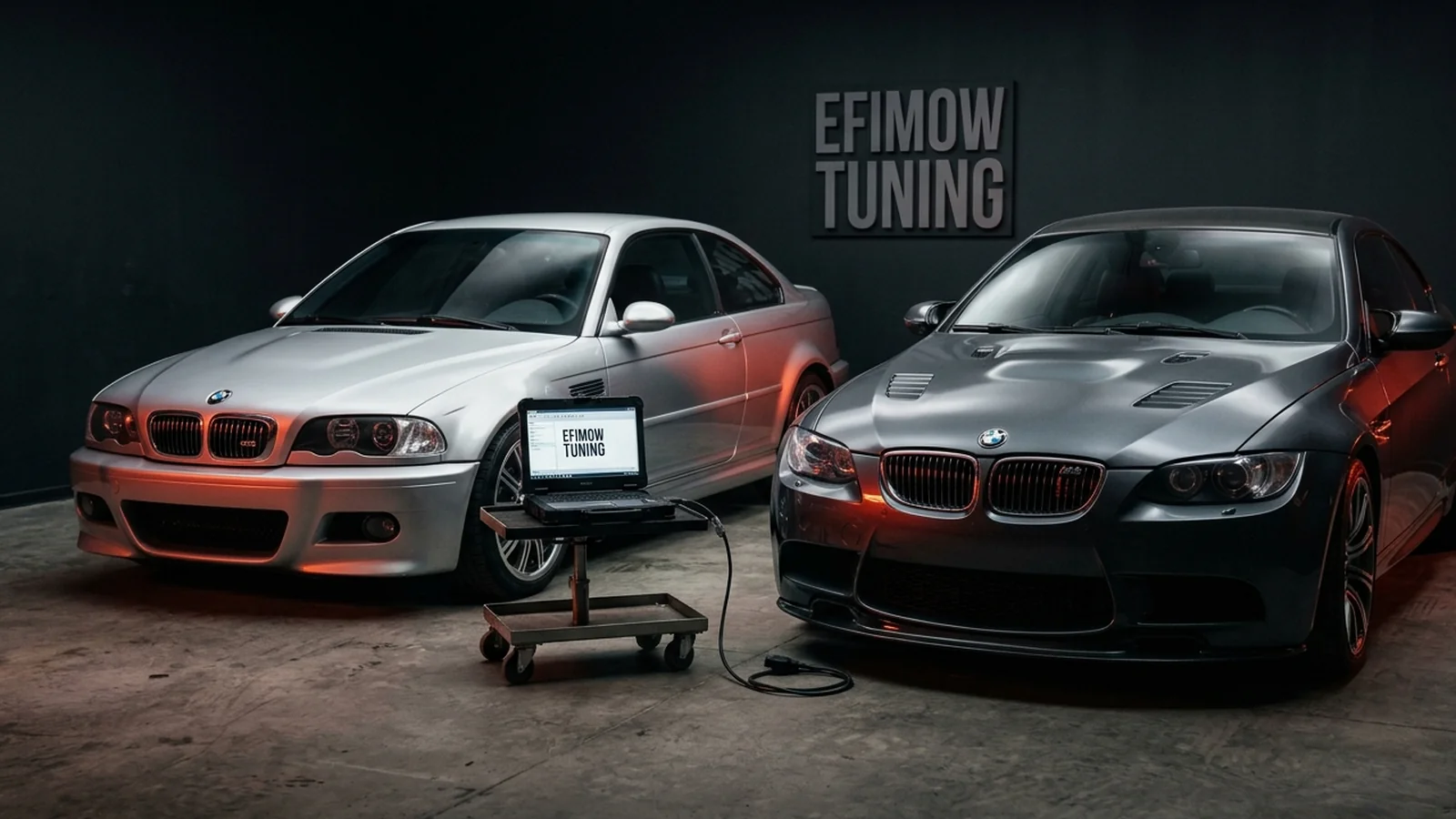
M3 E46 and E9x: MSS54 and MSS60 in High-Revving Naturally Aspirated Engines
The S54 and S65 are high-revving engines with Siemens MSS54 and MSS60. What software realistically brings on the M3 E46 and E9x, and what matters more than hp.
October 26, 2026 by Leo Efimow
The M3 E46 and the M3 E9x stand for an era that has ended at BMW M: naturally aspirated engines that only really come alive beyond 7,000 rpm. The inline-six S54 in the E46 M3 revs to around 8,000 rpm, the V8 S65 in the E90/E92/E93 M3 to over 8,000 rpm. Both are controlled by Siemens units from M's own MSS line: the MSS54 on the S54 and the MSS60 on the S65. Owners of these cars usually do not want to change them but to refine them. That is exactly the right approach for these engines.
The cars and their control units
The 3.2-litre S54B32 powers the M3 E46 (coupé and convertible, roughly 2000 to 2006) with 343 hp, as well as the Z4 M Coupé and Roadster (E85/E86). The M3 CSL uses a more powerful version. The S54 is controlled by the Siemens MSS54 or its later variant, the MSS54HP.
The S65B40 is a 4.0-litre V8 with 420 hp and 400 Nm, fitted to the M3 of the E90, E92 and E93 series (roughly 2007 to 2013). Its DME is the Siemens MSS60. Closely related is the S85 V10 in the M5 E6x with the MSS65.
| Car | Engine | DME | Stock | Stage 1 (reference) | Stage 2 (reference) |
|---|---|---|---|---|---|
| M3 (E46), Z4 M (E85/E86) | S54B32 | MSS54 | 343 hp | approx. 371 hp | approx. 385 hp |
| M3 (E9x) | S65B40 | MSS60 | 420 hp / 400 Nm | approx. 442 hp / 420 Nm | approx. 452 hp / 430 Nm |
The values come from the product pages and are calculated reference values, not dyno measurements.
What makes the MSS54 and MSS60 special
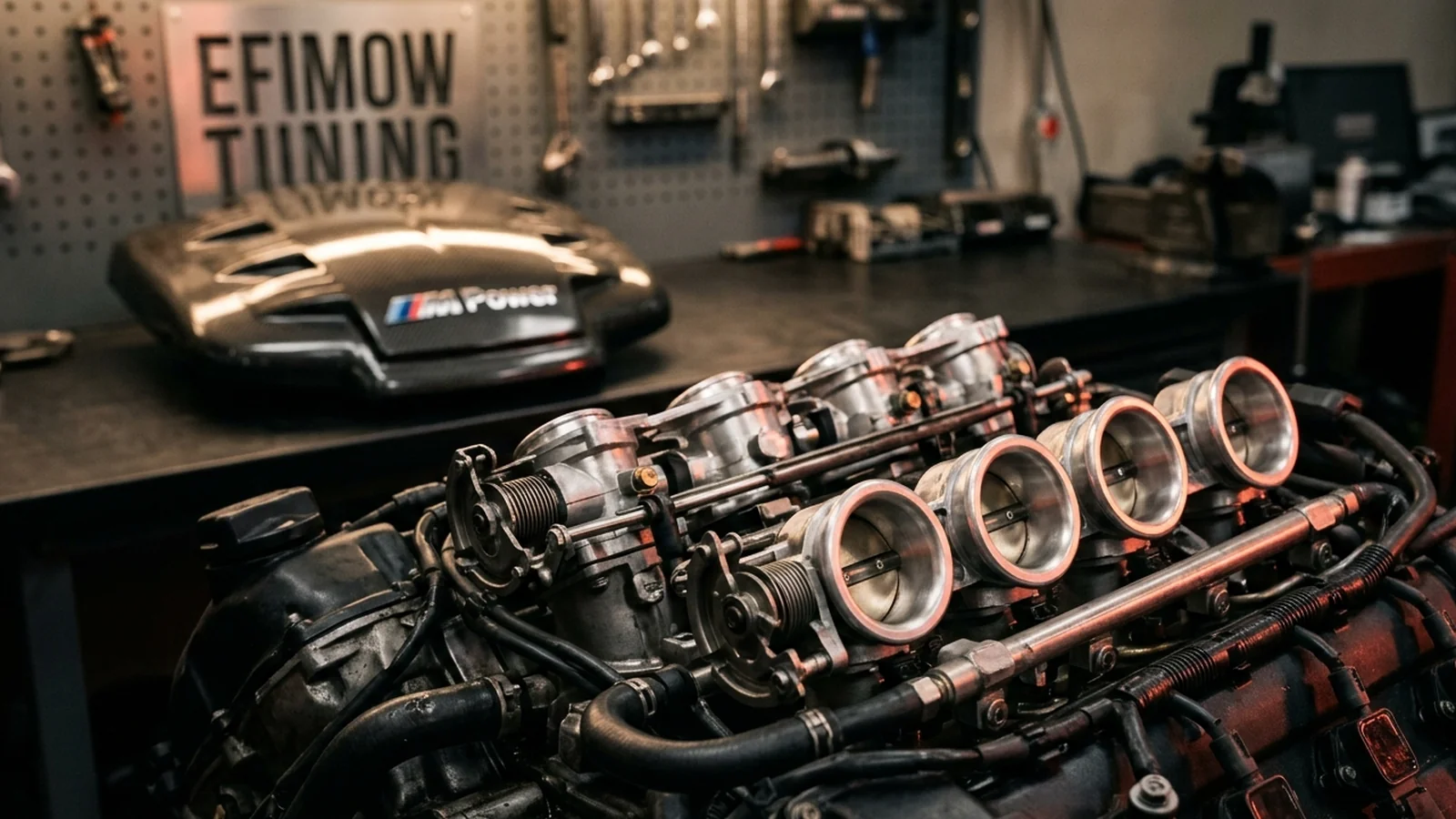
Both engines have individual throttle bodies: six on the S54, eight on the S65. Each cylinder gets its own throttle directly in front of the intake port. This gives extremely direct response, but requires the DME to coordinate all throttles very precisely via an electric actuator. On top comes the double VANOS, which allows fast timing adjustments even at high revs.
Both units monitor combustion cylinder by cylinder and immediately pull ignition when knock occurs. Because the high compression and revs of these engines leave little reserve, BMW M already runs ignition very close to the limit from the factory, which is one reason why a calibration finds little additional headroom here.
Both units work with port injection and lambda control and additionally control M-specific functions such as the Sport button with a sharper pedal map, on the S65 also the interaction with the dual-clutch transmission (M DCT), and on the E46 with the SMG II.
What software realistically brings on the S54 and S65
BMW M brought these engines very close to their mechanical and thermal limits from the factory. Specific output, revs and charge are exhausted. A Stage 1 calibration therefore brings comparatively little: on the M3 E46 from 343 to approx. 371 hp, on the M3 E9x from 420 to approx. 442 hp. That is 5 to 8 percent.
More important than the horsepower figure on these cars are other points:
- Pedal map: On the S54 in particular, many drivers find the pedal sluggish in normal mode and too nervous in Sport mode. A calibrated curve makes both modes more coherent.
- Torque curve: In the mid-range, ignition and timing can be tuned for high-octane fuel so the engine pulls more evenly.
- Limiters: Speed and rev limiters are parameters. The rev limiter on these engines should only be touched with great restraint, because valvetrain and crank drive already run very high from the factory.
Stage 2 means exhaust-side hardware: headers and/or a 200-cell sports catalytic converter. According to the product page, the reference value is then approx. 385 hp for the S54 and approx. 452 hp for the S65. Exhaust parts need approval or an expert report.
Before tuning: mechanics first
A high-revving naturally aspirated engine forgives little. Before we adjust a file for an S54 or S65, the mechanics should be in order:
- Rod bearings: Both the S54 and S65 are known for rod bearing wear. Many owners have them replaced preventively. An engine with questionable bearings should not be stressed further.
- VANOS: The S54's double VANOS is a known weak point; wear costs power and refinement.
- Throttle actuator: Problems with the throttle actuators are known on the S65. Related fault entries should be fixed beforehand.
- Ignition and oil: Plugs, ignition coils and a well-kept oil change interval with the right oil are a must on these engines.
Typical questions from the workshop
Does tuning reduce the M3's value? With sought-after cars like the M3 E46, many buyers look for original condition. With the backed-up original file, the stock state can be restored at any time, so keep it safe.
Does the SMG or DCT transmission change? Transmission control is a separate control unit and is not changed by the DME calibration. The small additional torque of these naturally aspirated engines is usually not an issue for the transmissions.
Do I need premium fuel? Yes. Both engines are designed for high-octane fuel from the factory, and a calibration makes consistent use of that.
Does the sound change after tuning? The software hardly changes the sound. Audible differences come mainly from the exhaust and intake.
Is it worth it at all? If you tune the car for the horsepower figure, you will be disappointed. If you want to refine throttle response and drive modes, you get a noticeable difference.
Process and price
For the E-series, you read out the original file with a K-DCAN cable and upload it in the customer portal. Today you pay only for hardware and a €5 deposit; we adjust the file by hand, usually within 48 hours. You pay for the software only once it is finished and flash it yourself via OBD.
According to the product pages, software for the BMW M3 (E46) costs from €300 for Stage 1 and €350 for Stage 2, and for the BMW M3 (E9x) from €325 and €400. The price for your configuration is shown in the configurator.
Legally: the software change voids your vehicle's type approval; the software is intended exclusively for motorsport (motorsport notice).
Conclusion
The MSS54 and MSS60 control two of the most characterful naturally aspirated engines BMW has built. Software cannot extract turbo-style gains from them, and it should not promise to. What it can do: tune throttle, torque curve and drive modes so the engine suits its driver even better, on healthy mechanics. Where the MSS units sit in the history of BMW engine management is shown in the overview of DME generations.