
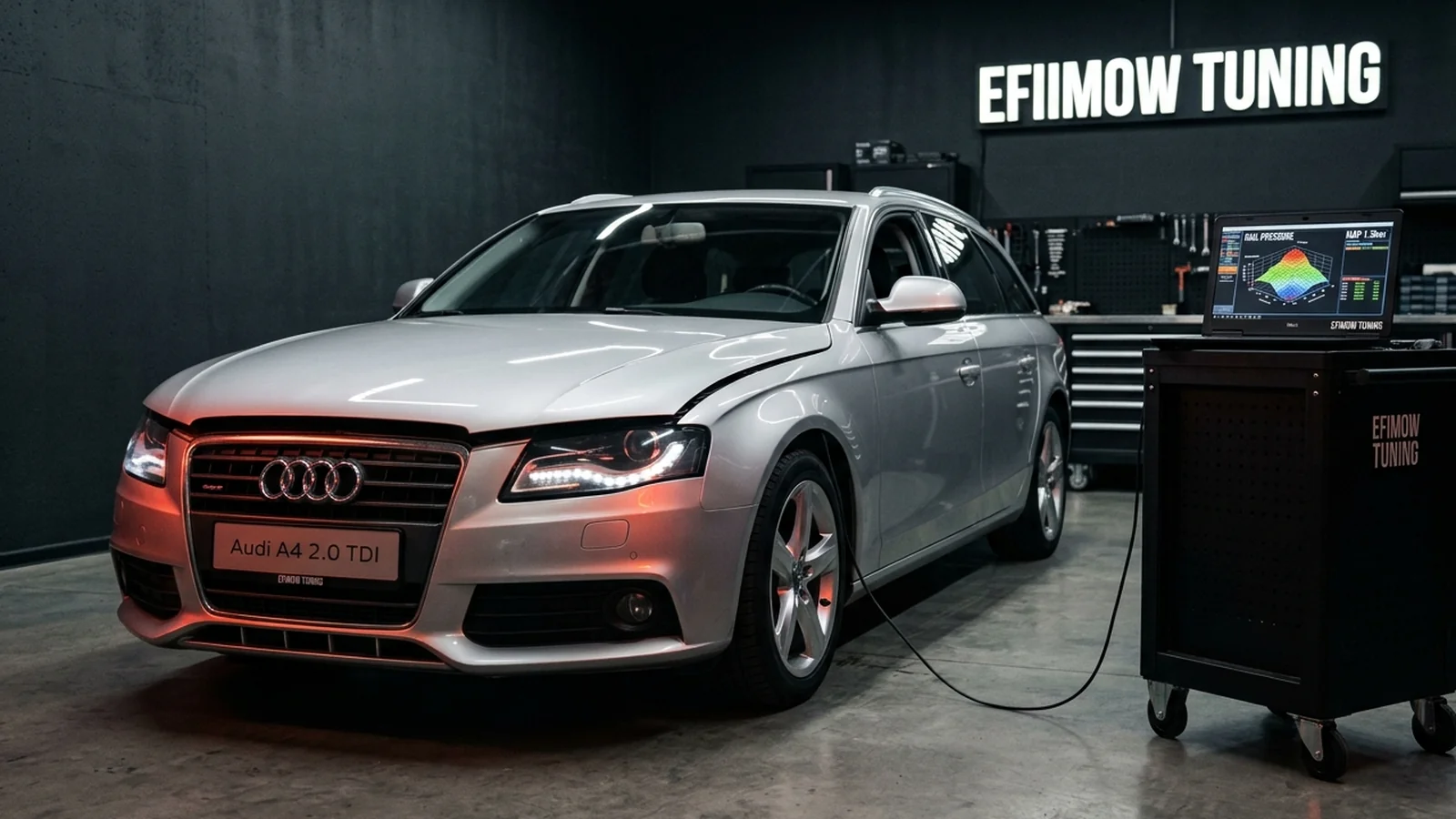
Audi A4 B8 2.0 TDI (CAGA/CAGB) Chip Tuning
Audi A4 B8 2.0 TDI with CAGA or CAGB and Bosch EDC17CP14: engine variants, typical Stage 1 guide values, options, checks and pricing from 300 €.
October 25, 2026 by Leo Efimow
Today the Audi A4 B8 is a typical used car with a six-figure odometer reading, and the 2.0 TDI in particular sits in many garages as a reliable long-distance car. The engine codes CAGA and CAGB come up especially often in enquiries. They are not high-performance engines, but very solid common rail diesels whose stock calibration is noticeably conservative. Here you can read what a software optimisation does on this engine, what you should check beforehand, and why the history of the ECU matters so much on this particular engine.
The 2.0 TDI variants in the A4 B8
According to our catalogue, the A4 IV (B8) ran from 2007 to 2016. The 2.0 TDI comes with a whole range of engine codes that differ mainly in power and calibration:
| Engine code | Power | ECU |
|---|---|---|
| CAGC | 120 PS | Bosch EDC17CP14 |
| CAGB / CJCB | 136 PS | Bosch EDC17CP14 |
| CAGA / CMEA | 143 PS | Bosch EDC17CP14 |
| CAHB | 163 PS | Bosch EDC17CP20 |
| CAHA | 170 PS | Bosch EDC17CP14 |
| CGLC | 177 PS | Bosch EDC17C46 |
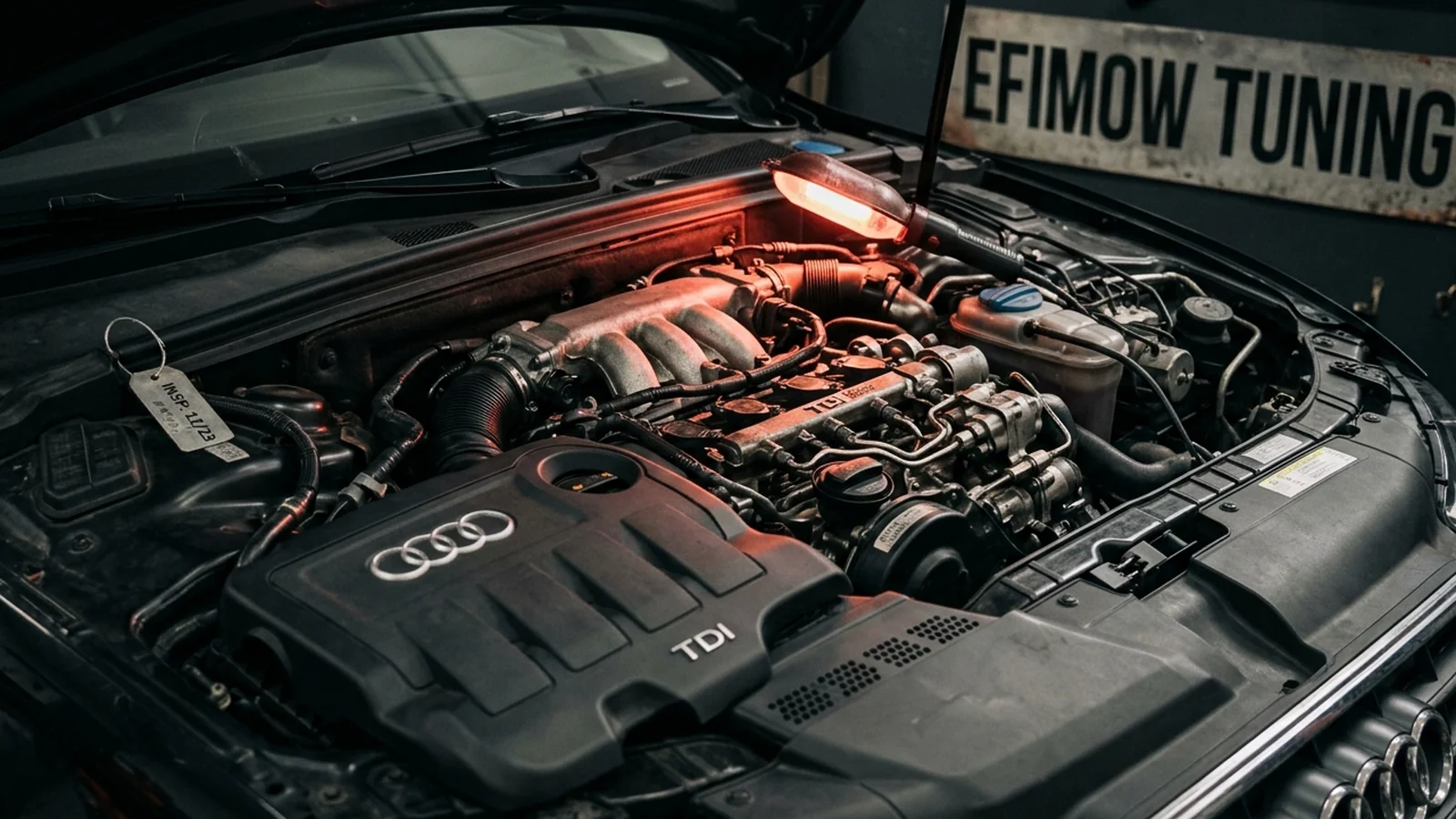
CAGA and CAGB are the core engines of the range: a longitudinally mounted four-cylinder with common rail injection, a variable-geometry turbocharger and a particulate filter. The difference between 136 and 143 PS lies essentially in the software. That is a sign that the hardware can do more than the calibration allows.
What Stage 1 changes on the CAGA and CAGB
The EDC17CP14 belongs to the Bosch EDC17 family for VAG TDI engines. For Stage 1, the maps that determine torque are adapted: torque request and limiters, boost targets and VTG control, rail pressure, injection quantity and the smoke limiter. The interplay is what counts: more fuel without matching boost creates soot, more boost without regard to turbo speed stresses the charger. A clean calibration shifts all values together and keeps the protection functions active.
Typical guide values for this ECU family are around 20–30 % more power and around 20–30 % more torque. These are experience values for healthy engines on stock hardware, not a promise. In daily driving you notice it mainly in mid-range pull: the A4 becomes more composed, not more nervous.
The history of the ECU
The 2.0 TDI engines of this generation belong to the EA189 engine series. Many of these engines received a software update from the manufacturer as part of the recall following the emissions scandal. For tuning this means: the calibration in your ECU can differ from that of an identical car. That is why we always work with the file actually read from your ECU, not with a generic template. The original file is saved before any change.
Another point with older cars: ECUs that have already been modified by another provider are not unusual. If you know your A4 has been tuned before, say so when booking. Using an already modified file as the basis for a new tune is not a good idea.
Options for the EDC17CP14
Besides Stage 1, the following options can be booked for these ECUs:
- Stage 1+: a slightly more aggressive Stage 1 calibration
- ECO tuning: more torque low down and in the mid-range with unchanged peak power
- Sharp Throttle: a more responsive pedal
- Vmax removal: observe the tyre speed rating and registration requirements
- DTC Off: only for individual, non-emissions-related fault codes
Launch control and hardcut limiter are only partly feasible and therefore only available on request after the file has been checked. Both are intended for motorsport only.
On exhaust aftertreatment: the particulate filter and exhaust gas recirculation can technically be influenced by software. Disabling them, however, is emissions tampering and prohibited on public roads. With the EA189 and its history, this is not a side issue.
Checks before the appointment
On a high-mileage A4 B8, the condition of the hardware decides whether tuning makes sense:
- Particulate filter: a heavily loaded DPF raises exhaust back pressure and exhaust temperature. If regenerations are frequently interrupted, find the cause first.
- EGR valve and intake tract: carbon build-up is a known issue on diesels of this generation and costs airflow.
- Turbocharger: a sticking VTG mechanism leads to boost deviations, and tuning will not make that better.
- Clutch and dual-mass flywheel: on a manual gearbox these are the first parts to feel more torque. With automatic gearboxes, the torque limits of the transmission have to be observed.
- Fault memory: fix entries for boost pressure, rail pressure, exhaust temperature or the glow plug system beforehand.
Access, price and process
The EDC17CP14 in the A4 B8 is listed with OBD access in our catalogue. Depending on the software version, bench access may still be needed; if the ECU has to be opened for that, a 50 € surcharge applies.
For the A4 B8 2.0 TDI CAGA with 143 PS and the CAGB with 136 PS, Stage 1 starts from 300 €, Stage 2 from 375 €. The price follows the ECU generation, here the EDC17 diesel tier. Technical details on the ECU are on the page for the Bosch EDC17CP14.
Booking is done online in the configurator. You decide whether you come to us in Stödtlen on a date of your choice or send in the ECU. The price is the same, because the work on the ECU is identical.
And Stage 2?
Stage 2 is also possible on the EDC17 units, but only together with hardware. Typical parts are a larger intercooler, an exhaust from the turbo back with catalyst and particulate filter and, depending on the goal, a larger turbocharger. Exhaust parts are only an option with type approval or an expert report; a pipe without catalyst or DPF is not Stage 2 but emissions tampering. Stage 2+ can also be booked for these ECUs. Important: more hardware also means more load on the clutch, gearbox and driveshafts. On a high-mileage A4 it should be clear beforehand that turbo, clutch and DPF are in good condition. As with Stage 1, the software and hardware changes void the type approval; Stage 2 is intended for motorsport use only.
Legal note
The software change voids your vehicle's type approval; the software is intended for motorsport use only (see the motorsport notice). For public roads, an inspection and registration of the power increase would be required. Ignoring that risks more than a fine in a roadside check or after damage. Insurance cover is then in question as well.
Conclusion
The Audi A4 B8 2.0 TDI with CAGA or CAGB is a solid candidate for a software optimisation. As typical guide values, the EDC17CP14 offers around 20–30 % more power and torque, and mid-range pull in particular benefits. Because many of these EA189 engines received a manufacturer update and older cars often have an eventful history, the individual file from your ECU is the only serious basis. A healthy DPF, a clean intake tract and an intact clutch are the preconditions for enjoying the extra power over the long term.
Select your A4 in the configurator to see the price and available options for your engine code.