
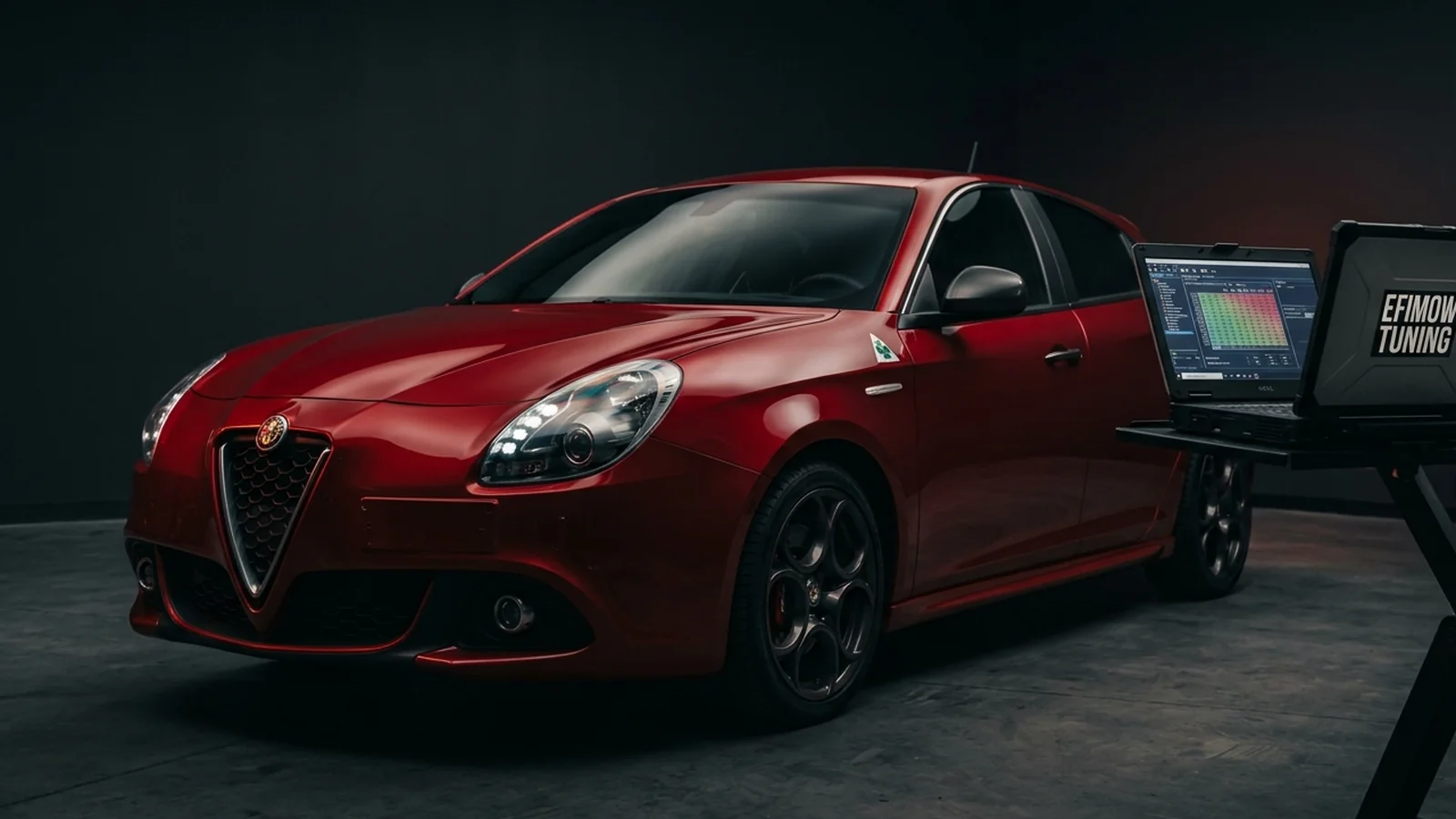
Alfa Romeo Giulietta 1750 TBi and 2.0 JTDm Tuning
From the 1750 TBi and 1.4 MultiAir to the 2.0 JTDm: which Giulietta engines gain from software, which ECUs are fitted and what it costs.
October 25, 2026 by Leo Efimow
For many, the Giulietta (2010–2020) is the last "real" compact Alfa: front-wheel drive, a chassis with character and an engine range from the economical diesel to the 235 hp turbo petrol. It is particularly interesting for tuning because it combines almost every engine concept the Fiat Group had at the time: a classic direct-injection turbo petrol, MultiAir valve control and MultiJet diesels. Each of them responds differently to software.
The Giulietta's engines
Our catalog lists these versions:
| Engine | Output (catalog) | ECU | Family |
|---|---|---|---|
| 1.4 16V T-Jet | 120 hp | Bosch ME7.9.10 | Bosch ME7 |
| 1.4 MultiAir Turbo | 170 hp | Magneti Marelli 8GMF | Marelli modern |
| 1.4 TB MultiAir | depends on version | Bosch MED17.3.x | Bosch MED17 |
| 1750 TBi | 235 hp | Bosch MED17.3.1 | Bosch MED17 |
| 1.6 JTDm | 105 hp | Bosch EDC16C39 | Bosch EDC16 |
| 2.0 JTDm | 140 / 170 hp | Bosch EDC16C39 | Bosch EDC16 |
| 1.6 / 2.0 MultiJet II | depends on version | Bosch EDC17C49 / C69 | Bosch EDC17 |
1750 TBi: the performance engine
The 1750 TBi in the Quadrifoglio Verde is a direct-injection turbo with 1.75 litres of displacement, a tribute to classic Alfa engine sizes. It uses a Bosch MED17.3.1. For forced-induction engines in this MED17 family, our data gives a typical 15–30% more power and torque as a Stage 1 guide value.
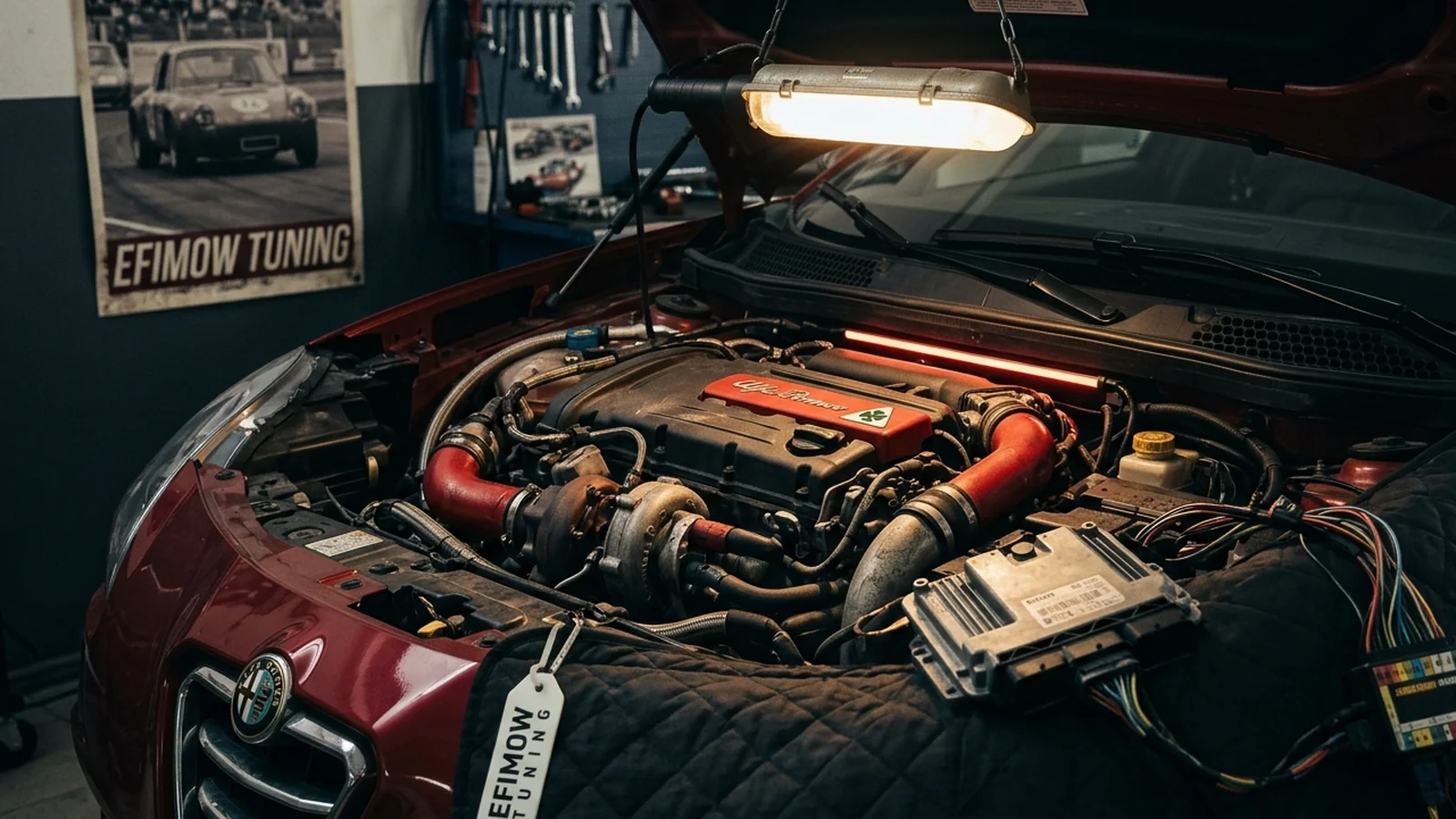
The software adjusts boost targets, ignition timing, torque limiter and full-load lambda targets. Fuel quality is important on the TBi: a calibration with more advanced timing requires high-octane fuel, otherwise knock control takes the extra power back. Stage 2 with a downpipe or sports catalyst (with catalyst and certification), intercooler and intake is possible on this family.
1.4 MultiAir: the valvetrain as a special feature
The 1.4 MultiAir Turbo controls the intake valves electro-hydraulically instead of via a conventional camshaft. That matters for tuning, because cylinder filling is not controlled by the throttle and boost alone. With the Marelli 8GMF, our data gives a typical 10–25% more power and 15–25% more torque for the turbo versions. The MultiAir turbos are often electronically restricted from the factory. The hardware is similar across several power levels.
One point deserves attention: the TCT dual-clutch gearbox offered with the 1.4 MultiAir. It has its own torque limits. A serious calibration stays within what the gearbox can tolerate permanently.
2.0 JTDm: the diesel with reserves
The 2.0 JTDm with 140 or 170 hp uses the Bosch EDC16C39. This family is very well documented; our data gives a typical 20–30% more power and torque as a guide value. The diesel gains mainly in the mid-range, where it works in daily driving. On the later MultiJet II versions with EDC17C49/C69, the guide value is also a typical 20–30%, but the ECU often has to be opened.
Options and which of them are motorsport
For the Giulietta's petrol families, the following are documented alongside Stage 1, among others:
- Sharp Throttle for a more direct throttle pedal
- Vmax removal and rev limiter increase
- Launch Control: documented for the 1750 TBi with MED17, on the MultiAir turbos depending on software version
- DTC Off only for non-emissions-related fault codes
On the diesels, the focus is on ECO tuning, Sharp Throttle, Vmax and DTC Off.
Then there are the functions Alfa drivers often ask about: pops & bangs, hardcut limiter and popcorn limiter. They are technically documented for the MED17 family, but intended exclusively for motorsport on closed tracks, not for public roads. They change noise and emissions behaviour and put load on the catalyst and turbocharger. On MultiAir engines with a stock catalyst, pop & bang is particularly risky.
Before tuning
On the petrol engines, check spark plugs, ignition coils and the charge-air path. On the MultiAir, the oil change should have been done with the specified oil, because the electro-hydraulic valve control works with engine oil. On the diesel, the particulate filter, EGR and dual-mass flywheel should be checked. Disabling the DPF, EGR or catalyst is emissions tampering and illegal on public roads.
Process and prices
We work on the Giulietta directly at the ECU: on site in Stödtlen at an appointment of your choice or by sending in the removed ECU. The price is the same in both cases, and booking is online.
Under our pricing rules, the Giulietta 1750 TBi with 235 hp starts from €250 for Stage 1, as does the 1.4 MultiAir Turbo TCT with 170 hp. The Giulietta 2.0 JTDm with 170 hp starts at €200, and the MultiJet II versions come to €350 including opening the ECU. You will find all versions in the configurator.
On the legal side: the software change voids your vehicle's type approval. The software is intended for motorsport use only. Details in the motorsport notice.
Common questions from the workshop
What does the DNA switch do after tuning? Among other things, the DNA switch changes the throttle pedal curve and torque release. A good calibration takes all modes into account: "Dynamic" delivers full power, "Natural" stays suitable for everyday use. That way the car feels coherent in every mode rather than just one.
Is the 1750 TBi sensitive? The TBi is a highly stressed direct-injection turbo. With a well-kept oil level, good fuel and an intact ignition system, it handles a moderate Stage 1 well. It becomes critical at high mileage without service records, with oil consumption or with misfires. Repair first, then tune.
Can the TCT gearbox be optimised too? The TCT dual-clutch gearbox has its own control unit with its own torque limits. The engine software has to respect these limits, otherwise the gearbox intervenes. A separate gearbox calibration is a topic of its own that we clarify in advance for the specific car. We make no blanket promises. Before any work, the original state of the engine ECU is backed up.
Conclusion
The Giulietta offers a sensible tuning approach for every engine. The 1750 TBi has the most potential at a typical 15–30% as a guide value and needs good fuel, the 1.4 MultiAir responds with 10–25% and has to respect the TCT gearbox, and the 2.0 JTDm delivers strong pulling power with 20–30%. More on the engine technology in the glossary under MultiAir and MultiJet.