
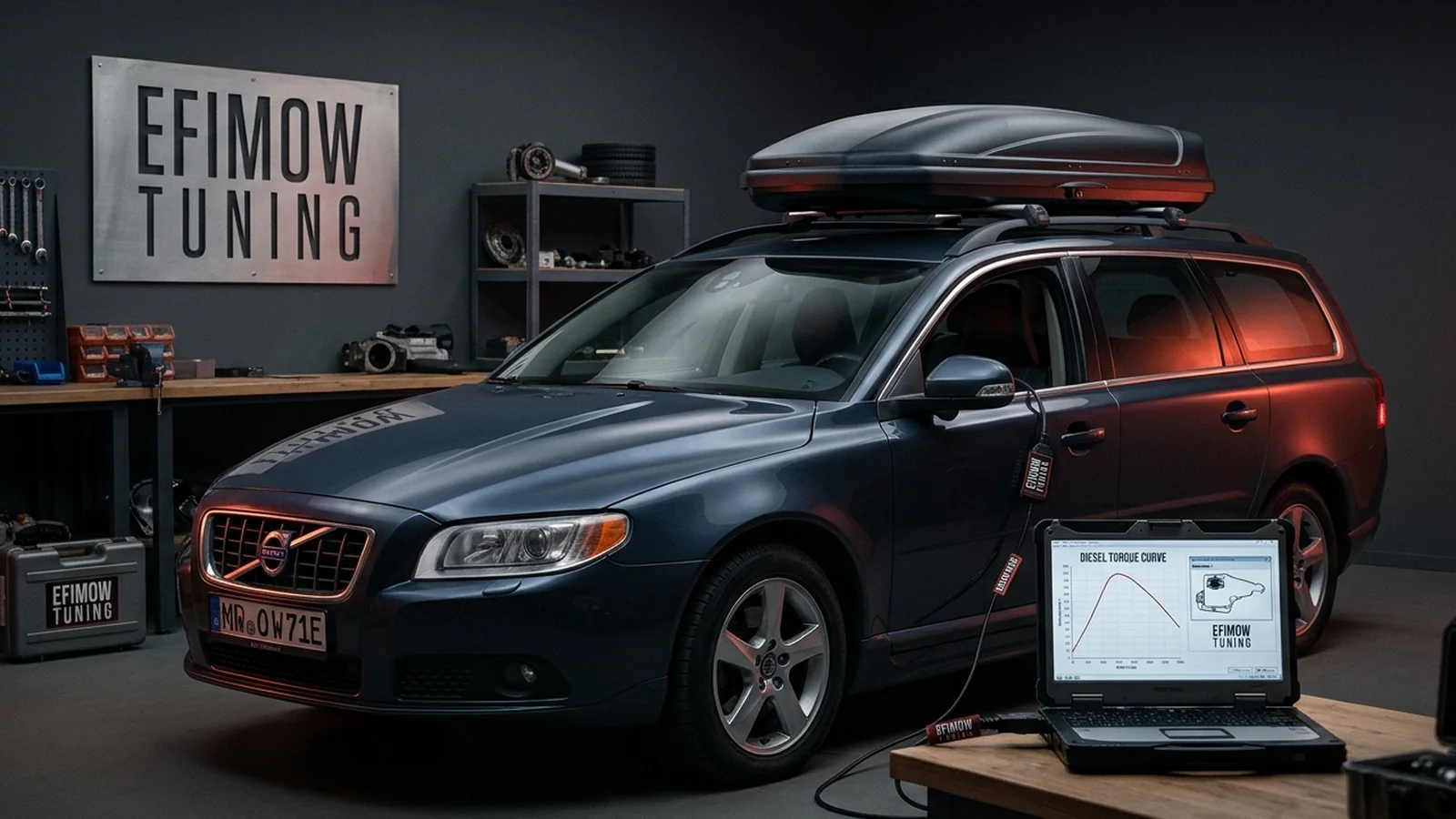
Volvo D5 / D4: Diesel Tuning for Swedish Estates
The D5244 five-cylinder diesel in V70, XC90, S60 and more: EDC15 and EDC16 ECUs, realistic guide values, options and what to watch out for.
October 25, 2026 by Leo Efimow
Hardly any engine shapes the image of the big Volvo estates as much as the 2.4-litre five-cylinder diesel. Whether V70, XC70, XC90, S60 or S80: for many years the D5244 ran under the bonnet in various power levels, sometimes badged D5, sometimes just "D". The engine is known for strong torque, smooth running and longevity, and in many cars it has long passed six-figure mileages. That is exactly why a close look pays off before tuning: which ECU is fitted, what is realistic, and what condition should the engine be in?
The five-cylinder and its variants
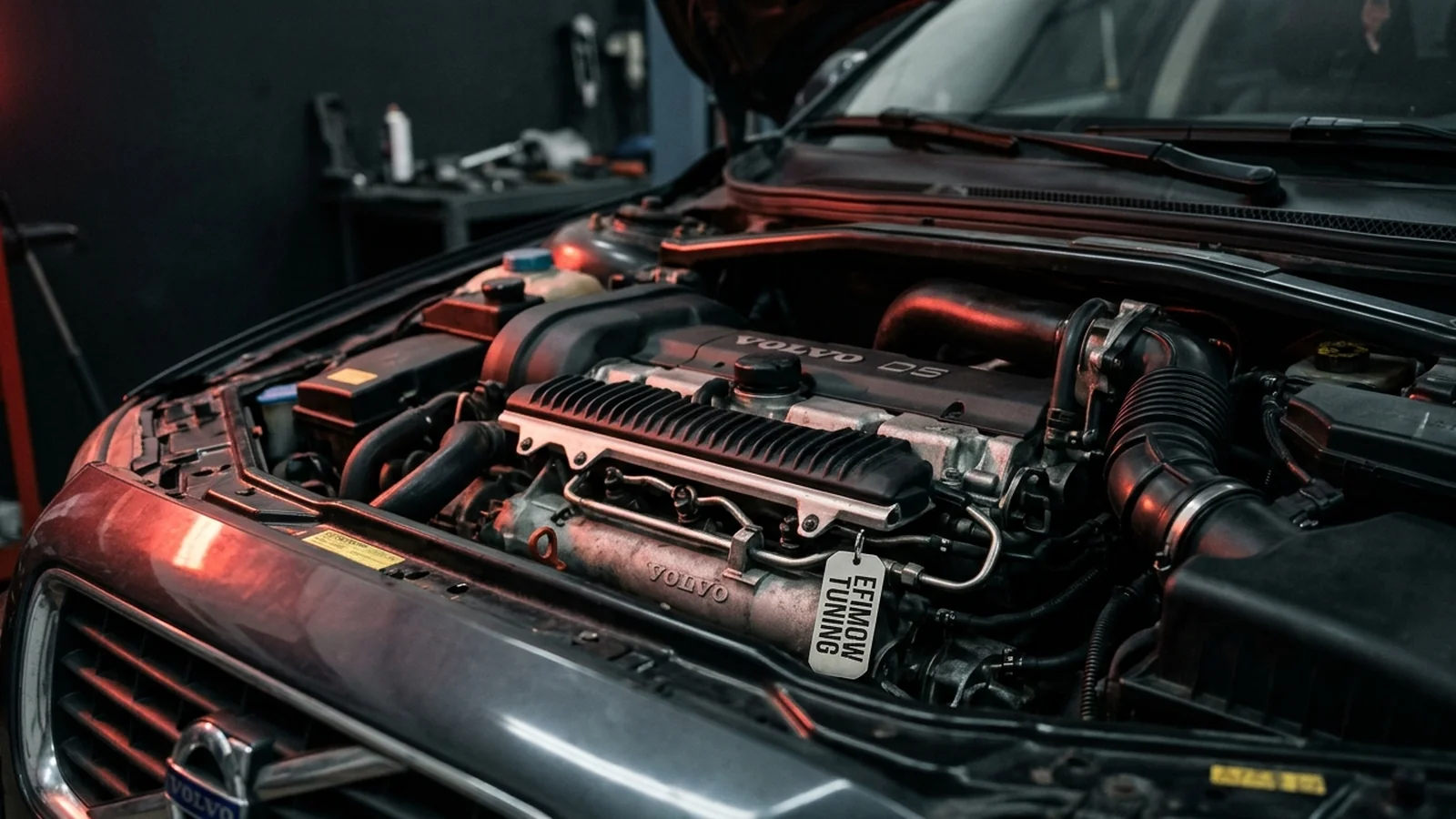
The D5244 is a common-rail diesel with five cylinders, 20 valves and turbocharging. In our catalog you will find it in these variants:
| Engine code | Power | ECU | Typical models |
|---|---|---|---|
| D5244T2 | 130 hp | Bosch EDC15C2 | S80, V70 II, XC70 II |
| D5244T | 163 hp | Bosch EDC15C2 | S80, V70 II, XC70 II |
| D5244T7 | 126 hp | Bosch EDC16C31 | S60, V70 II |
| D5244T5 | 163 hp | Bosch EDC16C31 | S60, S80 II, V70 III, XC60, XC90 |
| D5244T4 | 185 hp | Bosch EDC16C31 | S60, S80, V70 II/III, XC60, XC70, XC90 |
| D5244T8 / T13 | 180 hp | Bosch EDC16C31 | C30, C70 II, S40 II, V50 |
The table already shows the key point: there are two ECU generations. The early engines use the Bosch EDC15, from the facelift onwards the EDC16. That affects guide values, options and price.
D5, D4, D: what the badges mean
At Volvo the tailgate badge only tells you so much about the engine. For many years various power levels of the five-cylinder carried the D5 badge, weaker versions were sold as "D" or later as D4. With the new "Drive-E" engine generation from around 2013/2014 came a 2.0-litre four-cylinder diesel, which was also sold as D4 and D5. That four-cylinder is a different engine with a different ECU, and it is currently not listed as a separate variant in our catalog. If you drive a newer Volvo with a four-cylinder diesel, you can enter it via the free request in the configurator; we then check the specific ECU.
For the five-cylinder models: what counts is the engine code in the registration document or on the type plate and the ECU's software ID, not the badge on the tailgate.
What tuning does for the D5
On a common-rail diesel the software works on the familiar parameters: injection quantity, rail pressure, boost pressure, torque limiters and smoke limitation. According to our data, typical Stage 1 guide values are
- for the EDC16 generation around 20 to 30 percent more power and torque,
- for the EDC15 generation around 15 to 25 percent more power and 20 to 30 percent more torque.
These are ranges for the ECU family, not measurements for your car. In everyday driving the tune shows mainly in the low and mid-range: the heavy estate or the XC90 with a trailer pulls more evenly, and the automatic needs to kick down less often on motorway gradients. Especially when towing caravans or horse trailers, many drivers feel this is the real gain.
A serious calibration keeps the protection functions active: exhaust temperature limitation, smoke limiter and component protection are adapted to the new load points, not switched off.
Condition before power
Many D5s have high mileage. Before tuning you should have a few points checked:
- Turbocharger and boost control: Shaft play, oil loss or sticking vane adjustment show up faster after tuning than before.
- Injectors: Uneven injection quantities cause rough running and smoke. The injector correction values in the diagnostic tool give clues.
- Intake manifold and swirl flaps: On some five-cylinder variants the swirl flaps and their actuator are a known wear point. Defective parts should be replaced; swirl flaps are part of the emissions strategy and stay functional.
- Gearbox and clutch: Many D5s run with a torque-converter automatic. A gearbox that already shifts harshly or slips before tuning will not improve with more torque. On manual cars the dual-mass flywheel matters.
- Diesel particulate filter: A DPF with a high soot load or frequently aborted regenerations should be checked beforehand.
Options
For the EDC16 ECUs our data lists the following options as feasible: Stage 1+ and Stage 2+, ECO tuning, Sharp Throttle, Vmax removal and suppressing individual, non-emissions-related fault codes. Raising the rev limiter is only possible to a limited extent and rarely useful on a diesel, Launch Control depends on the software version (both on request). For the EDC15 the list is similar, but Stage 2+ is only partly feasible there.
ECO tuning is interesting on the D5 for high-mileage drivers: torque in the low and mid-range is optimised while peak power stays unchanged. A diesel hardcut (a hard injection cut at the limiter) is partly possible but intended exclusively for motorsport.
What about Stage 2?
For the EDC16 engines a Stage 2 is technically possible but requires hardware: a more capable intercooler, an exhaust from the turbo back and, depending on the goal, a larger turbocharger. A modified exhaust is only an option with catalytic converter and DPF plus type approval or certification. Honestly, on the D5 this is rarely the right route: most of these cars are tow vehicles, family cars or long-distance estates, and for that use a clean Stage 1 with a healthy turbocharger is the more sensible solution. On the older EDC15 engines Stage 2 is only partly feasible anyway. If you still want more, include the clutch or automatic gearbox and cooling in the planning first. More power also means more heat and more load in the drivetrain.
Emissions control and the law
The software change voids your vehicle's type approval; the software is intended for motorsport use only. For road use, a power increase requires an inspection and registration. Removing or disabling the diesel particulate filter, exhaust gas recirculation (EGR) or swirl flaps in software is emissions tampering and prohibited on public roads, regardless of the car's age.
Process and price
We tune Volvo vehicles directly on the ECU, either on site in Stödtlen at a date of your choice or you send us the ECU. The price is the same in both cases and can be booked online. According to our pricing rules, Stage 1 for the EDC16 engines starts at €200, for example on the V70 III D5 with 185 hp or the XC90 D5. For the older EDC15 engines, such as the V70 II D5 with 163 hp, it starts at €175.
Conclusion
The Volvo five-cylinder is a rewarding tuning candidate: strong torque from the factory, solid reserves and a well-documented ECU landscape. The gain lies less in peak power than in more confident pulling, exactly what a heavy estate or SUV needs in daily life. Condition is decisive: turbo, injectors, intake and gearbox should be healthy before more torque is applied.
The configurator shows you which variant you drive and which options can be booked. You can also request a newer four-cylinder Volvo there.