
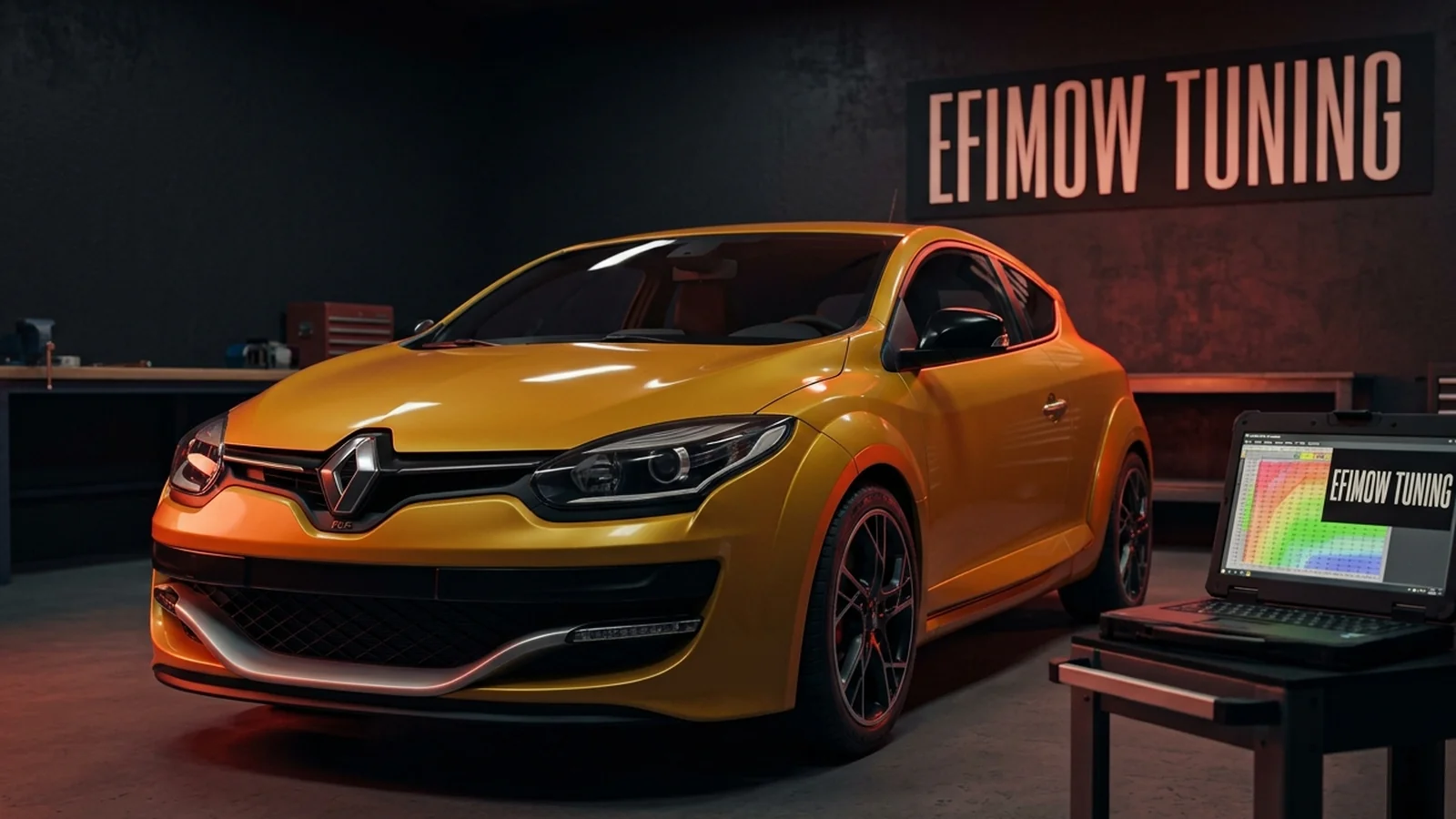
Renault Megane RS: Calibrating France's Turbo Hot Hatch
Megane II RS and Megane III RS with the 2.0 turbo: which ECUs they use, what software realistically delivers and which functions remain motorsport-only.
October 25, 2026 by Leo Efimow
For many, the Megane RS is the epitome of the French hot hatch: front-wheel drive, a strong two-litre turbo and a chassis that is more fun on a circuit than on the motorway. Sooner or later, anyone who drives one starts thinking about software. The good news: the turbo engines of the RS models have reserves. The less good news: they come from different generations with different ECUs, and not every function you see online belongs on the road.
Which Megane RS models are there?
Our catalog lists both generations with the 2.0 turbo engine:
| Model | Engine | Output (catalog) | ECU |
|---|---|---|---|
| Megane II RS | 2.0 16V Turbo | 225 hp | Sagem S3000 |
| Megane II RS F1 Team | 2.0 16V Turbo | 228 hp | Sagem S3000 |
| Megane III RS | 2.0 16V Turbo | 250 hp | Siemens EMS |
| Megane III GT | 2.0 16V TCe | 180 hp | Siemens EMS |
Both generations use the turbocharged two-litre four-cylinder from Renault's F engine family. The third generation was built in several versions; the catalog covers the 250 hp model. We do not currently list the Megane IV RS with its 1.8-litre turbo as a separate variant. An enquiry through the configurator is worthwhile here so that we can check the ECU and readability in advance.
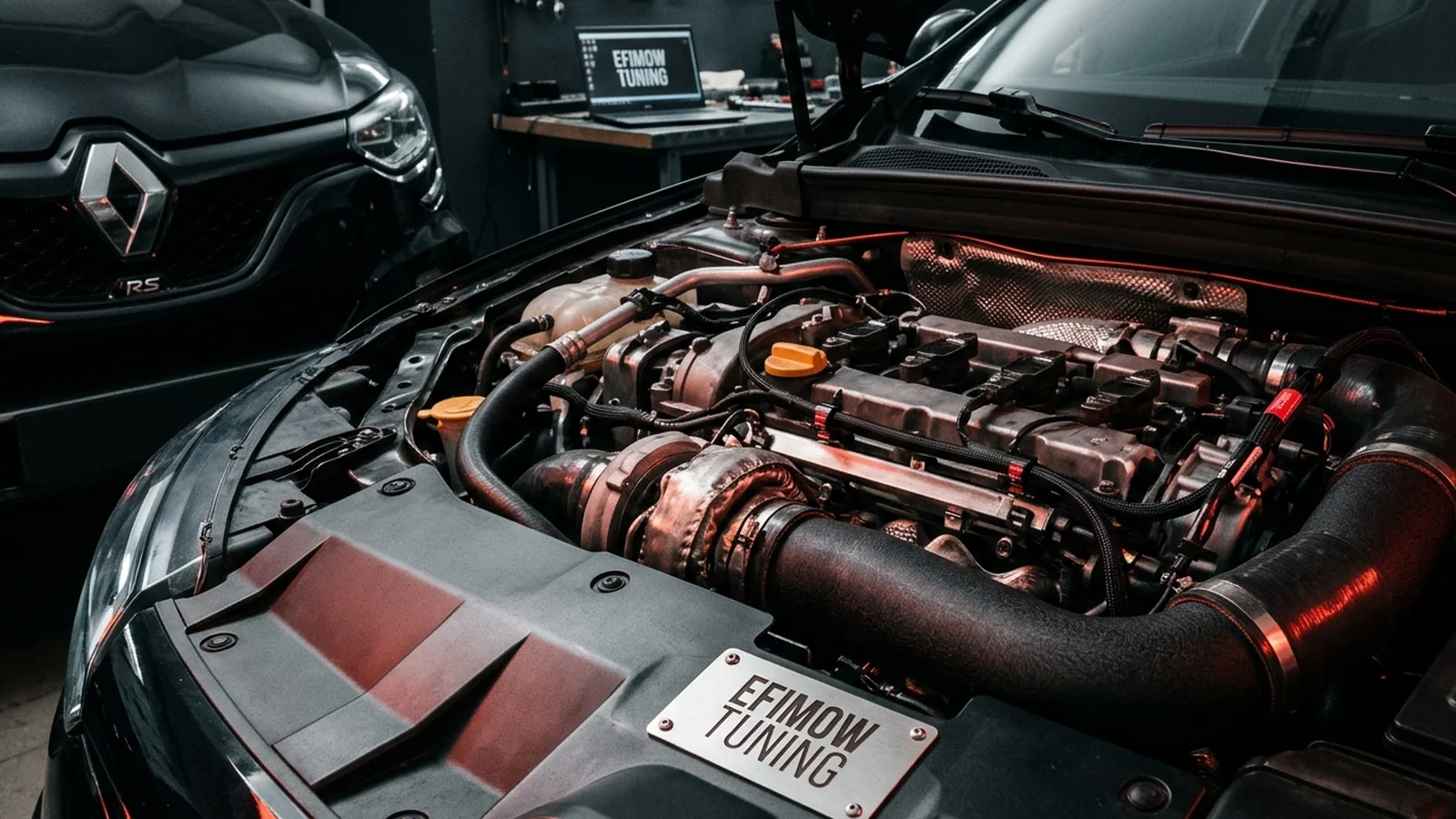
Megane II RS: Sagem S3000
The second generation uses a Sagem S3000. These ECUs can be read via OBD, but there is less published material on tuning software than for Bosch units. For the turbo versions of the Sagem family, our data gives around 15–25% more power and torque as a typical Stage 1 guide value.
On a high-mileage Megane II RS it is worth checking the spark plugs, ignition coils and charge-air piping before tuning. A turbocharged petrol engine with more boost reacts to weak ignition with misfires, which the knock control then answers by pulling timing, and the extra power evaporates.
Megane III RS: Siemens EMS
The Megane III RS uses a Siemens/Continental ECU from the EMS series. For forced-induction engines in this family, our data gives around 15–30% more power and 20–30% more torque as a typical guide value. The engine uses a twin-scroll turbo that responds early; a good calibration exploits this by raising torque in the mid-range instead of only building boost at the top.
What the software specifically adjusts:
- Boost targets across rpm and load
- Ignition timing, matched to fuel quality; high-octane fuel is the basis for a safe calibration
- Torque limiter and the torque request from the throttle pedal
- Lambda targets at full load, keeping exhaust temperatures in check
The protective functions stay active: knock control, component protection and temperature limits are adapted to the new load points, not switched off.
Stage 2 and hardware
For both generations, Stage 2 is possible on the turbo versions, but only with matching hardware. Typical building blocks are a larger intercooler, an exhaust from the turbo back with a catalyst and certification, and an improved intake. The clutch is a topic of its own on the Megane RS: even the stock clutch works close to its limit once torque rises significantly. If you are planning Stage 2, plan the clutch in too.
Options and which of them are motorsport
For the Sagem and Siemens families, several functions are documented alongside the power increase:
- Sharp Throttle for a more direct throttle pedal
- Vmax removal and rev limiter increase
- DTC Off only for non-emissions-related fault codes
- Launch Control: only on certain software versions, so on request
Then there are the functions you see most often in videos: hardcut limiter, pops & bangs, popcorn limiter and anti-lag. Some of them can be implemented technically on these ECUs, but they are intended exclusively for motorsport on closed tracks. They are not permitted on public roads because of noise and emissions behaviour and because they put extra load on the catalyst and turbocharger. With pops & bangs on a stock catalyst, the risk of catalyst damage is real.
Process and prices
We work on the Megane RS directly at the ECU: you come to Stödtlen for an appointment of your choice or send us the removed ECU. The price is the same in both cases, and booking is online.
Under our pricing rules, both the Megane II RS 2.0 Turbo with 225 hp and the Megane III RS 2.0 Turbo with 250 hp start from €150 for Stage 1. You can put together options and Stage 2 in the configurator.
On the legal side: the software change voids your vehicle's type approval. The software is intended for motorsport use only. Details in the motorsport notice.
Before your appointment
A few things make the difference between a good and a very good result:
- Read the fault memory first: misfires, boost deviations or sensor faults should be fixed.
- Check the charge-air path: on a turbo, a leaking hose costs more power than any software adds.
- Fuel: if the calibration is designed for high-octane fuel, that is what should go in the tank.
- Clutch: if it already slips at full load on the stock engine, it will not hold more torque.
Common questions from the workshop
Do I need super unleaded after Stage 1? If the calibration is designed for high-octane fuel, yes. Knock control protects the engine even on lower-grade fuel, but then pulls ignition timing and therefore power. If you want to use the extra power, fill up with the fuel the software was made for.
Will the clutch cope? With a healthy stock clutch and a moderate Stage 1, usually yes. It becomes borderline if the clutch already shows wear or the car is regularly launched hard. A simple test: full throttle in fourth gear at low revs. If the revs rise without matching acceleration, the clutch is slipping.
Can I run a different calibration on track than on the way there? An ECU runs one software. Functions such as the hardcut limiter or pops & bangs are intended exclusively for motorsport on closed tracks; if you want to use them, you need a vehicle used for exactly that. For a car that is also driven on public roads, these functions do not belong in the software.
Conclusion
The Megane RS is a rewarding tuning candidate. With a typical Stage 1 guide value of 15–25% (Megane II, Sagem) or 15–30% (Megane III, Siemens EMS), a fast hot hatch becomes an even faster one, without needing any hardware. If you want more, plan an intercooler, an exhaust with catalyst and certification and a stronger clutch from the outset. And the sound functions remain what they are: motorsport. More in the glossary under pop and bang and hardcut limiter.